
Table of Contents
If you’re thinking about taking the PTE (Pearson Test of English), you might be wondering whether you’re eligible and if there are any age limits to keep in mind. The good news is that the PTE is open to most people who want to study, work, or migrate to an English-speaking country. Generally, test takers need to be at least 16 years old, and anyone under 18 must have parental consent before registering. There’s no upper age limit, so adults of any age can take the exam as long as they feel ready. It’s a straightforward process designed to welcome a wide range of candidates, making it accessible for students and professionals alike.
Join Enrtri PTE Coaching Course
Introduction
Before registering for the PTE exam, it’s important to understand whether you meet the basic eligibility requirements. Many test takers often wonder about the minimum age, whether there’s a maximum age limit, and if any specific qualifications are needed. The good news is that the PTE has simple and flexible criteria, making it accessible to students, professionals, and individuals planning to migrate abroad. Knowing these requirements in advance helps you avoid confusion and move forward with confidence.
What is the PTE Exam?
The PTE (Pearson Test of English) is a computer-based English language exam designed to measure how well a person can use and understand English in real-life academic and professional settings. It is widely accepted by universities, colleges, and governments around the world, especially in countries like Australia, Canada, the UK, and New Zealand. People typically take the PTE when they plan to study abroad, apply for a work visa, or migrate to an English-speaking country.
The main purpose of the PTE exam is to assess a candidate’s ability to communicate effectively in English. It focuses on everyday and academic English rather than complex or outdated language. Because it is fully computer-based, the test uses artificial intelligence to evaluate responses, which helps ensure fast and unbiased scoring.
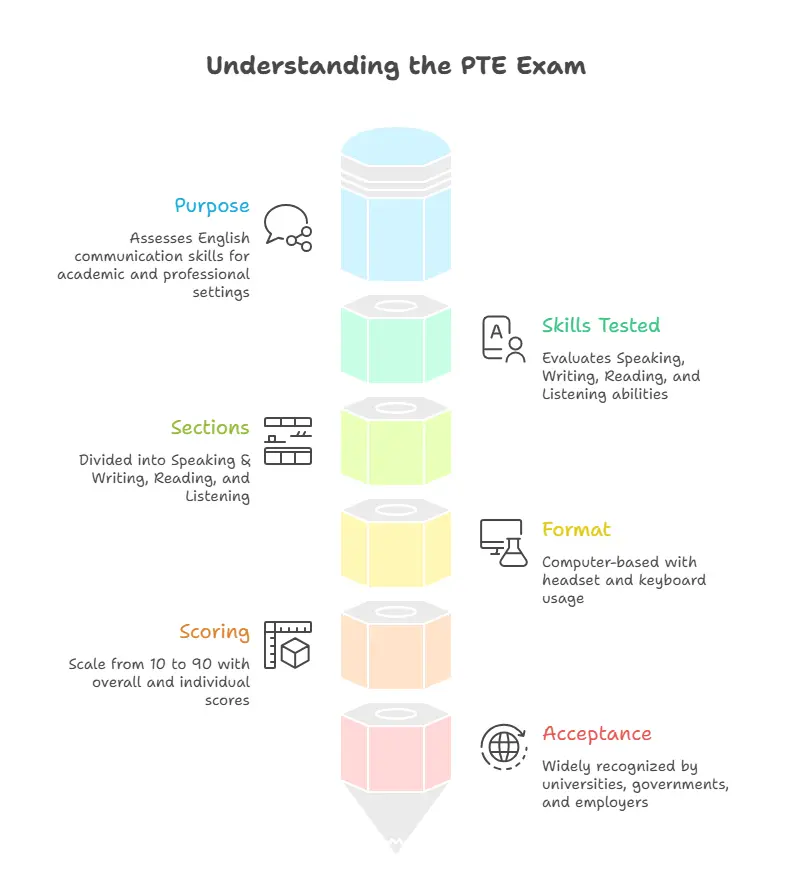
The exam measures four key language skills: Speaking, Writing, Reading, and Listening. These skills are tested across three main sections:
-
Speaking & Writing (combined section) – This part evaluates how clearly and confidently you can speak and write in English. Tasks may include reading aloud, repeating sentences, describing images, answering short questions, summarizing written text, and writing an essay.
-
Reading – In this section, you’ll read different types of texts and answer questions that test your understanding. You might fill in blanks, reorder paragraphs, or choose the correct answers from multiple options.
-
Listening – This section checks how well you understand spoken English. You will listen to audio clips such as lectures or conversations and answer questions based on what you hear. Tasks may include summarizing spoken text, identifying missing words, or selecting correct summaries.
The PTE exam usually takes about two hours to complete and is conducted at authorized test centers. Since it’s computer-based, you use a headset for the speaking and listening parts and type your responses for writing tasks.
When it comes to scoring, the PTE uses a scale from 10 to 90. You receive an overall score as well as individual scores for each communicative skill (Speaking, Writing, Reading, and Listening). The scoring system is designed to reflect your real ability to use English in academic and professional environments. Results are typically available within 48 hours, which makes it a popular choice for candidates who need quick outcomes.
For academic purposes, universities use PTE scores to determine whether students have the required level of English proficiency to succeed in their courses. For professional and migration purposes, governments and employers use the scores to ensure applicants can communicate effectively in English-speaking workplaces and communities.
PTE Eligibility Criteria
If you’re planning to take the PTE exam, it’s important to understand the basic eligibility requirements before registering. The good news is that the PTE has simple and flexible criteria compared to many other exams. There are no strict educational qualifications required, which means you don’t need a specific degree or percentage to apply. Whether you are a school student, a university graduate, or a working professional, you can take the exam as long as you meet the age requirement and have a valid passport for identification.
The PTE is open to anyone who wants to prove their English proficiency for study, work, or migration purposes. However, always check the specific score requirements set by the university, employer, or immigration authority you are applying to, as eligibility for the exam and eligibility for your goal may differ.
Minimum Age Limit for PTE Exam
The minimum age to take the PTE Academic exam is 16 years. However, if a candidate is under 18 years old, they must provide parental consent to register for the test. This ensures that younger candidates have approval from a parent or guardian before appearing for the exam.
Most PTE test takers are 18 years or older, especially those applying for higher education or migration. If you are 16 or 17 and planning to study abroad, you can still take the test as long as you complete the required consent process.
Maximum Age Limit for PTE Exam
There is no maximum age limit for the PTE exam. This means adults of any age can take the test if they need proof of English proficiency. Whether you are a recent graduate, a mid-career professional, or someone planning to migrate later in life, you are eligible to appear for the exam.
This flexibility makes the PTE accessible to a wide range of people with different goals and life stages. As long as you meet the minimum age requirement and have valid identification, you can register and take the exam whenever you feel ready.
Educational Qualification Required for PTE
If you’re thinking about taking the PTE exam, you might be wondering whether you need a specific degree or academic background to apply. The good news is that the PTE (Pearson Test of English) does not require any fixed educational qualification. It is designed to test your English language skills, not your academic performance.
Unlike many exams that ask for certain percentages or completed degrees, the PTE keeps things simple and flexible. Your ability to communicate in English matters more than your past academic records.
No Specific Degree is Required
You do not need to have:
-
A high school diploma
-
A college degree
-
A minimum percentage or grade
-
Any specific academic stream (science, commerce, arts, etc.)
The PTE registration process does not ask you to upload mark sheets or degree certificates. As long as you meet the minimum age requirement and have a valid passport, you can book the test.
Open to Students and Working Professionals
The PTE is suitable for a wide range of candidates, such as:
-
Students planning to study abroad
-
Graduates applying for postgraduate programs
-
Professionals seeking overseas job opportunities
-
Individuals applying for permanent residency or migration
While the PTE itself has no academic restrictions, the university, employer, or immigration authority you are applying to may have its own education requirements. For example, a university may require completion of 12th grade or a bachelor’s degree along with a certain PTE score. So it’s always wise to check those separate criteria.
Focus Is on English Proficiency
The main purpose of the PTE exam is to measure your skills in:
-
Speaking
-
Writing
-
Reading
-
Listening
Your score reflects how well you can use English in real-life academic or professional settings. It does not depend on your previous academic achievements.
Is there any English Background Requirement?
This is a very common question, especially for students who feel nervous about their English level. The simple answer is no, there is no formal English background requirement to register for the PTE exam.
You do not need to have studied in an English-medium school or completed any special English course to take the test. There’s no rule that says you must have English as a subject in your previous education. The PTE is open to anyone who wants to prove their English proficiency, regardless of their academic or language background.
What Really Matters?
The PTE does not ask for:
-
Proof of studying in English medium
-
English-related degrees or certifications
-
Minimum grades in English from school or college
However, since the exam is entirely in English, you should have a basic understanding of the language before attempting it. The test evaluates your ability to:
-
Speak clearly and confidently
-
Write structured responses
-
Read and understand passages
-
Listen and interpret spoken English
If you are not very confident in your English skills, you can always prepare through practice tests, online resources, coaching classes, or self-study before booking the exam.
PTE Eligibility for Students
Planning to study abroad often means proving your English proficiency, and the PTE is one of the most widely accepted tests for this purpose. When it comes to eligibility, the requirements are simple and designed to be accessible for students from different educational backgrounds.
Basic Requirements
To register for the PTE exam, students must:
-
Be at least 16 years old
-
Submit parental consent if under 18
-
Hold a valid passport as official identification
There are no complicated procedures or academic restrictions during registration.
Academic Qualification
The PTE does not demand any specific educational qualification. You do not need:
-
A completed bachelor’s degree
-
A minimum percentage in school or college
-
An English-medium background
-
A particular academic stream
Whether you are currently in high school, have completed grade 12, or are pursuing a college degree, you can take the exam as long as you meet the age requirement.
Important Consideration
Although the PTE itself has flexible eligibility, universities and colleges may set their own academic and English score requirements. For example, an undergraduate program may require completion of secondary education, while a postgraduate program may require a bachelor’s degree along with a certain PTE score. It’s always important to check the admission criteria of the institution you’re applying to.
Why It Matters for Students
The PTE helps students:
-
Meet English language requirements for university admission
-
Apply for student visas
-
Strengthen their international education plans
PTE Eligibility for Working Professionals
For working professionals aiming to expand their careers internationally, the PTE exam can play an important role in proving English proficiency. Whether the goal is overseas employment, permanent residency, or professional registration, the eligibility requirements for the PTE are straightforward and accessible.
Basic Eligibility Criteria
Working professionals must meet the following requirements to register for the PTE:
-
Be at least 16 years old
-
Provide parental consent if under 18 (rare for professionals, but officially required)
-
Hold a valid passport as primary identification
There is no maximum age limit, so professionals at any stage of their career can take the exam.
Educational Background
The PTE does not require a specific degree, minimum percentage, or academic stream for registration. Even though most professionals already hold diplomas or degrees, the exam itself does not ask for proof of educational qualifications.
You do not need:
-
A degree in English
-
An English-medium education background
-
Minimum marks in English during school or college
The focus is entirely on your current ability to use English effectively.
Why Working Professionals Take PTE
Professionals typically take the PTE for:
-
Work visa applications
-
Permanent residency or migration programs
-
Professional licensing or skill assessments
-
Employment opportunities in English-speaking countries
While the PTE exam has flexible eligibility rules, immigration authorities, employers, or professional bodies may have specific score requirements. Meeting those score standards is essential for achieving your career goals.
What Truly Matters
The PTE assesses practical communication skills in:
-
Speaking
-
Writing
-
Reading
-
Listening
Your performance depends on your preparation and language proficiency—not your age, job title, or academic history.
Who is Not Eligible to Take PTE?
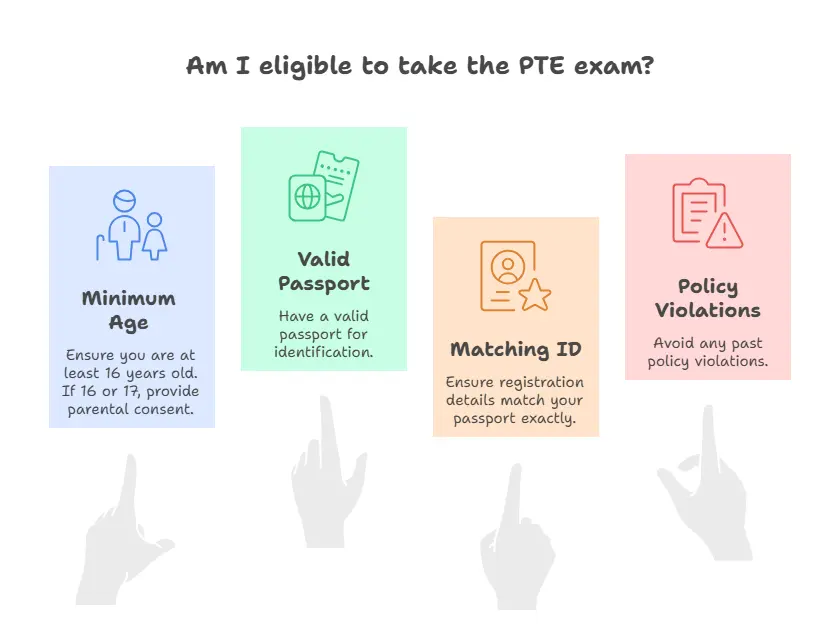
The PTE (Pearson Test of English) is designed to be accessible and flexible, so most people can register without difficulty. However, there are a few situations where someone may not be eligible to take the exam.
1. Candidates Below the Minimum Age
The minimum age to take the PTE Academic exam is 16 years. Anyone younger than 16 is not allowed to register or sit for the test.
Candidates who are 16 or 17 years old can take the exam, but they must provide parental consent. Without this consent form, registration cannot be completed.
2. Individuals Without a Valid Passport
A valid passport is mandatory for taking the PTE exam. It serves as your official identification on test day. If you do not have a valid passport, you will not be permitted to enter the test center or sit for the exam.
Other forms of ID are generally not accepted, so having an up-to-date passport is essential.
3. Candidates with Mismatched Identification Details
If the personal details used during registration do not exactly match the information on your passport, you may be denied entry to the test center. Even small differences in spelling, date of birth, or name order can create issues. Accuracy during registration is very important.
4. Test Policy Violations
Anyone who has previously violated PTE test policies—such as engaging in misconduct, cheating, or using unfair means—may be restricted or banned from taking the exam again. Pearson takes exam security very seriously.
Join Enrtri PTE Coaching Course
Conclusion
Understanding the PTE eligibility criteria and age limit is an important first step before booking your exam. The good news is that the requirements are simple and flexible. As long as you are at least 16 years old, have a valid passport, and follow the official guidelines, you can register for the test. There is no maximum age limit and no strict educational qualification required, which makes the PTE accessible to students, working professionals, and migrants alike.
By knowing these basic requirements in advance, you can avoid confusion and plan your next steps with confidence. Once you’re clear about your eligibility, you can focus on what truly matters—preparing well and achieving the score you need for your academic or professional goals.
Ace Your PTE Exam with Confidence!
Unlock your potential with our expert-led PTE preparation course. Achieve your dream score and open doors to global opportunities!
Start Your PTE Preparation Today!Frequently Asked Questions
What is the minimum age required to take the PTE exam?
The minimum age to take the PTE Academic exam is 16 years. Candidates who are 16 or 17 years old must provide a signed parental consent form during registration. Without this consent, they will not be allowed to sit for the exam.
Is there a maximum age limit for the PTE exam?
No, there is no maximum age limit for the PTE exam. Anyone above 16 years of age can take the test, whether they are a student, working professional, or someone planning to migrate later in life.
Are there any educational qualifications required to register for PTE?
No, the PTE does not require any specific academic degree, percentage, or stream. You do not need to submit mark sheets or certificates while registering. However, universities or immigration authorities may have their own academic requirements.
Is a passport mandatory for the PTE exam?
Yes, a valid passport is mandatory. It is the only accepted form of identification at most test centers. The details on your registration must exactly match the details on your passport.
Can school students take the PTE exam?
Yes, school students who are at least 16 years old can take the PTE. If they are under 18, parental consent is required. Many students take the exam while preparing for higher education abroad.
Do I need to have studied in English medium to take the PTE?
No, there is no requirement to have studied in an English-medium school or college. The exam is open to everyone. However, since the test is conducted entirely in English, you should be comfortable with the language.
Who cannot take the PTE exam?
Individuals under 16 years of age, those without a valid passport, or candidates who have violated PTE test policies (such as cheating or misconduct) may not be eligible to take the exam.
Can working professionals apply for the PTE exam?
Yes, working professionals can take the PTE for job opportunities, work visas, permanent residency, or professional registration purposes. There are no restrictions based on profession or work experience.
Is there a limit on how many times I can take the PTE?
There is no strict lifetime limit, but you must wait for your previous test results before booking a new exam. You can retake the test if you want to improve your score.
Does meeting PTE eligibility guarantee university admission or visa approval?
No, meeting PTE eligibility only allows you to take the exam. Admission to universities or visa approval depends on meeting their specific academic, financial, and English score requirements.