
Table of Contents
Having the ability to articulate one’s thoughts in front of a group of people is a valuable skill in any industry. It is essential to possess strong communication skills if you want for your message to be received, regardless of whether you are delivering a presentation at a seminar, a presentation as part of a group, or a public speech presentation. The mastery of these qualities has a favorable influence on a number of aspects, including confidence, leadership, and personal and professional progress.
Begin Your Personality Transformation- Enroll Today!
Understanding Public Speaking and Presentation Skills
The ability to communicate one’s ideas in a manner that is convincing to others is essential for those who are in charge of communication. To be able to persuade, educate, or amuse an audience, it is essential to have the ability to explain your thoughts in a concise and straightforward manner. The strategies and procedures that are used to collect, arrange, and effectively deliver information are referred to as presentation skills. It is usual for these strategies to include visuals, variations in tone of voice, and facial clues.
Speaking with self-assurance in front of a group is an example of one of these talents. Another example is the ability to communicate effectively. The capacity to communicate with and connect with the audience, as well as confidence and clarity, are also essential to their success. Public speakers who are skilled in their craft arrange their thoughts in such a way that they are easily understood, communicate their views in a way that is understandable, and adapt their delivery to suit the needs of various audiences. When you express your opinions in a straightforward manner and encourage others to do the same, you have the potential to create an impact that will last in social, professional, and educational environments. Speaking in front of an audience and delivering presentations are both valuable abilities that, when combined, increase the likelihood that you will achieve your objective.
Types of Public Speaking
Speaking in public may take on a variety of forms, depending on the speaker’s intention, the audience, and the circumstances surrounding the speech. In order to choose the appropriate technique and tone for your message, it is beneficial to have a solid understanding of the many different types of methods and tones. Among the several categories of public speeches that may be classified are the following:
1. Messages of Informational Kind
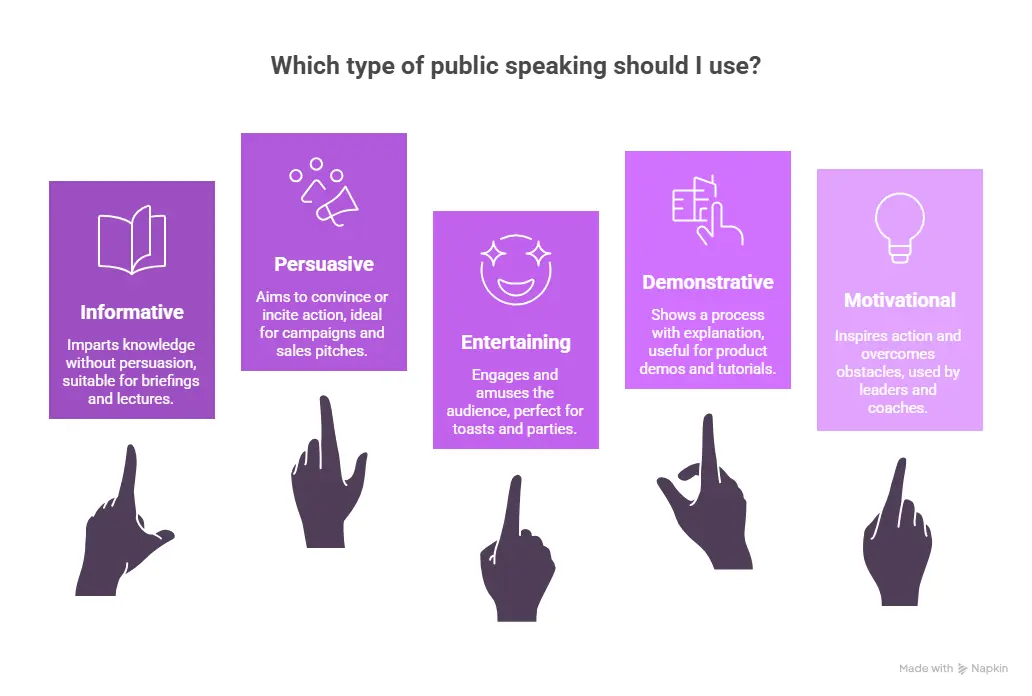
One of the objectives of informative speaking is to impart fresh knowledge to the audience on a certain subject matter. Without attempting to convince the reader of anything, the primary objective is to provide information that is unambiguous, precise, and well-organized. Presentations similar to this one are commonplace in a variety of contexts, including corporate briefings, professional seminars, and classroom lectures.
2. Providing a Presentation That Will Have an Impact
A persuasive speech is one that is intended to persuade the audience to either agree with the position of the speaker or to take some form of action at some point. Evidence that can be relied upon, appeals to the emotions, and arguments that are compelling are all essential to its success. Campaign speeches, political speeches, and commercial presentations are all examples of types of speeches that are often used.
3. Being able to deliver an engaging speech
Presentations such as this one attempt to do more than simply get people thinking and discussing; they also strive to entertain and interest the audience. It is not uncommon to find stories that include comic overtones and other stuff that is humorous and cheerful. Providing speeches after meals, making toasts at weddings, and hosting parties are all examples of situations in which this is necessary information.
4. Presenting One’s Argument Evidently
A method known as “demonstrative speaking” involves demonstrating a procedure while simultaneously providing an explanation of each step. For the purpose of conveying information, it blends verbal explanation with either a physical demonstration or visual representations. Demonstrations of products, demonstrations of culinary arts, and scientific research are all included in this category.
5. Engages in public speaking with the intention of motivating or inspiring the audience
This presentation is being given with the expectation that it will act as a spark for the audience to accomplish their objectives and triumph over the obstacles that they are facing. Personal narratives and emotional appeals are often used by motivational speakers, leaders, and coaches in order to captivate their audience and keep their attention.
Boost Your Skills & Kickstart Your Career!
Employability and Personality Development Course by Entri App: Enhance your communication, confidence, and job-ready skills to excel in your career.
Join Now!Key Elements of an Effective Presentation
More than merely conveying information, a strong presentation is able to maintain the attention of the audience, convey ideas in a clear manner, and leave an impression that is long-lasting. In order to achieve this goal, it is necessary for a number of important conditions to coincide:
The Goal Is Defined
Do you want to educate, persuade, inspire, or entertain your audience with your presentation? Before you begin constructing it, you should choose your purpose. In the event that you have a certain goal in mind, your content will continue to be concentrated and pertinent to the requirements of your particular audience.
Launch that is Powerful
It is from the very beginning of your presentation that the tone of your presentation is defined. The first step is to include a fascinating component in order to attract attention and stimulate curiosity. A question, a surprising fact, a quote, or even a brief tale might be used to put this into action.
Organized Structure
- The three elements that make up a presentation that is well organized are as follows:
- During the introduction, both the topic and the aim will be revealed.
- In the main body, you should present your argument by identifying sources that are pertinent and providing examples.
- Last but not least, reiterate and stress the most important argument.
When information is presented in a manner that is supported by logic, audiences are more likely to absorb and retain it.
Pictures that are interesting
Your argument will be stronger if you include visual aids like maps, videos, and graphs. Use pictures in your lecture to keep people engaged and help them comprehend, but don’t put too much text on the slides.
Happy Customers
What you say is not as important as how you say it. To keep people engaged, move naturally, adjust your tone and speed, and look them in the eye. Be clear and enthusiastic about your point of view to indicate that you are confident.
Getting the audience to take part
When you change your words, photos, and jokes, keep in mind the history and what your audience is anticipating. You may assist them pay attention and connecting by asking them what they’re thinking or having brief discussions with them.
The Ways in Which You Can Make the Most of Your Time
Give each component of your discussion the appropriate amount of time within the time that has been allotted to you. People may get disinterested in what you have to say if you speak too much, and they may overlook significant information if you don’t talk enough.
Dealing with People Who Have Diverse Points of View
Ensure that the conclusion of your discussion goes off without a hitch. If you want to leave your audience with something that will inspire them, such as a quotation, a message, or a call to action, you should be sure to reiterate your aim, list your important points, and leave them with something they will remember.
The likelihood that your presentation will be effective, amusing, informative, and simple to remember is high if it has all of these characteristics.
Begin Your Personality Transformation- Enroll Today!
Common Challenges in Public Speaking
Even seasoned public speakers may fear the thought of presenting to an audience. Many problems might arise before and during a speech. Understanding these obstacles is the first step to solving them.
Fear of Public Speaking
The main difficulty for many individuals is an irrational fear of being viewed as less intelligent or evaluated. Symptoms include trembling, sweating, and time perception issues. When individuals relax and prepare, they may be able to solve their difficulties better.
Limited planning time
What happens if you lack knowledge, have disorganized information, waste time, and fail to draw attention? All of these might cause problems. The persistent practice and study of information to master the topic may boost self-confidence.
Your monotonous speech indicates voice modulation issues
Your voice will become monotonous if you speak quietly or monotonously. Change your cadence, tone, and pitch to make your presentation more engaging.
Too Many Redundant Words
You may seem less professional if you use “um,” “uh,” “like,” or “you know” often. They will lose interest in your speech. You may decrease quiet by speaking slower and halting more frequently.
Inability to understand nonverbal communication
Avoid eye contact, cross your arms, and adopt an unnatural posture to convey nervousness. Your excellent posture, natural gestures, and expressive facial expressions make you more noticeable.
Concerns have been raised about technology
If the projector, microphones, or slides malfunction, your presentation may suffer. Before proceeding, check that all components are properly positioned and consider a backup plan.
Having trouble getting others to listen
If they talk too much without connecting with others, they may feel bored. Use questions, visuals, and examples to keep people interested.
Consider losing track of time
Many speech givers worry about forgetting their words. Rather of focusing on attempting to recall every single word, you should concentrate on grasping the essential themes and, if necessary, using cue cards.
Feedback on one’s skills
If you give yourself permission to doubt your capabilities before you speak, you may not perform as effectively as you might with your ability. If you find yourself thinking badly, try telling yourself things that are encouraging and concentrating on how competent you are and how well-prepared you are the next time you find yourself thinking adversely.
Tips to Improve Your Public Speaking and Presentation Skills
Public speaking and presentation skills may be improved via the cultivation of patience, practice, and self-awareness. The best speakers are always becoming better. The following suggestions might assist you in communicating with more self-assurance and efficiency:
- Be well prepared
Get familiar with the topic at hand and organize your views. Your confidence will increase as you get more comfortable with your material. Both worry and errors may be reduced via preparation.
- Be aware of your target demographic
You should modify your speech to accommodate the age, background, and interests of your audience. You are better able to choose instances, tone, and details when you are aware of their expectations.
- Putting in consistent drills
Before giving the presentation, you should do a number of practice runs. Practicing in front of a mirror, recording yourself on camera, or showing your friends and family will help you improve.
- Practice your body language
Maintain eye contact with the audience, use natural hand gestures, and maintain a healthy posture. Trust and credibility are built via the use of confident body language.
Boost Your Skills & Kickstart Your Career!
Employability and Personality Development Course by Entri App: Enhance your communication, confidence, and job-ready skills to excel in your career.
Join Now!How Public Speaking Helps in Career Growth
A professional’s toolkit should always include the ability to explain one’s views effectively in front of an audience. This ability may lead to promotions, new connections, and greater compensation, all of which are extremely desirable outcomes. Having strong communication skills is one way to differentiate yourself in today’s highly competitive employment market. This is a list of ways in which public speaking might help you develop in your career:
Enhances One’s Self-Confidence and Constructs a Powerful Initial Image
Through regular practice in front of a group, you may develop the confidence that is necessary for success. Preserving this level of calm will not only assist you in becoming a more successful leader, but it will also provide you with more credibility while interacting with customers or colleagues.
Improves the ability to express oneself verbally
Regularly delivering a speech in front of an audience will help you improve your communication skills, which will be beneficial to you in situations like as meetings, interviews, and communicating with customers.
Recognition and a Boost to One’s Profile
Your ability to deliver presentations at events such as community gatherings, conferences, or business meetings is one approach to attract the attention of people to your expertise and knowledge. It is directly proportional to your level of ability in public speaking that your reputation as a knowledgeable and trustworthy expert will increase.
Impact and persuasion are both increased
Having strong public speaking talents is a characteristic that is necessary for entrepreneurs and managers because it enables you to convince other people to do what you want them to do, whether it be to accept a project, pay for it, or not be approved at all.
Makes it Possible to Network More Often
Give talks in front of an audience, and you will open the door to opportunities to network with other professionals, mentors, and perhaps potential employers. It is possible that these sorts of ties may result in collaborations, promotions, or even whole new career paths.
Evidence of both knowledge and dependability
You will be able to distinguish yourself as an expert if you are able to provide presentations that are not just engaging but well planned. Trust is increased as a result of the fact that it is well recognized that you are capable of providing an intelligent opinion.
Opportunities for Professional Development Are Expanded
Candidates who can confidently represent the firm are what employers seek when they are recruiting. Improving one’s presentation skills may result in a number of positive consequences, including a chance to advance one’s career, a promotion, or even speaking engagements at industry events.
Encourages Personal Growth
Public speaking practice has the potential to help individuals become more self-aware, empathic, and disciplined, in addition to enhancing their professional position.
Begin Your Personality Transformation- Enroll Today!
Conclusion
The ability to articulate one’s thoughts confidently in front of an audience is a skill that will serve you well in whatever line of work you choose to pursue. Their capacity to articulately express themselves, communicate with others, and cultivate true connections is much improved as a result of their presence. Everyone has the potential to become an exceptional communicator with sufficient practice, self-assurance, and preparation. Public speaking may initially be nerve-wracking, but anybody can become an effective communicator.
Not only does the acquisition of these skills make it easier to produce effective presentations, but it also increases one’s leadership ability, self-confidence, and prospects for professional growth. However, it is important to bear in mind that every single excellent public speaker was once a student. There is a possibility that you might achieve self-assurance in your capacity to speak with clarity, purpose, and inspiration if you put in the effort and continue to better yourself.
Boost Your Skills & Kickstart Your Career!
Employability and Personality Development Course by Entri App: Enhance your communication, confidence, and job-ready skills to excel in your career.
Join Now!Frequently Asked Questions
How can I overcome stage fright?
Practice regularly, prepare well, use deep breathing techniques, and focus on your message instead of your fear.
How does public speaking help in career growth?
It improves leadership presence, boosts professional visibility, and strengthens persuasion and communication skills.
What tools can help improve my presentation skills?
Using PowerPoint, Canva, or Prezi for visuals, along with recording and reviewing your speech, can greatly enhance your delivery.
. Why are these skills important?
They help build confidence, improve communication, and enhance career opportunities by allowing you to express ideas effectively.
What makes a presentation effective?
A clear objective, engaging visuals, confident delivery, and good audience connection make a presentation impactful.
Can anyone become a good public speaker?
Yes. With consistent practice, feedback, and self-confidence, anyone can develop strong public speaking abilities.