Table of Contents
Qualcomm Embedded Software Engineer Interview tests strong technical foundations. It evaluates real-world embedded software development skills. Candidates face questions on systems and low-level programming. Problem-solving ability is carefully assessed during interviews. Understanding hardware and software interaction is very important. C programming knowledge plays a major role here. Interviewers expect clarity in explaining technical concepts. Preparation helps candidates approach interviews with confidence.
The interview process includes multiple technical discussion rounds. Each round focuses on specific embedded software topics. Core concepts are tested through practical scenarios. Debugging skills receive significant attention during evaluations. Communication clarity is also closely observed. Candidates should explain solutions step by step. Good preparation improves overall interview performance.
Kickstart your embedded systems career and turn your tech passion into high-demand skills!
Introduction
Qualcomm is a global leader in semiconductor innovation. The company designs advanced chipsets for mobile and embedded systems. Its embedded software teams support many cutting-edge technologies. These teams power smartphones, IoT devices, automotive, and AI platforms. Engineers work closely with hardware and system layers. Performance, reliability, and efficiency remain key development goals.
Qualcomm interviews focus on strong technical fundamentals. They also test practical problem solving abilities.
Real-world scenarios form a major interview component. This blog helps candidates understand interview expectations clearly. It covers important questions and core technical areas. Preparation tips are included for confident interview performance.
The blog highlights key preparation areas below.
-
Embedded systems fundamentals and low-level programming concepts
-
C language proficiency and memory management understanding
-
Operating systems, RTOS basics, and synchronization mechanisms
-
Debugging approaches and real-world embedded problem scenarios
About Qualcomm as a Company
Company Overview
Qualcomm is a multinational semiconductor and technology company. It focuses on wireless communication and computing solutions. The company operates across multiple global markets. Innovation drives Qualcomm’s long-term business strategy.
Qualcomm headquarters are located in the United States. The company serves customers worldwide. Its technologies enable modern digital connectivity.
Core Business Areas
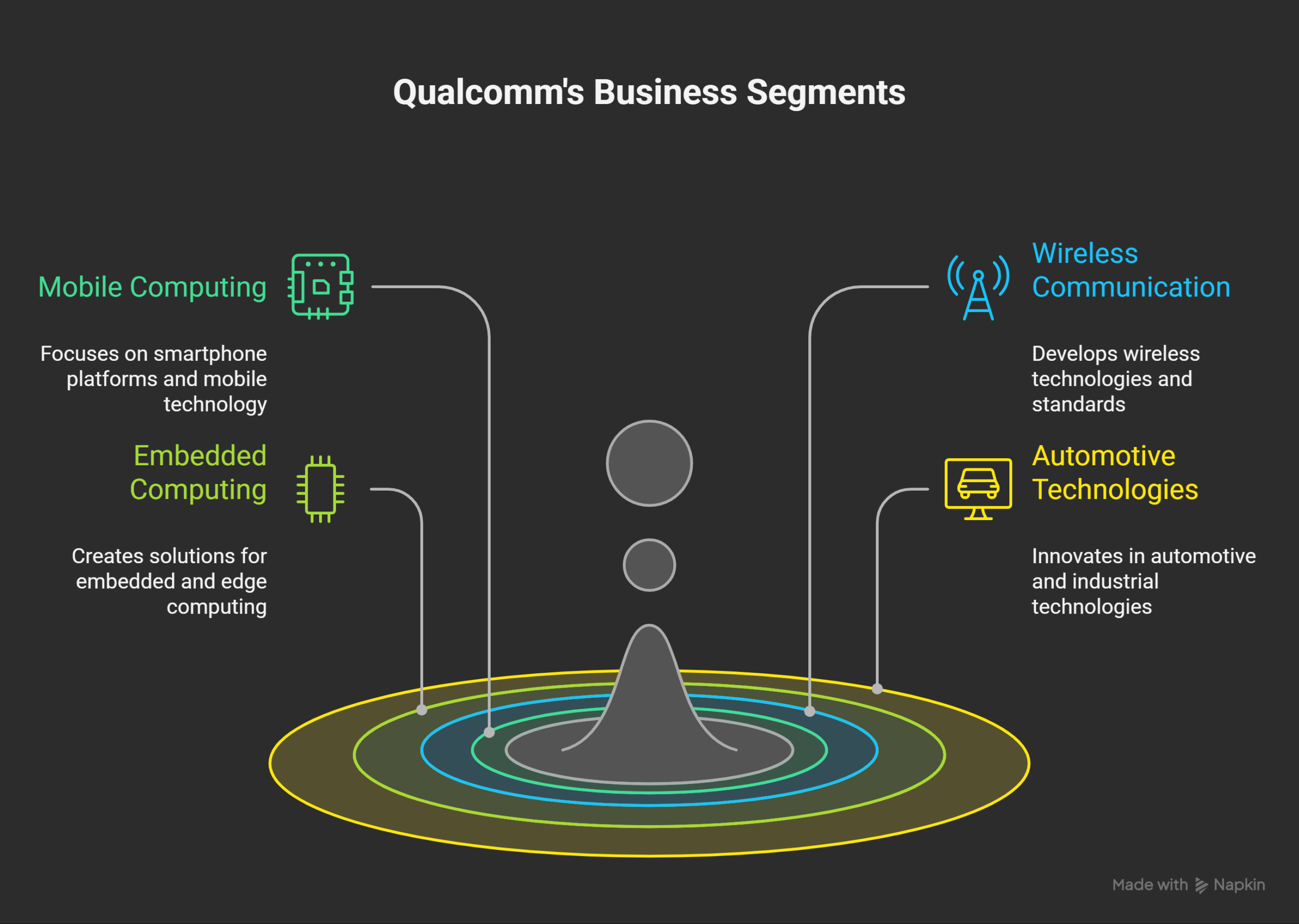
Qualcomm works across several key technology domains.
Major business segments include:
-
Mobile computing and smartphone platforms
-
Wireless communication technologies
-
Embedded and edge computing solutions
-
Automotive and industrial technologies
Each segment supports advanced digital ecosystems.
Semiconductor and Chipset Development
Qualcomm designs high-performance semiconductor products. Its chipsets are used across many electronic devices. Design focuses on speed, efficiency, and power optimization.
Key chipset characteristics include:
-
High processing performance
-
Low power consumption
-
Advanced connectivity features
-
Scalable architecture support
These features meet evolving industry demands.
Research and Innovation Culture
Qualcomm strongly invests in research and development. Innovation remains central to company growth. Engineers work on next-generation technologies continuously.
Innovation focus areas include:
-
Wireless standards development
-
AI and machine learning acceleration
-
Edge computing advancements
-
Energy-efficient system designs
Research teams collaborate across global locations.
Global Presence and Workforce
Qualcomm operates in many countries worldwide. It employs engineers, researchers, and technical professionals. Diverse teams contribute to product innovation.
Workforce strengths include:
-
Multidisciplinary engineering expertise
-
Cross-functional collaboration culture
-
Strong technical learning environment
Global teams support regional and international projects.
Industry Impact and Partnerships
Qualcomm influences global technology standards. Its innovations shape wireless communication ecosystems. The company partners with device manufacturers and industries.
Key partnership areas include:
-
Mobile device manufacturers
-
Automotive technology providers
-
IoT and industrial solution developers
These partnerships expand technology adoption.
Qualcomm at a Glance
| Aspect | Details |
|---|---|
| Industry | Semiconductors and wireless technology |
| Core Focus | Connectivity and computing solutions |
| Global Presence | Operations across multiple continents |
| Innovation Strength | Strong research-driven development |
| Customer Base | Device makers and technology companies |
This company continues driving future-ready technology solutions.
Master Embedded Systems Programming!
Launch your tech career with our Embedded Systems Course, designed for hands-on learning and industry readiness.
Know MoreQualcomm Embedded Software Engineer Interview Process
Interview Overview
The interview process evaluates strong embedded software fundamentals. It tests technical knowledge and practical problem solving. Multiple rounds assess different skill areas. Each round filters candidates progressively.
The process varies by role and experience. Freshers and experienced candidates face similar core evaluations.
Application and Shortlisting
Candidates apply through official or referral channels. Recruiters review resumes for relevant technical skills. Shortlisting focuses on embedded systems experience.
Key resume focus areas include:
-
Embedded C programming exposure
-
Operating systems or RTOS knowledge
-
Hardware interface understanding
-
Project or industry experience
Strong resumes increase interview selection chances.
Online Assessment Round
This round evaluates core programming abilities. It may include coding and technical questions. Time management is very important here.
Assessment topics generally include:
-
C programming fundamentals
-
Basic data structures
-
Logical problem solving
-
Embedded concept questions
Accuracy and clarity matter during evaluations.
Technical Interview Rounds
Candidates attend one or more technical discussions. Interviewers explore deep embedded software knowledge. Practical understanding is carefully examined.
Common focus areas include:
-
Embedded systems fundamentals
-
Memory management and pointers
-
RTOS concepts and scheduling
-
Inter-process communication mechanisms
Real-world examples strengthen candidate responses.
Debugging and Problem-Solving Round
This round tests analytical and debugging abilities. Candidates solve scenario-based technical problems. Logical thinking is closely evaluated.
Typical discussion areas include:
-
Debugging system crashes
-
Identifying race conditions
-
Memory leak analysis
-
Performance optimization techniques
Clear explanations improve evaluation outcomes.
Managerial or Behavioral Round
This round assesses communication and teamwork skills. Interviewers evaluate problem ownership and attitude. Cultural fit matters significantly here.
Common discussion points include:
-
Team collaboration experiences
-
Handling technical challenges
-
Learning new technologies
-
Managing project deadlines
Honest and structured answers are preferred.
HR Discussion and Final Selection
The HR round focuses on organizational alignment. Salary, role expectations, and policies are discussed. Candidates clarify career goals and interests.
HR evaluation includes:
-
Role understanding and motivation
-
Communication clarity
-
Professional behavior
Successful candidates receive final offers.
Interview Process Summary
| Stage | Purpose |
|---|---|
| Application | Resume screening and shortlisting |
| Online Assessment | Programming and core knowledge testing |
| Technical Rounds | Deep embedded systems evaluation |
| Debugging Round | Practical problem solving assessment |
| HR Discussion | Final fit and offer confirmation |
Proper preparation helps candidates navigate each stage confidently.
Kickstart your embedded systems career and turn your tech passion into high-demand skills!
Core Embedded Software Interview Questions
This section explains important embedded interview questions. Each answer uses simple language and short sentences. The focus remains on clear understanding and fundamentals.
Embedded Systems Fundamentals
What is an embedded system?
An embedded system is a dedicated computing system. It performs a specific function within a device. Hardware and software work closely together. Examples include washing machines and medical devices. Embedded systems often run without user interaction. They are designed for reliability and efficiency.
Explain hard and soft real-time systems.
Hard real-time systems require strict deadline compliance. Missing deadlines causes system failure. Soft real-time systems tolerate occasional deadline misses. Performance degrades but systems continue functioning. Examples include avionics and multimedia systems.
What are interrupts and their types?
Interrupts signal the processor for immediate attention. They pause normal program execution temporarily. Hardware interrupts come from external devices. Software interrupts are generated by programs. Interrupts improve system responsiveness.
Explain polling versus interrupt handling.
Polling repeatedly checks device status. It wastes CPU time during idle waiting. Interrupt handling responds only when events occur. It improves efficiency and system performance. Interrupts are preferred for real-time systems.
What is a watchdog timer?
A watchdog timer detects software malfunctions. It resets the system during failures. The software periodically refreshes the timer. Failure to refresh triggers system reset. It improves system reliability.
These questions test basic embedded knowledge.
C and C++ Programming Questions
Difference between volatile and const.
Volatile prevents compiler optimization. It handles variables changing unexpectedly. Const prevents modification after initialization. It enforces read-only access. Both serve different programming purposes.
Explain pointers and pointer arithmetic.
Pointers store memory addresses. They enable efficient memory access. Pointer arithmetic moves across memory blocks. Increment depends on data type size. Careless usage causes memory errors.
What is memory alignment?
Memory alignment arranges data at specific boundaries. It improves processor access speed. Misalignment can reduce performance. Some architectures require strict alignment.
Difference between stack and heap memory.
Stack memory stores local variables. It follows last-in-first-out order. Heap memory stores dynamically allocated data. Heap allocation is slower but flexible. Memory management differs for both.
Explain static versus dynamic memory allocation.
Static allocation occurs during compile time. Memory size remains fixed. Dynamic allocation occurs during runtime. Memory size changes as needed. Dynamic memory needs careful deallocation. Qualcomm expects strong C programming skills.
Data Structures and Algorithms
Explain linked lists and their applications.
Linked lists store elements using nodes. Each node contains data and pointer. They allow dynamic memory usage. Applications include queues and stacks. Insertion and deletion become efficient.
Difference between arrays and linked lists.
Arrays use contiguous memory locations. Linked lists use non-contiguous memory. Arrays allow fast indexing.
Linked lists allow flexible size changes. Memory overhead differs significantly.
What is time complexity?
Time complexity measures algorithm execution time. It depends on input size. Big-O notation represents complexity. Efficient algorithms reduce processing time.
Explain stack overflow scenarios.
Stack overflow occurs due to excessive stack usage. Deep recursion often causes overflow. Limited stack size worsens the issue. It leads to program crashes.
How would you detect a loop in a list?
Use two pointers moving at different speeds. They eventually meet in loops. This method uses constant memory. It is called Floyd’s algorithm.
Efficiency and logic are closely evaluated.
Operating Systems and RTOS Questions
What is an RTOS?
RTOS stands for Real-Time Operating System. It guarantees predictable task execution. Timing constraints are strictly maintained. RTOS supports deterministic behavior.
Explain task scheduling algorithms.
Scheduling decides task execution order. Common algorithms include round robin. Priority-based scheduling is widely used. RTOS scheduling ensures deadline compliance.
What are semaphores and mutexes?
They manage shared resource access. Semaphores allow multiple task access. Mutexes allow exclusive access.
They prevent race conditions.
Difference between process and thread.
Processes have separate memory spaces. Threads share the same memory. Threads are lightweight units.
Context switching differs significantly.
What causes deadlocks?
Deadlocks occur due to circular resource waiting. Improper synchronization causes deadlocks. Multiple locks increase deadlock risk. Prevention requires careful design.
These topics are very important at Qualcomm.
Embedded Linux Questions
What is a device driver?
A device driver controls hardware devices. It acts as a hardware interface. Drivers communicate with the kernel. They enable hardware functionality.
Explain kernel space and user space.
Kernel space runs core operating system code. User space runs application programs. Separation improves system security. Kernel space has higher privileges.
What is bootloader functionality?
Bootloader initializes system hardware. It loads the operating system kernel. Bootloaders execute before the OS. They support firmware upgrades.
How does memory management work in Linux?
Linux uses virtual memory management. It maps virtual addresses to physical memory. Paging handles memory allocation efficiently. Kernel manages memory resources dynamically.
What are system calls?
System calls provide kernel service access. Applications use them for hardware interaction. They bridge user space and kernel space.
Linux knowledge is often mandatory.
Microcontroller and Hardware Concepts
Difference between microcontroller and microprocessor.
Microcontrollers include memory and peripherals. Microprocessors require external components. Microcontrollers suit embedded applications. Microprocessors suit general computing.
Explain GPIO functionality.
GPIO stands for General Purpose Input Output. Pins can act as input or output. They interface with external devices. GPIO enables hardware communication.
What is memory-mapped I/O?
Memory-mapped I/O maps devices to memory addresses. CPU accesses devices like memory. It simplifies hardware communication.
Explain UART, SPI, and I2C.
UART supports asynchronous serial communication. SPI supports high-speed synchronous communication. I2C supports multi-device communication. Each protocol serves different use cases.
How do you debug hardware-software issues?
Check signals using debugging tools. Verify hardware connections and configurations. Analyze logs and error messages. Test components individually.
Hands-on understanding is highly valued.
Debugging and Problem-Solving Questions
How would you debug a system crash?
Analyze crash logs and error codes. Check memory usage and stack traces. Reproduce the issue consistently. Identify root causes logically.
What tools do you use for debugging?
Common tools include debuggers and analyzers. Logic analyzers inspect hardware signals. GDB helps software debugging. Logs provide runtime insights.
How do you analyze memory leaks?
Monitor memory allocation patterns. Use profiling tools for detection. Ensure proper memory deallocation. Repeated leaks degrade performance.
Explain race condition scenarios.
Race conditions occur due to shared resources. Multiple tasks access data simultaneously. Improper synchronization causes inconsistent results. Locks prevent race conditions.
How do you optimize embedded code?
Reduce memory usage and execution time. Optimize algorithms and loops. Avoid unnecessary dynamic allocations. Use hardware acceleration when possible.
Real-world experience matters here.
Behavioral and HR Interview Questions
Why do you want to join Qualcomm?
Qualcomm leads embedded and wireless innovation. It offers challenging technical opportunities. The work environment promotes learning. Career growth opportunities attract candidates.
Describe a challenging embedded project.
Explain project goals and constraints. Describe technical challenges faced. Highlight solutions and results achieved. Show problem-solving skills clearly.
How do you handle tight deadlines?
- I prioritize tasks effectively.
- I break work into manageable parts.
- I communicate risks early.
- I remain focused under pressure.
How do you work with hardware teams?
- I communicate requirements clearly.
- I collaborate during debugging phases.
- I respect cross-team expertise. Teamwork ensures project success.
Describe a time you fixed a critical bug.
I identified the root cause quickly & implemented and tested the fix. Then I documented the solution properly. The fix improved system stability.
Clear communication is expected in this round.
Tips to Prepare for Qualcomm Interviews
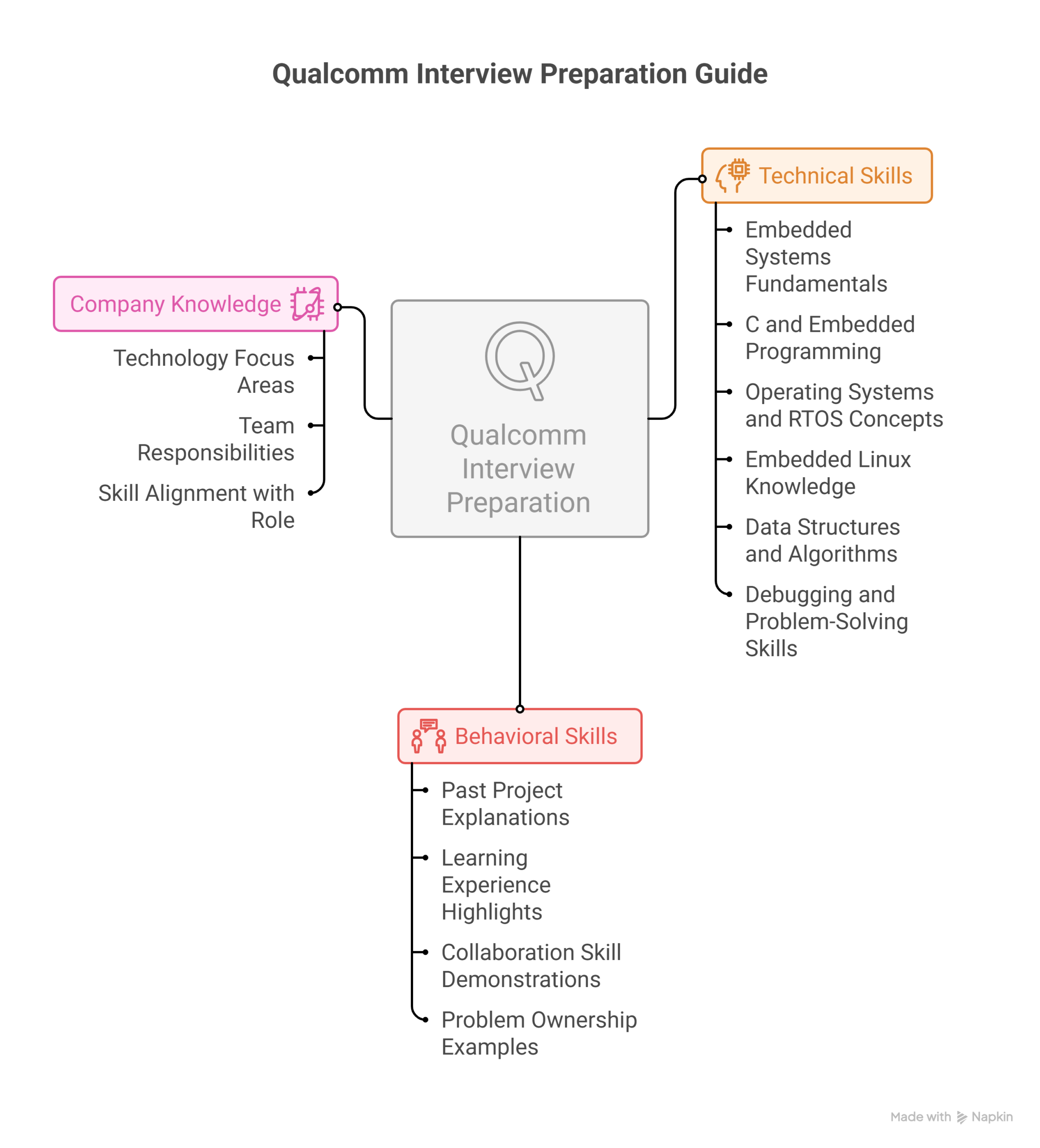
Preparing for Qualcomm interviews requires strong technical focus. Consistent preparation improves confidence and clarity. Understanding expectations helps candidates plan effectively.
Strengthen Embedded Systems Fundamentals
Revise core embedded systems concepts thoroughly. Understand hardware and software interaction clearly. Learn real-time constraints and system behavior. Focus on reliability and performance principles.
Key preparation areas include:
-
Embedded system architecture basics
-
Real-time system behavior
-
Interrupt handling mechanisms
-
System timing constraints
Strong fundamentals form the interview foundation.
Master C and Embedded Programming
C programming is critical for Qualcomm roles. Practice writing clean and efficient code. Understand memory usage and optimization. Avoid common pointer-related mistakes.
Important topics to practice include:
-
Pointers and memory allocation
-
Volatile and const usage
-
Data types and structures
-
Stack and heap behavior
Code clarity and correctness matter greatly.
Understand Operating Systems and RTOS Concepts
Operating system knowledge is heavily tested. RTOS concepts are especially important. Learn scheduling and synchronization methods.
Focus areas should include:
-
Task scheduling algorithms
-
Semaphores and mutex usage
-
Context switching concepts
-
Deadlock causes and prevention
RTOS understanding improves problem-solving ability.
Build Strong Embedded Linux Knowledge
Linux is widely used at Qualcomm. Understand kernel and user space separation. Learn basic device driver concepts.
Linux preparation topics include:
-
Boot process and bootloaders
-
Memory management basics
-
System calls and interfaces
-
Debugging Linux-based systems
Practical Linux exposure adds strong value.
Practice Data Structures and Algorithms
Efficient logic improves interview performance. Focus on memory-efficient data structures. Practice solving problems under constraints.
Important topics include:
-
Linked lists and arrays
-
Stack and queue operations
-
Time and space complexity
-
Algorithm optimization techniques
Clear logic explanations impress interviewers.
Improve Debugging and Problem-Solving Skills
Debugging skills are highly valued. Practice analyzing real-world issues. Understand both software and hardware failures.
Preparation techniques include:
-
Analyzing crash logs
-
Simulating fault scenarios
-
Using debugging tools
-
Tracing execution flows
Structured thinking helps during interviews.
Gain Hands-On Project Experience
Hands-on projects strengthen technical confidence. Practical experience demonstrates applied knowledge. Projects show real-world problem-solving ability.
Useful project examples include:
-
Microcontroller-based applications
-
RTOS-based system implementations
-
Embedded Linux projects
-
Hardware interface experiments
Projects make discussions more impactful.
Prepare for Behavioral and HR Questions
Behavioral preparation is equally important. Qualcomm values teamwork and communication. Be ready with real examples.
Preparation tips include:
-
Practice explaining past projects
-
Highlight learning experiences
-
Demonstrate collaboration skills
-
Show problem ownership
Honest answers build interviewer trust.
Revise Company and Role Expectations
Understand Qualcomm’s technology focus areas. Know the team’s core responsibilities. Align your skills with role expectations.
Final preparation checklist includes:
-
Review job description carefully
-
Match skills to requirements
-
Prepare thoughtful questions
Clear role understanding improves interview confidence.
Final Preparation Advice
Maintain consistent daily preparation. Practice explaining concepts aloud. Stay calm and confident during interviews.
Well-planned preparation increases success chances.
Master Embedded Systems Programming!
Launch your tech career with our Embedded Systems Course, designed for hands-on learning and industry readiness.
Know MoreConclusion
Qualcomm interviews value clear thinking and genuine technical understanding. They encourage candidates to explain concepts with confidence. Each question reflects real engineering challenges faced daily. Strong fundamentals help navigate complex discussions smoothly. Interviewers appreciate structured reasoning and honest responses. Preparation builds the ability to think under pressure. Every interview experience adds valuable learning. Approach each round with a positive mindset.
Stay focused and trust the effort you invested. Practice helps transform knowledge into confidence. Mistakes can become learning opportunities. Maintain clarity while explaining your thought process. Show curiosity and willingness to improve continuously. Your preparation reflects your dedication and discipline. Wishing you success and confidence in your Qualcomm interview.
Master Embedded Systems Programming!
Launch your tech career with our Embedded Systems Course, designed for hands-on learning and industry readiness.
Know MoreFrequently Asked Questions
What technical areas should I prioritize for a Qualcomm Embedded Software Engineer interview?
You should prioritize embedded systems fundamentals, C programming, data structures, operating systems concepts, RTOS behavior, and embedded Linux basics, because Qualcomm evaluates both low-level understanding and practical problem-solving ability during interviews.
Is hands-on project experience important for clearing Qualcomm embedded interviews?
Yes, hands-on project experience is very important, as interviewers often ask candidates to explain real projects, debugging challenges, hardware interactions, and design decisions to assess practical knowledge beyond theoretical understanding.
How deep should my C programming knowledge be for Qualcomm interviews?
Your C programming knowledge should be strong enough to confidently explain pointers, memory management, volatile usage, data structures, and common pitfalls, since embedded roles rely heavily on efficient and reliable C code.
Do Qualcomm interviews focus more on RTOS or Embedded Linux?
The focus depends on the specific team and role, but most interviews expect basic understanding of both RTOS concepts and Embedded Linux fundamentals, including scheduling, synchronization, kernel space, and driver interactions.
How are debugging skills evaluated during the interview process?
Debugging skills are evaluated through scenario-based questions where candidates must explain how they would analyze system crashes, memory leaks, race conditions, or performance issues using logical steps and appropriate tools.
How can I improve my confidence before attending a Qualcomm embedded interview?
You can improve confidence by revising core concepts regularly, practicing problem explanations aloud, reviewing past projects in detail, and approaching the interview as a technical discussion rather than a test.
Are coding questions asked in Qualcomm Embedded Software Engineer interviews?
Yes, coding questions are commonly asked, especially in C or C++, and they usually focus on pointers, memory handling, data structures, and writing efficient, bug-free logic rather than complex competitive programming problems.
How important is hardware knowledge for an embedded software role at Qualcomm?
Hardware knowledge is very important, as candidates are expected to understand microcontrollers, interfaces like UART, SPI, I2C, GPIO behavior, and how software interacts directly with hardware components.
What type of answers do Qualcomm interviewers prefer during technical discussions?
Qualcomm interviewers prefer clear, structured, and logical answers where candidates explain their thinking process step by step, mention assumptions, and relate concepts to real-world embedded scenarios.
Can freshers crack Qualcomm Embedded Software Engineer interviews with proper preparation?
Yes, freshers can crack Qualcomm embedded interviews by building strong fundamentals, practicing hands-on projects, understanding core concepts deeply, and confidently explaining their learning and problem-solving approach.