Table of Contents
Are you an architecture student who is looking for courses to improve your resume after completing your degree? Then Building Information Modeling (BIM) is one of the best options available in the academic and job market for you. There are many reasons to choose a BIM course after your Architecture degree B.Arch. These include more career opportunities, higher pay etc. If you are new to this course, then this blog will explain exactly why BIM is the best course for you to pursue after your B.Arch.
Learn Building Information Modeling principles from experts! Join the Entri BIM course!
Why BIM Matters for Architecture Graduates: Introduction
Architecture is a sector that is developing rapidly. Modern technology and innovative ideas are reshaping the ideas of how buildings are designed, constructed, and managed. One of the most transformative innovations in this field is none other than Building Information Modeling (BIM). It is for this very reason that pursuing a certification course in BIM is the best idea for an architecture graduate. Pursuing a BIM course can help the architecture graduates to open new doors to career opportunities and remain relevant in an industry that is evolving at a fast pace. In this blog, we will discuss what BIM is, why it is important, and the top reasons for which an architecture graduate would consider joining this course.
What is BIM?
Building Information Modeling (BIM) is a digital process that integrates 3D modeling with intelligent data management. The aim of this novel feature is to make the collaboration of construction professionals like architects, engineers, etc. seamless and smooth by creating a shared digital representation of a building’s physical and functional characteristics.

The main aspects of BIM are discussed in the table below.
| Aspect | Description |
| Visualization | 3D models that bring designs to life |
| Collaboration | Shared platforms for architects, engineers, and contractors |
| Efficiency | Streamlined workflows that reduce errors and save time |
| Lifecycle Management | Data-driven insights for construction, maintenance, and sustainability |
Join Entri BIM course to improve your architecture resume!
Master BIM and Elevate Your Career – Enroll Today!
Stay ahead in the construction and design industry with our comprehensive BIM Course! Learn Building Information Modeling (BIM) from experts, gain hands-on experience with top software, and boost your career prospects. Join now and become a certified BIM professional!
Know MoreTop 7 Reasons to Choose a BIM Course After Your Architecture Degree
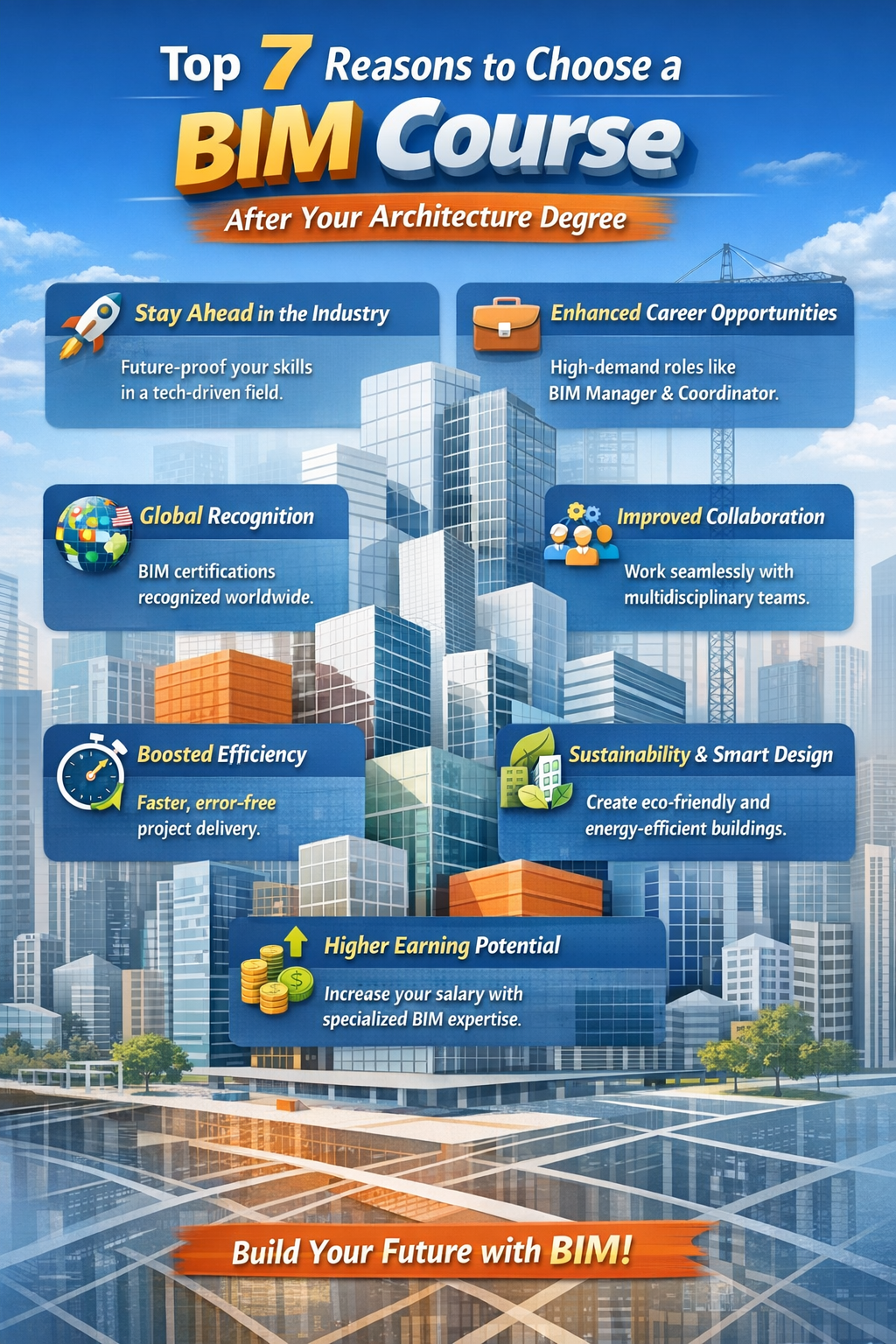
The top 7 reasons to choose a BIM course after your architecture degree are discussed below.
Stay Ahead in the Industry
Architecture is no longer a discipline that just focuses on the design. It is also about the way in which you integrate technology to achieve that design. Learning BIM skills will improve your employability worldwide by making your skills future-ready.
Enhanced Career Opportunities
There are many institutions in which BIM expertise is in demand. Some of them are:
- Architecture firms
- Construction companies
- Government projects
Many firms offer high-demand and highly paid positions like BIM Coordinator, BIM Manager, and BIM Consultant.
Global Recognition
Many developed countries have mandated BIM for public projects. These include the UK, USA, UAE, and Singapore. If you learn and get a certification in BIM, it can give you international career mobility.
Improved Collaboration Skills
Being able to work smoothly and effectively with a multidisciplinary team is essential in a modern workplace. The architecture and construction sector is no different. BIM teaches you how to efficiently coordinate and smoothen communication between architects, engineers, and contractors.
Boosted Efficiency and Accuracy
BIM can help you avoid design errors tremendously. Mastering BIM tools will help you avoid mistakes, optimize workflows, and deliver projects faster. All these are things that employers look for exactly.
Sustainability and Smart Design
Sustainability is an important factor in many construction projects right now. BIM techniques integrate energy analysis and sustainability metrics in them. This ensures that your building designs are eco-friendly and meet modern environmental standards.
Higher Earning Potential
Like in any other scenario, in construction too, professionals with higher qualifications will command higher salaries. Therefore, it is a good idea to join a BIM course and gain related specialized technical knowledge to get a better pay range during your next appraisal.
Learn Building Information Modeling! Open your career to more global opportunities! Join Entri!
Key Takeaways
Everything discussed in this post points out that BIM is not a course that should be seen as a passing trend. It is the next steppingstone for your profession as an architect, as BIM is something that is revolutionizing the architecture and construction industry. Attending this course will add advanced technical skills to your resume and hence help you gain global career opportunities and higher earning potential. So, if you are an architecture graduate, then BIM is not just an option for you. It is rather a strategic career move that has long-term relevance and improves your chances of success in the field. All in all, we can say that learning a BIM course can be a game changer for architecture graduates.
If you are someone who completed an architecture degree, then investing in a BIM course is one of the smartest decisions you can make to future-proof your career.
Master BIM and Elevate Your Career – Enroll Today!
Stay ahead in the construction and design industry with our comprehensive BIM Course! Learn Building Information Modeling (BIM) from experts, gain hands-on experience with top software, and boost your career prospects. Join now and become a certified BIM professional!
Know MoreFrequently Asked Questions
What is BIM in simple terms?
BIM is a digital process that creates and manages 3D models of buildings, integrating geometry with data like materials, costs, and schedules.
How is BIM different from CAD?
CAD focuses on 2D drawings or 3D geometry, while BIM adds intelligence—linking design elements to real-world information such as structural performance or energy use.
Why should architecture students learn BIM?
BIM is widely used in the industry, improves collaboration, reduces errors, and helps architects design more efficiently and sustainably.
Why should architecture students learn BIM?
BIM is widely used in the industry, improves collaboration, reduces errors, and helps architects design more efficiently and sustainably.
Which software tools are commonly used for BIM?
Popular BIM tools include Autodesk Revit, ArchiCAD, Bentley Systems, and Vectorworks.
Does BIM only benefit architects?
No, BIM benefits the entire construction ecosystem—engineers, contractors, facility managers—by providing a shared, data-rich model.
Can BIM help with sustainability?
Yes, BIM can simulate energy use, daylighting, and material efficiency, supporting green building design.
Is BIM mandatory in professional practice?
In many countries, BIM is required for public projects, and its adoption is rapidly growing worldwide.