

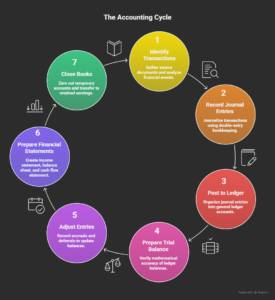
The 7 Steps of Accounting – also known as the Accounting Cycle – are the way you handle a company’s financial transactions. This process makes sure all the financial activity gets recorded and put together into good, usable financial reports – reports that clearly show how a business is doing. At the end of the day, its all about turning raw financial numbers into clear, easy-to-read reports that show how your business is performing. Here are the 7 core steps – in the right order:
- Identify & Analyze Transactions: Grab that stuff – receipts and invoices – and see what’s what, and how each one affects your finances.
- Record Journal Entries: With double-entry bookkeeping, you just log all those transactions as debits and credits in your general journal. It’s a pain, but it works.
- Post to the General Ledger: Next, you transfer those journal entries over to the specific accounts in your general ledger, and make sure you’re tracking all those balances.
- Make an Unadjusted Trial Balance: Get a report together that checks to see if your debits and credits are all good and matched up after you’ve posted everything.
- Record Adjusting Entries: You need to make a few adjustments at the end of the period to get everything sorted out – stuff like unearned income, and rent you paid in advance, that kind of thing.
- Prepare Your Financial Statements: Take all that info and generate your income statement, balance sheet, and cash flow statement from that adjusted trial balance.
- Close the Books: Finally, zero out all those temporary accounts – revenues and expenses – so you can start fresh for the next period.
This is the foundation of any business’s financial management – it keeps things accurate and gives you a clear picture of what’s going on with your finances.
Key Takeaways
- The 7 steps of accounting are a complete cycle – start to finish, from a transaction to getting your books ready for next time
- Doing these steps right ensures you’re complying with all the financial regulations, and you get reports you can actually use to make decisions
- Double-entry bookkeeping is the key to keeping your accounting equation (Assets = Liabilities + Equity) in balance throughout the cycle
- Adjusting entries are a big deal, though – they keep you honest with the matching principle, which is all about making sure you record expenses in the same period as the income they helped bring in
- After each accounting period – month, quarter, or year, it doesn’t matter – your cycle is complete, and you get a fresh snapshot of how your business is doing.
Understanding the Accounting Cycle

Before diving into the details of each step, it helps to get a good sense of how the whole accounting cycle fits together. The accounting cycle is basically a framework that businesses use to keep their financial records in order. Think of it like a checklist that you go through at regular intervals. It starts with a clean slate at the beginning of a period, and by the end of it, all the financials are squared away and ready to be reviewed.
Ultimately, the purpose of these 7 steps is to get accurate and timely financial information to the people who need it most – owners, managers, investors, and regulatory bodies. Without the accounting cycle in place, financial data can quickly get out of hand and become completely unreliable, making it impossible to tell if a business is making a profit or even still solvent.
Become an Accounting Pro – Learn from Industry Experts!
Step 1: Identify and Analyze Transactions
The accounting cycle starts the moment a financial event happens. This first step is all about gathering the evidence. You’ll need to start collecting source documents as soon as a business transaction takes place. These can be things like sales receipts, invoices from suppliers, bank statements, contracts, payroll records, and so on.
Once you’ve identified a transaction, you need to take a closer look and figure out what its impact is going to be. This means working out which accounts are going to be affected and by how much. For example, if a company buys office supplies for cash, the obvious impact will be an increase in the “Office Supplies” account and a corresponding decrease in the “Cash” account. This analysis is key because it determines exactly how the transaction will be recorded in the next step.
Step 2: Record Journal Entries
After you’ve analysed a transaction, the next step in the 7 steps of accounting is to record it in the general journal. This is called journalising. The general journal is basically a chronological record of every single business event, like a diary. It shows you what happened when.
When recording a transaction in the journal, you’re using the double-entry bookkeeping system. This means that every transaction has to affect at least two accounts, and the total of all the debit entries has to match up perfectly with the total of all the credit entries. A journal entry will typically include the date, the accounts being debited and credited, the amounts, and a brief description of the transaction. So, for example, a cash sale might look something like this:
- Debit: Cash
- Credit: Sales Revenue
This all helps keep the overall equation balanced.
Step 3: Post to the General Ledger

Once transactions are in the journal its time to start thinking about organisation – to get all the transactions that affected the same account together in one place. This is what posting to the general ledger is all about. The general ledger is the master record that contains all the financial accounts for the business – it has a separate entry for things like Cash, Accounts Receivable, Inventory, and Rent Expense.
Posting is just a matter of taking the debit and credit info from the journal and shoving it over into the right accounts in the ledger. So for example, all the entries that affected the Cash account are all collected in the one spot in the ledger. This allows anyone to see the activity and current balance of Cash at a glance. This step organizes the detailed journal entries into a more useful and accessible format.
Step 4: Prepare an Unadjusted Trial Balance
At the end of a financial accounting period, once all the transactions have been journalized and posted, it’s time to give the numbers a good once-over for mathematical accuracy. The fourth step is to knock together an unadjusted trial balance. That’s an internal report that lists every single general ledger account and its balance at that exact point in time.
The main purpose of this trial balance is to prove that the total of all debit balances stacks up against the total of all credit balances. And because of double-entry bookkeeping, these totals should as far as all practical purposes, match. But if they don’t, it can signal that an error has been made somewhere along the line in the journalizing or posting process. It might be a simple mistake, like a number being transposed the wrong way round, or an entry being posted to the wrong account altogether. Whatever it is, finding and fixing the problem now is crucial because once you’ve sorted that out, you can press on with confidence.
Become an Accounting Pro – Learn from Industry Experts!
Step 5: Get Your Adjusting Entries in Order
You can have a trial balance that’s been ‘balanced’ to perfection, but still not be entirely up to date for reporting purposes. That’s because of timing differences. Some transactions span multiple accounting periods. So, the fifth step is to record adjusting entries to sort that situation out. These entries ensure that all revenues and expenses get recorded in the period they’re earned or incurred in, all according to the matching principle.
There are two main types of adjustments to make here: accruals and deferrals. Accruals are for revenues earned or expenses incurred that haven’t yet been recorded. For example, if employees have worked overtime at the end of the period, but you won’t be paying them until the next period. Deferrals, on the other hand, are for cash that was received or paid in advance. So, for instance, prepaid insurance – where the expense gets spread out over the period the insurance policy is actually in force. After making these adjustments, you’ll be able to prepare another trial balance – the adjusted trial balance.
Step 6: Finally, Get Your Financial Statements Sorted

Once you’ve got the adjusted trial balance sorted, it’s time to create your financial statements. That’s the real payoff for all the hard work you’ve put in. And the adjusted trial balance gives you everything you need, accurate and in one place, to draft these essential documents.
The three key financial statements you’re going to be working with in this step are:
- Income Statement: This one shows you how profitable the company has been over the period, simple as that – subtract the expenses from the revenues.
- Balance Sheet: This is where you get a snapshot of what the company owns (its assets), what it owes (its liabilities), and the owner’s stake (equity) as it stands at that exact point in time.
- Cash Flow Statement: This report will show you exactly how much cash the company has generated and used in operations, investing, and financing activities over the period.
These statements are the ones internal and external stakeholders rely on to make informed decisions about the company.
Step 7: Close the Books
The final step of the 7 steps of accounting is to close the books for the period. This process prepares the company’s accounts for the next accounting cycle. Closing involves “zeroing out” all temporary accounts. Temporary accounts include revenue, expense, and dividend accounts. They track financial activity for just one period.
To close them, their balances are transferred to a permanent account called “Retained Earnings” (for a corporation). This transfer shows how the period’s profits or losses have changed the owners’ claim on the business. After these closing entries are posted, all revenue and expense accounts have a zero balance, ready to start tracking the next period’s activity. A final post-closing trial balance is often run to ensure that only permanent asset, liability, and equity accounts remain and that the books are still in balance.
Become an Accounting Pro – Learn from Industry Experts!
Why These 7 Steps Matter for Your Business
Following these 7 steps is not just an accounting exercise. It has real-world benefits for any business. First, it ensures accuracy. The built-in checks, like the trial balances, help catch errors early. Second, it ensures compliance. Accurate records are required for filing taxes and meeting regulatory requirements, and they provide a clear trail for auditors.
Finally, it empowers better decision-making. When you follow the cycle, you get reliable financial statements. These statements tell you if your business is making money, how much cash you have on hand, and what your debts are. With this information, you can confidently plan for the future, apply for loans, and make strategic investments to grow your company.
Placement Oriented PWC Business Accounting Course
PWC Certified Business Accounting Course by Entri App: Master in-demand skills, ace interviews, and secure top-tier jobs.
Join Now!Frequently Asked Questions
What are the 7 steps of accounting in order?
The 7 steps are: 1) Identify and analyze transactions, 2) Record journal entries, 3) Post to the general ledger, 4) Prepare an unadjusted trial balance, 5) Record adjusting entries, 6) Prepare financial statements, and 7) Close the books.
Why is the accounting cycle important?
The accounting cycle is important because it ensures all financial transactions are accurately recorded and reported. It produces reliable financial statements that help business owners make informed decisions.
What is the difference between the journal and the ledger?
The journal is the first place transactions are recorded in chronological order. The ledger organizes those transactions by specific accounts, showing the balance for each account.
Do small businesses need to follow all 7 steps?
Yes, small businesses benefit from following all 7 steps. The process helps maintain accurate records, simplifies tax preparation, and provides clear financial insights for growth.
What are adjusting entries in accounting?
Adjusting entries are updates made at the end of an accounting period. They record items like accrued expenses or prepaid rent that were not captured in daily transactions.
How often does the accounting cycle repeat?
The accounting cycle repeats every accounting period. Common periods are monthly, quarterly, or annually, depending on the business’s reporting needs.
What is a trial balance?
A trial balance is an internal report listing all general ledger accounts and their balances. It checks that total debits equal total credits before preparing financial statements.
What financial statements are prepared in step 6?
Step 6 produces the income statement, balance sheet, and cash flow statement. These reports show profitability, financial position, and cash activity for the period.
What does "closing the books" mean?
Closing the books means zeroing out temporary accounts like revenues and expenses. Their balances are transferred to retained earnings to prepare for the next period.