Germany pushes BIM harder than most places in Europe. Rules from the government make BIM standard for many public jobs like roads, bridges, and train stations. Private developers jump on board too because clients want faster builds, fewer surprises, and buildings that use less energy. The result is clear: more projects need BIM experts, and good ones get rewarded with solid pay checks.
Get Career Oriented BIM Certification Course with Expert Mentors! Get Free Demo Here!
What a BIM Engineer Actually Does Every Day in Germany
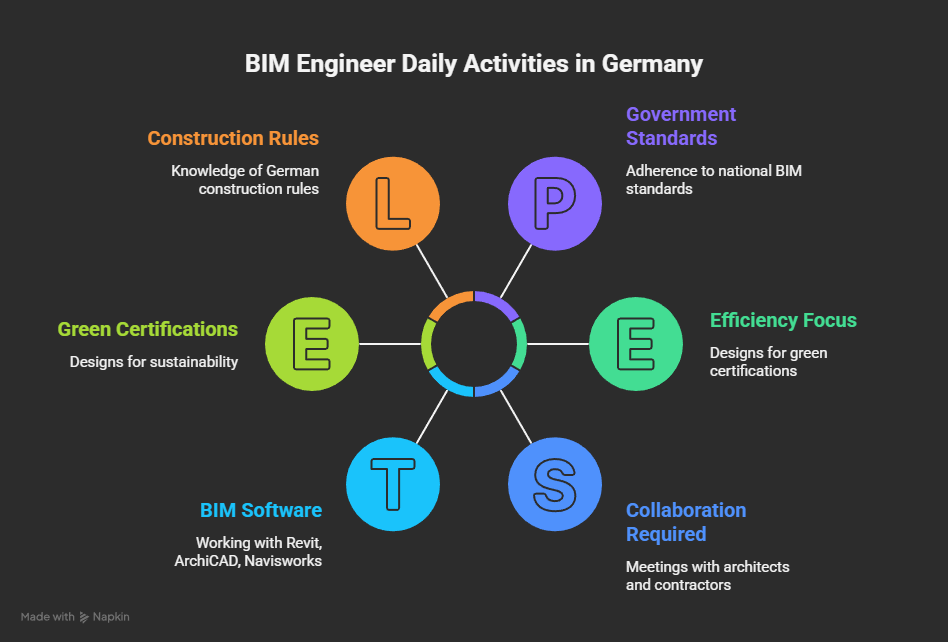
BIM engineers spend their days working with Building Information Modelling. They build and update detailed 3D digital versions of buildings, bridges, or other structures. Tools like Revit, ArchiCAD, or Navisworks fill their screens from morning to afternoon.
The work covers a lot of ground. An engineer takes rough sketches or plans from architects and turns them into precise models. They bring together pieces from structural teams, mechanical installers, electricians, and plumbers so everything fits without overlap. When the software flags a clash—say a duct running through a beam—they fix it right away so the real construction stays smooth. From the finished model, they pull out clean drawings, lists of materials needed, and reports that guide the whole project forward. They stay involved from early design all the way through building and even into handover when the owner takes the keys.
Projects in Germany vary widely. Some engineers focus on huge public works like new autobahn sections or airport expansions. Others handle office towers, modern hospitals, or apartment blocks in growing cities. Government jobs stick closely to national BIM standards set by ministries. Private companies chase efficiency and want designs that earn green certifications.
The role mixes hard technical work with plenty of talking. Engineers sit in meetings with architects to explain model changes, chat with contractors about site realities, and answer client questions about costs or timelines. Knowing German construction rules inside out makes someone far more useful on the team.
People new to the job usually stick to modelling—building the shapes and adding data. With time, they start coordinating whole models, leading small groups, or helping set BIM rules for an entire company. Almost everyone in the role has a degree in civil engineering, architecture, or something close. Extra certificates in Revit or official BIM standards give a real edge when applying.
What BIM Engineers Earn in Germany Right Now in 2026
Fresh data from reliable sources puts the average gross salary for a BIM engineer between roughly 57,000 € and 61,000 € each year. Places like SalaryExpert and ERI point to around 56,800 € to 60,800 € as common figures. That works out to about 27 € to 29 € per hour. On top of the base, many people pick up a bonus around 1,900 € to 2,050 € yearly. Remember these numbers show gross pay—taxes and social contributions come out before the money hits your account.
Someone just starting with one to three years of experience usually sees 40,000 € to 45,000 € gross per year. Smaller offices or quieter regions sometimes start even lower for true beginners.
After four to seven years on the job, pay climbs to 55,000 € up to 65,000 €. People with eight years or more often clear 70,000 €, and the very best in demanding roles push past 75,000 €.
BIM managers run a step higher. They guide teams, set company standards, and handle bigger responsibilities. Their average sits around 60,000 € to 65,000 €, though the full range stretches from 54,000 € all the way to 85,000 € depending on the firm and how much they lead.
These amounts beat what many regular engineers make in building-related fields. The push toward digital ways of working keeps lifting pay year after year.
What Really Moves the Needle on Your Salary
A few big things decide how much ends up in your pay check. Years on the job matter most. Brand-new graduates start modest. Every project finished adds proof you can handle real pressure. Hit five years or more and employers notice—offers jump noticeably.
School background and extra papers help a lot. A solid bachelor’s or master’s in engineering or architecture gets your foot in the door. Proof you master Revit or understand standards like ISO 19650 can bump starting pay five to ten percent right away.
Who you work for changes the picture. Giant contractors and well-known consultancies hand out bigger checks than small local architecture shops. Jobs tied to major public builds or international companies usually bring steadier money plus nicer perks.
The size of the project counts too. Model a massive hospital or high-speed rail line and pay follows. Handle a few family homes and the salary stays more average.
Speaking German fluently opens far more doors. International offices sometimes run on English, but most German firms want you comfortable in meetings and reading local codes in the original language. Better German almost always means better offers.
How you talk about your skills during interviews or reviews makes a difference. Show examples of problems you solved or money you saved on past jobs, and you walk away with stronger numbers.
How Pay Shifts Depending on Where You Live in Germany
Location plays a big role because living costs and job numbers differ so much.
The south pays the most. Munich stands out with averages from 59,000 € to 65,000 €—often four to ten percent above the country as a whole. Stuttgart and Frankfurt sit close behind at around 60,000 € to 64,000 € thanks to strong industry and banking scenes.
Berlin tends to run lower, usually 48,000 € to 55,000 €. The city pulls in lots of young talent, so entry pay stays softer. Senior people in fast-growing areas still do well though.
Western spots like Cologne or Düsseldorf land in the middle at 55,000 € to 60,000 €. Hamburg in the north pays competitively because of shipping, logistics, and big port projects.
Eastern cities like Leipzig or Dresden generally sit five to fifteen percent below western levels. More companies move in every year, so demand—and pay—creeps upward.
Big cities mean more openings but also steep rent and crowded trains. Smaller places pay less yet let you live comfortably and reach the office quickly.
How BIM Engineer Pay Stacks Up Against Similar Jobs
BIM engineers pull ahead of people who only use basic CAD or draw by hand. Regular civil engineers average 50,000 € to 60,000 €, but the digital side adds 5,000 € to 15,000 € extra because companies need those skills badly.
BIM coordinators focus on finding clashes and keeping teams in sync. Their pay lands close to BIM engineers—usually 55,000 € to 65,000 €.
Junior BIM modelers spend most hours building in Revit. They average 42,000 € to 50,000 € and often start here before moving up.
BIM managers run the show. They earn 60,000 € to 80,000 € or higher when they lead departments.
Against software developers in other fields, BIM pay holds its own in construction. Plus the hours often feel more predictable—no constant late-night bug fixes.
Practical Ways to Push Your Salary Higher
This is where you can find steady growth in incomes over time if you are intentional about how you grow your skills, responsibilities and status within the industry. Employers notice people who don’t wait to be told what to do and who consistently deliver on demanding assignments, and their reputation supports higher pay debates later.
An additional strong factor for long-term growth in salary is investing in high quality certifications and specialized technical experience. Instead, master one or more BIM tools and not get into so many tools on a surface basis. Employers value professionals who can quickly shift environments but who can also maintain accuracy and efficiency. A commitment and professionalism, through official certifications, structured training, and a solid understanding of process standards. These credentials often serve as the evidence during hiring or promotion interviews, and are an argument for a higher pay scale.
Language skills are also far more important to income than people think. If your German is not very good yet, it should be one of your main goals. Fluency opens up opportunities to a wider array of firms, including local firms that prefer or require German in their everyday activities. It also impacts how you are perceived in the office, at the phone, and in the interactions with clients. This, in turn, creates a sense of seniority, dependability, and commitment to more responsibility that comes out, as well as an attractive wage.
Career changes need to be planned not emotionally. Thinking about the job change once every three to five years is often one of the fastest ways to increase the salary. New employers usually offer ten to twenty percent more to attract competent, qualified professionals. The prospect of remaining in one position for too long may be dangerous if the income growth is low or if it is small internal increases. The trick is to make decisions based on purpose and to ensure that each role brings new skills, size, or leadership experience that may not be the equivalent of a new title.
Location can also affect your earnings. If you are interested in moving, high-paying areas can help you build incomes faster than waiting for increase increases in lower-paying regions.
The biggest salary rises are also attributed to leadership experience. Moving toward coordinator, lead, or manager positions takes you away from execution into oversight, decision-making and accountability. But in these positions, communication, planning, and people-management skills are necessary but they also require higher salaries. Even small actions of leadership, such as mentoring juniors or having a workstream are enough to establish the foundation for higher paying positions.
The power of specialization also exists when it is chosen wisely. It is possible to become a different breed of generalist by being focused on niches of great demand, such as low-energy building modeling, sustainable design workflows, or large-scale infrastructure projects. These types of activities can pay more because fewer professionals have the technical knowledge and practical project experience needed. When you have mastered that skill, it’s easier to replace it and better to justify higher wages.
Networking is something to never lose sight of. Keeping track of industry peers through meetings, webinars, or professional organizations helps you be seen and heard. Many great opportunities do not end up in public job boards but become personal recommendations. Just one good connection can lead to a better offer, a referral, or insider knowledge of better paying jobs.
Finally, you cannot get away with learning endlessly unless you want long-term income growth. Software changes, regulations change, and workflows change every year. Keeping up with the latest versions, standards, and best practices will keep you current. Those who maintain current tend to be more productive, make less mistakes, and adapt faster, which makes them much more useful to employers and much harder to replace.
The Full Picture: Benefits That Add Real Value
The story of salaries is just one part. Generally, contracts require a third or even fourteenth month pay, typically one that allows extra income around Christmas or summer vacation. This additional pay can positively affect average annual earnings and allow workers more financial breathing room during critical holidays.
Health insurance is typically a standard benefit, not an add-on. Employers also participate in pension schemes, which ensures that employees have an extended security of income without having to worry about everything for themselves. These investments bring in value over time, but this is not always apparent until you look at monthly earnings.
Another advantage is vacation policies. The standard annual leave spans 25-30 days, longer than most countries. Most also have flexible start/end times, which allow them to coordinate their work day around family, personal needs, or peak productivity hours.
Many teams have grown used to remote work, with home office days part of their regular work schedule. This reduces commuting time and costs and also provides better work-life balance. Some employers go further, offering a company car, public transport pass, or money to support cycling which makes daily travel easy and cost-effective.
Also, professional development is aided by training budgets. Workers can attend courses, certifications or large BIM conferences without the need for a cost. When combined, these benefits can often lead to a ten-to-20% increase in the real value of a job, more than the basic salary implies.
Where BIM Engineer Pay Heads Next in Germany
BIM continues to grow with the construction and infrastructure industries. Nearly every new project today uses BIM in some way – design, planning, execution, or facility management. Governments also play a large role in this expansion, by introducing tighter regulations and mandates that will require BIM adoption to be more standardized and layered. These policies are urging businesses to consider BIM as part of their project processes, not an optional but integral element of the project flow, and thus BIM skills become more needed than optional.
Despite the growing adoption, the number of well-trained BIM professionals has not caught up with market demand. The open positions tend to be far more significant than qualified candidates, and this gap persists. Because of this disparity professionals who have a proven BIM skill set continue to be highly sought after in the industry. Indeed, the wages are generally three to five percent higher in most years during periods where other construction positions are growing slower.
Industry reports further strengthen this view with strong long-term growth. Some estimates project a combined growth of around twelve percent for BIM related roles over the next five years. This growth is likely to be fuelled by scale-up infrastructure projects, urban renewal, smart cities and a larger digitalization across the construction lifecycle. A more cohesive form of BIM, meaning skilled professionals, will continue to be required.
At the same time, automating is changing the nature of BIM work. Modern software, scripts and AI-driven tools are increasingly addressing the more common modelling and drafting tasks. But this automation also means that human expertise is not eliminated
BIM talent is also increasingly in demand worldwide. Firms outside of Germany and other established markets are hiring skilled workers, often with attractive salary packages, flexible hours and foreign connections. This global demand makes the job security and career mobility even more secure for BIM capable individuals.
For those who are now entering or upgrading their skills, the longer-term prospects are very good. The time invested learning BIM tools, workflows, coordination strategies, and leadership skills can give you a stable, paid and future-proof job. Now, those who place focus on developing real, practical expertise are poised for sustained growth and long-term success in an industry that is still growing and developing.
Get Career Oriented BIM Certification Course with Expert Mentors! Get Free Demo Here!
Wrapping It Up
BIM Engineer Salary in Germany looks strong and rewarding in 2026. Average gross pay lands between 57,000 € and 61,000 €, with experienced people clearing 70,000 € and top specialists going higher. Your exact amount depends on years worked, where you live, what you know, and how well you show your value.
Construction relies more on BIM every day. Jobs stay stable, benefits stay generous, and the field keeps growing. People who keep learning, take on bigger challenges, and stay sharp see their income rise steadily.
If this career calls to you, the outlook feels bright. BIM engineers help build smarter, cleaner projects while earning pay that matches the skill. The path ahead rewards those ready to put in the effort.
|
RELATED POSTS |
|
Master BIM and Elevate Your Career – Enroll Today!
Stay ahead in the construction and design industry with our comprehensive BIM Course! Learn Building Information Modeling (BIM) from experts, gain hands-on experience with top software, and boost your career prospects. Join now and become a certified BIM professional!
Know MoreFrequently Asked Questions
Beyond the Averages: What Does a Real "Mid-Career" BIM Engineer Salary Progression Look Like in Germany (2026)?
The average figures (€55k-€65k) are useful, but the real story is in the progression. A typical, ambitious career path for a BIM Engineer in Germany, based on 2026 market data, might look like this:
-
Years 0-2 (Junior / Modeller): You start at €40,000 – €48,000. Your focus is on mastering Revit/ArchiCAD, understanding German building codes (DIN/VDI), and learning project workflows. You’re “building the bricks” in the model under supervision.
-
Years 3-5 (BIM Engineer): Salary jumps to €52,000 – €62,000. You now own disciplines (e.g., structural or MEP), run clash detection autonomously, and extract construction documents. You’re a reliable project member who can liaise with other trades.
-
Years 5-8 (Senior BIM Engineer / Coordinator): This is where specialization pays. With deep experience in, say, hospital design or sustainable building certifications (like DGNB), you can earn €65,000 – €75,000. You coordinate models from multiple teams, mentor juniors, and ensure project-wide BIM standards are met.
-
Years 8+ (BIM Manager / Lead Digital Engineer): Transitioning from technical execution to strategy and leadership. You define the company’s BIM execution plan, manage software licenses, and lead the BIM team. This role commands €70,000 – €85,000+, with the upper range at major engineering consultancies or global contractors.
The key takeaway: Your value isn’t just in your years, but in the complexity of projects you’ve handled and your move from a task-doer to a process-owner and knowledge-sharer.
I'm an International Candidate with a Foreign Degree. How Much Will This Realistically Affect My Starting Salary and Job Prospects?
This is a crucial consideration. Your foreign degree will affect the initial stages more than your long-term ceiling.
-
The Recognition Hurdle: German employers highly value degrees accredited under the German system. For non-EU degrees, you’ll likely need an official “Statement of Comparability” from the Zentralstelle für ausländisches Bildungswesen (ZAB). Without this, many HR departments may place you in a lower initial salary bracket or be hesitant.
-
The “Experience vs. Degree” Balance: A recognized foreign degree plus 3+ years of proven BIM experience on international projects can offset the “foreign” factor significantly. Your portfolio and project examples become more important than your diploma. Expect to land in the lower-to-mid range of the “BIM Engineer” bracket (€50k-€58k) if you have solid experience.
-
The Language Premium: This is the biggest differentiator. An international candidate with B2/C1 German will command a 10-15% higher starting salary than an English-only speaker at the same experience level. Fluency demonstrates you can integrate into site meetings, understand local regulations firsthand, and work directly with German clients and authorities.
-
The Strategy: Target large, international engineering firms (like AECOM, Arup, WSP) or German giants with global projects (like Hochtief, STRABAG, Drees & Sommer) for your first role. They operate more in English and are used to evaluating international qualifications. Use this as a springboard to gain German project experience and improve your language skills for a future move.
How Do Bonuses, "13th Month Salary," and Other Allowances Actually Work in the German BIM Industry?
The gross salary is just one part of a structured compensation package.
-
Performance Bonuses (Leistungsbonus): The €1,900-€2,050 average is typical. This is rarely guaranteed. It’s usually tied to company performance and your personal annual review. In very profitable years at large contractors, this can exceed €3,000. In small architecture studios, it might be nonexistent or a symbolic Christmas bonus.
-
The “13th Month Salary” (Weihnachtsgeld): This is common but not legally required. It’s often paid in November/December. Some companies even have a “14th month” for vacation pay (Urlaubsgeld), paid in the summer. When evaluating an offer, always ask if the stated annual salary includes these extra payments or if they are on top. A €60,000 offer “inklusive Weihnachtsgeld” means your monthly is lower, but you get a lump sum later.
-
Allowances & Benefits:
-
Mobility: A company car (Dienstwagen) is rare for pure BIM roles but possible for managers who visit sites. A public transport subsidy (Jobticket) is very common and valuable in cities.
-
Training Budget (Fortbildungsbudget): This is a critical, non-cash benefit. A budget of €2,000-€5,000 per year for certifications (like Autodesk Certified Professional, TÜV BIM Manager) directly boosts your future earning potential.
-
Pension Contribution (bAV): Many employers contribute to a supplementary private pension plan on top of the state system.
-
Flexibility: The true value of 1-3 remote work days per week and 28-30 days of vacation cannot be overstated for work-life balance.
-
Is There a Concrete Salary Difference Between Working for a Contractor, an Engineering Consultancy, or an Architecture Firm?
Yes, the business model directly influences pay scales and culture.
-
Major Contractors & Construction Giants (e.g., STRABAG, Ed. Züblin): Typically offer the highest base salaries (often 5-10% above average). The work is fast-paced, focused on construction sequencing, logistics, and clash resolution for buildability. Bonuses can be higher but tied to project profitability. The environment is more hierarchical.
-
Large Engineering & Multidisciplinary Consultancies (e.g., Arup, Drees & Sommer, Buro Happold): Offer competitive salaries (at or slightly above average) with a strong emphasis on technical excellence and innovation. You’ll work on complex, design-focused projects early in the lifecycle. Benefits like training budgets are generous. Career paths into specialized technical leadership are clear.
-
Architecture Firms (from large practices like GMP to small studios): Salaries tend to be the lowest of the three, especially in design-focused studios. The trade-off is deeper involvement in the conceptual and design development phases. The focus is on architectural intent, materiality, and spatial coordination. For BIM engineers who love design, this can be more fulfilling despite the lower pay.
-
Specialist BIM or Digital Twin Consultancies: A growing niche. They often pay very well for top talent (senior levels can exceed €80k) as they sell pure BIM/Digital expertise. The work is varied and at the cutting edge, but job security can be more project-dependent.
What Are the Most In-Demand Technical and Soft Skills That Can Justify a Salary at the Top of the Range (€75k+)?
To break into the upper echelons, you must combine deep technical expertise with strategic and interpersonal skills.
-
Technical “Hard Skills”:
-
Beyond Modeling: Expertise in Dynamo (for Revit) or Grasshopper (for ArchiCAD) for automation and complex geometry. The ability to write simple scripts is a massive differentiator.
-
Interoperability & Data Management: Mastery of openBIM standards (IFC) and Common Data Environment (CDE) platforms like Autodesk BIM 360, ThinkProject, or Aconex. Understanding ISO 19650 is expected at this level.
-
Specialization: Deep knowledge in sustainability analysis (linking BIM to energy modeling tools), digital fabrication, or existing building digitization (Point Cloud to BIM).
-
-
Strategic & Soft “Power Skills”:
-
BIM Management & Process Design: Ability to author and implement a BIM Execution Plan (BEP). This shifts you from a modeler to a process designer.
-
Client & Stakeholder Management: You can explain BIM’s value to non-technical clients, lead coordination workshops, and resolve conflicts between disciplines. Your German must be fluent for this.
-
Mentorship & Training: Proven ability to upskill junior team members and standardize workflows across the office. This demonstrates leadership without a formal manager title.
-
Business Acumen: You understand how efficient BIM processes save time and money, and you can quantify this value for project bids.
-
How Does the German Tax and Social Security System Work for a Typical €60,000 BIM Engineer Salary? What is the Actual Net Income?
Understanding the “netto” (net) is essential for personal budgeting. For a single person with no children (Steuerklasse I) earning €60,000 gross in a state like North Rhine-Westphalia:
-
Monthly Gross: €5,000
-
Key Deductions:
-
Income Tax (Lohnsteuer): ~€1,100
-
Solidarity Surcharge (mostly phased out): ~€5
-
Church Tax (if applicable): ~€50
-
Statutory Health Insurance (≈7.3%): ~€365
-
Statutory Pension Insurance (9.3%): ~€465
-
Unemployment Insurance (1.3%): ~€65
-
Long-Term Care Insurance (2.6%): ~€130
-
-
Approximate Monthly Net Income: €5,000 – €2,180 = €2,820
This is a rough estimate. Your net pay increases with tax class (III for married couples where one partner earns less), child allowances, and private health insurance options (available above an income threshold of ~€66k in 2026). Always use an official German Brutto-Netto-Rechner online for a precise figure.
For EU and Non-EU Citizens, What Are the Realistic Visa Pathways to Work as a BIM Engineer in Germany?
-
EU/EEA/Swiss Citizens: You have the right to live and work in Germany freely. You simply need to register your address (Anmeldung) and have your degree recognized if needed for the specific engineering title.
-
Non-EU Citizens (e.g., India, Turkey, UK, USA): The standard pathway is the EU Blue Card. The minimum salary threshold for regulated professions (which includes engineering) is adjusted annually. For 2026, it is expected to be around €45,000 – €48,000 gross. A BIM Engineer offer will almost certainly meet this.
-
Process: 1) Secure a job contract meeting the salary threshold. 2) Your employer may need approval from the Federal Employment Agency (a formality if the role is in demand). 3) Apply for the Blue Card at the German embassy and then the local immigration office (Ausländerbehörde).
-
Advantages: It grants temporary residency, allows for fast-track permanent settlement (21-33 months with B1/C1 German), and offers high mobility within the EU.
-
Alternative: For those with a recognized degree but a salary slightly below the threshold, the Skilled Worker Visa is an option, with a lower minimum salary requirement.
-
How Does the Future Look? Will AI and Automation Make the BIM Engineer Role Obsolete, or Simply Change It?
Automation will not erase the role but will fundamentally reshape it, elevating its strategic importance.
-
The “Automation” of Routine Tasks: AI-powered tools will handle more automatic model generation from sketches, routine clash detection, and code compliance checks. This frees the BIM Engineer from tedious work.
-
The “Elevation” to Data Manager and Strategist: The future BIM Engineer will be a “Digital Build Manager.” Their core value will be:
-
Curating the “Single Source of Truth”: Managing the flood of data from IoT sensors, drones, and construction tech flowing into the BIM model.
-
Ensuring Data Integrity and Flow: Making sure data is structured, usable, and flows seamlessly between design, construction, and facility management (the “Golden Thread” of information).
-
Decision Support Analytics: Using the model’s data to run scenarios for cost, energy use, and construction sequencing.
-
-
The New Skills Required: Future-proof your career by leaning into data science basics, API usage, and a deep understanding of lifecycle information requirements. The role becomes less about creating geometry and more about governing information for smarter decisions. This shift will protect and increase salaries for those who adapt.
I'm Currently a Civil Engineer or Architect. What is the Most Effective Way to Transition into a BIM Specialist Role in Germany?
This is a common and smart career move. A structured transition plan is key.
-
Internal Pivot (Best First Step): Express interest to your current employer. Volunteer for BIM-related tasks on projects. Many companies prefer to upskill a known, reliable engineer than hire an external specialist. They may pay for your Revit certification.
-
Targeted Education: Enroll in a part-time, practice-oriented certification program from a German technical academy (e.g., BIM Akademie, TÜV-certified courses). These are respected by employers and provide the structured German methodology you need.
-
Build a “Transition Portfolio”: Don’t just list “Revit” on your CV. Create a small portfolio. Show how you took a traditional 2D drawing set and modeled it in 3D, performed a clash check, or extracted a material schedule. This demonstrates proactive initiative.
-
Adjust Your Job Search: Apply for “BIM Coordinator” or “Digital Engineering” roles rather than pure “BIM Modeller” jobs. Your domain knowledge in engineering/architecture is your superpower. Frame your application around how your deep understanding of construction/design combined with new BIM skills makes you uniquely valuable for coordination and process roles.
What Are the Most Authoritative Sources for Ongoing Salary Research in the German Construction and Engineering Sector?
Rely on a mix of sources to get a true picture:
-
Industry-Specific Salary Reports: The annual “VDI Ingenieurmonitor” (from the Association of German Engineers) is the gold standard for engineering salaries, often broken down by discipline, experience, and region.
-
Collective Bargaining Agreements (Tarifverträge): If applying to a large company, check if they are bound by a Tarifvertrag (e.g., for the metal/electrical industry – IG Metall – which covers many engineering roles). These set defined salary levels based on experience, providing transparency and security. A “TvöD” agreement applies to public sector roles.
-
Recruiter Benchmarks: Major recruitment firms like Hays, Michael Page, and Randstad publish annual salary guides for the German market. They offer realistic, up-to-date figures based on actual job placements.
-
Professional Networks: Use platforms like LinkedIn to cautiously network with peers in similar roles and locations. Glassdoor and Kununu provide self-reported data, but be aware of potential bias (often those with very high or low salaries are more likely to post). Cross-reference this data with the more official sources above.