Table of Contents
As a BIM architect in 2026, you are expected to do far more than just model walls in Revit. Your skills and grasp of collaboration standards make you a potential candidate at the job interviews.
Not just that, you need to be aware of sustainability workflows, data management and the need of the hour – AI-assisted design.
Here you can find the most asked BIM architect interview questions with interview-ready answers. Now, you can walk in prepared and confident.
Get Career-Oriented BIM Certification Course with Expert Mentors! Get a free demo here!
Key Takeaways
- A BIM architect in 2026 is a digital project strategist, not just a Revit operator.
- Interviewers test standards knowledge (ISO 19650, BEP, LOD) alongside software skills.
- Clash detection, 4D/5D BIM, COBie, and digital twins are high-priority topics.
- Soft skills – clear communication and collaboration – matter as much as technical fluency.
- Prepare real project stories using the Problem → Solution → Outcome format.
Who is a BIM Architect?
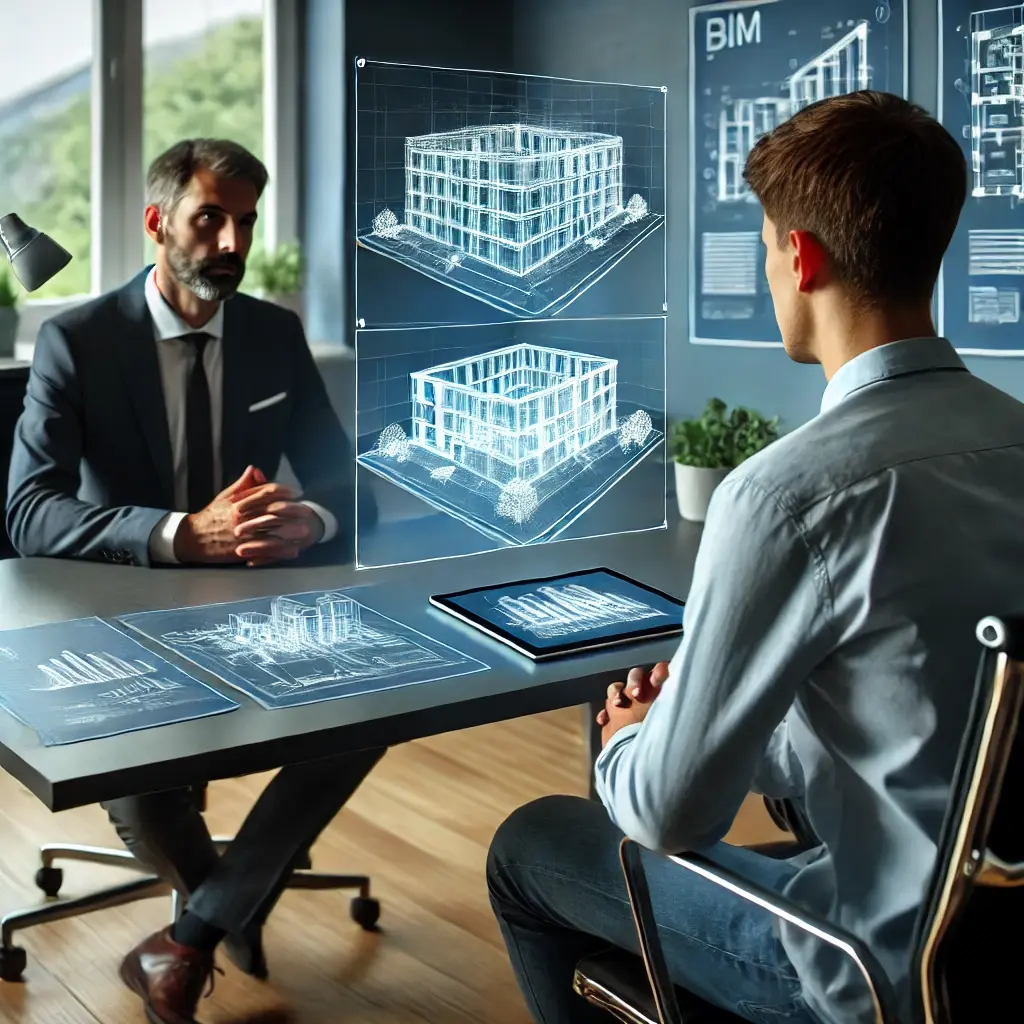
To put simply, a BIM architect is a qualified professional who uses Building Information Modelling as a complete project lifecycle environment; not just a drafting tool.
In 2026, the role goes beyond 3D modelling and data management in platforms such as ArchiCAD or Revit. It includes translating client Employer’s information Requirements (EIRs) into a BIM Execution Plan (BEP) and cloud collaboration through Common Data Environments (CDEs).
As a BIM architect, you will also be integrating clash detection, energy analysis and construction sequencing into the live model.
This is exactly why interviewers today expect very strong communication as well as problem-solving skills in addition to technical expertise.
Master BIM and Elevate Your Career – Enroll Today!
Stay ahead in the construction and design industry with our comprehensive BIM Course! Learn Building Information Modeling (BIM) from experts, gain hands-on experience with top software, and boost your career prospects. Join now and become a certified BIM professional!
Know MoreWhat Recruiters Look for in 2026
Before diving into the questions, here’s what modern AEC firms prioritize:
- Software fluency: Revit Architecture, Navisworks, Solibri, Dynamo
- Standards knowledge: ISO 19650, BEP, LOD frameworks, EIRs
- Collaboration mindset: CDE workflows, multi-discipline coordination
- Sustainability & AI: Energy modeling, generative design, automated clash checks
- Soft skills: Stakeholder communication, version control discipline, non-technical explanations
BIM Architect Interview Questions and Answers
Beginning with something to be thorough with and so in detail:
1. What is BIM, and why does it matter for architects today?
BIM is a data-rich 3D modeling process where engineers, architects, and contractors collaboratively analyze, design, and manage buildings across their entire lifecycle.
Context: It replaces isolated 2D drawings with a single, shared intelligent model that carries geometry, materials, costs, and performance data.
Proof: Studies consistently show BIM adoption reduces rework and on-site errors significantly, and in 2026 it also underpins digital twin and sustainability reporting workflows.
Interview-Ready Answer:
BIM is the backbone of modern architecture. Instead of disconnected 2D drawings, architects build a live 3D model that carries costs, geometry, and performance data. This means better coordination, fewer site surprises, and more informed sustainability decisions from concept to handover.
2. How does BIM differ from traditional CAD?
| Aspect | Traditional CAD | BIM (2026) |
| Core focus | 2D drafting | 3D model with embedded data |
| Collaboration | Separate discipline files | Shared cloud model with version control |
| Changes | Manual, error-prone | Parametric — updates propagate automatically |
| Lifecycle use | Design & documentation | Design, construction, cost, FM, and digital twins |
Interview-Ready Answer:
CAD is drawing structures digitally whereas BIM is building a digital twin. In CAD, moving a wall means manually updating every plan, section, and schedule. In BIM, that change propagates everywhere automatically, saving time and reducing costly errors.
3. What are LOD and BIM Levels, and how do they affect your work?
LOD (Level of Development) defines model detail at each project stage; BIM Levels describe process maturity.
Context: LOD ranges from 100 (concept massing) through 500 (as-built verified model). BIM Levels range from 0 (2D CAD, no collaboration) to Level 3 (fully integrated, cloud-based, real-time).
4. Which BIM software and tools are you comfortable with?
Revit Architecture for modelling, Navisworks or Solibri for coordination, and BIM 360 / Autodesk BIM Collaborate for cloud-based workflows.
Interview-Ready Answer:
Primarily I prefer Revit Architecture for documentation and modelling. For clash detection I use Navisworks, and for cloud collaboration I use Autodesk BIM Collaborate. I also use Dynamo to automate repetitive tasks like tagging and view generation on large projects.
5. How do you ensure BIM model accuracy and consistency?
By establishing clear naming conventions, organizing work sets properly, and running regular clash detection and model audits.
Interview-Ready Answer:
I start with strict standards such as how we name families, views, and levels. Keeping work sets organized so teams work on separate parts without overloading one file, running regular Navisworks clash checks, and cross-checking key drawings against the model at every milestone.
6. How do you perform clash detection in a BIM workflow?
Clash detection is a rules-based, scheduled process – not a one-time event – using tools like Navisworks, Solibri, or BIM 360 Issues.
Context: It involves exchanging model files across disciplines, defining soft/hard/clearance clash rules, logging issues with screenshots, and tracking resolution before each milestone.
7. What are the key elements of a BIM Execution Plan (BEP)?
A BEP is the project’s BIM rulebook. It defines roles, LODs, collaboration workflows, naming conventions, and QA/QC processes.
Interview-Ready Answer:
I think of the BEP as the project’s BIM constitution. It states what the client expects – deliverables, LODs, data formats, timelines – and how all teams work together. A clear BEP from day one reduces conflicts, especially when multiple consultants and contractors are involved.
8. How do you stay compliant with ISO 19650?
ISO 19650 governs information management across an asset’s lifecycle, centred on a Common Data Environment as the single source of truth.
Interview-Ready Answer:
I set up a CDE with a structured folder hierarchy and enforce naming and versioning rules from the BEP. Every file uses proper status codes such as draft, issued for review, approved for construction, so the project stays audit-ready and FM teams can pick up clean data at handover.
9. What is COBie, and why does it matter?
COBie (Construction-Operations Building Information Exchange) is a structured data format for handing over asset information from the construction team to facility managers.
Interview-Ready Answer:
COBie replaces loose PDFs and spreadsheets with a searchable database of equipment, warranties, and maintenance schedules. We populate key parameters in Revit — manufacturer, warranty dates, maintenance intervals — and export in COBie format, so the FM team can import it directly into their CAFM system.
10. How can BIM support sustainability and green building design?
BIM models connect to energy analysis tools like Insight, IESVE, or EnergyPlus to simulate energy loads, daylight, and carbon impact from the early design stages.
Interview-Ready Answer:
From concept stage, we can link the Revit model to energy tools and test glazing types, shading strategies, and insulation levels. We also track material quantities and carbon impacts, which helps propose more sustainable options. BIM makes sustainability evidence-based, not an afterthought.
|
Engineering Upskilling Courses
|
| MEP Course |
| BIM Course |
| Quantity Surveyor Course |
| Structural Design Course |
| MEP QS Course |
11. How do digital twins relate to BIM in 2026?
BIM is the foundation of a digital twin. It supplies the asset data, geometry, and relationships; IoT sensors and building management systems then feed real-time performance data into that twin.
Interview-Ready Answer:
I think of BIM as the building’s birth certificate and the digital twin as its living profile. The twin feeds real-world data — energy, temperature, occupancy — back into the model, letting facility managers anticipate issues, optimize HVAC schedules, and measure actual performance against design intent.
12. What role does AI play in BIM workflows today?
In 2026, AI will be actively used for automated clash prioritization, generative design, and BIM data quality checks – handling repetitive tasks so architects can focus on design thinking.
Interview-Ready Answer:
AI tools can scan thousands of potential clashes and flag only the critical ones, or suggest MEP routing alternatives. Generative design lets us explore layouts that maximize daylight or minimize energy use based on set constraints. I see AI as a powerful assistant, not a replacement, for the architect.
13. How do you handle 4D and 5D BIM?
4D links the model to the construction schedule to visualize phasing; 5D extracts quantities and links them to cost databases for real-time cost control.
Interview-Ready Answer:
With 4D, we can literally watch how the building rises over time and spot scheduling bottlenecks – like too many trades in the same zone at once. 5D takes it further by linking quantities to unit rates, so we can track cost impacts of design changes in real time. Together, they make decision-making far more proactive.
14. How would you handle a BIM model falling behind construction progress?
First, identify why the divergence happened. Then capture all on-site changes as markups and RFIs while pushing for a clearer model-update schedule going forward.
Interview-Ready Answer:
Sitting with the site team and project manager to understand where the gap started would be the first step. Capturing all changes as markups, prioritize updating critical areas like structural connections, and assign a model owner per discipline is important. The goal is making the model a reliable reference again, not an afterthought.
15. How do you coordinate with structural, MEP, and contractor teams using BIM?
Effective BIM coordination starts with a clear BEP that defines roles, LODs, and file exchange protocols, supported by regular coordination meetings inside a Common Data Environment.
Context: The BIM architect acts as the central connector ensuring that structural, MEP, and contractor models are always aligned, clashes are tracked, and everyone is working from the latest version.
Quick Tips to Nail Your BIM Architect Interview
- Tell stories. Structure your project examples as: Problem → Solution → Outcome.
- Simplify your language. Practice explaining BIM concepts as if speaking to a non-technical client.
- Ask smart questions. Prepare 2 to 3 questions for the interviewer about their BIM culture, tools, and roadmap.
- Show your portfolio. Include coordination drawings, clash reports, sustainability analysis, and digital-twin examples where possible.
Get Career-Oriented BIM Certification Course with Expert Mentors! Get a free demo here!
Master BIM and Elevate Your Career – Enroll Today!
Stay ahead in the construction and design industry with our comprehensive BIM Course! Learn Building Information Modeling (BIM) from experts, gain hands-on experience with top software, and boost your career prospects. Join now and become a certified BIM professional!
Know MoreConclusion
To put it shortly, when you appear for BIM architect interviews don’t just expect to get questions around Revit shortcuts.
Firms are looking for professionals who can lead multi-discipline coordination, grasp information management standards and are aware of how AI and digital twins are reshaping the construction industry.
Strategic thinking is the key that makes your technical knowledge impactful. Go through your portfolio and frame your thoughts on the project experiences clearly. Presenting yourself as a well-rounded BIM professional can make you stand out and be the right pick.
Master BIM and Elevate Your Career – Enroll Today!
Stay ahead in the construction and design industry with our comprehensive BIM Course! Learn Building Information Modeling (BIM) from experts, gain hands-on experience with top software, and boost your career prospects. Join now and become a certified BIM professional!
Know MoreFrequently Asked Questions
Why is BIM important in architecture?
BIM improves design accuracy, reduces errors, enhances collaboration, and saves time and costs in construction projects.
Can BIM be used for renovation projects?
Yes, BIM is great for renovations! It helps in documenting existing structures and planning modifications efficiently.
Is BIM only for large projects?
No! BIM is useful for small, medium, and large projects, improving efficiency at all scales.
How does BIM help in sustainability?
BIM helps analyze energy efficiency, daylighting, material use, and carbon footprint for green building design.
Can BIM detect construction issues before building starts?
Yes! BIM tools like Navisworks identify clashes between components (e.g., pipes going through walls), preventing costly errors.