Table of Contents
Choosing the right education for your child early can be confusing for many parents. In India there are two common options, Montessori schooling and Anganwadi centres. Both system could focus on a child’s growth and development, they differ in teaching style, environment, and their approach.
The Montessori education encourages kids to learning through different activities, while the Anganwadi focus more on basic care, nutrition, and early learning as part of government programs.
Understanding these differences can help you make a good choice for your child’s future with these Montessori education and Anganwadi centres.
Key Takeaways:
- Should understand the purpose of both Montessori and Anganwadi
- Montessori system has an independent, activity-based learning system
- Anganwadi supports the basic education along with nutrition and care
- The infrastructure and training methods differ in each system
- Choose based on your child’s needs, comfort, and your budget
Register for the Entri Elevate Montessori Teacher Training Program! Join Now!
What is Montessori Education?
The Montessori education is developed by Maria Montessori, it is an advanced child-focused learning method. Also it allows children to learn with self confidence through doing different activities and real-life experiences.
1. The Child-focused Learning
The Montessori education is focuses on the child’s interests.
- Every child learns differently, and this technique respects that.
- The children feel free to choose which activities they want to do.
- This will make learning more exciting and less annoying.
2. Learning by Doing activities
Children learn through doing different activities instead of just listening.
- They use special teaching materials like puzzles, beads, and blocks.
- This allows them to understand the concepts without difficulty.
- Also this improves memory and real-world understanding.
3. Role of the Teacher
Teachers in the Montessori school are known as guides.
- They observe the children and support them when they needed.
- They do not force or pressure the children.
- They would create a peaceful learning environment.
4. Mixed-Age Classrooms
Here children of different ages will learn together.
- Younger ones may learn by watching the elder children.
- The elder children may develop leadership and helping skills.
- This builds confidence with teamwork.
5. Focus on the Life Skills
The Montessori also teaches daily life skills.
- Daily activities like cleaning, dressing, and organizing are included in this part.
- Children become independent and more responsible.
- These skills are useful in their daily life.
6. Freedom with Discipline
Children are given freedom, but with some limits.
- Every child can choose their favourite activities but must follow the basic rules.
- This would teaches self-control and responsibilities.
7. The Holistic Development
Montessori education will support overall growth of children.
- It improves child’s thinking, creativity, and their problem-solving skills.
- This also support their emotional and social development.

What is Anganwadi?
1: What is the primary focus of the first plane of development in the Montessori method?
An Anganwadi is a small childcare and learning center within the villages and local communities across India. It will be the part of a government program like the Integrated Child Development Services, which aims to help the young children, pregnant women, and mothers.
Understanding of Anganwadi
Anganwadi centers are places where young children (usually under the age of 6) come to learn basic in a friendly and peaceful environment. These centers also take care of the childs nutrition and the health needs.
What Happens in an Anganwadi?
- The Basic Learning: Every children easily learn alphabets, numbers, rhymes, and stories. This will prepares them for school in a gentle way.
- The Nutrition Support: Every children get healthy meals or snacks. This helps in their proper growth and prevents the malnutrition.
- Health Check-ups: The regular health check-ups, vaccinations, and weight monitoring are done to keep children healthy.
- The Care and Safety: Each children are looked after in a safe and caring environment.
Who Runs an Anganwadi?
Each anganwadi is managed by a trained worker called an Anganwadi worker with a helper.
- The anganwadi worker will take care of children’s learning, food, and their health needs.
- They also guide every mothers about their child’s care and nutrition.
Why is Anganwadi Important?
- It will supports the children from a very young age.
- It helps to improve the health and nutrition in the community.
- It prepares every children for their formal schooling.
- It supports the working parents, especially in the rural areas.
Key Differences Between Montessori and Anganwadi
When choosing between the Montessori and Anganwadi, it helps to understand how they differ in their approach and purpose.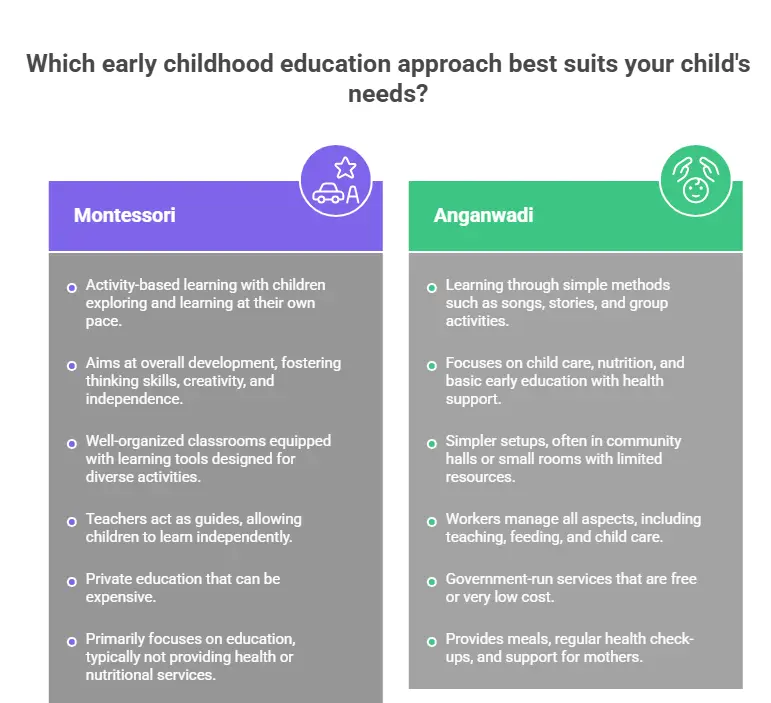
1. Their Learning Approach
Montessori classrooms focus on activity-based learning. Children explore, play, and learn at their own pace using special materials. In Anganwadi centers, learning is more basic. Children are taught through simple methods like songs, stories, and group activities.
2. Main Purpose
Montessori mainly aims at overall development—thinking skills, creativity, and independence. While the anganwadi centers focus more on child care, nutrition,and basic early education along with the health support.
3. Classroom Setup
Montessori schools usually have well-organized classrooms with learning tools designed for different activities. While the anganwadi centers are simpler and may run in a small rooms with limited resources.
4. Role of Teachers
In Montessori schools, the teachers guide children and let them learn on their own. In Anganwadi, workers handle everything from teaching to feeding and taking care of every children.
5. Cost and Accessibility
Montessori education is private and can be more expensive. While the anganwadi services are run by the government and are either free or very low cost, making them accessible to all the families.
6. Focus on Health and Nutrition
This would be the big difference. Anganwadi centers provide meals, regular health check-ups, and support for every mothers. While the montessori schools usually focus only on the education and do not provide such services.
Get Certified & Start Your Montessori Career
Montessori Teacher Training Course by Entri App: Gain expert skills, earn certification, and kickstart your teaching career.
Join Now!Curriculum and Teaching Methods
Understanding how children are taught in Montessori and Anganwadi is very important and can make your decision much easier. Both has its own value, but follow their own different styles.
Montessori Curriculum
The Montessori curriculum is well-planned but it is flexible. It mainly focuses on helping children learn step by step through real life experiences.
What children learn here:
- Practical life skills: Activities like pouring water, buttoning clothes, cleaning and more.
- Language: Like learning letters, sounds, reading, and writing.
- Math: Counting numbers, and soving simple problems using some objects.
- Activities: Identifying shapes, colors, sizes, and textures.
Teaching method:
- Children choose activities primarily based on their interests.
- Learning happens through simple material, not just books.
- Teachers guide, not control and watch.
- Every child learns at their own pace.
Anganwadi Curriculum
Every anganwadi follows a simple and basic curriculum basically designed for early childhood care and the development.
What children learn:
- Basic education: Like Alphabets, numbers, rhymes, and simple words.
- Social habits: Sharing, playing together, and the basic manners.
- Health awareness: Cleanliness and the hygiene practices.
Teaching method:
- Learning is done by singing songs, sharing stories, and group play.
- Doing simple activities and easy to follow.
- There is no strict syllabus or pressure on their performance.
- They focus more on overall care than detailed academics.
Key Differences
- Montessori is structured and activity-based and the Anganwadi is simple and focusing on childs care.
- Montessori uses special learning materials and the Anganwadi uses basic tools.
- Montessori supports individual learning and the Anganwadi focuses mainly on group learning.
- Montessori focuses more on child’s skills and the Anganwadi balances learning with nutrition and caring.
Infrastructure and Learning Environment
Where a child learns, plays a huge role in how they feel comfortable and safe. So, Montessori schools and Anganwadi facilities are pretty unique in terms of their layout and environment.
Montessori Infrastructure
These classrooms are specifically designed to facilitate independent learning. Everything arranged in a thoughtful manner inside a room. The Montessori classroom looks like a nicely organized area where children can explore and analyze without confusion or any distraction.
What you will usually see:
- Child-sized furniture that is easy to use for every children.
- Open shelves with easily accessible learning materials.
- Clean, quiet, and well-designed classrooms.
- Different areas for each activities like reading, math, and play.
Learning environment:
- Children are free to move around and can choose their favourite activities.
- The atmosphere is calm and peaceful.
- Each item kept in a fixed place, which helps children stay organized.
- The setup may encourages child’s focus and self-discipline.
Anganwadi Infrastructure
Anganwadi centers are usually accessible and basic. They are usually placed in a building, small rooms, or local spaces. The anganwadi center is a simple and caring space where the younger ones feel safe even though there are not many facilities.
What you will usually see:
- Basic seating is there, like mats or small chairs.
- Limited learning materials such as charts, toys, and books.
- A shared space for learning, playing, and eating.
- Simple kitchen or storage area for food distribution.
Learning environment:
- Children learn and play together in groups.
- The space may be lively and active.
- The focus is more on care, safety, and comfort.
- Facilities may vary depending on the location.
Key Differences of Montessori and Anganwadi Educations
- Montessori classrooms are well-equipped and the Anganwadi centers are simply maintained.
- Montessori focuses on an organized learning spaces and the Anganwadi uses a shared spaces.
- Montessori offers a calm environment and the Anganwadi may be more active and social.
- Montessori materials are specially designed and the Anganwadi uses simple things.
Teacher Qualifications and Training
The people who train and care for younger ones play a big role in their early education. Montessori schools and anganwadi centers follow different system in terms of teacher training and schooling.
Montessori Teacher Qualifications
The montessori teachers are particularly good at following a child-centered approach. Their job is not just to teach, but to guide the children on their learning journey. Montessori teachers are skilled in their curriculum. They allow younger ones to discover and analyze on their own, while gently helping them when desired.
What qualifications they usually have:
- Should have a certification or diploma in Montessori Teacher Training
- Should have basic education like a degree or higher secondary qualification
- Should have the knowledge of child development and their learning methods
Training focus:
- Understanding how the children learn at different stages.
- Learning how to use the Montessori materials correctly.
- Observing the children and supporting in their interests.
- Creating a positive classroom environment,
Anganwadi Worker Qualifications
Anganwadi workers are community-based caregivers who help every child and mother. Their role is teaching, caring, giving nutrition and child’s health awareness. Anganwadi teacher are concerned helpers who keep needs of children every day with the primary choice.
What qualifications they usually have:
- Minimum education of anganwadi worker will be 10th or 12th passed (it may varies by state).
- Selected from the local community.
- Basic training provided by the government.
Training focus on:
- The child care and their early learning basics.
- Child’s nutrition and meal planning.
- The health awareness and hygiene practices in children.
- Supporting every pregnant women and mothers.
Key Differences of Montessori Teacher and Anganwadi Worker
- The montessori teachers have specialized training and the Anganwadi workers receive basic government training.
- Montessori focuses on simple learning methods and the Anganwadi focuses on the child care, health, and nutrition.
- Montessori teachers guide learning and the Anganwadi workers manage the multiple roles.
- Montessori training is more detailed and the Anganwadi training is based on practical.
Get Certified & Start Your Montessori Career
Montessori Teacher Training Course by Entri App: Gain expert skills, earn certification, and kickstart your teaching career.
Join Now!Which One is Better for Your Child?
There is no “great” option for every child. What you choose depends on your needs, your family situation, and your expectations from early education.
Choose Montessori if:
- You want a structured learning environment
- Your child enjoys exploring and learning independently
- You are looking for skill development like problem-solving and creativity
- You can afford higher fees
- You prefer a calm and organized classroom setting
Montessori education is a good option if your child need to build strong learning skills and confidence from their early age.
Choose Anganwadi if:
- You are looking for a low-cost or free option
- You want support for nutrition and health care
- Your child needs a safe and caring place while you work
- You prefer a nearby option
- You want your child to learn the basic skills in a simple way
Anganwadi is a good option if you want care, including food, health support, and the basic learning.
Register for the Entri Elevate Montessori Teacher Training Program! Join Now!
Conclusion
By choosing between Montessori and Anganwadi is not about which one is better for your child, but about what perfect for their future. Both options were support early childhood in their own ways and play an important role in a their growth and development.
The montessori education will focuses more on the structured learning, independence, and their skill development. This is a good option if you want your child to explore, think, and learn in a well-planned environment. While Anganwadi centers focus on the basic learning along with the care, nutrition, and health support. Which is very helpful for families looking for an affordable and nearby option.
Get Certified & Start Your Montessori Career
Montessori Teacher Training Course by Entri App: Gain expert skills, earn certification, and kickstart your teaching career.
Join Now!Frequently Asked Questions
What is the main difference between Montessori and Anganwadi?
The main difference lies in their purpose and approach. Montessori focuses on structured learning, independence, and skill development through activities. Anganwadi focuses on basic education along with nutrition, health care, and overall child welfare.
Which is better for early learning, Montessori or Anganwadi?
It depends on your child’s needs. Montessori is better for developing learning skills and independence, while Anganwadi is better for basic education, care, and health support
Is Montessori education expensive compared to Anganwadi?
Yes, Montessori schools are private institutions and usually have higher fees. Anganwadi centers are government-supported and are free or very low cost, making them more affordable for many families.
What age group is suitable for Montessori and Anganwadi?
Both Montessori and Anganwadi are meant for young children, usually below 6 years. Montessori typically starts from around 2 or 3 years, while Anganwadi may include younger children and even infants in some cases.
Do Anganwadi centers provide education like schools?
Anganwadi centers provide basic early learning such as alphabets, numbers, rhymes, and social skills. However, they are not as structured or detailed as formal school education like Montessori.
Are teachers in Montessori and Anganwadi trained differently?
Yes, Montessori teachers receive specialized training in child-centered learning methods. Anganwadi workers receive basic training focused on child care, nutrition, and health awareness.
How do I choose the right option for my child?
You can choose based on your priorities. If you want structured learning and can afford it, Montessori is a good option. If you need affordable care with basic learning and health support, Anganwadi is a suitable choice. Always consider your child’s comfort and happiness before deciding.