Denim Stitching Techniques shape strong and stylish garments. They help beginners create neat and lasting seams. Denim fabric is thick and tightly woven. This makes simple stitching slightly challenging. Good techniques improve accuracy and stitch strength. They also reduce common sewing mistakes. Learning basics builds sewing confidence quickly. It prepares beginners for creative denim projects.
Denim garments are worn daily and frequently washed. Strong stitching helps them last much longer. Proper methods maintain comfort and perfect fit. They also enhance the overall garment appearance. Clear steps make learning simple and enjoyable. Practice improves speed, control, and stitch quality. Each project builds better sewing understanding. This guide supports confident denim stitching success.
Denim is a timeless and versatile fabric. It is widely used for clothing and accessories. People love denim for strength and style. It suits casual, formal, and everyday wear. Learning denim stitching opens many creative possibilities. It allows beginners to make durable handmade garments. It also supports simple repair and alteration projects. Proper knowledge ensures clean and professional stitching results.
Working with denim requires careful planning and preparation. The fabric thickness affects stitch quality and accuracy. Incorrect methods may cause uneven or weak seams. This often leads to fabric damage or discomfort. Correct techniques help manage fabric layers smoothly. They reduce machine strain and thread breakage. This ensures comfortable and long-lasting denim garments. Good preparation always improves final stitching quality.
Beginners should start with basic denim sewing skills. Simple stitches help build confidence and control. Practice develops hand coordination and fabric handling ability. It also improves understanding of stitch behavior. Gradual learning prevents frustration and common beginner mistakes. Each completed project improves technical sewing understanding. This makes advanced techniques easier to master later. Patience supports consistent improvement and steady skill growth.
Denim projects offer learning and creative satisfaction. They allow experimentation with textures and finishes. Beginners can create skirts, bags, jackets, and jeans. Each project teaches important sewing lessons. Stitching denim builds discipline and creative expression. It also encourages problem-solving and design thinking. These skills improve overall tailoring abilities. They prepare beginners for professional garment construction.
Builds strong sewing foundation and essential fabric knowledge.
Improves stitch accuracy and seam durability.
Enhances confidence in handling thick materials.
Encourages creative garment design and customization.
Supports sustainable fashion through clothing repairs.
Saves tailoring costs with home alterations.
Expands opportunities for hobby and business projects.
Develops patience, focus, and fine motor skills.
Understanding denim stitching basics creates sewing confidence. It helps beginners approach projects without hesitation. Clear techniques simplify complex stitching processes. They reduce common fabric handling difficulties. With proper guidance, denim sewing becomes enjoyable. Each successful project increases motivation and learning interest. This journey begins with mastering essential stitching fundamentals.
Why Denim Requires Special Stitching Techniques
Denim is not an ordinary fabric. It is thicker than most common materials. Its weave is dense and tightly packed. This structure increases fabric strength and durability. However, it also increases stitching difficulty. Regular sewing methods often fail on denim. Special stitching techniques ensure better sewing results. They improve seam strength and stitch appearance.
Denim garments experience frequent daily use. They face constant movement and stretching stress. Poor stitching can easily cause seam damage. Strong stitching prevents early garment failure. Special techniques support long-term fabric performance. They maintain garment comfort and perfect fitting. They also improve overall stitching reliability. This makes denim suitable for regular wear.
Fabric Thickness and Layer Management
Denim fabric is naturally thick. Multiple layers increase stitching complexity. Common garment areas contain several overlapping layers. These areas include hems, waistbands, and pockets. Machines struggle to sew through stacked layers. Needles may bend or break easily. Threads may also snap unexpectedly. Special techniques help manage fabric thickness.
Careful layer handling improves stitch consistency. Proper tools prevent fabric shifting and distortion. Correct methods ensure smooth needle movement. This avoids uneven stitching lines and skipped stitches. Layer control supports professional garment construction. It also protects sewing machine components.
Key challenges of thick denim layers:
Difficult needle penetration
Increased thread tension
Machine motor strain
Fabric shifting during stitching
Effective layer management solutions:
Using denim needles
Adjusting stitch length
Slowing stitching speed
Applying steady fabric guidance
Dense Weave and Needle Resistance
Denim has a tightly woven structure. This increases needle resistance during sewing. Standard needles often fail to penetrate easily. This causes skipped stitches and uneven seams. Strong needles are required for smooth stitching. They reduce friction and improve fabric penetration. This ensures accurate and clean stitch formation. Special stitching methods address this resistance.
Denim fibers grip thread more firmly. This increases thread tension and breakage risks. Proper tension adjustments prevent frequent snapping. Balanced tension improves stitch smoothness and consistency. Correct handling reduces sewing frustration significantly. It also improves garment durability and comfort.
Problems caused by dense weave:
Skipped stitches
Needle bending
Thread breakage
Fabric puckering
Solutions using special stitching techniques:
Using sharp heavy-duty needles
Adjusting machine tension settings
Increasing stitch length
Stitching at slower speeds
High Stress Areas in Denim Garments
Denim clothing experiences repeated physical movement. Stress concentrates around seams and joint areas. Pockets, belt loops, and seams face heavy pressure. Weak stitches fail quickly under constant strain. Special stitching reinforces these high-stress zones. This prevents seam splitting and fabric tearing. Strong stitches increase garment reliability significantly. They ensure long-term wear comfort.
Reinforced stitching adds structural garment stability. It supports natural body movement. It also maintains garment shape over time. This prevents sagging and seam deformation. Durable seams enhance garment professional appearance. They also increase overall customer satisfaction.
Common high-stress areas:
Pocket corners
Belt loop attachments
Inner leg seams
Waistband joins
Reinforcement techniques:
Bar tack stitching
Double stitching
Backstitch reinforcement
Flat-felled seam construction
Stitch Visibility and Aesthetic Importance
Denim garments often showcase visible stitching. This stitching forms part of garment design. Decorative seams enhance garment visual appeal. Uneven stitches reduce garment aesthetic quality. Special techniques maintain clean decorative lines. They improve garment presentation and market value. Proper stitching adds professional finishing touches. This increases fashion appeal significantly.
Contrasting thread often highlights denim seams. This demands high stitch precision and accuracy. Minor errors become immediately noticeable. Special methods ensure uniform stitch spacing. They create consistent decorative seam patterns. This enhances garment style and visual balance.
Design-focused stitching requirements:
Uniform stitch spacing
Straight seam alignment
Balanced thread tension
Clean fabric edges
Fabric Movement and Feeding Challenges
Denim resists smooth machine feeding. Its thickness slows fabric movement. Multiple layers worsen feeding resistance. This causes uneven stitch lengths. It also leads to fabric shifting problems. Special stitching techniques improve fabric control. They ensure steady feeding through machine components. This improves stitching accuracy significantly.
Balanced fabric feeding prevents stitch distortion. It also prevents needle deflection issues. Consistent feeding improves seam strength. This results in smoother stitching flow. It also reduces machine motor stress.
Common feeding challenges:
Fabric slippage
Uneven stitch lengths
Layer shifting
Needle deflection
Effective feeding solutions:
Using walking foot
Applying even hand pressure
Maintaining steady sewing speed
Supporting fabric weight properly
Durability Expectations of Denim Garments
Denim garments are expected to last long. Users demand high durability and strength. Weak seams reduce garment life significantly. Special stitching ensures lasting garment performance. It supports frequent washing and heavy usage. Durable stitches prevent seam separation. They maintain garment integrity and structure. This builds user trust and satisfaction.
High durability also supports sustainable fashion goals. Long-lasting garments reduce textile waste. They promote responsible clothing consumption. Strong stitching supports garment repair and reuse. This extends clothing life cycle effectively.
Comparison Table: Regular vs Special Denim Stitching
Feature
Regular Stitching
Special Denim Stitching
Needle Type
Standard
Heavy-duty
Stitch Strength
Moderate
High
Fabric Penetration
Difficult
Smooth
Seam Durability
Low
High
Stress Resistance
Weak
Strong
Visual Appearance
Basic
Professional
Machine Strain
High
Controlled
Garment Longevity
Short
Extended
Summary of Why Special Techniques Matter
Special stitching ensures garment durability. It improves seam strength and appearance. It reduces sewing machine strain. Special technique prevents frequent stitching errors. It improves fabric handling and control. It supports professional garment construction. These advantages justify learning special techniques. They make denim stitching efficient and reliable.
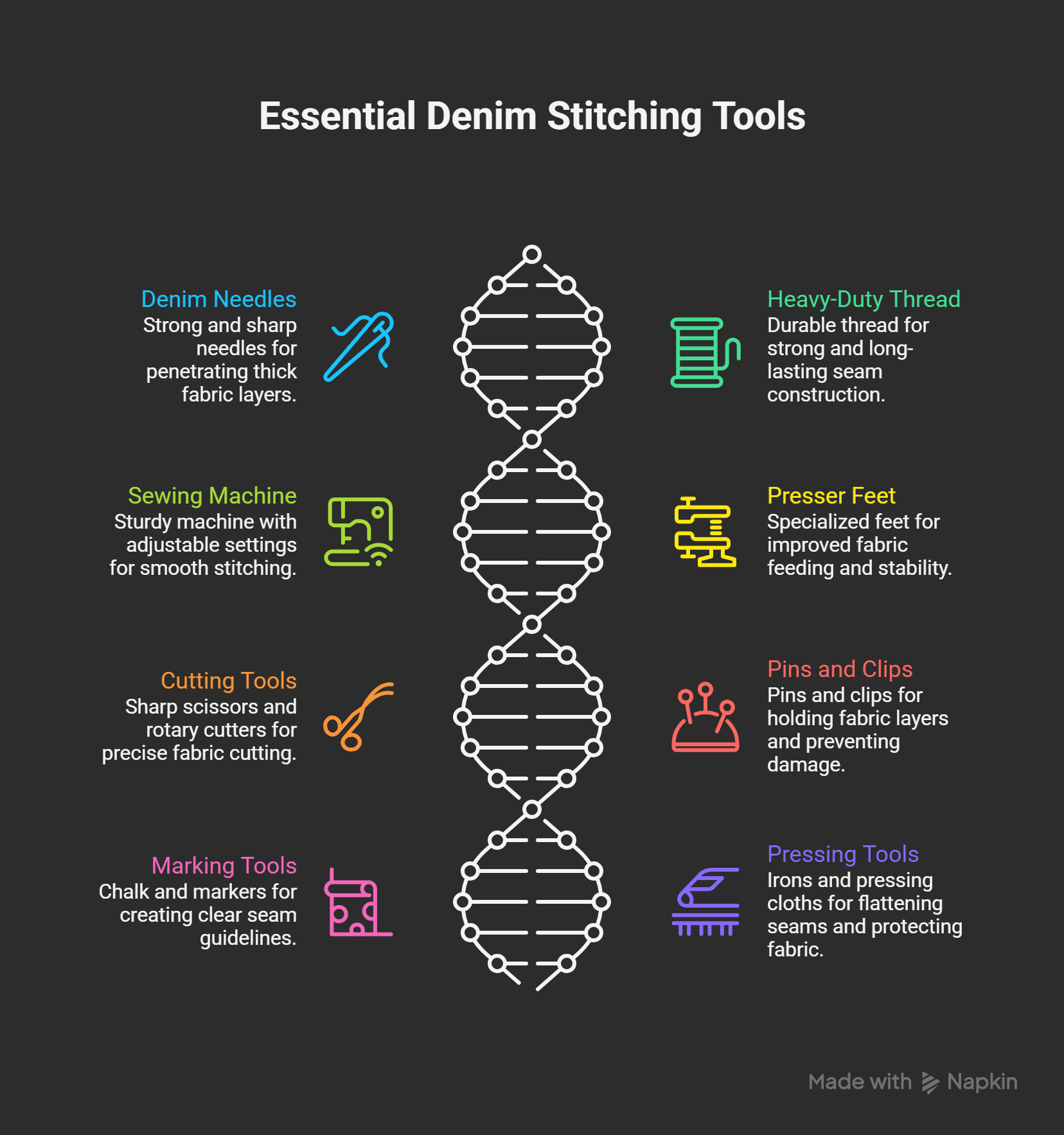
Denim stitching requires proper tools and suitable materials. Correct tools improve stitching accuracy and sewing comfort. They also reduce fabric damage and machine stress. Good materials ensure strong and long-lasting seams. Using incorrect tools often causes stitching difficulties. This leads to frustration and poor garment quality. Proper selection supports smooth and professional stitching results. Each tool plays a specific and important role.
Denim Needles
Denim needles are specially designed for thick fabrics. They have strong shafts and sharp pointed tips. These features allow easy penetration through dense material. They reduce skipped stitches and needle bending. Correct needle size improves stitch consistency and strength. It also protects sewing machine internal components.
Denim needle sizes depend on fabric thickness. Thicker fabrics require larger needle sizes. Correct size selection prevents fabric damage and thread breakage. It ensures smooth and uninterrupted sewing flow.
Recommended needle sizes for denim:
90/14 for medium-weight denim
100/16 for heavy-weight denim
110/18 for extra thick layers
Benefits of using denim needles:
Smooth fabric penetration
Reduced needle breakage
Improved stitch accuracy
Better seam strength
Heavy-Duty Sewing Thread
Denim requires strong and durable sewing thread. Standard thread often breaks under fabric tension. Heavy-duty thread withstands thick fabric resistance. It supports long-lasting and secure seam formation. Strong thread also enhances garment durability.
Polyester thread offers high tensile strength. Cotton-wrapped polyester provides smooth stitch appearance. Topstitching thread adds decorative and bold seam effects. Proper thread choice improves stitch consistency and finish.
Heavy-duty sewing machines perform better with denim. They manage fabric resistance efficiently. They also maintain consistent stitch quality. Good machines protect internal components from strain.
Important sewing machine features for denim:
Adjustable stitch length
Adjustable thread tension
Strong motor capacity
Multiple stitch options
Advantages of proper machine selection:
Smooth fabric feeding
Reduced needle breakage
Consistent stitch formation
Enhanced sewing comfort
Presser Feet and Specialized Attachments
Presser feet control fabric movement during stitching. Different presser feet support specific sewing tasks. Walking feet help feed thick fabrics evenly. They prevent layer shifting and uneven stitches. Denim feet improve fabric grip and stability.
Zipper feet help stitch near thick seam edges. Edge stitching feet support decorative topstitching. Proper presser foot selection improves stitch precision. It also enhances seam consistency and alignment.
Useful presser feet for denim stitching:
Walking foot
Denim foot
Zipper foot
Edge stitching foot
Benefits of specialized presser feet:
Smooth fabric feeding
Improved stitch accuracy
Reduced fabric shifting
Better seam appearance
Fabric Cutting Tools
Sharp cutting tools ensure clean fabric edges. Clean edges support accurate seam alignment. Dull tools cause fabric fraying and uneven cuts. This reduces stitching quality and garment appearance. Proper cutting improves garment construction accuracy.
Fabric scissors provide precise cutting control. Rotary cutters offer smooth and fast cutting action. Cutting mats protect surfaces and improve safety. Correct tools improve measurement accuracy and fabric handling.
Essential cutting tools:
Sharp fabric scissors
Rotary cutter
Cutting mat
Measuring tape
Advantages of proper cutting tools:
Clean fabric edges
Accurate pattern cutting
Reduced material waste
Improved garment fit
Pins, Clips, and Fabric Holding Tools
Denim thickness makes pinning difficult. Standard pins may bend or break easily. Strong pins or fabric clips provide secure holding. They prevent fabric shifting during stitching. Stable fabric layers ensure accurate seam alignment.
Fabric clips reduce fabric puncture damage. They are safer for heavy fabric layers. Magnetic pin holders improve workspace organization. Proper holding tools enhance stitching efficiency.
Chalk pencils provide visible but removable marks. Washable fabric markers offer easy mark removal. Tailor’s chalk supports pattern and seam markings. Good marking improves garment measurement accuracy.
Effective denim marking tools:
Tailor’s chalk
Washable fabric markers
Chalk pencils
Tracing paper
Iron and Pressing Equipment
Pressing improves seam flatness and garment finish. Proper pressing enhances stitch appearance. Steam irons soften fabric fibers for shaping. Pressing also sets stitches firmly into place. This improves seam durability and neatness.
Pressing cloth protects fabric from heat damage. Tailor’s ham supports curved seam pressing. Clappers help set crisp seam edges. Good pressing improves garment professional appearance.
Essential pressing tools:
Steam iron
Pressing cloth
Tailor’s ham
Seam clapper
Comparison Table: Basic vs Denim-Specific Tools
Feature
Basic Sewing Tools
Denim-Specific Tools
Needle Type
Standard
Heavy-duty
Thread Strength
Medium
High
Fabric Holding
Regular pins
Fabric clips
Presser Foot
Standard
Walking foot
Cutting Accuracy
Moderate
High
Stitch Durability
Average
Excellent
Machine Strain
High
Low
Seam Finish
Basic
Professional
Summary of Tool Importance
Proper tools simplify denim stitching. They improve accuracy and garment durability. They reduce sewing effort and machine strain. Tools support professional-quality garment construction. Correct materials enhance stitch reliability and appearance. These tools build sewing confidence for beginners. They ensure enjoyable and successful denim projects.
Basic Denim Stitching Techniques for Beginners
Denim stitching requires learning simple and effective methods. These techniques help manage thick fabric layers smoothly. They improve stitch strength, neatness, and overall durability. Beginners should focus on mastering basic stitching foundations. Simple techniques reduce errors and improve sewing confidence. Each method supports professional-looking garment construction. Consistent practice improves speed, control, and accuracy. These techniques build a strong sewing foundation.
Straight Stitch for Seam Construction
Straight stitching forms the base of denim sewing. It joins fabric pieces into complete garments. This stitch creates clean and secure seam lines. Longer stitch length suits thick denim layers. Short stitches may cause fabric bunching. Balanced stitch length ensures smooth fabric movement.
Steady hand control improves stitch line accuracy. Slow sewing prevents needle deflection and thread snapping. Consistent pressure ensures uniform stitch formation. Proper guidance improves seam alignment.
Uses of straight stitch:
Joining garment panels
Creating side seams
Attaching waistbands
Constructing pockets
Benefits of proper straight stitching:
Strong seam structure
Clean stitch lines
Reduced fabric puckering
Improved garment durability
Topstitching for Strength and Decoration
Topstitching enhances garment appearance and durability. It adds visible decorative seam lines. This technique also strengthens seam edges. Contrasting thread improves visual appeal. Slow stitching ensures clean decorative lines.
Even spacing improves stitch consistency. Proper tension prevents loose or tight stitches. Accurate seam guidance ensures straight decorative lines. This improves garment professional finish.
Common topstitching areas:
Pocket edges
Waistbands
Yoke seams
Outer leg seams
Advantages of topstitching:
Enhanced garment strength
Decorative seam enhancement
Improved edge stability
Professional visual appeal
Flat-Felled Seam for Extra Strength
Flat-felled seams are strong and durable. They enclose raw edges within seam layers. This prevents fabric fraying and discomfort. Such seams are common in jeans construction. They provide clean internal garment finishing.
Careful folding ensures proper seam formation. Accurate stitching improves seam durability. Pressing enhances seam flatness and appearance. This technique supports long-lasting garment wear.
Flat-felled seam applications:
Inner leg seams
Side seams
Shoulder seams
Jacket seams
Benefits of flat-felled seams:
High seam durability
Clean garment interior
Reduced fabric fraying
Enhanced garment comfort
Zigzag Stitch for Edge Finishing
Zigzag stitching prevents raw edge fraying. It secures fabric edges effectively. This technique replaces serger machine finishing. Proper width selection ensures strong edge control. Correct length avoids excessive fabric gathering.
Bar tack stitching strengthens high-stress garment areas. It forms dense and compact stitch patterns. This prevents seam splitting and fabric tearing. Such stitches increase garment structural stability. They protect areas facing frequent movement.
Precise placement ensures effective reinforcement. Short and dense stitches increase holding strength. Consistent positioning improves garment balance. This technique supports long-term garment durability.
Common bar tack locations:
Pocket corners
Belt loop attachments
Zipper ends
Seam intersections
Benefits of bar tack stitching:
High stress resistance
Improved garment strength
Reduced seam failure
Enhanced durability
Backstitching for Seam Locking
Backstitching secures seam starting and ending points. It prevents stitches from loosening over time. This technique improves seam durability. It also enhances stitch line stability.
Short reverse stitches strengthen seam locking. Proper placement ensures neat seam appearance. This technique reduces thread unraveling. It supports long-lasting seam integrity.
Uses of backstitching:
Seam beginnings
Seam endings
Stress area reinforcement
Decorative stitch security
Proper Stitch Length Selection
Correct stitch length supports smooth denim sewing. Longer stitches suit thick fabric layers. Short stitches cause fabric puckering. Balanced length ensures clean stitch formation. It reduces needle penetration difficulty.
Stitch length adjustments improve seam strength. They also enhance garment comfort. Correct settings prevent fabric distortion. This improves overall stitching quality.
Recommended stitch lengths:
Denim Thickness
Stitch Length
Light-weight
2.8 – 3.0 mm
Medium-weight
3.0 – 3.5 mm
Heavy-weight
3.5 – 4.0 mm
Slow Stitching Speed Control
Slow stitching improves fabric handling accuracy. It prevents needle bending and breakage. Controlled speed ensures uniform stitch spacing. It also improves seam alignment.
Steady pace reduces sewing mistakes. It improves hand coordination and control. Consistent speed enhances stitch neatness. This supports professional garment construction.
Comparison Table: Common vs Denim Stitching Techniques
Feature
Common Stitching
Denim Stitching
Stitch Length
Short
Medium to long
Needle Type
Standard
Heavy-duty
Seam Reinforcement
Minimal
High
Stress Area Support
Basic
Strong
Stitch Durability
Moderate
High
Fabric Handling Control
Basic
Advanced
Garment Longevity
Average
Extended
Summary of Beginner Denim Stitching Techniques
Basic techniques improve denim sewing confidence. They enhance seam strength and garment appearance. They reduce stitching difficulties and machine strain. These techniques support professional garment finishing. Consistent practice improves speed and accuracy. Mastering basics simplifies advanced stitching methods. These techniques ensure durable and attractive denim garments.
Tips for Neat and Durable Denim Stitching
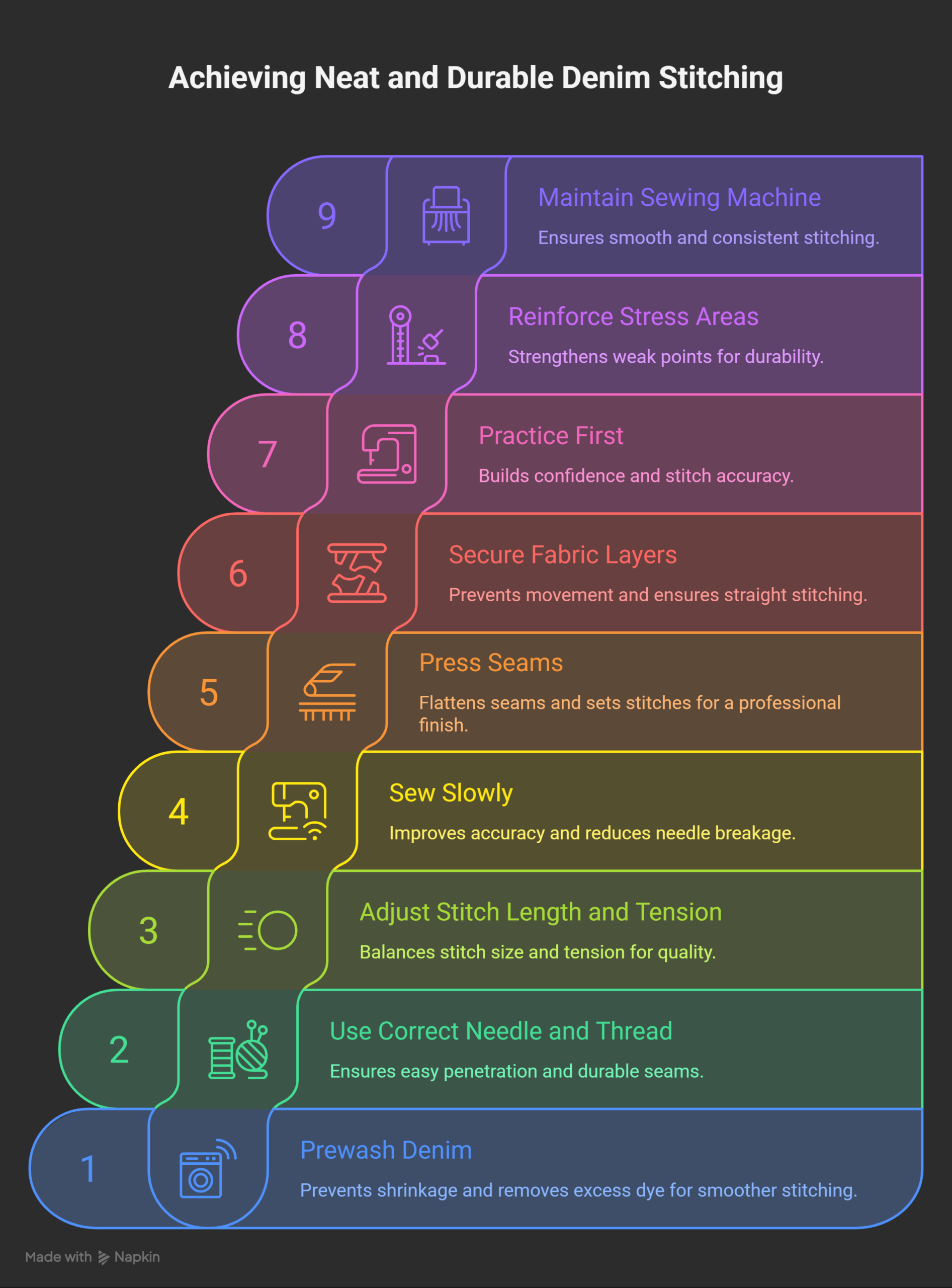
Neat and durable stitching improves denim garment quality. Good practices ensure strong seams and professional finishes. Proper handling prevents common stitching mistakes. Simple habits improve accuracy and long-lasting performance. Each tip supports smooth fabric management and stitch control. Consistent application builds sewing confidence and efficiency. These tips simplify denim stitching for beginners. They also enhance overall garment appearance.
Prewash Denim Before Stitching
Prewashing removes fabric shrinkage risk. It also eliminates excess dye residue. This prevents size changes after garment construction. Clean fabric ensures better stitching consistency. It also improves seam alignment and comfort.
Prewashing softens denim fibers. Softer fabric becomes easier to stitch. This reduces needle resistance and machine strain. It supports smoother sewing flow.
Benefits of prewashing denim:
Prevents garment shrinkage
Improves fabric softness
Reduces dye bleeding
Enhances stitch consistency
Use Correct Needle and Thread
Correct needle selection prevents fabric damage. Proper thread ensures seam durability and strength. Wrong combinations cause skipped stitches and breakage. Correct pairing improves stitch smoothness and appearance.
Strong thread withstands fabric tension. Heavy-duty needles penetrate thick layers easily. Together, they produce secure seam construction. This combination ensures long-lasting garment performance.
Correct needle and thread pairing:
Denim Weight
Needle Size
Thread Type
Light-weight
90/14
Polyester
Medium-weight
100/16
Polyester
Heavy-weight
110/18
Topstitching
Adjust Stitch Length and Machine Tension
Proper stitch length ensures smooth sewing flow. Longer stitches suit thick fabric layers. Short stitches cause puckering and needle strain. Correct length supports even seam formation.
Balanced machine tension prevents thread snapping. It also avoids loose or tight stitches. Correct tension improves stitch durability and neatness. Test adjustments before final stitching.
Ideal machine adjustments:
Increase stitch length
Balance upper thread tension
Maintain steady pressure
Avoid excessive pulling
Sew Slowly and Maintain Control
Slow sewing improves stitch accuracy. It prevents needle deflection and fabric shifting. Controlled speed supports straight seam lines. It also reduces sewing errors.
Steady hands ensure even fabric movement. Consistent pace maintains stitch uniformity. Slow sewing supports better seam alignment. This improves overall garment finish.
Press Seams During Construction
Pressing improves seam flatness and appearance. It helps set stitches firmly. This enhances garment professional finishing. Pressing also improves seam alignment.
Steam softens denim fibers for shaping. Proper pressing prevents bulky seam buildup. It improves garment comfort and structure. This supports neat final presentation.
Pressing benefits:
Flat and crisp seams
Improved garment shape
Better stitch visibility
Enhanced professional finish
Secure Fabric Layers Properly
Proper fabric holding prevents layer shifting. Clips and pins ensure accurate seam alignment. Secure layers improve stitch line precision. This prevents crooked seams and fabric distortion.
Practice builds stitching confidence. Scrap testing prevents costly project errors. It allows adjustment of machine settings. Testing improves stitch quality and control.
Scrap practice improves hand coordination. It also reduces fabric handling anxiety. Consistent testing builds technical sewing understanding. This supports smooth project execution.
Reinforce High-Stress Areas
Reinforcement prevents seam splitting. Stress points require extra stitching strength. Additional stitches improve garment durability. They protect frequently used areas.
Backstitching secures seam beginnings and endings. Bar tacks strengthen pocket corners and loops. Double stitching improves seam reliability. These methods ensure long-lasting garment structure.
Common reinforcement areas:
Pocket corners
Belt loops
Seam intersections
Zipper ends
Maintain Sewing Machine Regularly
Clean machines stitch more smoothly. Regular oiling reduces friction and noise. Dust removal prevents mechanical problems. Good maintenance improves machine lifespan.
Proper care ensures consistent stitch quality. It also reduces unexpected breakdowns. Well-maintained machines handle thick fabrics easily. This supports stress-free denim sewing.
Summary of Denim Stitching Tips
Correct practices improve denim stitching results. They ensure neat seams and strong construction. They reduce sewing difficulties and fabric damage. These practices enhance garment professional appearance. Consistent application builds long-term sewing skills. These tips simplify denim stitching for beginners. They support durable and visually appealing garments.
Master Fashion Designing and Create Your Signature Style
Unlock your creative potential with our expert-led Fashion Designing course. Build in-demand skills and step confidently into the world of fashion!
Denim stitching becomes simple with correct techniques and practice. Proper tools improve stitch strength and fabric handling. Simple methods ensure clean and durable seams. Consistent effort builds confidence and sewing accuracy. Each completed project improves technical understanding. Patience supports steady skill development. Good habits prevent common stitching mistakes. These steps ensure professional garment construction.
Learning denim stitching opens creative sewing opportunities. It allows garment customization and effective repairs. Strong seams enhance comfort and garment durability. Regular practice improves speed and stitch control. Each project builds better sewing discipline. These skills support long-term tailoring growth. They encourage sustainable fashion and creative expression.
Denim stitching may seem challenging at first due to fabric thickness and density. Beginners often find it harder than sewing lighter materials. However, with the right tools and techniques, denim becomes manageable. Learning basic stitching methods helps reduce early difficulties. Practice improves control, accuracy, and confidence. Starting with small projects makes learning easier. Gradual improvement helps avoid frustration. With patience, beginners can master denim stitching successfully.
What is the best needle for denim stitching?
Denim needles are best suited for stitching thick fabrics. These needles are stronger and sharper than regular needles. They penetrate dense fabric layers easily. Common sizes include 90/14, 100/16, and 110/18. Medium-weight denim usually needs a 90/14 needle. Heavy-weight denim requires larger needle sizes. Using correct needles prevents skipped stitches and breakage. This ensures smooth and consistent stitching results.
Which thread works best for denim sewing?
Polyester and cotton-wrapped polyester threads work best for denim. These threads provide high strength and durability. Heavy-duty thread supports thick fabric resistance. Topstitching thread adds decorative and bold seam appearance. Using strong thread prevents seam breakage. It also improves garment lifespan. Thread quality significantly affects stitch reliability. Choosing suitable thread ensures professional stitching results.
Can a regular sewing machine handle denim stitching?
Most regular sewing machines can stitch denim effectively. Correct needle, thread, and settings are essential. Machines with adjustable tension and stitch length perform better. Sewing slowly helps prevent machine strain. Thick layers require careful handling and patience. Heavy-duty machines provide additional comfort. However, beginners can succeed using standard machines. Proper technique makes denim stitching smooth and manageable.
Why does my sewing needle keep breaking on denim?
Needle breakage often occurs due to incorrect needle size. Thick fabric layers increase resistance. Sewing too fast also causes needle stress. Incorrect machine tension may lead to breakage. Using a denim needle reduces this problem. Slowing stitching speed improves needle control. Proper fabric guidance also prevents bending. Correct setup ensures smoother stitching performance.
How can I prevent skipped stitches while sewing denim?
Yes, prewashing denim is highly recommended. Denim often shrinks after washing. Prewashing prevents size changes in finished garments. It also removes excess dye and chemicals. Clean fabric stitches more smoothly. Prewashing softens fibers for easier handling. This improves comfort and stitching consistency. It ensures better garment fit after construction.
What stitch length should I use for denim?
Longer stitch lengths work best for denim. Thick fabric layers require smooth needle movement. Short stitches may cause fabric puckering. Medium-weight denim suits 3.0 to 3.5 mm stitch length. Heavy denim benefits from 3.5 to 4.0 mm length. Correct length improves seam strength and appearance. Testing settings on scrap fabric ensures proper results.
How can I sew over thick denim seams easily?
Thick seams create uneven fabric levels. This makes needle penetration difficult. Using a hump jumper or folded scrap fabric helps. These tools level the presser foot height. Slowing sewing speed improves control. Hand-turning the wheel assists needle movement. Gentle fabric guidance prevents needle breakage. These methods ensure smooth seam crossing.
What are the most common mistakes in denim stitching?
Common mistakes include wrong needle choice and incorrect tension. Sewing too fast often causes uneven stitches. Ignoring fabric thickness leads to seam distortion. Skipping prewashing causes size issues later. Poor fabric handling results in crooked seams. Using dull cutting tools affects accuracy. Lack of pressing reduces garment finish quality. Awareness helps avoid these beginner mistakes.

Famida is an experienced educator with over a decade of teaching experience, specializing in grades 8 to 12, business management (BBM), and electronics engineering. Holding a Master's degree in Electronics and Communication Engineering, she has also trained interns in IoT. For the past four years, Famida has been writing articles for Entri, focusing on exam preparation tips, question papers, and study plans. She also creates practice questions for the Entri app and provides support to users. Additionally, Famida's writing skills extend to parenting and personal blogs, as well as curriculum development.