Table of Contents
Understanding when to use “for” and “since” can be tricky for many English learners, but mastering them makes your sentences clear and accurate. Both words are used to talk about time, but they have different purposes. “For” refers to a duration of time, while “since” points to a specific starting point. In this blog, we’ll break down the difference with easy explanations and examples, so you can use them confidently in everyday conversations and writing.
Elevate your speaking skills with our Spoken English Course!
Introduction
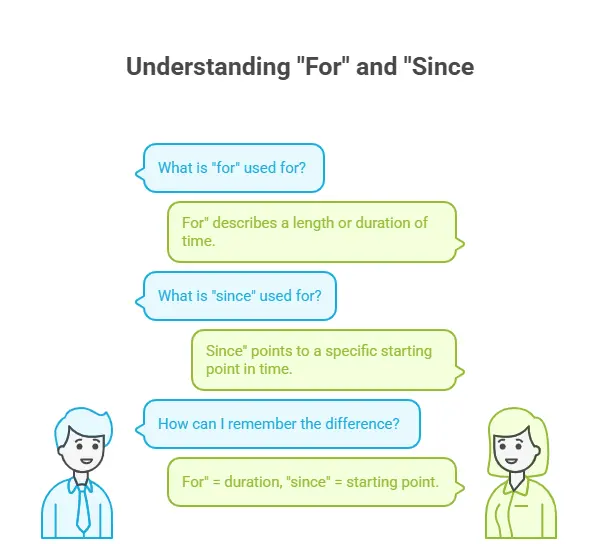 Many English learners often get puzzled by the words “for” and “since” because both relate to time, but they are used differently. Understanding the difference between them can make your sentences more precise and natural.
- “For” is used to describe a length or duration of time—how long something has been happening. For example, “I have been studying English for three years” tells us the total time spent studying.
- “Since”, on the other hand, points to a specific starting point in time—the exact moment when something began. For example, “I have been studying English since 2020” shows the starting year of the action.
Many beginners mix them up because both talk about time, but remembering that “for” = duration and “since” = starting point makes it easier to use them correctly. Using these words accurately helps conversations and writing sound more fluent and clear.
Understanding Duration vs. Starting Point
1: Which of the sentences below is grammatically correct?
When talking about time in English, it’s important to understand the difference between duration and starting point, because these two ideas help us choose the right word—for or since. Many learners mix them up, but once you understand the concept clearly, using them becomes very easy.
What is Duration?
Duration refers to how long something has been happening. It focuses on the length of time — the total period from the beginning until now. Duration does not tell us exactly when something started. It simply shows the amount of time that has passed.
For example:
- “I have been studying English for three years.” Here, the important information is the length of time — three years — not the year or date you started.
Duration answers the question: “How long has this been happening?”
Think of duration as the length of the movie, not when the movie started. Words like for are used to express duration.
What is a Starting Point?
On the other hand, a starting point tells us when something began. It marks the exact moment an action or situation started and continues until now. Instead of telling us the length of time, it points to the beginning.
For example:
- “I have been studying English since 2020.” This sentence gives the specific year when the studying began.
Starting point answers the question: “When did this begin?”
Think of a starting point as the time the movie began, not how long it has been playing. Words like since are used to express the starting point.
| Free PDFs for download | |
Why Understanding the Difference Matters
Many English learners mix up “for” and “since”, even though they express different ideas. Using the wrong one can make your sentence confusing or incorrect.
Remember:
- For = Duration (How long)
- Since = Starting point (When it began)
Correct usage examples:
- “She has lived here for six years.” → duration
- “She has lived here since 2018.” → starting point
Understanding this difference helps you express time clearly, whether you’re talking about habits, experiences, or ongoing situations. It also makes your English sound more natural and confident.
Both duration and starting point help us express ongoing actions clearly. Once you connect for = how long and since = when it started, your sentences become more natural and accurate. This small understanding makes a big difference in sounding fluent and confident in English.
Spoken English Course for Guaranteed Confidence and Career Growth
Spoken English Course by Entri App: Enhance your communication skills, gain certification, and boost your career with confidence.
Join Now!How to Use “For” Correctly (Rules + Examples)
The word “for” is one of the most common prepositions in English, yet it often causes confusion for learners. One of its main uses is to talk about duration, which means the length of time something happens. Understanding how to use “for” correctly will make your English sound clearer, more natural, and more accurate. Below are simple rules, clear explanations, and practical examples to help you use “for” with confidence.
1. Use “for” with a period of time
Use “for” when you want to say how long an action happens or how long a situation lasts. The focus is always on the length of time, not the starting point.
Examples:
-
I studied for two hours last night.
-
They lived in Mumbai for five years before moving.
-
She practised the piano for thirty minutes every day.
-
We talked for a long time after dinner.
In all these sentences, “for” answers the question: How long?
2. Common time words used with “for”
“For” is often used with time expressions that show length or amount. These words help describe duration clearly.
Common time expressions include: minutes, hours, days, weeks, months, years, a long time, a short time, ages
Examples:
-
for ten minutes
-
for three weeks
-
for six months
-
for many years
-
for a short time
-
for ages
You can also use “for” with exact numbers or vague time periods. Both are correct as long as they show duration.
3. Use “for” with perfect tenses to show ongoing duration
When an action started in the past and is still continuing now, use “for” with the present perfect or present perfect continuous tense.
Examples:
-
I have worked here for six years.
-
She has been learning French for three months.
-
We’ve been waiting for half an hour.
-
They have lived in this house for a long time.
These sentences show that the action began in the past and continues up to the present moment.
4. Use “for” with past simple to show completed durations
If the action is finished, use “for” with the past simple tense to show how long it lasted.
Examples:
-
He slept for eight hours last night.
-
They stayed in Rome for two weeks last summer.
-
I worked at that company for five years, then changed jobs.
Here, the action is complete, and “for” simply explains the length of time.
5. Use “for” in requests, reasons, and purposes
“For” is not only used for time. It is also commonly used to explain purpose, reason, or intention. Although this meaning is different, it is very common in everyday English.
Examples:
-
This gift is for you.
-
I bought flowers for my mother.
-
Can you book a taxi for 7 PM?
-
This button is for emergencies only.
Understanding this helps you avoid confusion between time-related “for” and purpose-related “for.”
6. Avoid common mistakes
Many learners confuse “for” and “since.” Remember:
-
Use for with a length of time.
-
Use since with a specific starting point.
Wrong: I have lived here for 2018.
Right: I have lived here since 2018.
Wrong: She worked here since two years.
Right: She worked here for two years.
7. Quick memory trick
Ask yourself this simple question: “How long?”
If the answer is a length of time (two hours, five years, a long time), use “for.”
8. Short practice set
Try filling in the blanks:
-
I’ve known him ___ ten years. → for
-
They waited ___ three hours. → for
-
She studied Spanish ___ a year before moving. → for
How to Use “Since” Correctly (Rules + Examples)
The word “since” is very important in English because it helps us talk about starting points in time. While “for” tells us how long something lasts, “since” tells us when it started. Understanding this difference will help you avoid one of the most common grammar mistakes in English and make your sentences sound more natural.
1. Use “since” with a specific starting time
“Since” is always used with an exact point in time, not a length of time. This starting point can be a year, date, month, day, clock time, age, or even a moment in life.
Examples:
-
I have lived here since 2015.
-
She has worked at the hospital since January.
-
They have been friends since childhood.
-
He has been awake since 6 AM.
-
I haven’t seen her since last Friday.
Each sentence clearly shows when the action began.
2. Use “since” with perfect tenses
“Since” is usually used with the present perfect or present perfect continuous tense. These tenses are perfect because they describe actions that started in the past and are still true now.
Examples:
-
I have been learning English since 2020.
-
She has been reading that book since morning.
-
We have known each other since school.
-
They have been living abroad since their wedding.
Using “since” with these tenses helps connect the past to the present.
3. “Since” can refer to a specific event
A starting point does not always need to be a number or date. It can also be an event or life change that marks when something began.
Examples:
-
She has been happier since her vacation.
-
He hasn’t eaten junk food since his last health check-up.
-
Life has changed a lot since the pandemic.
-
I’ve felt more confident since I started practicing daily.
Here, the event acts as the moment when the change began.
4. “Since” can also mean “because” (different meaning)
Sometimes “since” is used to explain a reason, not time. This meaning is different, so be careful not to confuse the two.
Examples:
-
Since it was raining, we stayed home.
-
Since you’re here early, we can start now.
-
Since she didn’t reply, I called her.
A helpful trick: if you can replace “since” with “because” and the sentence still makes sense, then it’s the reason-giving meaning.
5. Avoid common mistakes with “since”
Many learners mix up “since” and “for.” Remember:
-
Since → starting point
-
For → duration
Wrong: I have lived here since 10 years.
✔ Correct: I have lived here for 10 years.
Wrong: She worked here since 2018.
✔ Correct: She has worked here since 2018.
Always check whether you are talking about when something started or how long it lasted.
6. Quick memory trick
Think of “since” = “from when.”
Ask yourself: When did it start?
Examples:
-
When did it start? 2010 → since 2010
-
When did she move? Last week → since last week
-
When did the change happen? After graduation → since graduation
By practicing “since” with real-life examples, you will quickly feel more confident using it in speaking and writing. Once you clearly understand starting points, “since” becomes easy and natural to use.
Common Errors Learners Make with For and Since
Learning to use for and since correctly takes time, and making mistakes is a normal part of the process. Even advanced learners occasionally mix them up in fast speech or informal writing. The key is to slow down and focus on what kind of time expression you are using. If you are talking about how long something lasts, choose for. If you are talking about when something started, choose since. With regular practice, reading examples, and listening to native speakers, these choices will start to feel natural instead of confusing. Over time, you will notice yourself using for and since correctly without even thinking about the rules.
 1. Using since with a duration instead of a starting point
Wrong: I have lived here since five years.
Right: I have lived here for five years.
Why: Since must be followed by a starting point, not a length of time. “Five years” answers how long, so for is correct.
More examples:
-
Wrong: She has studied English since two months.
-
Right: She has studied English for two months.
Tip: Ask “How long?” If the answer is a number + time unit, use for.
2. Using for with a starting point
Wrong: I have worked here for 2018.
Right: I have worked here since 2018.
Why: Years, dates, and times show when something started, not how long it lasted.
More examples:
-
Wrong: He has lived here for last Monday.
-
Right: He has lived here since last Monday.
Tip: If you can say “from 2018,” then you should use since.
3. Forgetting to use the perfect tense with since
Wrong: She worked here since 2019.
Right: She has worked here since 2019.
Why: Since usually works with the present perfect or present perfect continuous to show an action that began in the past and continues now.
More examples:
-
Wrong: I am sick since Monday.
-
Right: I have been sick since Monday.
Tip: When you see since, check that your verb includes has/have.
4. Using simple past for actions that are still true
Wrong: I lived here for five years. (but you still live there)
Right: I have lived here for five years.
Why: The simple past suggests the action is finished. If it continues now, use present perfect.
More examples:
-
Wrong: She worked here for ten years. (still works there)
-
Right: She has worked here for ten years.
Tip: Ask yourself, “Is this still true now?”
5. Confusing since (time) with since (because)
Time: I have been tired since Monday.
Reason: Since it was raining, we stayed home.
Why it’s confusing: Both meanings use the same word, but the structure and meaning are different.
More examples:
-
Since he moved away, we don’t talk much. (time)
-
Since you finished early, you can leave now. (reason)
Tip: If because fits, it’s not about time.
6. Omitting the time phrase after for
Wrong: I practiced for.
Right: I practiced for one hour.
Why: For must be followed by a clear duration.
More examples:
-
Wrong: She waited for.
-
Right: She waited for twenty minutes.
Tip: Never leave for alone—always complete it.
7. Using since with vague durations
Wrong: She has been here since a long time.
Right: She has been here for a long time.
Why: Vague expressions describe length, not starting points.
More examples:
-
Wrong: I’ve known him since many years.
-
Right: I’ve known him for many years.
Tip: Vague length = for.
8. Mixing up contractions and verb forms
Wrong: I’m here since 2010.
Right: I’ve been here since 2010.
Why: Ongoing situations need have been, not am.
Tip: Practice the pattern: I’ve been + place/action + since…
9. Using for with a single moment in time
Wrong: He waited for 7 PM.
Right: He has waited since 7 PM.
Why: Clock times are starting points, not durations.
Tip: Specific times → since.
10. Overgeneralizing rules across tenses
Wrong: She will work here since 2022.
Right: She has worked here since 2022.
Why: Since connects past to present using perfect tenses.
Tip: When you mean “from then until now,” use since + present perfect.
Mastering for and since takes practice, but once you focus on duration vs. starting point, the rules become much clearer and easier to apply in real conversations.
Elevate your speaking skills with our Spoken English Course!
Spoken English Course for Guaranteed Confidence and Career Growth
Spoken English Course by Entri App: Enhance your communication skills, gain certification, and boost your career with confidence.
Join Now!Conclusion
Understanding the difference between for and since is essential for speaking and writing English naturally and clearly. Both words are used to talk about time, but they serve different purposes. For helps you express the length or duration of time, while since tells you the starting point of an action that continues until now.
When you use them correctly, your sentences sound more accurate, confident, and professional. But when they are mixed up, the meaning becomes confusing and sometimes completely wrong.
The key to mastering for and since is simple:
- Use for with periods of time like minutes, hours, days, months, or years.
- Use since with a specific starting time like 9 AM, Monday, 2020, or “I was a child.”
Practice using them in your daily conversations, writing, and even while thinking in English. The more you use them, the more natural they will feel. With consistent practice and attention to these simple rules, you will be able to express time more accurately and avoid common grammar mistakes.
| Related Links | |
| English Idioms for Travelling with Examples | Understanding Clauses and Phrases |
| Rules for Using “Some” vs. “Any” | Future Tenses in English: A Complete Guide |
Spoken English Course for Guaranteed Confidence and Career Growth
Spoken English Course by Entri App: Enhance your communication skills, gain certification, and boost your career with confidence.
Join Now!Frequently Asked Questions
What is the main difference between “for” and “since”?
For is used to talk about the duration of time (how long something happens). Since is used to talk about the starting point of an action that continues until now.
Example:
-
I have lived here for 5 years.
-
I have lived here since 2019.
Can “for” be used with both present and past tenses?
Yes. For works with manytenses, including present perfect, past, and future.
Examples:
-
I have studied English for two hours.
-
I lived in Delhi for three years.
-
I will stay here for a week.
Is “since” only used with the present perfect tense?
Mostly yes. Since is commonly used with present perfect or present perfect continuous.
Examples:
-
She has worked here since 2020.
-
They have been waiting since morning.
Can “since” be used for general durations of time?
No. Since cannot be used for general lengths of time like 2 hours, 5 days, or 3 years.
Incorrect: I have lived here since 5 years.
Correct: I have lived here for 5 years.
Can “for” be used with specific dates or times?
No. For is not used to mention specific starting times like 7 AM or 2010.
Incorrect: I have waited for 7 AM.
Correct: I have waited since 7 AM.
Can “since” refer to life events or moments?
Yes. Since works with events, not just dates.
Examples:
-
Since my childhood
-
Since the lockdown
-
Since we first met
These events act as starting points.
Why do learners often confuse “for” and “since”?
Because both are used to talk about time. However:
-
For = how long (duration).
-
Since = when it started (starting point).
Remembering this simple rule helps avoid mistakes.
How can I practice using “for” and “since” correctly?
You can improve by:
-
Making 5 daily sentences using for and since.
-
Paying attention to verb tense (use present perfect with since).
-
Reading English articles and noting time expressions.
-
Listening to native speakers in movies or podcasts.