Table of Contents
It is of the utmost importance to pay close attention to the auxiliary verbs “do,” “does,” and “did” when speaking English in everyday circumstances. Not only may we highlight a point by asking questions and building negative phrases with them, but we can also do it without changing the main verb. In the event that you make use of them in the ideal approach, your English will sound more confident and straightforward. These words, despite the fact that they are quite brief, carry a great deal of weight when it comes to the regular course of conversation. Your command of the English language will significantly improve if you are able to discover a method by which you can make effective use of them.
Elevate your speaking skills with our Spoken English Course!
Why Do, Does & Did Are Important in Spoken English
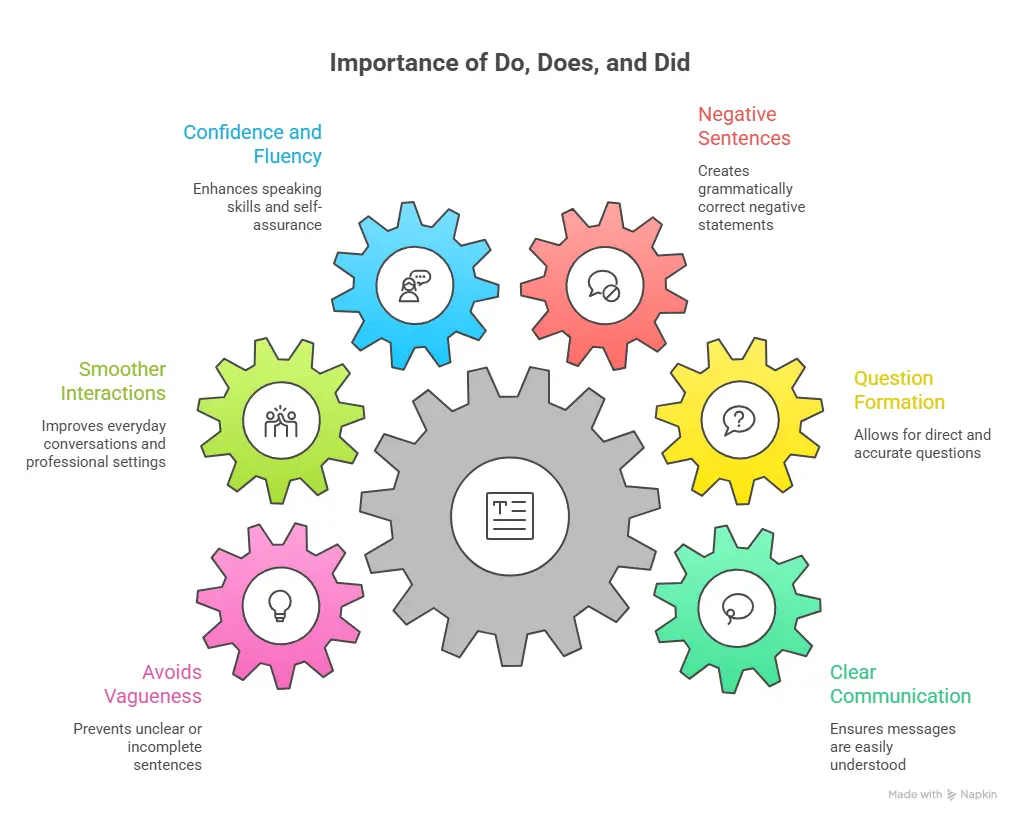
The tenses do, does, and did play a significant role in spoken English, as they ensure precise and understandable communication. They help us express ourselves clearly, ask questions without modifying the main verb, and create negative sentences correctly. If we know how to use them correctly, we may sound more assured and fluent, which in turn improves everyday interactions; meetings at work and interviews go more smoothly. Sentences could come out as vague or unfinished without these auxiliary verbs.
Use of “Do” in Spoken English
1: Which of the sentences below is grammatically correct?
In the present tense, “do” can be used with “I,” “you,” “we,” and “they.” No reason not to. Applying it effectively involves stressing, asking questions, and saying harsh things. Other effective methods include disparaging language. We say, “I don’t like tea!” to make a negative statement, “I do want to go!” to make a point, and “Do you like tea?” to ask a question. These comments are planned self-talk. They’re all terms we can use to communicate. These expressions are common in daily life. When used correctly, “do” simplifies your words and boosts your confidence when speaking to laypeople. The word boosts confidence in speech. Due to their greater comprehension of your message.
Examples:
- Question: Do you like travelling?
- Negative: I do not (don’t) like travelling.
- Emphasis: I do want to go to the park!
| Free PDFs for download | |
Spoken English Course for Guaranteed Confidence and Career Growth
Spoken English Course by Entri App: Enhance your communication skills, gain certification, and boost your career with confidence.
Join Now!Use of “Does” in Spoken English
Generally, we use the verb “does” with “he,” “she,” and “it.” The verb “does” means to do something. Different criteria apply in several cases under this guideline. Like “do,” you can use it to ask questions, form negative phrases, and highlight things. Therefore, you can use it similarly. We employ negative sentences like “Does she play football?” and “He does not like coffee” and “She does know the answer!” to pose a question. We utilize phrases like this to accentuate our message. Two negative sentences are examples. Use “does” in the right context to increase your spoken English’s naturalness, clarity, and confidence. Since “does” is non-conventional, this is feasible. This will boost your English communication skills. It’s crucial to remember this when discussing current events.
Examples:
- Question: Does he play cricket?
- Negative: She does not (doesn’t) play cricket.
- Emphasis: He does know the answer!
Use of “Did” in Spoken English
“Did” is used for all subjects in the past tense in spoken English. The reason for this is because “did” is a verb. People normally do things this way. Here you may find all the pronouns: “I,” “you,” “he,” “she,” “it,” “we,” and “they.” This group includes them. Negative language, questions, and emphasizing finished actions all have their uses. In addition, each one is useful. “Did you finish your homework?” is one of the phrases that we use to stress the gravity of the problem. “I did not go to school yesterday” in addition to “She did complete the project on time!” The following are only a few examples of the many contexts in which these expressions are common. Mastering the use of “did” in the past tense is a certain way to boost your grammar, self-assurance, and spoken English. Because “did” is a verb, it is conceivable to say this. Doing this may help you become a better grammarian.
Examples:
- Question: Did you complete your assignment?
- Negative: I did not (didn’t) complete my assignment.
- Emphasis: She did complete the project on time!
Do, Does & Did in Questions
The auxiliary verbs do, does, and did allow English questioning without changing the core verb. This is possible in languages other English. This is because auxiliary verbs work with the principal verb. A common question is “Do you like pizza?” This is a present-tense question. “Do you like pizza?” illustrates this. The present-tense question “Does she play football?” seeks information. This is another present-tense question instance. With every subject, we can use the past tense. We might inquire “Did they watch the movie yesterday?” on many occasions. After “do” or “did” and a subject and primary verb, “and” ends the sentence. This completes the phrase. This framework appears in every instance. Casual queries that use these important verbs are direct, courteous, and genuine about the topic.
- Do/Does → Present tense questions
- Do you like parties?
- Does she speak French?
- Did → Past tense questions
- Did they play football yesterday?
Elevate your speaking skills with our Spoken English Course!
Spoken English Course for Guaranteed Confidence and Career Growth
Spoken English Course by Entri App: Enhance your communication skills, gain certification, and boost your career with confidence.
Join Now!Do, Does & Did in Negative Sentences
In the English language, we have the option of forming a negative statement by utilizing the words “do,” “does,” or “did.” The very character of the English language makes this a possibility. The following is the structure that exists regardless of the circumstances: Do/Does/Did + Not + Base Verb + …… Subject plus Do/Does/Did plus…” The use of these auxiliary verbs in the appropriate manner will result in sentences that are not only correct from a grammatical standpoint but also simple to understand.
- Do/Does → Present tense negatives
- I don’t (do not) eat eggs.
- He doesn’t (does not) like vegetables.
- Did → Past tense negatives
- We didn’t (did not) go to the museum.
Common Spoken English Examples
- Do you want to learn music?
- He doesn’t like traveling.
- Did she call you yesterday?
- I do enjoy drinking coffee.
- Does your brother play football?
- They didn’t understand the problems.
Simple Practice Exercises
- Make questions using do/does/did:
- (you / eat / pizza) → ____________________
- (he / go / school yesterday) → ____________________
- (they / like / ice cream) → ____________________
- Make negative sentences using do/does/did:
- (I / watch / TV) → ____________________
- (she / play / guitar) → ____________________
- (we / visit / museum) → ____________________
- Emphasize using do/does/did:
- (I / love / chocolate) → ____________________
- (he / know / the answer) → ____________________
Conclusion
Use “do,” “does,” and “did” wherever appropriate to improve your English speaking and writing. You must read this carefully! Using both the past and present tense makes it easier to ask questions, explain negative things, and stress what you’re saying. These phrases are used because they greatly simplify the process. This is why they’re used.
If used properly, these terms can make your work appear more substantial, less difficult, and more natural. Engaging with others at home, school, or in business is always effective. Daily use of “do,” “does,” and “did” in current English with questions, examples, and negative remarks will make you proficient. You may increase your comfortable and spontaneous communication by making these changes. Consistently applying these techniques will improve your skills.
Elevate your speaking skills with our Spoken English Course!
Spoken English Course for Guaranteed Confidence and Career Growth
Spoken English Course by Entri App: Enhance your communication skills, gain certification, and boost your career with confidence.
Join Now!Frequently Asked Questions
What is the difference between Do, Does, and Did?
Do and does are used in the present tense, while did is used in the past tense. Use do with I, you, we, they and does with he, she, it.
Can we use “did” with all subjects?
Yes, did is used with all subjects in the past tense. Example: Did they go to school yesterday?
Do we change the main verb after Do, Does, or Did?
No, the main verb always stays in its base form (without -s or -ed). Example: Did you watch the movie? (not watched).
What are short forms used in spoken English?
Common contractions are don’t (do not), doesn’t (does not), and didn’t (did not). These make speech sound natural.
Why are Do, Does & Did important in English speaking?
They help form questions and negatives and show emphasis—making your spoken English clear, confident, and grammatically correct.