Table of Contents
English is important for many airport jobs. However, complete fluency is not always required. Requirements vary by role, airport, employer, and passenger contact.
Do You Need English Fluency for Airport Jobs? — Quick Answer
English is important for many airport jobs. However, you do not always need fluency. Basic English may suit some airport positions. Customer-facing roles usually need stronger communication skills.
Is English mandatory for airport jobs?
English is not mandatory for every airport role. Requirements depend on the employer and position.
What level of English is usually needed?
Most roles need basic or intermediate English. Passenger-facing roles may require better speaking skills.
Which airport jobs require better English?
Ground staff and customer service need stronger English. Check-in agents also communicate with passengers frequently. Airline customer service roles may have similar requirements.
Can you get an airport job with basic English?
Yes, some roles accept basic English skills. Strong local-language skills can also provide advantages. However, improving English can expand your options.
Why Is English Important in Airport Jobs?
Airports bring together passengers from many places. English often helps employees communicate with them. It also supports communication between airport teams. Clear communication can prevent misunderstandings during operations.

English Helps With Passenger Communication
Airport employees regularly answer passenger questions. They may explain gates, counters, or procedures. They may also provide directions around terminals.
Common conversations can involve:
- Check-in procedures
- Boarding information
- Baggage questions
- Flight schedules
- Gate changes
- Security procedures
- Airport facilities
- Travel documents
Employees must communicate this information clearly. Simple English can often handle these conversations.
English Supports Workplace Communication
Airport operations involve many different teams. Employees may coordinate with airline staff. They may also work with security personnel. Ground handling teams require regular communication.
English can support these workplace interactions. It can help employees understand instructions quickly. It can also reduce communication-related mistakes.
English Helps With Travel Documents
Airport employees often handle travel documents. These documents commonly contain English terms. Employees may need to understand basic travel information.
Useful terms include:
- Boarding pass
- Passport
- Departure
- Arrival
- Gate
- Terminal
- Baggage
- Check-in
- Boarding
- Security
Understanding these terms improves workplace confidence. It also helps employees assist passengers better.
English Can Improve Professional Confidence
Good communication can make passenger interactions smoother. Employees may feel more confident while speaking. Confidence can also improve overall customer service.
However, perfect grammar is not always necessary. Clear and polite communication matters more. Employees should focus on understandable spoken English.
✈️ Start Your Aviation Career Today
Explore career-focused insights on airport jobs, ground staff roles, and aviation training. Learn about salaries, skills, certifications, and hiring trends to start and grow your career in the aviation industry.
Join NowHow Much English Do You Need for Different Airport Jobs?
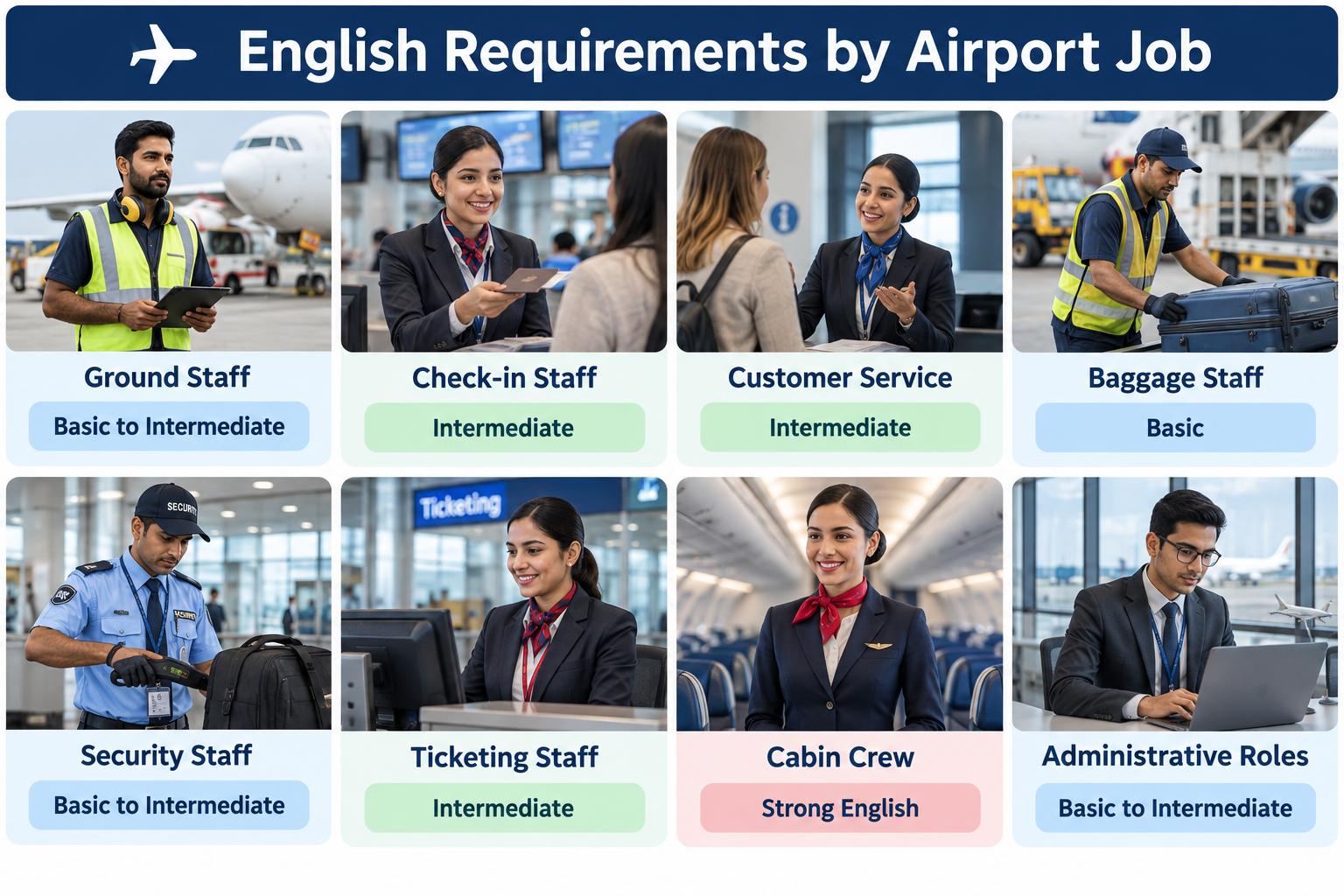
English requirements differ across airport positions. Some roles involve constant passenger interaction. Others involve limited direct communication.
The required level depends on daily responsibilities. Employers may also have different language standards.
1. Airport Ground Staff
Ground staff usually need moderate English skills. They regularly communicate with passengers and colleagues. Their duties can include check-in assistance and boarding.
They may answer questions about flights. They may also verify travel documents. Clear communication is important during these tasks.
Useful skills include:
- Basic spoken English
- Passenger communication
- Listening skills
- Reading comprehension
- Polite customer service
- Basic aviation vocabulary
Fluent English can provide an advantage. However, perfect pronunciation is not essential.
2. Check-In Staff
Check-in staff need stronger communication skills. They interact with passengers throughout their shifts. Their work involves several important procedures.
They may need to explain:
- Baggage allowances
- Boarding procedures
- Seat information
- Travel requirements
- Flight details
- Check-in procedures
Check-in staff should understand passenger questions quickly. They should also provide clear responses.
Intermediate English is often useful here. Strong listening skills are especially important.
3. Customer Service Staff
Customer service roles require regular conversations. Employees may handle passenger concerns and complaints. They need to remain calm during difficult situations.
Good English helps employees explain solutions clearly. It also helps them understand passenger concerns.
Important skills include:
- Active listening
- Clear speaking
- Polite language
- Problem-solving
- Basic professional vocabulary
- Confident communication
Advanced fluency can improve opportunities further. However, practical communication remains the main requirement.
4. Baggage Handling Staff
Baggage roles may need less English. Their work often focuses on baggage operations. Direct passenger interaction may be limited.
Basic English can still be useful. Employees may need to understand instructions. They may also communicate with supervisors.
Important language skills include:
- Understanding basic instructions
- Recognizing baggage terms
- Reading labels
- Communicating with team members
- Understanding safety instructions
The required level depends on the employer. Passenger-facing baggage roles may need more English.
5. Airport Security Roles
Security positions have specific communication requirements. Employees may interact with passengers and staff. They must understand instructions and procedures clearly.
Basic English may work for some tasks. Other security roles can require stronger communication.
Employees may need to understand:
- Security instructions
- Identification documents
- Passenger questions
- Restricted-item information
- Emergency instructions
Employers decide the required language level. Job descriptions usually provide useful clues.
6. Airline Ticketing Staff
Ticketing employees need good communication skills. They handle passenger bookings and travel questions. They may also explain ticket conditions.
English helps with several common tasks:
- Booking assistance
- Ticket changes
- Cancellation information
- Fare explanations
- Travel details
- Passenger queries
Intermediate English is useful for these positions. Stronger English can improve customer interactions.
7. Cabin Crew
Cabin crew generally need stronger English skills. They communicate with passengers throughout flights. They also follow important safety procedures.
English can be essential for many cabin crew roles. Airlines may set specific language requirements.
Applicants may need to demonstrate:
- Clear spoken English
- Strong listening ability
- Professional communication
- Safety-related vocabulary
- Passenger service skills
Requirements differ between airlines and positions. Always check the specific vacancy requirements.
8. Airport Administrative Roles
Administrative jobs may need moderate English skills. Requirements depend on daily responsibilities. Some positions involve limited passenger interaction.
Employees may handle emails and documents. They may also prepare reports and records.
Useful skills include:
- Reading English
- Writing professional emails
- Understanding instructions
- Basic computer communication
- Document handling
Strong written English can help in these positions. Spoken fluency may be less important.
Is English Fluency Mandatory for Airport Jobs?
Complete English fluency is not always mandatory. Many airport jobs need functional communication skills instead. Employers usually focus on job-related communication abilities.
However, requirements can differ significantly. International airports may expect stronger English. Large airlines can also have stricter standards.
When English Becomes More Important
English becomes more important with passenger interaction. Roles involving international passengers need stronger communication. Supervisory positions may also require better English.
English requirements can increase when employees:
- Handle passenger complaints
- Explain travel procedures
- Make public announcements
- Communicate with international teams
- Handle important documentation
- Coordinate multiple airport departments
The employer ultimately decides the requirement. Always read the official job description carefully.
Can You Get an Airport Job With Basic English?
Yes, basic English can still provide opportunities. However, available positions may be more limited. Some operational roles require less passenger communication.
Candidates should focus on their other strengths. Customer service and teamwork can support applications. Local-language abilities can also be valuable.
Roles That May Accept Basic English
Depending on the employer, basic English may suit:
- Baggage support roles
- Ground operations support
- Cleaning and facility roles
- Some cargo operations
- Certain back-office positions
- Entry-level operational roles
Requirements differ between employers and airports. Never assume every airport has identical standards.
Local Languages Can Also Help
Indian airports serve multilingual passengers every day. Regional languages can therefore provide additional value. Hindi can help across many Indian locations. English still supports broader passenger communication.
Knowing multiple languages can strengthen your profile. It can also improve customer service opportunities.
✈️ Start Your Aviation Career Today
Explore career-focused insights on airport jobs, ground staff roles, and aviation training. Learn about salaries, skills, certifications, and hiring trends to start and grow your career in the aviation industry.
Join NowDoes English Level Affect Your Airport Job Opportunities?
English ability can affect available job opportunities. Stronger communication can qualify candidates for more roles. It can also improve confidence during interviews.
Candidates with better English may access:
- Customer service positions
- International airport roles
- Airline support positions
- Check-in roles
- Ticketing positions
- Supervisory opportunities
Basic English does not end your opportunities. It simply may narrow certain options. Continuous improvement can gradually expand your choices.
English skills can also affect career growth. Employees often communicate with different airport departments. Better communication can support leadership responsibilities.
However, English is not the only factor. Employers also consider education and experience. They may assess customer service and technical skills. Professional behavior also matters during recruitment.
English Skills to Improve Before Applying for Airport Jobs
You do not need perfect English initially. Focus on practical communication skills first. Airport employees use English for everyday tasks. Regular practice can improve confidence and workplace communication.

1. Improve Basic Speaking Skills
Start with simple sentences used at airports. Practice speaking clearly and at a steady pace. Avoid worrying about perfect grammar initially.
Practice sentences such as:
- “How can I help you?”
- “Please show your boarding pass.”
- “Your gate is number five.”
- “Please proceed to the security area.”
- “Your baggage needs additional checking.”
- “The boarding process starts soon.”
These sentences cover common airport situations. Practice them until they feel natural.
2. Build Airport-Related Vocabulary
Airport jobs require specific vocabulary. Learning these terms can improve workplace understanding.
Important words include:
- Boarding pass
- Check-in counter
- Departure
- Arrival
- Boarding gate
- Baggage claim
- Security check
- Flight delay
- Cancellation
- Connecting flight
- Travel document
- Baggage allowance
Learn words through practical situations. Avoid memorizing large vocabulary lists without context. Understanding usage is more important than memorization.
3. Improve Listening Skills
Listening is important during passenger interactions. Employees must understand questions and instructions quickly. Strong listening also prevents communication mistakes.
Practice by listening to:
- English airport announcements
- Travel-related conversations
- English news reports
- Customer service videos
- Aviation training materials
Start with slower conversations when necessary. Gradually move toward normal speaking speeds.
4. Practice Customer Service English
Airport employees often handle different passenger situations. Some passengers may be confused or frustrated. Polite English can help manage these interactions.
Useful phrases include:
- “How may I assist you?”
- “Let me check that for you.”
- “Please wait for a moment.”
- “I understand your concern.”
- “I will help you with this.”
- “Please follow these instructions.”
Use polite and professional language. Avoid informal expressions during passenger interactions.
5. Improve Reading Skills
Airport employees may read different documents. These can include schedules, instructions, and notices. Basic reading skills are therefore important.
Practice reading:
- Boarding information
- Airport signs
- Travel instructions
- Airline notices
- Workplace emails
- Safety instructions
Focus on understanding the main information quickly. You do not need advanced literary English.
6. Improve Basic Writing Skills
Some airport roles involve written communication. Administrative and customer service positions may require more writing.
Practice writing:
- Short professional emails
- Passenger responses
- Simple reports
- Workplace messages
- Basic incident descriptions
Keep written communication clear and professional. Avoid unnecessary words and complicated sentences.
7. Practice Common Interview Questions
English may be assessed during interviews. Candidates should prepare simple answers beforehand. Clear answers are more important than complicated vocabulary.
Practice questions such as:
- “Tell me about yourself.”
- “Why do you want this job?”
- “Why do you want to work at an airport?”
- “What are your strengths?”
- “How would you handle an angry passenger?”
- “How do you work under pressure?”
Practice speaking without memorizing every sentence. This makes answers sound more natural.
8. Work on Pronunciation
Clear pronunciation helps passengers understand you. You do not need to copy a particular accent. Focus on speaking each word clearly.
Record yourself while practicing. Listen to your recording afterward. Identify words that sound unclear. Repeat difficult words until pronunciation improves.
9. Learn Common Airport Questions
Passengers may ask similar questions repeatedly. Preparing answers can increase confidence.
Common questions include:
- “Where is the check-in counter?”
- “Where is my boarding gate?”
- “When does boarding start?”
- “Where can I collect my baggage?”
- “Has my flight been delayed?”
- “Where is the security checkpoint?”
Practice answering these questions naturally. This can prepare you for real interactions.
10. Build Confidence Through Daily Practice
Daily practice is more useful than occasional study. Spend time speaking English every day. Even short practice sessions can create improvement.
Try these activities:
- Speak English for 15 minutes.
- Read airport-related content aloud.
- Watch English travel videos.
- Practice conversations with friends.
- Record answers to interview questions.
- Learn five airport words daily.
Focus on steady improvement rather than perfection. Confidence usually develops through repeated practice.
How to Improve English Before an Airport Job Interview
An interview requires both speaking and listening skills. Candidates should prepare for common questions before applying. Practice answers using simple and natural English.
Create short answers about your background. Include education, skills, and relevant training. Mention customer service experience when applicable.
For example, explain your strengths clearly. Discuss teamwork, communication, and problem-solving. Avoid using complicated words unnecessarily.
Practice Professional Body Language
English communication involves more than spoken words. Eye contact and confidence also matter. Maintain a professional posture during interviews.
Remember these points:
- Speak at a comfortable speed.
- Listen carefully before answering.
- Avoid rushing your responses.
- Maintain suitable eye contact.
- Ask for clarification when necessary.
- Stay polite throughout the interview.
If you do not understand something, stay calm. Politely ask the interviewer to repeat it. This is better than giving an unrelated answer.
Does English Improve Your Airport Career Growth?
Better English can support long-term career development. Airport employees often interact with different teams. Communication becomes increasingly important with greater responsibility.
Strong English can help with:
- Supervisory positions
- Customer service roles
- Airline support roles
- International passenger handling
- Administrative responsibilities
- Team coordination
- Training opportunities
English can also improve workplace confidence. Employees may communicate more comfortably with supervisors. They may also handle passenger concerns more effectively.
However, English alone does not guarantee career growth. Experience and technical knowledge remain important. Professional behavior and teamwork also matter. Candidates should therefore develop multiple workplace skills.
What If Your English Is Weak?
Weak English should not automatically stop your application. First, check the language requirements carefully. Some entry-level roles may accept basic communication skills.
Continue improving English alongside your job search. Practice common airport conversations regularly. Learn vocabulary related to your preferred position.
Do not compare your English with fluent speakers. Focus on communicating clearly and confidently. Progress becomes easier with regular practical practice.
Conclusion
English is important for many airport careers. However, complete fluency is not always necessary. The required level depends on the specific role, employer, and passenger interaction. Ground staff and customer service roles usually need stronger communication skills. Some support roles may accept basic English.
Candidates should focus on practical communication skills. Practice speaking, listening, airport vocabulary, and interview questions. Regular practice can build confidence over time. Stronger English can also expand future airport job opportunities.
✈️ Start Your Aviation Career Today
Explore career-focused insights on airport jobs, ground staff roles, and aviation training. Learn about salaries, skills, certifications, and hiring trends to start and grow your career in the aviation industry.
Join NowFrequently Asked Questions
Is English mandatory for airport jobs?
English is important for many airport jobs, but it is not mandatory for every position.
Can I get an airport job with basic English?
Yes, some airport roles accept candidates with basic English communication skills.
What level of English is needed for ground staff?
Basic to intermediate English is generally useful for ground staff positions.
Which airport jobs require good English?
Ground staff, check-in agents, customer service staff, ticketing staff, and cabin crew usually need stronger English skills.
Do airport jobs require fluent spoken English?
Not always, as clear and confident communication can be more important than complete fluency.
Can I work at an airport without speaking English fluently?
Yes, some operational and support roles may have lower English requirements.
Does English affect airport job opportunities?
Yes, stronger English can help candidates qualify for more passenger-facing and international roles.
Are local languages useful for airport jobs?
Yes, knowing regional or multiple languages can be valuable when assisting passengers.
How can I improve English for airport jobs?
You can improve by practicing airport vocabulary, passenger conversations, listening skills, and common interview questions.
Is English tested during airport job interviews?
Some employers may assess English communication during interviews, especially for customer-facing positions.