Table of Contents
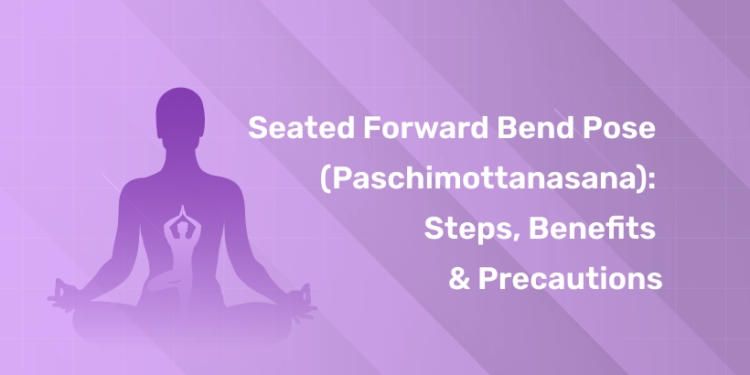
Seated Forward Bend Pose, or Paschimottanasana, is a beginner-level yoga posture where you sit with both legs extended and fold forward from the hips to stretch the hamstrings, calves, hips and spine.
Make having a long spine and a steady breath the prime goal and not just touching your toes. A 30-second hamstring stretch is found to have improved flexibility as much as a 60-second hold. It means that short, mindful holds are enough.
Want to Step Up? Join our Yoga Instructor Course Online!
What is Seated Forward Bend Pose?
Seated Forward Bend Pose is a seated forward fold that starts from Dandasana (Staff Pose) and stretches the entire “back line” of the body. It might look simple but is difficult to practise correctly.
| Sanskrit term | Meaning |
| Paschima | West or back; in tradition, the back body, since yoga was practised facing the rising sun |
| Uttana | Intense stretch |
| Asana | Posture or seat |
How to Do Seated Forward Bend Pose: Step by Step
1: Which of these is the primary goal of yoga practice?
If you want to get into Paschimottanasana, start by sitting up straight with your legs stretched out in front of you – inhale to really feel your spine lengthening, then exhale let your body hinge forward from the hips. Stop when your spine’s still nice and long.
Sit in Dandasana
First off, extend your legs out in front of you, keep your feet together and your toes pointing up. Put your hands beside your hips. Press down on your sit bones and take a deep breath in – let your shoulders just relax.
Set your Legs
Now, gently flex your feet towards you and keep your knees nice and soft. If you find your lower back’s starting to round out, try sitting on a folded up blanket or bending your knees a little bit.
Inhale and Lengthen
Take a deep breath in and raise both arms up over your head. Without leaning back at all just lift up through the sides of your waist. You’re aiming to keep your spine nice and long.
Exhale and Hinge
Now exhale and start to tip your pelvis forward – like a bowl tilting – and let your chest lead the way, not your chin.
Place your Hands
Rest them wherever they end up on your thighs, shins, ankles or feet – or if you need to, loop a strap around the balls of your feet.
Breathe
Breathe in deeply and lengthen as you inhale, and soften on every exhale. Don’t try to bounce or hold your breath.
Hold
Stay in the pose for anywhere between 30 and 60 seconds – keeping your face, jaw and neck nice and relaxed.
Release Slowly
Inhale, lift your torso back up into Dandasana and take a few nice deep breaths to calm down.
Alignment Cues at a Glance
| Body area | What to do |
| Sitting bones | Ground them evenly |
| Spine | Lengthen before folding |
| Hips | Hinge at the hip crease, not the waist |
| Knees | Keep them soft, never locked |
| Feet | Flex gently toward you |
| Shoulders and neck | Relax them away from the ears |
| Breath | Smooth and natural |
Become a Certified Yoga Instructor
Yoga Teacher Training Course by Entri App: Master authentic yoga techniques, earn certification, and build a successful career as a professional yoga instructor.
Join Now!What are the Benefits of Paschimottanasana?
Paschimottanasana mainly improves flexibility in the hamstrings, calves, hips and spine and encourages slow breathing. Some quoted benefits rest on tradition alone and not on clinical trials.
| Benefit | What to know |
| Hamstring flexibility | Well supported: static hamstring stretching increases range of motion, with 30 seconds shown effective in research |
| Calf and hip mobility | Flexed feet stretch the calves, and the hinge builds hip awareness |
| Spinal length and posture awareness | Practising a long spine helps you notice slouching habits |
| Relaxation | Slow breathing in a quiet fold can ease tension, though pose-specific research is limited |
| Digestive comfort | A traditional claim with little clinical evidence; avoid the pose if your stomach is upset |
What Mistakes Should You Avoid?
The biggest mistake is rounding the lower back just to reach the toes. It loads the lumbar spine and reduces the hamstring stretch.
| Mistake | Better approach |
| Rounding the lower back | Sit on a blanket and fold only as far as the spine stays long |
| Pulling with the arms | Hold lightly or use a strap |
| Leading with the head | Lead with the chest and keep the neck long |
| Locking the knees | Keep a micro-bend |
| Bouncing | Move slowly and hold steadily |
| Holding the breath | Breathe slowly and continuously |
| Forcing the forehead to the knees | Bring the belly and chest toward the thighs first |
Which Props and Modifications Help?
Props keep the spine long, which matters more than depth.
| Modification | How to do it | Best for |
| Folded blanket under hips | Sit on its edge so the pelvis tilts forward | Tight hamstrings, rounding back |
| Yoga strap | Loop around the balls of the feet | Anyone who cannot reach comfortably |
| Bent knees | Add a rolled blanket under them | Tight hamstrings, sensitive knees |
| Bolster on thighs | Rest the torso on it | Restorative practice |
| Chair variation | Sit tall, fold over the thighs | Office workers, older adults |
Become a Certified Yoga Instructor
Yoga Teacher Training Course by Entri App: Master authentic yoga techniques, earn certification, and build a successful career as a professional yoga instructor.
Join Now!Who Should Avoid Seated Forward Bend?
You should avoid the classical pose if you have
- an acute back injury
- herniated disc
- sciatica
- hamstring strain
- hernia
- abdominal ulcer
- recent abdominal surgery
Spinal flexion and abdominal compression can aggravate these conditions. Teaching manuals also list sacroiliac joint dysfunction and the second and third trimesters of pregnancy.
| Condition | Safer approach |
| Herniated disc, sciatica, severe back pain | Avoid deep folds; seek medical advice |
| Hamstring strain | Avoid until healed |
| Hernia, ulcer, diarrhoea, abdominal pain | Skip the pose |
| Recent abdominal or hip surgery | Avoid until medically cleared |
| Pregnancy | Avoid the classical pose; use pregnancy-safe variations with expert guidance |
| Osteoporosis | Forward spinal flexion is generally discouraged; ask your doctor |
| Glaucoma or high blood pressure | Take medical advice before head-down folds |
| Knee, hip or ankle injury | Modify under supervision |
Eye-Pressure Caution:
Research from a 2015 PLOS ONE study on 20 people found that some head-down poses raised eye pressure and returned to normal within 2 minutes of sitting up.
The study didn’t look at seated forward bends, but if you’ve got glaucoma, make sure to talk to a specialist before giving it a try.
Stop Immediately:
If you start to feel sharp or shooting pains, numbness or tingling in your legs, dizziness, nausea or breathlessness – or any pain that lingers after you release – stop right away.
Who Should Practise this Pose & Where does it Fit?
Paschimottanasana suits:
- Beginners
- Desk workers
- Anyone with tight hamstrings
They should use props and avoid forcing. Practise it after a warm-up, never as your first intense stretch of the day.
| Stage | What to practise |
| Warm-up | Ankle rotations, seated spinal movements, shoulder rolls |
| Preparation | Dandasana and gentle hip movements |
| Main posture | Paschimottanasana for 30–60 seconds |
| Counter-pose | Gentle seated back extension or Sukhasana |
| Relaxation | Slow breathing or short meditation |
Want to Step Up? Join our Yoga Instructor Course Online!
Conclusion
This is a really simple posture, but what it is got to teach you is quite profound. Here, depth is way less important than getting the alignment right. Fold in from the hips, keep your spine nice and long, breathe steadily and don’t be afraid to use a strap of blanket if your body’s asking for it.
Start with short holds, use all the props you need, and stop the moment you feel even the slightest twinge of pain. If you stick to it and practice this pose two or three times a week, you can end up with a looser back, a calmer breath, and a clearer sense of what your limits are.
Become a Certified Yoga Instructor
Yoga Teacher Training Course by Entri App: Master authentic yoga techniques, earn certification, and build a successful career as a professional yoga instructor.
Join Now!Frequently Asked Questions
How long should I hold the pose?
Hold for 30 to 60 seconds, or 15 to 20 seconds if you are a beginner. Research on hamstring stretching found 30 seconds as effective as 60.
Is Paschimottanasana good for beginners?
Yes, it is a beginner-level pose when done with bent knees, a strap or a folded blanket. Avoid forcing the full fold.
Do I need to touch my toes?
No, touching your toes is not the goal. A long spine and a comfortable hip hinge matter more than depth.
Which muscles does it stretch?
It stretches the hamstrings, calves, glutes, hips and the muscles along the spine. Flexed feet add a stretch to the calves.
Can it relieve lower back pain?
Supervised yoga programmes show small benefits for chronic non-specific low back pain, but no strong evidence supports this single pose. Never force the fold, and see a doctor for persistent pain.
Is it safe during pregnancy?
The classical pose is generally avoided, especially in the second and third trimesters. Use pregnancy-safe variations only under expert guidance.
How often can I practise it?
Two or three times a week works well for most beginners, with two or three repetitions each time. Increase gradually as comfort improves.