Table of Contents
Key Takeaways:
- German nouns are -> naming words.
- All nouns begin -> with capital letters.
- Each noun has -> a gender.
- German genders are -> der, die, and das.
- Article exchange on the basis of a sentence.
What Are German Nouns
1: How do you say "Good Morning" in German?
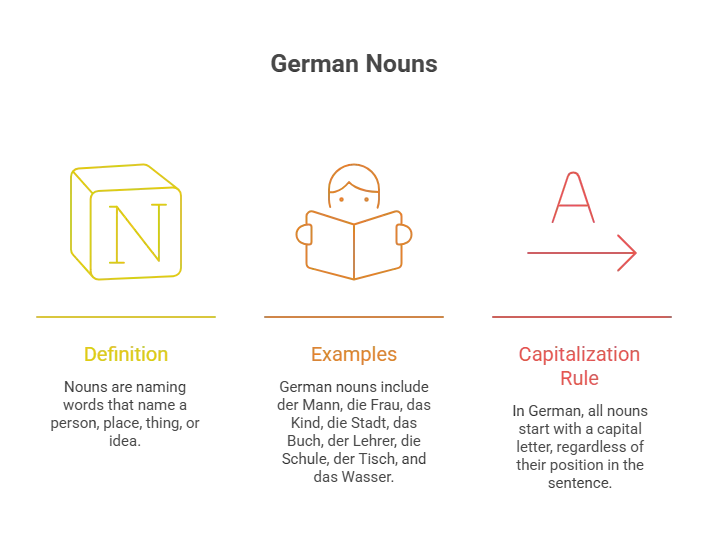
German nouns are naming words. They are used for people, places, things, and ideas. Nouns are important in German language.
Examples in German and English
- der Mann = man
- die Frau = woman
- das Kind = child
- die Stadt = city
- das Buch = book
👉 More examples:
- der Lehrer = teacher
- die Schule = school
- der Tisch = table
- das Wasser = water
Capitalization Rule in German
- In German, all nouns start with a capital letter
- This is different from English
- It does not matter where the noun is in the sentence
👉 Example:
Learn German language in your own language! Get free Demo Classes Here!
Free German A1 Mock Tests – Powered by AI!
Test your skills on our interactive platform. Get instant feedback from our AI to help you communicate better and track your progress. Start your free German mock test now.
Test Your German A1 for FreeGerman Noun Gender (Der, Die, Das)
1. Masculine (der)
- Used for many male people and some objects
- Article: der
Examples:
- der Mann = the man
- der Vater = the father
- der Lehrer = the teacher (male)
- der Tisch = the table
- der Hund = the dog
2. Feminine (die)
- Used for female people and many nouns
- Article: die
Examples:
- die Frau = the woman
- die Mutter = the mother
- die Lehrerin = the teacher (female)
- die Katze = the cat
- die Blume = the flower
3. Neuter (das)
- Used for things, young people, and some objects
- Article: das
Examples:
- das Kind = the child
- das Baby = the baby
- das Buch = the book
- das Haus = the house
- das Auto = the car
|
German A2 Exercises – Download Free PDF |
||
Common Gender Patterns in German Nouns
- German nouns have -> different genders.
- Some endings help -> identify the gender.
- Learning patterns makes -> German easier.
- Regular practice improves -> understanding naturally.
1. Feminine Endings (die)
Most nouns with these endings are feminine.
Common endings:
- -in → for female people
- -heit / -keit → ideas or qualities
- -ung → actions or processes
- -schaft → groups or conditions
- -tion → words from other languages
Examples:
- die Lehrerin = female teacher
- die Freiheit = freedom
- die Möglichkeit = possibility
- die Zeitung = newspaper
- die Freundschaft = friendship
- die Information = information
2. Masculine Endings (der)
Some endings are usually masculine.
Common endings:
- -er → many jobs and people
- -en / -el → some objects
- -ling → persons or things
Examples:
- der Lehrer = teacher
- der Fahrer = driver
- der Garten = garden
- der Apfel = apple
- der Schmetterling = butterfly
3. Neuter Endings (das)
Some endings are usually neuter.
Common endings:
- -chen / -lein → small things (diminutives)
- -ment → borrowed words
- -um → scientific or formal words
Examples:
- das Mädchen = girl
- das Häuschen = small house
- das Dokument = document
- das Zentrum = center
German Plural Nouns
In German, nouns change in plural form. All words do not follow the same rule. But some simple patterns can help.
What is Plural?
- Singular = one Book
- Plural = Many books
In German, the plural form of the word finishing can be changed in order.
Common Plural Endings
➤ -e
- Very common plural ending
- Sometimes adds an umlaut (ä, ö, ü)
Examples:
- der Hund → die Hunde (dog → dogs)
- der Tag becomes → die Tage (one day → many days)
➤ -en / -n
- Very common for many nouns
- Often used with feminine nouns
Examples:
- die Frau → die Frauen (woman → women)
- die Blume becomes → die Blumen (one flower → many flowers)
➤ -er
- Often used with neuter nouns
- Usually adds an umlaut
Examples:
- das Kind → die Kinder (child → children)
- das Buch changes to → die Bücher (one book → many books)
➤ -n
- Used when word already ends in “e”
Examples:
- die Katze changes to → die Katzen (one cat → many cats)
- die Tasche changes to → die Taschen (one bag → many bags)
➤ -s
- Used for foreign words or short words
Examples:
- der Chef → die Chefs (boss → bosses)
| Singular | Meaning | Plural | Ending |
|---|---|---|---|
| der Hund | dog | die Hunde | -e |
| die Frau | woman | die Frauen | -en |
| das Kind | child | die Kinder | -er |
| die Katze | cat | die Katzen | -n |
| das Auto | car | die Autos | -s |
- German plurals have different endings
- Common endings: -e, -en, -er, -n, -s
- All plural nouns use die
- Practice helps you learn faster
|
Goethe 2026 Exam Dates: Multiple Test Centers |
|
| Trivandrum Goethe Exam Dates | Kochi Goethe Exam Dates |
| Chennai Goethe Exam Dates | Coimbatore Goethe Exam Dates |
Free German A1 Mock Tests – Powered by AI!
Test your skills on our interactive platform. Get instant feedback from our AI to help you communicate better and track your progress. Start your free German mock test now.
Test Your German A1 for FreeGerman Noun Cases
- In German, nouns change based on their role in a sentence.
- These changes are called cases.
- There are 4 main cases in German.
🟢 Nominative (Subject Case)
- Shows who or what is doing the action
- It is the subject of the sentence
Examples:
- Der Mann läuft. → The man runs
- Die Katze schläft. → The cat sleeps
👉 “Der Mann” and “Die Katze” are doing the action
🔴 Accusative (Object Case)
- Shows who or what receives the action
- It is the direct object
Examples:
- Ich sehe den Mann. → I see the man
- Sie hat einen Hund. → She has a dog
👉 “den Mann” and “einen Hund” receive the action
🔵 Dative (Indirect Object Case)
- Shows to whom or for whom something happens
- It is the indirect object
Examples:
- Er hilft der Frau. → He helps the woman
👉 “dem Mann” and “der Frau” are the receivers
🟡 Genitive (Possession Case)
- Shows ownership or belonging
- Means “of” or “’s” in English
Examples:
- Das ist das Auto des Mannes. → That is the man’s car
- Die Farbe der Blume ist schön. → The color of the flower is nice
German Noun Declension
German noun declension means the article changes in a sentence. Words like der, die, and das may change based on the sentence. Sometimes the noun stays the same, but the article becomes different.
What Changes?
- The article changes (der, die, das)
- Sometimes the noun also changes (mainly in Genitive)
- Changes depend on the case
- Helps show the role of the noun
Declension Table (Simple)
| Case | Masculine | Feminine | Neuter | Plural |
|---|---|---|---|---|
| Nominative | der | die | das | die |
| Accusative | den | die | das | die |
| Dative | dem | der | dem | den |
| Genitive | des | der | des | der |
Nominative (Subject)
- No change for basic form
Examples:
- der Mann (the man)
- die Frau (the woman)
- das Kind (the child)
Accusative (Direct Object)
- Masculine changes: der → den
Examples:
- Ich sehe den Mann. → I see the man
- Ich habe die Tasche. → I have the bag
Dative (Indirect Object)
- Changes:
- der → dem
- die → der
- das → dem
Examples:
- Ich gebe dem Mann das Buch.
- Ich helfe der Frau.
Genitive (Possession)
- Changes:
- der → des
- das → des
- Often adds -s or -es to noun
Examples:
- das Auto des Mannes → the man’s car
German Compound Nouns
In German language, some words are formed by joining two or more words together. These long joined words are called compound nouns.
What Are Compound Nouns?
- Two or more words joined together
- Form one single noun
- Very common in German
- The last word is the main word
How They Work
- The last word decides:
- Meaning (main idea)
- Gender (der, die, das)
- The first word(s) give extra information
Simple Examples
- das Haus + die Tür → die Haustür
→ house + door = house door (front door) - der Kaffee + die Tasse → die Kaffeetasse
→ coffee + cup = coffee cup - die Schule + das Buch → das Schulbuch
→ school + book = school book
More Examples
- das Krankenhaus
→ krank (sick) + Haus (house) = hospital - der Arbeitsplatz
→ Arbeit (work) + Platz (place) = workplace - die Sonnenbrille
→ Sonne (sun) + Brille (glasses) = sunglasses - das Kinderzimmer
→ Kinder (children) + Zimmer (room) = children’s room
Common German Nouns List
Here are some common German nouns with their meanings and gender:
| German Word | English Meaning | Gender |
|---|---|---|
| der Mann | man | Masculine |
| die Frau | woman | Feminine |
| das Kind | child | Neuter |
| der Lehrer | teacher | Masculine |
| die Lehrerin | female teacher | Feminine |
| das Buch | book | Neuter |
| der Tisch | table | Masculine |
| die Tasche | bag | Feminine |
| das Haus | house | Neuter |
| der Hund | dog | Masculine |
| die Katze | cat | Feminine |
| das Auto | car | Neuter |
| der Apfel | apple | Masculine |
| die Blume | flower | Feminine |
| das Wasser | water | Neuter |
| der Freund | friend (male) | Masculine |
| die Freundin | friend (female) | Feminine |
| das Brot | bread | Neuter |
| der Stuhl | chair | Masculine |
| die Schule | school | Feminine |
| das Fenster | window | Neuter |
| der Vater | father | Masculine |
| die Mutter | mother | Feminine |
| das Zimmer | room | Neuter |
| der Tag | day | Masculine |
| die Woche | week | Feminine |
| das Jahr | year | Neuter |
| der Garten | garden | Masculine |
| die Stadt | city | Feminine |
| das Land | country | Neuter |
| der Arzt | doctor (male) | Masculine |
| die Ärztin | doctor (female) | Feminine |
| das Bett | bed | Neuter |
| der Zug | train | Masculine |
| die Tür | door | Feminine |
| das Essen | food | Neuter |
- Always learn the noun with its article (der, die, das)
- This helps you remember the gender easily
Tips to Learn German Nouns Faster
Learning German nouns can feel hard at first. But with simple methods and regular practice, it becomes much easier.
1. Learn Nouns with Articles
- Do not learn the word alone
- This helps you remember the gender easily
Example:
- Learn der Tisch (not just Tisch)
- Learn die Blume, das Buch
2. Use Flashcards
- Write German word on one side
- Write meaning + article on the other side
- Practice daily for a few minutes
- You can use paper cards or mobile apps
3. Learn Plurals Together
- Learn singular and plural at the same time
- This saves time later
Example:
- der Hund → die Hunde
- das Buch → die Bücher
4. Use Color Coding
- Use colors for gender
- Blue = der
- Red = die
- Green = das
- Write words using colors
5. Group Similar Words
- Learn words in groups
- Example:
- Food words
- School words
- Family words
6. Practice Speaking
- Use new nouns in sentences
- Practice daily
7. Read and Listen
- Read simple German texts
- Listen to German audio or videos
- Notice how nouns are used
Learn German language in your own language! Get free Demo Classes Here!
German Noun Exercises
Practice helps you learn German nouns faster. Try these simple exercises.
Exercise 1: Fill in the Correct Article
(Write der, die, or das)
- ___ Mann
- ___ Frau
- ___ Kind
- ___ Tisch
- ___ Blume
- ___ Auto
- ___ Lehrer
- ___ Katze
Exercise 2: Identify the Gender
(Write Masculine, Feminine, or Neuter)
- der Hund → __________
- die Schule → __________
- das Buch → __________
- der Vater → __________
- die Tasche → __________
- das Haus → __________
Exercise 3: Write the Plural Form
- der Hund → __________
- die Blume → __________
- das Buch → __________
- die Katze → __________
- das Auto → __________
✅ Answers
✔ Exercise 1
- der Mann
- die Frau
- das Kind
- der Tisch
- die Blume
- das Auto
- der Lehrer
- die Katze
✔ Exercise 2
- der Hund → Masculine
- die Schule → Feminine
- das Buch → Neuter
- der Vater → Masculine
- die Tasche → Feminine
- das Haus → Neuter
✔ Exercise 3
- der Hund → die Hunde
- die Blume → die Blumen
- das Buch → die Bücher
- die Katze → die Katzen
- das Auto → die Autos
Conclusion
German nouns are an important part of the German language. Learning noun genders, articles, plurals, and cases helps learners make correct sentences. Regular practice makes German nouns easier to understand slowly.
Simple learning methods can improve German faster. Learn nouns with articles and practice daily. Reading, writing, listening, and speaking help improve German language skills naturally.
Free German A1 Mock Tests – Powered by AI!
Test your skills on our interactive platform. Get instant feedback from our AI to help you communicate better and track your progress. Start your free German mock test now.
Test Your German A1 for FreeFrequently Asked Questions
Why do German nouns have gender?
- In German, every noun has a gender: masculine (der), feminine (die), or neuter (das)
- This is part of German grammar
- Gender helps form correct sentences
- It also affects articles and adjective endings
Are all German nouns capitalized?
- Yes, all German nouns start with a capital letter
- This rule always applies
- It makes nouns easy to identify in a sentence
Example:
- Das Buch ist interessant. (The book is interesting)
Do plural nouns have gender?
- No, plural nouns do not have gender
- All plural nouns use “die” as the article
- Gender matters only in singular form
How can I learn German noun gender easily?
- Learn nouns with their articles (der, die, das)
- Use flashcards and practice daily
- Group words by patterns or endings
- Repeat regularly to remember better
Are there rules for German plural forms?
- There are some common patterns like -e, -en, -er, -n, -s
- But there is no single rule for all nouns
- Best way is to learn plural with each noun
What are German cases and why are they important?
- German has 4 cases: Nominative, Accusative, Dative, Genitive
- Cases show the role of a noun in a sentence
- They help you understand who is doing what
What is noun declension in German?
- It means changing the article based on the case
- Example: der → den → dem → des
- It helps form correct grammar
Why are German compound nouns so long?
- German combines many words into one
- This makes words longer but more specific
- You can understand them by breaking into parts
Example:
- Haus + Tür = Haustür (house door)