Table of Contents
Key Takeaways:
- Plural means more than one.
- German plurals change in different ways.
- Common endings: -e, -er, -n, -s.
- Some words use umlauts (ä, ö, ü).
- All plural nouns use die.
Introduction
In German, nouns can be singular (with one) or plural (more than one). Plurals are sentences when we talk about two or more people, animals, things, or ideas.
Forming plural nouns in German can be a touch hard for beginners. This is because German no longer uses a rule. Instead, there are different styles and endings to make a noun plural. So, one rule does not make pictures for all sentences.
For example, some nouns directly suggest clarifications, as others fully replace the spelling. That’s why learning German plurals makes me want to practice and meditate.
Examples:
- der Hund → die Hunde
- die Frau → die Frauen
- das Kind → die Kinder
One important rule is that all plural nouns in German use the article “die”, no matter if the original noun was der, die, or das.
|
German A2 Exercises – Download Free PDF |
||
Learn German language in your own language! Get free Demo Classes Here!
What Are German Plural Nouns?
1: How do you say "Good Morning" in German?
German plural nouns are phrases used when we talk about concepts that have more than one person or animal part. They show that the quantity is not always unmarried, but a couple.
- Singular = one
- Plural = more than one
So, when a noun becomes plural in German, its form usually changes.
Simple meaning:
- Singular nouns talk about one item
- Plural nouns talk about two or more items
Examples:
| Singular | Plural |
|---|---|
| der Hund (one dog) | die Hunde (dogs) |
| die Frau (one woman) | die Frauen (women) |
| das Kind (one child) | die Kinder (children) |
How German plural forms change
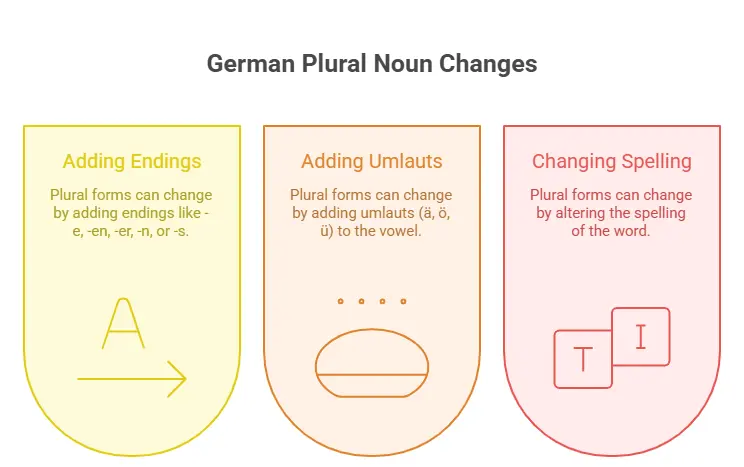
German plurals are not formed in only one way. The noun can change in different patterns. The main changes are:
1. Adding endings
Most German nouns become plural by adding an ending like -e, -en, -er, or -s.
Example:
- Hund → Hunde
- Frau → Frauen
- Kind → Kinder
2. Adding umlauts (vowel change)
Sometimes, the vowel inside the word changes by adding an umlaut (ä, ö, ü).
Example:
- Mann → Männer
- Vater → Väter
This small vowel change helps show plural meaning.
3. Changing spelling completely
In some cases, the noun changes more than just adding an ending or umlaut. The spelling becomes slightly different to form the plural.
Example:
- das Wort → die Wörter
- das Haus → die Häuser
Free German A1 Mock Tests – Powered by AI!
Test your skills on our interactive platform. Get instant feedback from our AI to help you communicate better and track your progress. Start your free German mock test now.
Test Your German A1 for FreeCommon German Plural Endings
In German, plural nouns are formed using different patterns or endings. There is no single rule, so we learn common groups to make it easier.
1. -e Plural
This is one of the most common ways to form plural nouns.
Examples:
- der Hund → die Hunde
- der Tag → die Tage
👉 Sometimes, the vowel inside the word also changes slightly. This is called an umlaut (ä, ö, ü).
Example with umlaut:
- der Mann → die Männer
This means the word changes both inside and at the end.
2. -er Plural
In this pattern, we add “-er” to make the noun plural. Some words also get an umlaut change.
Examples:
- das Kind → die Kinder
- das Buch → die Bücher
👉 Important point: Many nouns in this group also change the vowel (a, o, u → ä, ö, ü). This is the umlaut change.
So:
- Buch → Bücher (u → ü)
- Kind → Kinder (no umlaut here, but pattern still -er)
3. -n / -en Plural
This is a very common pattern, especially for feminine nouns (words with “die”).
Examples:
- die Frau → die Frauen
- die Blume → die Blumen
- die Studentin → die Studentinnen
👉 Simple rule:
- Most feminine nouns add -n or -en
- Some words double the “n” like Studentin → Studentinnen
4. -s Plural
This pattern is mostly used for foreign words (loanwords) or modern terms from English.
Examples:
- das Auto → die Autos
- das Hotel → die Hotels
👉 Simple point:
We just add “-s” at the end. It is very easy compared to other patterns.
5. No Change (Zero Plural)
German nouns not change at all in plural form in some cases. The word stays exactly the same.
Examples:
- der Lehrer → die Lehrer
- der Computer → die Computer
👉 Only the article changes to “die”, but the word remains unchanged.
Simple Summary
German plural nouns follow different endings:
- -e → Hunde, Tage
- -er → Kinder, Bücher
- -n / -en → Frauen, Blumen
- -s → Autos, Hotels
- No change → Lehrer, Computer
Each group has its own pattern, so learning with examples makes it easier to understand and remember.
|
Goethe 2026 Exam Dates: Multiple Test Centers |
|
| Trivandrum Goethe Exam Dates | Kochi Goethe Exam Dates |
| Chennai Goethe Exam Dates | Coimbatore Goethe Exam Dates |
Plural Nouns with Umlauts
In German, some nouns change their form in a special way when they become plural. One of these changes is called an umlaut change.
An umlaut is a small change in the vowel of the word. The vowel sound becomes slightly different, and two small dots are added above the vowel.
What is an Umlaut?
In plural forms, some German vowels change like this:
- a → ä
- o → ö
- u → ü
This change helps show that the word is now plural.
How umlauts work in plurals
Not all words use umlauts, but some common nouns do. Usually, the vowel in the middle of the word changes, while the rest of the word stays the same.
Examples of umlaut changes
- der Mann → die Männer
(a → ä) - der Sohn → die Söhne
(o → ö) - das Buch → die Bücher
(u → ü)
Simple explanation
- Singular word has normal vowels (a, o, u)
- Plural word may change those vowels into ä, ö, ü
- This change shows that there is more than one
Plural Articles in German
In German, every noun has an article. In singular form, the article depends on the gender of the noun. But in plural form, there is one very simple rule.
Main rule (very important)
👉 All plural nouns use the article “die”
👉 It does not matter what the singular gender was
So, whether the noun was der, die, or das in singular, it becomes die in plural.
Simple meaning
- Singular = different articles (der / die / das)
- Plural = always die
This makes plural easier in one way, because we do not need to think about gender anymore.
Examples
- der Hund → die Hunde
- die Frau → die Frauen
- das Kind → die Kinder
In all these examples, the plural form uses “die”.
Important point
👉 Gender is only important in the singular form
👉 It helps us know whether a noun is masculine, feminine, or neutral
👉 But in plural, gender does NOT matter anymore
Simple explanation
When a noun becomes plural:
- We change the word (sometimes)
- But the article always becomes “die”
Free German A1 Mock Tests – Powered by AI!
Test your skills on our interactive platform. Get instant feedback from our AI to help you communicate better and track your progress. Start your free German mock test now.
Test Your German A1 for FreeTips to Learn German Plurals Faster
Learning German plural nouns will be much easier if you follow some handy clever strategies. You should memorize everything immediately.
1. Learn nouns with their plural form
👉 Always learn a noun together with its plural form from the beginning.
Instead of learning only:
- der Hund
Learn like this:
- der Hund → die Hunde
This helps your brain remember both forms together.
2. Use flashcards
👉 Flashcards are a very helpful way to practice.
How to use:
- Write the singular form on one side
- Write the plural form on the other side
Example:
- Front: der Hund
- Back: die Hunde
You can quickly revise them anytime and improve memory.
3. Group nouns by plural endings
👉 Try to group words that follow the same pattern.
For example:
- -e ending: Hund → Hunde, Tag → Tage
- -er ending: Kind → Kinder, Buch → Bücher
- -n/-en ending: Frau → Frauen, Blume → Blumen
This makes learning more organized and less confusing.
4. Practice reading and listening
👉 The more you see and hear German, the faster you learn.
- Read simple German texts
- Listen to German conversations or audio
- Pay attention to plural words like “die Hunde” or “die Kinder”
This helps you understand how plurals are used in real life.
Common Mistakes
Many beginners make minor mistakes when learning German plural nouns. While these mistakes are common, correcting them early is much more important.
1. Wrong article in plural
👉 One very common mistake is using the wrong article.
❌ Wrong: der Hunde
✅ Correct: die Hunde
Simple explanation
In singular form, we use:
- der (masculine)
- die (feminine)
- das (neutral)
But in plural form, we NEVER use these.
👉 In plural, the article is always “die”
2. Forgetting the plural rule
Some learners think:
- “If it is der in singular, it will stay der in plural”
But this is not correct.
👉 Rule:
- Singular = der / die / das
- Plural = always die
3. Mixing singular and plural forms
Sometimes learners mix words and articles together.
Example mistake:
- ❌ der Kinder
- ❌ das Hunde
Correct forms:
- ✅ die Kinder
- ✅ die Hunde
Important point
👉 The most important rule to remember is:
- All plural nouns in German use “die”, no matter the word.
- German plural words change in different ways
- There is no single rule for all plural nouns
- Common plural endings are -e, -er, -n, -s
- Some words also change vowels using umlauts (ä, ö, ü)
- All plural nouns always use the article “die”
- Gender (der, die, das) is only important in singular form
- In plural, every noun becomes “die”, no matter what
Free German A1 Mock Tests – Powered by AI!
Test your skills on our interactive platform. Get instant feedback from our AI to help you communicate better and track your progress. Start your free German mock test now.
Test Your German A1 for FreeFrequently Asked Questions
1. What are German plural nouns?
- German plural nouns are words used for more than one thing
- Singular = one (der Hund)
- Plural = many (die Hunde)
How are plurals formed in German?
- There is no single rule
- Words can change by:
- Adding endings (-e, -er, -n, -s)
- Adding umlauts (ä, ö, ü)
- Changing spelling
What are the common plural endings?
- -e → der Hund → die Hunde
- -er → das Kind → die Kinder
- -n / -en → die Frau → die Frauen
- -s → das Auto → die Autos
👉 These are the most common patterns
What is an umlaut in plural nouns?
- Umlaut is a vowel change
- a → ä, o → ö, u → ü
- Example:
- der Mann → die Männer
- das Buch → die Bücher
Do all nouns follow the same plural rule?
- No, German nouns follow different patterns
- Some words even stay the same
- Example:
- der Lehrer → die Lehrer
What article is used for plural nouns?
- All plural nouns use “die”
- This rule is always true
Example:
- die Hunde
- die Bücher
- die Frauen
Does gender matter in plural form?
- No, gender matters only in singular
- In plural, all nouns use die
What is the best way to learn German plurals?
- Learn singular + plural together
- Use flashcards
- Practice daily
- Group words by endings