Table of Contents
Politely asking questions is a key skill for English conversation. These talents are essential! Showing respect for a teacher, colleague, or stranger through politeness is a terrific approach to set an example. Additionally, it makes you look more polished and competent. Truth is truth, regardless of who you’re talking to. English and other languages distinguish courteous and straightforward inquiries. Because English is the business language. This may help you interact with others more subtly and less aggressively.
Start speaking English like a native with our comprehensive course.
Difference Between Direct and Polite Questions
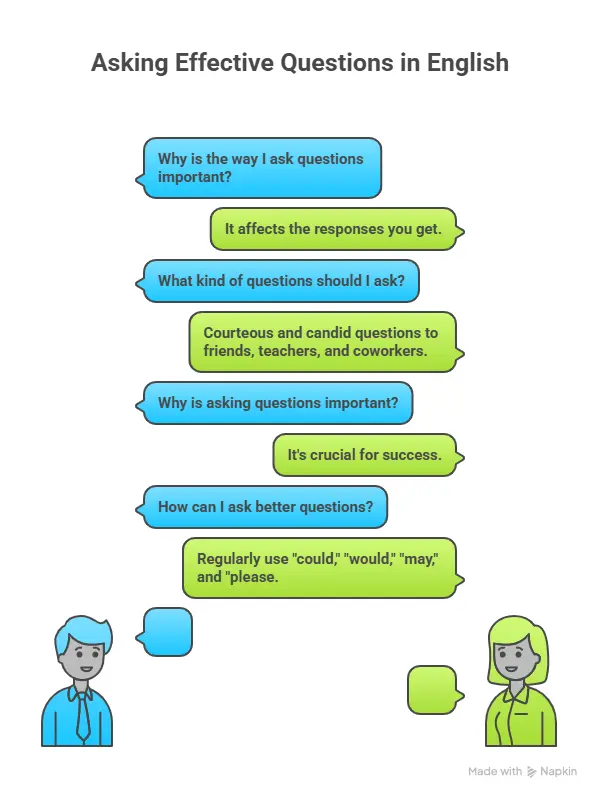
It is important to remember that how we construct queries while speaking English affects the responses we receive from others. Some queries are informal, while others are official and powerful. Because some inquiries are more casual. We must be able to ask courteous and candid questions to friends, teachers, and coworkers. This is because asking questions is crucial. Success requires this talent. We must regularly employ could, would, may, and please in speech. This will help us make a good impression and make us appear more polite than we are.
| Subject | Direct Questions | Polite Questions |
|---|---|---|
| Tone | Simple, sometimes difficult | Kind, respectful, friendly |
| Formality | Casual or informal use | For formal or dignified occasions. |
| Common Words Used | What, Where, Why, When, How | Could, Would, May, Can, Please |
| Purpose | To swiftly gather information | To politely request or show respect |
| Example 1 | Where is the bathroom? | Could you please tell me where the bathroom is? |
| Example 2 | Give me your notebook. | Could you please give me your notebook? |
| Example 3 | What’s your name? | May I know your name, please? |
| Effect on Listener | May seem rude or dictatorial if not careful. | Sounds pleasant and polite. |
Common Polite Question Structures in English
1: Which of the sentences below is grammatically correct?
You can make your request or question seem more considerate and sympathetic by following certain rules of polite query construction in English. One could find useful expressions like “would,” “may,” “can,” and “do you mind” in these forms. You may turn a simple request into a polite one by using these words. How about these examples of some of the most typical polite ways to pose a question?
| Structure | Example Question | Use / Meaning |
|---|---|---|
| Could you + base verb | Could you help me with homework? | Used for polite questions |
| Would you mind + -ing form | Would you mind opening the door | Used to politely request something. |
| Could you + base verb? | Could you provide me the details? | Requested gently or carefully. |
| Can I + base verb? | Can I sit? Can I borrow your pen? | Used to respectfully request permission. |
| Would it be possible to + base verb | Would it be possible to change the meeting time? | Used for polite, courteous inquiries. |
| Is it okay if / Would it be alright if + subject + verb | Is it okay if I come later? | Used to politely request permission. |
Join our Spoken English program today and communicate with ease!
Spoken English Course for Guaranteed Confidence and Career Growth
Spoken English Course by Entri App: Enhance your communication skills, gain certification, and boost your career with confidence.
Join Now!Polite Questions Using “Can”, “Could”, “Would”
In the English language, we frequently use the words “can,” “could,” and “would” in order to give the impression that our queries are more polite and attentive than they actually are. This is done for the aim of producing the desired effect. Each one has a somewhat different level of formality and tone than the others, despite the fact that they all contribute to making a request more approachable. Despite the fact that each of them contains the same quantity of information, this is the condition that exists. Take into account the following in order to understand the significance of this point:
Polite Questions Using “Can”
-
Can you pass me the book, please?
-
Can I use your dress for a day?
-
Can you help me with my work?
Polite Questions Using “Could”
-
Could you please open the door?
-
Could you tell me the way to the airport?
-
Could I have a glass of water, please?
Polite Questions Using “Would”
-
Would you like some coffee?
-
Would you mind helping me with this form?
-
Would it be okay if I came early tomorrow?
| Free PDFs for download | |
Polite Questions for Office and Workplace
How you ask questions to your supervisor and coworkers may affect how people view you. Remember this. Attention to this is crucial. Your behaviors will show that you appreciate others, can cooperate with them, and can communicate well with them. You can sound more courteous and professional by utilizing “could,” “would,” “may,” and “please” in your demands. This lets you sound more professional in your expectations. Because of how you expressed them, this is possible.
You can utilize the following formal questions at work or the office:
Requesting Help or Favors
- Could you help with this report?
- Could you review my presentation slides?
- What do you think of this design?
- Could you repeat?
Requesting Permission
- Can I leave early today?
- Can I use the meeting room briefly?
- Is working from home tomorrow okay?
- May I want a brief meeting?
Making Work-Related Requests
- Could you provide me the revised file?
- Can we postpone the meeting?
- Can you describe the project?
- Could I have that document?
Asking for Information or Clarification
-
Could you tell me when the deadline is?
-
Would you mind clarifying this point for me?
-
Can you please explain how this system works?
-
May I know who will attend the meeting?
Offering Help or Support (Polite Offers)
- Would you like me to do that?
- Can I assist with the report?
- Can I help organize the files?
- Do you mind if I handle this?
Polite Questions for Daily Conversations
Every single person, regardless of whether they are friends, coworkers, or total strangers, continually engages in the practice of asking questions to one another. Without exception, this holds true regardless of the nature of the interactions that take place. People will feel more at ease talking to you if you ask them nice questions, and you will appear more courteous in any circumstance if you do so. A growing number of individuals are responding in a considerate manner, which contributes to the formation of a favorable impression. In order to convey a sense of concern, it is advisable to employ phrases such as “can,” “could,” “would,” “may,” and “please.”
The following are some examples of pleasant inquiries that can be quite helpful in situations that occur in everyday life:
Asking for Help
-
Could you please help me carry this bag?
-
Can you tell me how to get to the bus stop?
-
Would you mind showing me the way?
-
Could you open the door for me, please?
Asking for Permission
-
May I sit here?
-
Can I borrow your pen for a moment, please?
-
Would it be okay if I used your phone?
-
Do you mind if I take this seat?
Offering Something
-
Would you like some water?
-
Can I get you a cup of tea?
-
Would you prefer to sit here?
-
Could I offer you some help?
Starting a Friendly Conversation
-
How are you doing today?
-
Could I ask where you’re from?
-
Would you mind if I joined you?
-
Can you tell me more about that?
Asking for Information
-
Could you please tell me what time it is?
-
Would you know where the nearest shop is?
-
Can you let me know when the movie starts?
-
May I know your name, please?
Elevate your speaking skills with our Spoken English Course!
Spoken English Course for Guaranteed Confidence and Career Growth
Spoken English Course by Entri App: Enhance your communication skills, gain certification, and boost your career with confidence.
Join Now!Polite vs Rude Question Examples
There are a number of factors that should be taken into consideration while attempting to differentiate between polite and unpleasant questions. The most essential of these are the choice of words, the amount of respect, and the tone of the conversation. Conversely, inquiries that are harsh or direct can come out as domineering, disrespectful, or abrupt to the person who is having the listening experience. This is because the individual is experiencing the listening experience. On the other hand, courteous queries have a greater probability of making the person who is participating in the conversation feel appreciated. This is because they are more likely to be received positively. The following are some examples that you should take into consideration before making your choice:
| Rude / Direct Question | Polite Question |
|---|---|
| What? | Sorry, could you repeat that, please? |
| Give me your phone. | Could I use your phone for a moment, please? |
| Where’s my book? | Do you know where my book might be? |
| Tell me now. | Could you please tell me when you have a moment? |
| Move this chair. | Would you mind moving this chair, please? |
| Why didn’t you do it? | Could you please tell me why this wasn’t done? |
| What are you doing? | May I ask what you’re working on? |
| Close the door. | Could you please close the door? |
Practice Examples of Polite Questions
This practice set aims to improve your polite request writing. Try learning how to say or write courteous forms on your own first, then watch how others react. You should consider this.
Rephrase Examples to Polite Questions
- Shut the window.
- Give me the book.
- Where’s the restroom?
- Tell me the time.
- Move your bag.
- Your name?
- Help me?
- Give me salt.
- Come sit.
- Open the door.
Polite Answers
- Could you close the window?
- Please give me the book.
- Excuse me, where is the bathroom?
- Please tell me the time.
- Please move your bag.
- Can I ask your name?
- Could you assist me?
- Please pass me the salt.
- Please let me sit.
- Please open the door.
Conclusion
To ask questions in English, it is important to be polite. So use “could,” “would,” “may,” “can,” and “please” when requesting. All of these characteristics make them seem more inviting than they are. Be polite while asking for anything, whether at work or at play. Keep this in mind continually. No matter what. This is always true. No other circumstance could exist.
Another benefit is that you’re more likely to get the right answer. Self-reflection is crucial. One can speak confidently without being rude by using polite words. Proper language attains this. You may maintain your career-long reputation by following this method. Hobbies make talking to you easier, more pleasant, and more pleasurable. Others will notice this instantly. This is due to future events.
Join our Spoken English program today and communicate with ease!
Spoken English Course for Guaranteed Confidence and Career Growth
Spoken English Course by Entri App: Enhance your communication skills, gain certification, and boost your career with confidence.
Join Now!Frequently Asked Questions
Is “can” rude to use?
No, “can” is not rude, but “could” and “would” sound more polite in formal situations.
When should I use “please”?
Use “please” at the beginning or end of a request to make it more polite. Example: Please pass the salt or Pass the salt, please.
What’s the difference between “could you” and “would you”?
Both are polite. “Could you” asks if someone can do something; “would you” asks if someone is willing to do it.
How can I sound more polite overall?
Use soft-toned words, say “please” and “thank you,” and show respect in your voice and body language.