Table of Contents
Switching from architecture to a BIM career is becoming an increasingly popular choice for professionals who want to blend design knowledge with modern technology. As the construction industry moves toward smarter, data-driven workflows, BIM offers architects an exciting opportunity to expand their skill set, improve project coordination, and stay relevant in a fast-evolving field. With a strong understanding of buildings and design processes, architects are already well-positioned to make this transition smoothly and successfully. In this blog, we will learn how architects can transition into a BIM career, the skills required to get started, and the steps needed to build a successful future in this evolving field.
Get Career Oriented BIM Certification Course with Expert Mentors! Get Free Demo Here!
Introduction
As the architecture industry continues to evolve, many professionals are rethinking their career paths and looking toward BIM as the next logical step. What once focused mainly on drawings and design aesthetics has now expanded into intelligent modeling, data management, and seamless collaboration. BIM is at the center of this shift, transforming how projects are designed, coordinated, and delivered.
For architects, moving into a BIM career is not a drastic change but a strategic progression. Your understanding of building systems, construction methods, and design intent already gives you a strong advantage. This blog will walk you through why BIM is a valuable career option for architects, how your existing skills fit into BIM roles, and what you need to do to make a smooth and confident transition into this growing field.
As the construction industry becomes more digital, the relationship between architects and BIM is stronger than ever. BIM has changed the way architects design, document, and coordinate buildings by turning drawings into intelligent, data-rich models. What was once a support tool is now a core part of modern architectural practice, influencing decisions from early design stages to project completion.
For architects, transitioning into a BIM career is a natural extension of their existing expertise. With a deep understanding of design intent, building systems, and construction workflows, architects are uniquely positioned to thrive in BIM-focused roles. In this blog, we will explore how architects can move into a BIM career, leverage their architectural background, and build a future in an industry that values both creativity and technology.
What “switching to BIM” really means for an Architect
For an architect, switching to BIM does not mean stepping away from design or creativity. Instead, it represents a shift in how architectural knowledge is applied, shared, and enhanced through technology. BIM (Building Information Modeling) transforms traditional architectural workflows into a more intelligent, data-rich, and collaborative process that supports the entire lifecycle of a building.
Rather than focusing only on drawings, BIM allows architects to build virtual representations of real buildings. These models carry detailed information about geometry, materials, quantities, performance, and sequencing. As a result, architects become more involved in coordination, problem-solving, and decision-making at every project stage.
Below is a clearer breakdown of what switching to BIM really means for an architect:
1. From Static Drawings to Dynamic Models
Architects move from producing isolated 2D drawings to creating interconnected 3D models. Any design change updates plans, sections, elevations, and schedules automatically, reducing errors and rework.
2. Greater Role in Project Coordination
BIM places architects at the center of coordination. Working with structural and MEP teams through shared models helps identify clashes early, saving time and cost during construction.
3. Stronger Technical and Digital Skills
Architects adopting BIM develop technical expertise in modeling standards, LOD, data accuracy, and software tools. Skills like automation, parametric design, and basic scripting become valuable additions.
4. Better Design Control and Quality
BIM helps architects maintain design intent throughout the project. Because information is centralized, design decisions are clearer and easier to track as the project evolves.
5. Expanded Career Pathways
Switching to BIM opens up specialized roles such as:
-
BIM Modeler
-
BIM Coordinator
-
BIM Manager
-
Digital Construction Specialist
-
Computational Designer
These roles often offer better career stability and international opportunities.
6. Involvement Beyond Design Phase
Architects in BIM roles contribute to construction planning, quantity takeoffs, and facility management, extending their influence beyond the design stage.
7. A Mindset Shift
More than software, BIM requires a collaborative and process-oriented mindset. Architects learn to think in systems, data, and workflows rather than isolated tasks.
Best BIM Career Paths for Architecture Graduates
BIM (Building Information Modeling) has created diverse, future-ready career opportunities for architecture graduates. As the AEC industry shifts toward digital design and integrated project delivery, BIM professionals are becoming essential to successful project execution. With a strong understanding of design principles, construction drawings, spatial planning, and building systems, architects can naturally transition into specialized BIM roles without starting from scratch.
Below are some of the best BIM career paths for architecture graduates, explained in detail to help you understand how each role fits into the industry and why it works well for architects.
1. BIM Modeler
Role Overview: A BIM Modeler is responsible for developing accurate and information-rich 3D models based on architectural concepts and construction requirements. This role involves converting design intent into detailed models that are used for drawings, coordination, quantity takeoffs, and project visualization.
Why It Suits Architects: Architecture graduates are already trained to read and create plans, sections, elevations, and details. This makes BIM modeling a natural extension of their academic and professional background. It is often the first step into the BIM world and helps build a strong technical foundation.
Key Skills Needed: Revit or Archicad proficiency, understanding of modeling standards, construction documentation, attention to detail, and basic BIM workflows.
2. BIM Coordinator
Role Overview: BIM Coordinators focus on collaboration and coordination between architectural, structural, and MEP teams. They manage combined models, run clash detection, and ensure that all disciplines work together smoothly throughout the project lifecycle.
Why It Suits Architects: Architects are skilled in spatial coordination and problem-solving, which are critical for identifying and resolving clashes before construction begins. Their ability to balance design intent with technical requirements makes them strong candidates for this role.
Key Skills Needed: Navisworks, clash detection processes, coordination meetings, communication skills, and understanding of multidisciplinary BIM workflows.
3. BIM Manager
Role Overview: A BIM Manager is responsible for overall BIM strategy and implementation across projects or organizations. This includes setting standards, defining workflows, managing teams, and ensuring quality and consistency in BIM deliverables.
Why It Suits Architects: This role is ideal for experienced architects who want leadership responsibility while staying connected to technology and project execution. It combines design understanding with management and decision-making.
Key Skills Needed: BIM standards and protocols, team leadership, project planning, advanced software knowledge, and process optimization.
4. Computational Designer / BIM Automation Specialist
Role Overview: This role focuses on improving efficiency through automation, parametric modeling, and custom workflows. Professionals use visual programming and scripting to automate repetitive tasks and optimize design processes.
Why It Suits Architects: Architects with an interest in logic, systems, and innovation can use computational design to enhance creativity while improving productivity.
Key Skills Needed: Dynamo, Grasshopper, basic scripting, parametric thinking, and analytical problem-solving.
5. Digital Construction / VDC Specialist
Role Overview: VDC specialists work closely with construction teams to integrate BIM with scheduling, cost estimation, and site planning. This includes 4D sequencing, 5D cost modeling, and construction coordination.
Why It Suits Architects: Architectural knowledge helps connect design intent with real-world construction processes, making architects valuable in bridging the gap between design and site execution.
Key Skills Needed: 4D and 5D BIM, construction sequencing, coordination tools, and collaboration with contractors.
Skills you Already have from Architecture (and how they Transfer)
If you come from an architectural background, you may already have more transferable skills than you realize. Architecture education and practice build a strong foundation that fits naturally into BIM and other digital roles. The key is understanding how your existing skills translate into new workflows rather than starting from zero.
1. Design Thinking and Spatial Understanding
Architects are trained to think in three dimensions, visualize spaces, and understand how buildings function as a whole. This skill transfers directly into BIM, where spatial coordination and model accuracy are critical. Your ability to foresee design conflicts and interpret complex layouts gives you an advantage in creating and managing BIM models.
2. Technical Drawing and Documentation
Producing plans, sections, elevations, and details is a core architectural skill. In BIM, this knowledge helps you generate coordinated drawings efficiently from a single model. Understanding drawing standards, scales, and construction documentation ensures high-quality BIM outputs.
3. Knowledge of Building Systems
Architects understand how architectural, structural, and MEP systems interact. This awareness is essential in BIM coordination, where identifying clashes and maintaining design intent across disciplines is a daily task.
4. Problem-Solving Skills
Architecture trains you to solve complex problems under constraints such as budget, regulations, and site conditions. BIM relies on the same mindset, especially when resolving coordination issues, optimizing workflows, or improving constructability.
5. Communication and Collaboration
Architects regularly communicate with clients, engineers, and consultants. These skills transfer directly into BIM roles, where teamwork and clear communication are essential for model coordination and project success.
6. Attention to Detail
Accuracy matters in architecture, and it matters even more in BIM. Your habit of checking dimensions, materials, and details helps maintain reliable and information-rich models.
7. Understanding of Project Lifecycle
From concept to construction, architects understand how projects evolve. BIM extends this lifecycle, allowing you to contribute meaningfully at every stage.
What you need to learn (Architecture BIM skill stack)
Moving from traditional architecture into a BIM-focused role requires building a clear and structured skill stack. While architects already possess strong design and construction knowledge, BIM adds a digital layer that focuses on data, coordination, and process efficiency. Learning BIM is not about mastering one software only—it is about understanding how technology supports the entire building lifecycle.
Core BIM Software Proficiency
The first step in the BIM skill stack is learning industry-standard software such as Revit, Archicad, or Bentley OpenBuildings. Architects must go beyond basic modeling and understand how to create intelligent elements, use parameters, manage families, and maintain model consistency. Knowing how to extract drawings, schedules, and quantities directly from the model is essential.
BIM Standards and Workflows
Understanding BIM standards is critical for working on real projects. This includes learning about Level of Development (LOD), naming conventions, model structuring, and file management. Architects must also understand how BIM Execution Plans (BEPs) guide collaboration and define responsibilities across teams.
Coordination and Clash Detection
BIM is highly collaborative. Architects need to learn how to work with structural and MEP models, perform clash detection using tools like Navisworks, and resolve conflicts efficiently. This skill reduces design errors and plays a major role in construction success.
Construction Documentation in BIM
Producing drawings in BIM requires a different mindset. Architects must learn how views, templates, and annotations work together. The focus shifts from drafting to managing views and data to ensure accurate documentation.
Data Management and Model Accuracy
BIM models are databases, not just geometry. Learning how to manage parameters, shared data, and schedules ensures that models remain reliable throughout the project lifecycle.
Basic Automation and Computational Skills
Understanding tools like Dynamo or Grasshopper helps automate repetitive tasks, improve productivity, and support parametric design. While not mandatory, these skills significantly enhance career growth.
Collaboration and Cloud-Based Platforms
Modern BIM projects rely on platforms like BIM 360 or ACC. Architects must learn version control, model sharing, and real-time collaboration workflows.
Continuous Learning Mindset
BIM evolves constantly. Staying updated with new tools, standards, and best practices is a crucial part of the skill stack.
90-day Switching Plan (Structured Roadmap)
Switching from architecture to a BIM-focused career can feel overwhelming without a clear plan. A structured 90-day roadmap helps you move step by step, building confidence and practical skills without disrupting your current workflow. This plan assumes you already have an architectural background and focuses on transforming that knowledge into BIM-ready expertise.
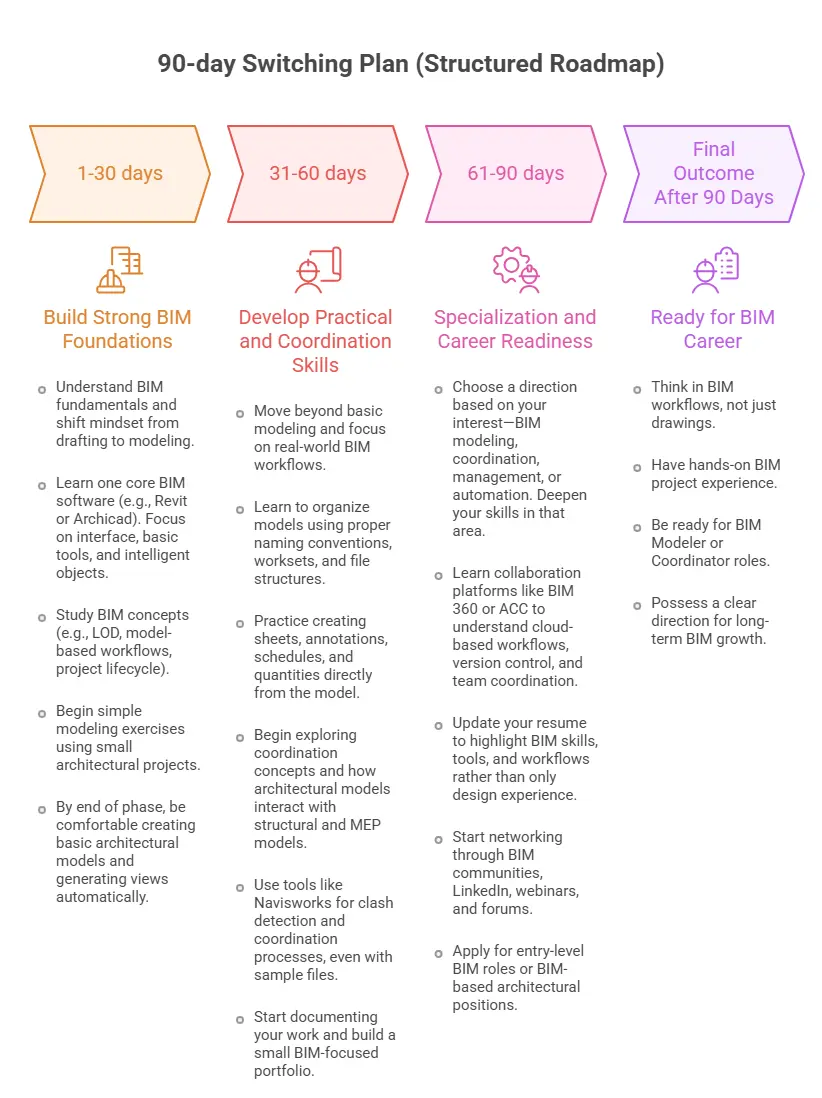
1-30 days: Build Strong BIM Foundations
- The first 30 days are about understanding BIM fundamentals and shifting your mindset from drafting to modeling.
- Start by learning one core BIM software, such as Revit or Archicad. Focus on understanding the interface, basic tools, and how BIM elements differ from traditional CAD drawings. Learn how walls, floors, doors, and windows behave as intelligent objects rather than lines.
- At the same time, study BIM concepts such as Level of Development (LOD), model-based workflows, and how BIM supports the full project lifecycle. Begin simple modeling exercises using small architectural projects to practice accuracy and consistency.
- By the end of this phase, you should be comfortable creating a basic architectural model, generating plans and sections from it, and understanding how changes update automatically across views.
31-60 days: Develop Practical and Coordination Skills
- In the second month, move beyond basic modeling and focus on real-world BIM workflows.
- Learn how to organize models using proper naming conventions, worksets, and file structures. Practice creating sheets, annotations, schedules, and quantities directly from the model. This helps you understand how BIM improves efficiency over manual drafting.
- Begin exploring coordination concepts. Learn how architectural models interact with structural and MEP models. Use tools like Navisworks to understand clash detection and coordination processes, even if only with sample files.
- Also, start documenting your work. Build a small BIM-focused portfolio that shows models, coordinated drawings, and workflows rather than just final visuals.
- By the end of 60 days, you should understand how BIM is used in active projects and feel confident producing coordinated documentation.
61-90 days: Specialization and Career Readiness
- The final 30 days focus on specialization and preparing for BIM roles.
- Choose a direction based on your interest—BIM modeling, coordination, management, or automation. Deepen your skills in that area. For example, if coordination interests you, focus more on clash detection and interdisciplinary workflows. If automation excites you, begin learning Dynamo or Grasshopper basics.
- Learn collaboration platforms like BIM 360 or ACC to understand cloud-based workflows, version control, and team coordination.
- Update your resume to highlight BIM skills, tools, and workflows rather than only design experience. Start networking through BIM communities, LinkedIn, webinars, and forums. Apply for entry-level BIM roles or BIM-based architectural positions.
Final Outcome After 90 Days
By following this roadmap, you will:
-
Think in BIM workflows, not just drawings
-
Have hands-on BIM project experience
-
Be ready for BIM Modeler or Coordinator roles
-
Possess a clear direction for long-term BIM growth
Switching to BIM is a transition, not a reset. With a focused 90-day plan, architects can confidently step into a future-ready BIM career.
Portfolio Requirements (what recruiters want to see)
When transitioning from architecture to a BIM-focused role, your portfolio becomes one of the most important tools for getting hired. Recruiters are not just looking for beautiful designs—they want proof that you understand BIM workflows, coordination, and real-world project requirements. A strong BIM portfolio clearly demonstrates how you think, model, and solve problems using BIM tools.
Clear BIM-Focused Project Examples
Recruiters want to see projects that highlight BIM usage, not just final visuals. Include 2–4 well-documented projects showing architectural models, coordinated drawings, and data-rich elements. Even academic or self-initiated projects are acceptable if they clearly demonstrate BIM skills.
Model Quality and Structure
Your models should be clean, well-organized, and logically structured. Recruiters often check how you name elements, manage levels, grids, and views, and follow modeling best practices. This shows that you understand professional BIM standards rather than just software commands.
Drawings Generated from the Model
Show plans, sections, elevations, and details that are directly extracted from the BIM model. This proves you understand model-based documentation and how changes propagate across drawings. Avoid manually edited drawings that break the BIM workflow.
Coordination and Clash Awareness
If possible, include examples of coordination work. Screenshots of clash detection, coordination views, or resolved issues demonstrate that you understand interdisciplinary workflows. This is especially important for BIM Coordinator roles.
Use of BIM Data and Schedules
Recruiters appreciate seeing schedules, quantity take-offs, or material data generated from the model. This shows that you understand BIM as a data-driven process, not just 3D modeling.
Workflow Explanation
Briefly explain your process for each project. Mention tools used, LOD achieved, coordination steps, and challenges solved. Recruiters want to understand how you think, not just what you produced.
Software and Skill Transparency
Clearly list the BIM tools and platforms used in each project, such as Revit, Navisworks, Dynamo, or BIM 360. Honesty matters more than listing too many tools.
Presentation and Clarity
Keep the portfolio clean and easy to navigate. Use simple layouts, clear labels, and concise explanations. A well-presented portfolio reflects professionalism and attention to detail.
Get Career Oriented BIM Certification Course with Expert Mentors! Get Free Demo Here!
Common Mistakes Architects make when Switching to BIM
Switching to BIM is a big shift, and many architects make similar mistakes during the transition. These mistakes are not due to lack of talent, but mostly due to mindset and habits carried over from traditional practice.
1. Treating BIM Like CAD
One of the most common mistakes is using BIM software as if it were just advanced drafting. Architects often draw lines instead of modeling intelligent elements. BIM works best when buildings are created as connected systems, not isolated geometry.
2. Focusing Only on Software, Not Process
Many architects spend time memorizing tools and shortcuts but ignore workflows. BIM is about how information flows through a project—from concept to construction—not just how fast you can model.
3. Ignoring Model Structure and Standards
Unorganized levels, poor naming conventions, and messy views are red flags in BIM projects. Recruiters and project teams quickly notice models that lack structure and consistency.
4. Over-Detailing Too Early
Architects often try to perfect models in early stages. In BIM, the level of detail should match the project stage. Over-modeling wastes time and creates coordination issues later.
5. Weak Coordination Mindset
Some architects focus only on architectural models and avoid coordination with structural and MEP teams. BIM roles demand collaboration, communication, and coordination skills.
6. Underestimating the Learning Curve
BIM takes time to master. Expecting instant productivity leads to frustration. Strong BIM professionals build skills gradually through real project experience.
7. Poor BIM Portfolio Presentation
Many architects present design-heavy portfolios with little BIM explanation. Recruiters want to see workflows, coordination, data usage, and problem-solving—not just visuals.
Should you Self-learn or join a Structured Course?
When transitioning into BIM, one of the biggest questions architects face is whether to self-learn or enroll in a structured course. Both paths can lead to success, but the right choice depends on your learning style, career goals, and time availability.
Self-Learning: Flexibility and Independence
Self-learning is a popular option for architects who are already working or prefer learning at their own pace. With access to tutorials, documentation, and online communities, it’s possible to build BIM skills independently. Self-learning allows you to focus on specific tools or workflows you need and revisit topics as often as necessary.
However, this approach often lacks direction. Many self-learners struggle with understanding industry standards, real-world workflows, and best practices. Without guidance, it’s easy to develop bad habits that later need correction. Progress can also feel slow and inconsistent, especially without feedback.
Structured Courses: Direction and Real-World Context
A structured BIM course provides a clear learning path. These programs are designed to cover not only software tools but also workflows, standards, coordination methods, and practical project scenarios. For architects new to BIM, this guidance can significantly shorten the learning curve.
Structured courses also offer accountability, mentorship, and exposure to real industry use cases. Many programs include portfolio development, which is valuable when applying for BIM roles. The downside is reduced flexibility and, in some cases, higher costs.
Which Option Is Better?
There is no one-size-fits-all answer. Self-learning works well for highly disciplined learners with prior BIM exposure. Structured courses are ideal for those seeking faster, more reliable career transitions with industry-aligned skills.
Balanced Approach
For many architects, the best solution is a hybrid approach—starting with a structured course to build strong foundations, then continuing with self-learning to specialize and grow.
Get Career Oriented BIM Certification Course with Expert Mentors! Get Free Demo Here!
Conclusion
Switching from architecture to a BIM career is not about starting over—it’s about evolving with the industry. Architects already possess the core skills needed to succeed in BIM, from design thinking to technical understanding and problem-solving. BIM simply adds a powerful digital layer that allows you to work smarter, collaborate better, and stay relevant in a rapidly changing construction landscape. With the right skills, mindset, and learning path, BIM can open doors to diverse roles, global opportunities, and long-term career growth.
Master BIM and Elevate Your Career – Enroll Today!
Stay ahead in the construction and design industry with our comprehensive BIM Course! Learn Building Information Modeling (BIM) from experts, gain hands-on experience with top software, and boost your career prospects. Join now and become a certified BIM professional!
Know MoreFrequently Asked Questions
Is BIM a good career option for architects?
Yes, BIM is an excellent career option for architects. The construction industry is increasingly digital, and BIM skills are in high demand globally. BIM allows architects to expand beyond traditional design roles and work in coordination, management, and technology-driven positions with strong career growth.
Do I need to stop practicing architecture to switch to BIM?
No. BIM is not a replacement for architecture but an extension of it. Many architects continue working in design-focused roles while using BIM tools. Others transition fully into BIM roles such as Coordinator or Manager, depending on their interests.
How long does it take to learn BIM properly?
Basic BIM skills can be learned in 2–3 months with focused effort. However, becoming confident in real project workflows typically takes 6–12 months of hands-on experience. BIM learning is continuous, as tools and standards evolve.
Is Revit enough to build a BIM career?
Revit is a strong starting point, especially for architectural BIM. However, a successful BIM career also requires understanding coordination tools, workflows, standards, and collaboration platforms. BIM is about process, not just software.
Can fresh architecture graduates enter BIM roles directly?
Yes. Many companies hire fresh graduates as BIM Modelers or junior coordinators. A strong BIM-focused portfolio and clear understanding of workflows are more important than years of experience.
Do BIM jobs pay more than traditional architecture roles?
In many regions, BIM roles offer better pay and faster growth compared to traditional drafting or junior architect roles. Salaries vary by location, experience, and specialization.
Is coding mandatory for a BIM career?
No. Coding is not mandatory for most BIM roles. However, learning basic automation tools like Dynamo or Grasshopper can improve efficiency and open advanced career paths.
What kind of portfolio do BIM recruiters prefer?
Recruiters prefer portfolios that show BIM workflows, model quality, coordination examples, and drawings generated from models. Clear explanations matter more than flashy visuals.
Can I self-learn BIM and still get hired?
Yes, many professionals succeed through self-learning. However, you must ensure your skills align with industry standards and real project workflows. Structured learning can reduce trial-and-error.
Is BIM a long-term career or just a trend?
BIM is a long-term industry shift, not a temporary trend. Governments, large firms, and infrastructure projects worldwide mandate BIM, making it a stable and future-proof career choice.