Table of Contents
AI is driving software testing’s rapid evolution. AI has become a practical technology that is changing how QA testers work in modern development settings in 2026.
AI use is crucial for QA personnel to compete. AI can automate tedious processes, analyze enormous amounts of data, and find errors faster. This lets testers concentrate on critical thinking and complicated scenarios rather than manual labor.
Testing teams may enhance productivity, execution cycles, and defect discovery with AI. AI ensures high-quality software releases without delaying development as software releases increase.
Key Takeaways
- AI improves speed, accuracy, and coverage in QA testing while reducing manual work.
- It adapts to application changes and learns from data, unlike traditional automation.
- Test case generation, bug prediction, visual, API, and regression testing are key uses.
- Testim, Applitools, and ChatGPT improve QA workflows.
- Methodically identify repetitive jobs, choose tools, and integrate them with CI/CD processes.
- Actual application indicates AI can reduce testing time and find edge-case issues.
- Predictive testing, autonomous systems, and AI-driven DevOps will dominate QA.
Develop a foundational understanding in Software Testing through our free materials!
What is AI in QA Testing?
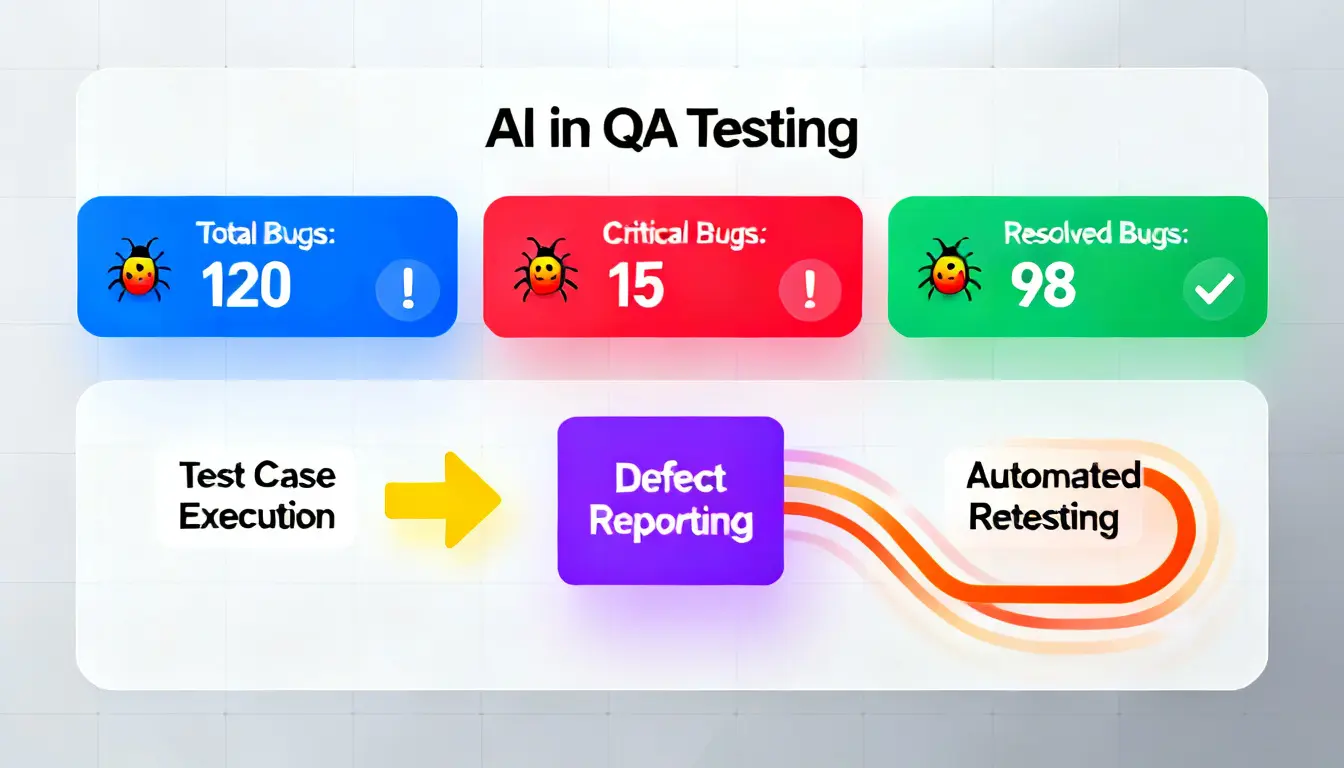
In the context of quality assurance testing, the term “artificial intelligence” (AI) refers to the application of intelligent algorithms and machine learning in order to make testing more efficient, intelligent, and less reliant on human labor. To put it another way, artificial intelligence makes it possible for testing tools to learn from data, adjust to changes, and make decisions rather than simply obeying predetermined instructions.
How AI Differs from Traditional Automation
Traditional methods of test automation rely on scripts that have been predefined. Exactly what is said is carried out by it; neither more nor less is done. In the event that the application undergoes any modifications, such as a button ID or UI layout, the script frequently crashes and requires manual upgrades.
In contrast, testing that is led by artificial intelligence is more adaptable and versatile. It is able to:
- Gain knowledge from your past attempts at the test.
- Automatically adjust to changes in the user interface or the code
- In order to identify patterns and anticipate prospective problems,
It is because of this that artificial intelligence is more robust and efficient than rule-based automation.
Examples:
- Predictive analysis – AI analyzes prior faults and test data to predict application failures, helping testers focus on high-risk regions.
- Self-healing scripts—AI-powered tools update test scripts instead of failing when UI elements change, decreasing maintenance.
- Smart Test Case Generation – AI can generate test cases from user behavior, requirements, or past test situations, enhancing coverage.
Why QA Testers Should Use AI
1: What is software testing?
AI helps QA testers offer better results faster, not simply as a trend. Why adopting AI matters:
- Quicker Testing
AI runs and prioritises test cases faster than manual or automated methods. It prioritises risk-based testing to speed up release cycles without compromising quality.
- Improved Bug Detection
AI finds hidden or sophisticated problems by analyzing trends, past defects, and user behavior. This allows testers to find issues earlier, even those missed by conventional testing.
- Better Test Coverage
AI can generate and run more test scenarios, including edge cases. Thus, more application pieces are evaluated, improving software quality and reducing production concerns.
- Reduced Manual Work
AI can automate regression testing, data validation, and script maintenance. This lets testers focus on exploratory testing, usability, and critical thinking rather than regular labor.
Master Testing Skills with Industry Experts
Become a Test Engineer: Learn Core Skills from Industry-Leading Mentors and Land High-Paying Testing Jobs!
Explore ProgramKey Use Cases of AI in QA Testing
Software testing is becoming smarter, faster, and more dependable using AI. Most important usage cases:
Test Case Generation
Test cases can be generated by AI from requirements, user stories, or application behavior. Pattern analysis and meaningful test scenarios reduce manual case writing and improve coverage.
Bug Prediction
AI predicts application failures by analyzing past defect data and code modifications. This improves QA teams’ attention on high-risk areas and early defect prevention.
Visual Testing
AI-powered visual testing tools find UI discrepancies that automation misses. They can spot layout flaws, colour mismatches, and broken designs across devices and browsers.
Automating API Testing
AI generates test requests, validates responses, and finds abnormalities to simplify API testing. Backend testing is faster and more efficient since it learns expected behaviors and flags deviations.
Regression Testing
AI selects the most relevant test cases based on code changes to improve regression testing. Auto-healing scripts reduce maintenance when the application UI or logic changes.
How to Use AI as a QA Tester (Step-by-Step Guide)
Adopting AI in QA doesn’t have to be complicated. By following a structured approach, you can gradually integrate AI into your testing workflow and see real results.
Step 1: Identify Repetitive QA Tasks
AI in QA is easy to implement. With a disciplined strategy, you can gradually integrate AI into your testing workflow and see results.
Analyze your testing procedure. Find tasks that are:
- Time-consuming
- Repetitive
- Rule-based
Examples include regression testing, test data creation, and test case writing. These are ideal areas where AI can add immediate value.
Step 2: Select AI Tools
Tool selection depends on project needs and skill level. As an example:
- ChatGPT—test case and debugging generator
- Testim allows UI automation
- Applitools—visual testing
Try one or two tools before trying everything.
Step 3: Train or Configure the Tools
AI tools need a correct configuration to work. This may include:
- Historical test data feed
- Rules or scenarios for testing
- Environment and process configuration
Machine learning and smart configuration tools require setup.
Step 4: Integrate with CI/CD Pipelines
Use Jenkins or GitHub Actions to integrate AI technologies into delivery pipelines. It guarantees:
- Every build, automated testing
- Developers get feedback faster
- Monitoring quality continuously
Step 5: Evaluate and Improve
You must review and improve AI after implementation.
- Examine defect trends and test reports
- Improve AI and test cases
- Remove low-value or superfluous tests
Optimization makes testing smarter and more efficient over time.
Popular AI Tools for QA Testers
Here are some of the most widely used AI-powered tools that QA testers rely on in 2026, along with their key features and real-world use cases:
ChatGPT
The AI helper helps testers generate ideas, write test cases, debug code, and explain mistakes rapidly.
Use Cases:
- Generating test cases from requirements
- Debugging automation programs
- Bug and error log explanations
- Set up API tests
Testim
Automates stable and scalable test scripts with minimum maintenance using AI.
Key Features:
- Self-repairing test scripts
- Smart element finders
- Quick test creation
Use Cases:
- Automating UI tests
- Regression testing
- CI/CD pipeline integration
Applitools
A top visual testing tool that uses AI to detect browser and device UI discrepancies.
Key Features:
- Visual AI comparison
- Cross-browser testing
- Validating pixels
Use Cases:
- Visual regression testing
- UI consistency tests
- Validating responsive design
Functionize
A powerful AI testing platform that lets testers write tests in simple English.
Key Features:
- Creating NLP tests
- Auto-healing automation
- Full testing support
Use Cases:
- Enterprise-level testing
- Workflows are complicated
- API+UI automation
Mabl
A cloud-based AI testing solution for Agile and DevOps continuous testing.
Key Features:
- Auto-heal scripts
- Smart regression testing
- CI/CD integration
Use Cases:
- Completion testing
- Continuous testing pipelines
- API and performance testing
Master Testing Skills with Industry Experts
Become a Test Engineer: Learn Core Skills from Industry-Leading Mentors and Land High-Paying Testing Jobs!
Explore ProgramReal-World Examples / Use Cases
AI in QA is not just theoretical—it’s already delivering measurable results across industries. Here are some powerful real-world examples:
Example: AI Reducing Testing Time
A 14-day regression testing cycle plagued a financial services organization. After AI-powered testing with smart test selection and self-healing scripts:
- Testing went from 14 days to 4 hours.
- QA teams cut manual maintenance considerably.
This shows how AI may accelerate release cycles without compromising quality.
AI-driven automation speeds up testing cycles for Infosys by 50%.
Example: AI Detecting Edge-Case Bugs
While traditional automation ignores unexpected situations, AI excels at researching real-world environments.
- AI-based testing tools imitate varied user inputs and behaviour.
- This reveals edge-case bugs scheduled for testing overlook.
- One instance of AI-driven testing found website usability concerns that conventional techniques missed.
AI increases test accuracy by covering unpredictable inputs.
Industry Adoption Insights
AI QA use is rising rapidly across industries:
- Over 70% of large companies use AI-driven testing.
AI is used by Google and Facebook for:
- Smart test choice
- Optimising regression
- UI bug detection
AI can cut large-scale regression processes from hours to minutes.
Develop a foundational understanding in Software Testing through our free materials!
Challenges of Using AI in QA
AI aids software testing, QA testers should know its drawbacks:
Learning
Machine learning, tool setups, and data processing are needed for AI technologies. These tools may take time to master for testing.
Cost of Tools
AI-powered testing platforms charge licenses and setup. Compared to normal open-source technologies, this can be difficult for small teams or beginners.
Data-dependent
Quality data is essential for AI. Misleading results from poor input data may affect test reliability and results.
Risks of Overreliance
Overusing AI is dangerous. AI-generated test cases and results may be wrong; human validation is needed to ensure quality.
Best Practices
To maximise AI testing value, use clever and practical methods. Proven best practices:
Manual + AI Testing
While powerful, AI works best with human expertise. Use AI for repetitive, data-heavy activities and manual testing for exploratory, usability, and edge-case scenarios.
AI-Generated Test Case Validation
While AI can generate test cases quickly, they are not necessarily flawless. Check and verify to ensure:
- Focus on accuracy and relevance
- Complete coverage
It reduces false positives and undetected defects.
Begin Small, Grow
Avoid implementing AI everywhere at once. Start small with regression testing or test case development. Introduce AI to your QA processes progressively after seeing results.
Maintain Human Oversight
It should support testers, not replace them. Always include people:
- Decision-making
- Test scenarios of importance
- Final verification
Quality, reliability, and user experience are improved by human judgment.
Future of AI in QA Testing
Artificial intelligence will make software testing smarter, more proactive, and more integrated into development workflows. The future’s biggest trends:
QA prediction
Testing will become proactive with AI. Artificial intelligence will analyze previous data, code modifications, and user behavior.
- Forecast flaws.
- Pre-identify high-risk regions
- Advise teams on testing priorities
This reduces production bugs and improves program reliability.
Tests autonomously
Self-operating testing technologies with minimum human interaction are the future of QA. The systems will:
- Automate test case creation, execution, and updates
- Adjust to application changes with self-healing.
- Continue to improve from test findings
Self-testing will greatly decrease manual labor and maintenance.
AI-Powered DevOps
AI will power DevOps pipelines for smarter, quicker delivery. It will:
- Improve CI/CD workflows
- Code updates trigger appropriate tests automatically.
- Give developers immediate feedback
Continuous quality and delivery are guaranteed by this tight integration.
Conclusion
AI helps to improve, speed up, and streamline quality assurance testing. Through the use of automated test case generation, predictive bug identification, and self-healing scripts, artificial intelligence provides testers with assistance in terms of correctness, reliability, and test coverage.
In a nutshell, artificial intelligence does not replace quality assurance testers but rather enables them. In the technology business, intelligent testers have the ability to increase software quality, speed up release cycles, and compete with other companies.
In your testing cycle, now is the ideal time to begin experimenting with artificial intelligence (AI). You should begin with straightforward use cases, make use of well-known tools such as ChatGPT, and then add abilities.
Learn artificial intelligence testing tools and practice on real projects right now to develop quality assurance abilities that are ready for the future.
Frequently Asked Questions
Is AI testing suitable for beginners?
Yes, beginners can start with simple AI tools like ChatGPT to generate test cases and understand concepts. Gradually, they can move to advanced tools as they gain experience.
Is coding required for AI testing?
Not always. Many AI tools offer low-code or no-code features. However, having basic coding knowledge can be an advantage.
What is the future of AI in QA testing?
The future includes predictive QA, autonomous testing, and AI-driven DevOps, where testing becomes more proactive and fully integrated into development pipelines.
How is AI different from automation testing?
Traditional automation follows fixed scripts, while AI can learn from data, adapt to changes, and make intelligent decisions, reducing script maintenance.
What is self-healing in AI testing?
Self-healing allows test scripts to automatically adjust when UI elements change, reducing test failures and maintenance effort.
Is AI testing useful for Agile and DevOps?
Yes, AI integrates well with Agile and DevOps by enabling continuous testing, faster feedback, and smarter test execution within CI/CD pipelines.
Does AI improve software quality?
Yes, AI improves quality by increasing test coverage, detecting hidden bugs, and reducing human errors in repetitive tasks.
Are AI testing tools expensive?
Some tools are paid, but there are also affordable and free options available. Beginners can start with tools like ChatGPT before moving to advanced platforms.
Is AI testing secure and reliable?
AI tools are generally reliable, but results depend on data quality and proper configuration. Human validation is still important for critical applications.
Will AI testing be in demand in the future?
Yes, AI-driven testing skills are highly in demand as companies move toward faster, smarter, and more automated development processes.