Table of Contents
Quick Summary
Choosing between SAP and an MBA isn’t about which credential has more raw market value. It’s about identifying where you want to sit in a corporate architecture.
- SAP is better if you want to be a deeply specialized technical or functional architect, fixing specific enterprise software wheels inside massive supply chains or finance frameworks without spending two years out of the workforce.
- An MBA is better if your goal is long-term lateral mobility, people management, and broad operational strategy where your day-to-day relies on reading spreadsheets, managing cross-functional teams, and steering corporate direction rather than configuring a software ecosystem.
Key Takeaways
- The Time Sink: SAP requires an intense 2-to-6-month sprint focused entirely on vendor software logic. An MBA is a systematic, 2-year lifestyle shift and academic commitment.
- Upfront Capital: SAP certifications are lean, costing between ₹50,000 and ₹3,00,000. An MBA demands a significant financial runway, ranging from ₹4,00,000 to over ₹25,00,000 depending on the institute’s tier.
- The Exit Architecture: SAP traps you happily inside a lucrative, global ERP niche. An MBA keeps the door open to pivot from tech to consulting, FMCG, or banking at will.
Introduction
When talking to a mid-level professional who’s hitting a career roadblock, the conversation tends to gravitate towards a few distinct escape routes. For a while the default advice was to buckle down and crack open a textbook – splash out on an education loan & pursue a business school degree.
But the landscape has changed. With enterprise software driving modern business operations, targeted technical credentials have quietly become highly viable alternatives to traditional management degrees. The choice between diving into the niche world of SAP consulting or taking the broader MBA route is no longer a simple hierarchy. It is a fundamental choice between becoming a master of a specific corporate engine or learning how to manage the entire factory.
Join Entri’s SAP FICO Training Course today!!
Master SAP with Expert-Led Courses
Unlock your potential with our comprehensive SAP courses! Learn essential modules like SAP MM (Materials Management), SAP SD (Sales and Distribution), and SAP FICO (Financial Accounting and Controlling) from industry experts.
Know MoreUnderstanding the Basics
To compare these paths properly, we have to look past the marketing brochures and see what these credentials actually look like on a random Tuesday at the office.
What is SAP?
SAP isn’t just a tech tool; it’s the operational spine of almost every fortune 500 company on Earth. When you get certified, you aren’t learning general business theory you are mastering the digital piping that connects a company’s warehouse to its bank account.
- The functional side (FICO, MM, SD): This is where you translate traditional business actions like tracking a shipment of raw materials or closing the quarterly books into software logic.
- The technical side (ABAP, HANA): This is the underlying engine room, where you write custom code and manage data architectures to keep the system running smoothly.
What is an MBA?
A Master of Business Administration is a fundamentally different beast. It is an academic degree designed to teach you the vocabulary of leadership. Instead of mastering a specific piece of software, you spend two years studying how organizations behave, how capital moves, how products find markets, and how to manage teams without losing productivity. It’s less about executing a process perfectly and more about deciding which processes are worth executing in the first place.
SAP vs MBA – Core Differences
The fundamental differences come down to specialization versus scope. Here is how they stack up side by side:
| Feature | SAP Certification | MBA Degree |
| The Real Credential | A specialized technical vendor stamp. | A formal postgraduate academic degree. |
| What You Master | Exact software logic and enterprise system architecture. | Corporate strategy, financial analysis, and human leadership. |
| The Grind | A focused technical sprint (2 to 6 months). | A 2-year cultural immersion and academic commitment. |
| Career Longevity Factor | Highly dependent on the tech stack and system relevance. | Highly resilient across varying industries and market shifts. |
| The Financial Risk | Low financial barrier with a highly predictable return. | High financial stakes heavily dependent on business school tiering. |
Career Outcomes – What Happens After Each?
The SAP Career Path
If you take the SAP route, your immediate professional ecosystem will likely be a global tech consultancy or a massive systems integrator.
[Associate Consultant] ➔ [Functional Lead] ➔ [Solutions Architect] ➔ [Global Delivery Director]
In the early years, the work was highly tactical. You might find yourself on a multi-month client deployment in a manufacturing hub, mapping out exactly how a client’s inventory tracking system integrates with their regional tax laws. It’s an analytical, problem-solving existence where your value is tied to your technical precision.
The MBA Career Path
An MBA will take you down a path that’s all about running an organisation and being in charge of the big picture.
Management Trainee ➔ Assistant Manager ➔ Department Head ➔ Business Unit VP/CXO
– that’s the typical trajectory you’ll be on. But the early days on this path aren’t usually about setting up new systems; they’re all about managing people, hitting deadlines and keeping track of the budget. You might start out in a company as a product lead, working with the design, engineering and sales teams to launch a new service line, or join a consultancy to help a company sort out a restructuring plan. Your day will be more about making things work together, having meetings and figuring out the right strategy to take. That’s a far cry from worrying about the details of a system – it’s more about getting everyone in line and navigating the bigger picture.
Master SAP with Expert-Led Courses
Unlock your potential with our comprehensive SAP courses! Learn essential modules like SAP MM (Materials Management), SAP SD (Sales and Distribution), and SAP FICO (Financial Accounting and Controlling) from industry experts.
Know MoreSalary Comparison in 2026
While it is true that the financial returns of each of the two career paths are generally discussed in terms of broad averages, actual values of these returns will be highly dependent on market timing and an individual expert’s personal circumstances.
The Realistic SAP Paycheck
- The Starting Phase (0-1 Years): ₹4 LPA to ₹9 LPA depending on if successful candidate receives an offer for “standard” training program from leading global consulting firm
- The Sweet Spot (5-9 Years): ₹8 LPA to ₹15 LPA; this is when your GP experience in implementations will begin to create your value in relationship to market.
- The Elite Architect (10+ Years): ₹17 LPA to ₹39+ LPA (i.e. top earners at these levels) typically are not generalist consultants, they got into the cloud migrations early in the process, are knowledgeable on how to integrate AI into an S/4HANA system and can talk to potential corporate clients without sounding like a software manual.
The Real-World MBA Paycheck
- Tier-3 Local B-Schools: ₹4 LPA to ₹8 LPA; due to large volume of candidates from these schools entering the workforce seeking similar opportunities as those with degrees from Tier-1 B-Schools, MBA degrees from Tier-3 B-Schools are simply entry-level requirements for standard corporate job opportunities.
- Tier-2 Regional B-Schools: ₹8 LPA to ₹15 LPA; generally these programmes provide good, secure, steady placement for graduates at jobs in the mid-market and/or regional markets.
- Tier-1 Premium Institutes (Top IIMs / Elite B-Schools): ₹18 LPA to ₹40+ LPA; upon graduation; typically receive high level positions as associates within well-established corporations.
Which One Has Better Demand in 2026?
The market dynamics for both roles reflect broader corporate spending priorities:
- The Core Demand for SAP: SAP’s Core Demand: Many companies are on a mission to replace their legacy on-premise data center environments with new cloud-based systems. There has been steady demand for these solutions over the past few years, as there is no way for a company to postpone a strategic growth opportunity while they await the rollout of upgraded software that supports critical business functions like payroll and inventory.
- The Core Demand for MBAs: The general managerial focus of the last decade has changed into one around data analytics to drive business strategies and digital transformation. Companies continue to have strong demand for MBAs; however, they have become much more selective and are actively looking for business candidates that possess strong analytical skills in addition to the traditional business mindset.
Who Should Choose SAP?
If you are considering SAP certification as a career choice, it will be a fit if you meet one or more of these criteria:
- Your Background: You currently work in IT, engineering, or computer science, or you have a degree in business and you find value in understanding how business systems work.
- Your Personality: You like thinking about “why” something happened, have the ability to think through a structured approach to problem solving, and enjoy determining how data flows through organizations.
- Your Constraints: You want to transition careers within the next 12 months, or you cannot afford to stop earning and go back to school for two years, or you would prefer to avoid paying off student loans for the next several years.
Who Should Choose MBA?
An MBA is the right move if your professional goals look a bit different:
- An MBA may be beneficial if you wish to do something other than a purely execution-oriented or technical role:
- Your Previous Work: You want to leave a “race”/execution-driven environment (such as coding or providing technical support) for an environment that has decision-making power over commercial decisions.
- Your Approach: You enjoy working with others to create agreement through team development and solving unstructured business problems.
- Your Future Plans: You want a tool kit that gives you the flexibility to move across functions (logistics to marketing to finance) in the future, ultimately with a view to senior corporate leadership.some degree of decision-making power (company profit and/or loss).
Cost vs ROI Analysis
The financial calculation here isn’t just about the cost of tuition; it’s about evaluating opportunity cost and speed to recovery.
An SAP certification is fundamentally a low-risk, high-probability bet. You invest a modest sum and a few months of study, and you can often recoup that cost within your first few months on a new project assignment. It’s a pragmatic, linear return on investment.
Conversely, a premier MBA is a significant/high-risk/high-stakes bet; you incur substantial out-of-pocket and forgone earnings costs associated with tuition and being out of work. However, you will also incur significant career opportunity while in an MBA program and after receiving your MBA.
Can You Do Both SAP and MBA?
An individual with this combination of skills could create a successful career niche. For example, someone who understands the corporate strategy and how an ERP system will handle multi-currency transactions. An example of where this person would bring tremendous value is to a major consulting firm.
The order in which you receive your credentials matters if you go the MBA route to provide a broad understanding of how business operations function. Once you obtain your MBA, a certification such as an SAP certification will help you determine your specialization in a particular SAP module like FICO (Financials and Controlling) or Supply Chain Management. Once you balance both ground level (technology) skills with your corporate strategy skills, you will have a successful future in a senior role of enterprise consulting or systems strategy development – which is bridging the gap between business leadership and technology implementation.
Practical Decision Framework
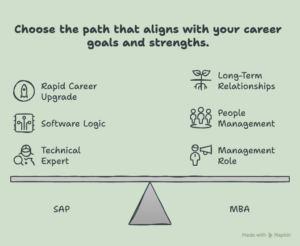
If you’re still unsure of which path to take, here’s a quick way to cut out the confusion by answering these 3 questions directly:
- How long do I have to advance my career? If you need a rapid upgrade with little-to-no new debt or a suspension of income, then SAP might be the best choice. If time and money allows you to develop long-term relationships and can cope with a broader scheme change, then an MBA may be your first priority.
- What type of problems are my strengths? If you like to work with software logic, develop system workflows, and put functional configurations together, look at SAP. If you are strong in managing a group of people, developing a business case, and helping the business grow, look to the MBA.
- What is my ten-year goal? If you want to be a technical expert with global credibility who can walk into a complex system and repair the system, then focus on SAP. However, if you want to manage the operating function of the organization, manage the budget for that function, and assist in driving the overall team, focus on the MBA.
Join Entri’s SAP FICO Training Course today!!
Conclusion
Truth is, neither path is inherently the “right” choice – they’re just two sides of the same coin, serving up different career mindsets. On the other hand, getting an SAP certification is a great way to take a more targeted approach. For a fraction of the cost, it can take you straight into the world of specialized enterprise consulting, and give you a clear, direct path to high-paying technical roles. Business school, on the other hand, is a more general, higher-investment play. It’s designed to get you the skills & credentials you need to take on executive leadership, and be ready to adapt to whatever industry comes your way, plus learn strategic management skills. Just make sure you’re choosing the one that best fits your strengths – what can you actually bring to the table, and what are you looking to get out of your next step.
| Related Links | |
| What Is SAP? Where is it Used? | Top MNCs Hiring SAP Global Certified Professionals |
| Who Can Take Sap Global Certifications? | Top Companies Hiring SAP FICO Roles in Chennai |
Master SAP with Expert-Led Courses
Unlock your potential with our comprehensive SAP courses! Learn essential modules like SAP MM (Materials Management), SAP SD (Sales and Distribution), and SAP FICO (Financial Accounting and Controlling) from industry experts.
Know MoreFrequently Asked Questions
Is an SAP certification considered equivalent to a post-graduate management degree?
No. They are completely different credentials. SAP is a professional vendor certification showing you know how to operate and configure a specific software ecosystem. An MBA is an academic postgraduate degree that covers broad organizational leadership, finance, and business management.
Can I become an SAP consultant if I don't have a background in coding?
Yes. Many of the most popular modules like SAP FICO for finance or SAP SuccessFactors for HR are functional, not technical. They require an understanding of business processes and accounting logic rather than traditional programming skills.
Will an MBA give me more geographic flexibility than an SAP certification?
An MBA provides broad professional flexibility across different corporate functions globally. However, SAP offers highly standardized global mobility within its ecosystem; because a financial or supply chain module operates on the same core logic whether you are in Chicago, Frankfurt, or Bengaluru, your technical skills translate directly across borders.