Table of Contents
A Montessori teacher is a qualified educator who highlights the use of a unique learning style developed using Maria Montessori for younger children. In the Montessori classroom, the teacher no longer actually stands in front and gives instructions. Their role is more like a guide. They monitor each child carefully, understanding their interests, abilities and learning pace. Based on this, they introduce different activities that will definitely helps in the child growth.
Role of a Montessori Teacher
A Montessori teacher teaches through doing different fun activities and simple methods.
- They act as a guide rather than giving strict instructions.
- They observe each child to understand their learning style and their interests.
- They support children only when they needed, instead of controlling everything.
Teaching Approach
Montessori teachers use a some unique way of teaching compared to other traditional classrooms.
- Learning done through doing simple activities.
- Children can choose what they want to do.
- The teacher introduces different materials and shows how to use them.
This makes learning more interesting and easy to catch.
Creating a Learning Environment
A Montessori teacher creates a calm and peaceful classroom.
- Everything is arranged neatly though easy to accessible.
- The environment is peaceful and focus on encourage children.
- Children feel free to do what they want and explore.

Get Certified & Start Your Montessori Career
Montessori Teacher Training Course by Entri App: Gain expert skills, earn certification, and kickstart your teaching career.
Join Now!Who is a Nursery Teacher?
A nursery teacher is an instructor who teaches and cares for young children, usually for a period of between two and half years to five years. They help children to learn some basic skills and put them together for their formal schooling in a fun and established way.
Role of a Nursery Teacher
The nursery teacher plays an important role in the early education.
- They practice basic concepts like the alphabet, numbers, and some simple words.
- They teach children through simple classroom activities.
- They make sure that the children feel safe, satisfied and comfortable.
Teaching Approach
Nursery teachers maintain more established and guided teaching methods.
- Classes are scheduled in advance.
- Learning is through singing songs, stories, rhymes and fun games.
- The teacher guides the children and explains what to do
Classroom Environment
The classroom is designed to be colorful and attractive.
- There are cards, toys and some learning materials.
- Children sit together and learn as a team.
- Activities are designed to keep children active and interested,
This creates a lively and friendly atmosphere.
Focus on Basic Skills
Nursery teachers concentrate on building a strong foundation.
- Children grasp communication and social skills.
- They practice sharing listening and following directions.
- They improve early reading and writing habits.
Key Differences Between Montessori and Nursery Teachers
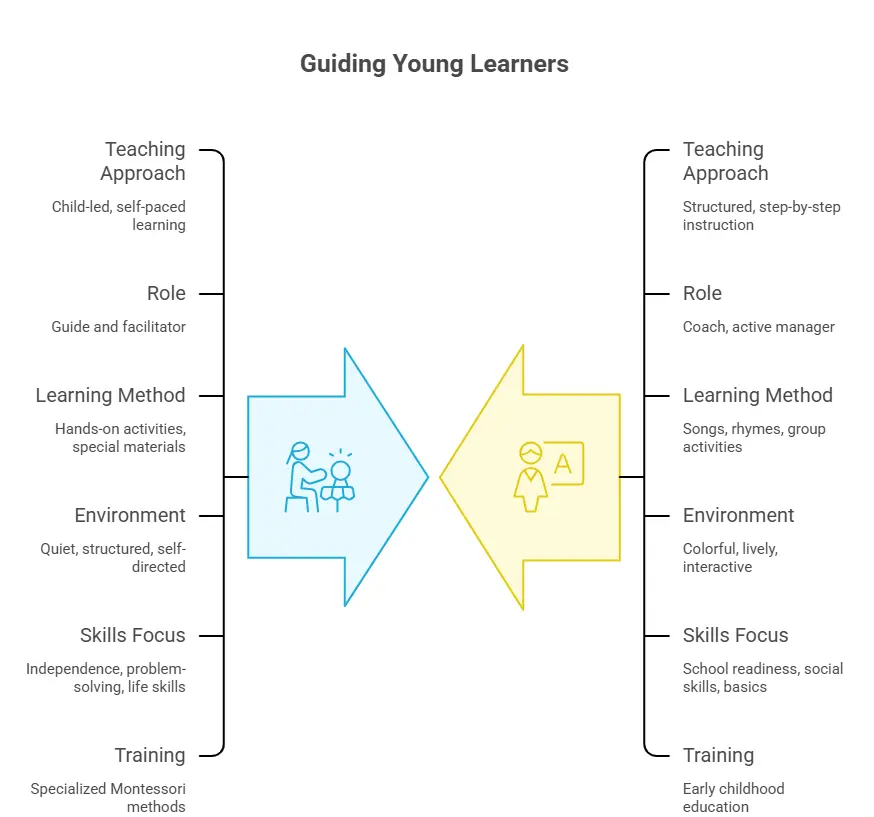
Montessori teachers and nursery teachers both work with younger ones, yet their roles and teachings methods are different. Understanding those differences can help you choose the perfect profession or learning environment.
1. Teaching Approach
- The biggest difference is their teaching style.
- Montessori teachers follow a child-led technique. The children choose their own activities and learn at their own pace.
- Nursery teachers follow a structured approach. They plan the session and explain it to children by step by step.
2. Role in the Classroom
- Montessori teachers serve as both publishers and guides. They take care of the children and help them only if they needed.
- Nursery teachers act as coaches. They explain instructions, provide guidance, and actively manage the class.
3. Learning Method
- In Montessori classrooms, children analyze through activities and special materials.
- In Nursery classrooms, learning through singing songs, rhymes, storytelling and team activities.
4. Classroom Environment
- Montessori classrooms are quiet, structured and well-mannered. Children doing activities by there own interests.
- The nursery classes are colourful, lively and interactive, with extra ordinary classes.
5. Focus on Skills
- Montessori teachers are aware of independence, problem-solving, and lifestyle competence.
- Nursery teachers recognition of primary school, social skills, and basic education.
6. Teacher Training
- Montessori teachers need specialized training through Montessori methods.
- The early childhood education of nursery school teachers is usually extensive.
Teaching Methods and Approaches
Both Montessori and Nursery teaching methods and approaches are explained below:
Montessori Teaching Method
Montessori teaching follows a child-centred approach, where the child plays an active role in their learning.
- Use of materials:
The Montessori classrooms uses special learning objects such as beads, puzzles, and some ordinary objects. These objects help children to understand and enjoy the standards through touch and experiences.
- Focus on independence:
Children are encouraged to do activities on their own, including planning, solving simple problems and completing activities. This builds confidence and commitment to them.
- Teacher’s role:
The teacher acts as a mentor. They observe the children and help them according to their needs rather than constantly giving instructions to them.
Nursery Teaching Method
The nursery teaching follows a learning-based and teacher-led technique, where the teacher plans and leads all the activities.
- How the learning happens:
Here children learn together as a team. The teacher will explains basic things like letters, numbers, colors, and shapes in a simple way.
- Focus on daily routine:
The nursery classes stick to a set schedule. This helps the children develop discipline and understand the daily activities.
- Teacher’s role:
The teacher will manage the classroom. They deliver orders, manage activities and ensure that all children may get knowledge together.
Get Certified & Start Your Montessori Career
Montessori Teacher Training Course by Entri App: Gain expert skills, earn certification, and kickstart your teaching career.
Join Now!Qualifications and Training Required
Having to raise your education and training to become a Montessori teacher or nursery teacher is different. Both roles require patience, care and love to mingle with younger children, however the level and training type may vary.
Montessori Teacher Qualifications
To become a Montessori teacher, special training should be needed. This training will be focus on understanding how the children learn and how to guide them in a calm and supportive way.
Basic qualifications:
- Need a diploma or certification in Montessori Teacher Training
- Minimum education is plus two or a degree (depends on the school)
Training focus:
- The child development and the learning stages.
- How to use the Montessori materials correctly.
- Observation skills to understand needs and interest of each child.
- Creating a positive and organized classroom.
Nursery Teacher Qualifications
The Nursery teachers usually follow a more general path in the early childhood education. Their training is focused on teaching basic concepts in a structured way.
Basic qualifications:
- Diploma in Nursery Teacher Training (NTT) or Early Childhood Education.
- Should have minimum education like 12th standard.
Roles and Responsibilities
Both have an important place in the early age learning of the child, but their daily task and process are different.
Role of a Montessori Teacher
A Montessori teacher mainly acts as a guide and observer in the classroom.
Key Responsibilities Montessori teacher:
- Observe each child to learn their interests and learning pace.
- Introduce appropriate measures based entirely on the needs of the child .
- Encouraging children to do activities independently.
- Maintaining a quiet and peaceful classroom environment.
- Establishing effective use of learning materials.
- Support younger ones gently without interrupting their learning process.
Role of a Nursery Teacher
A nursery teacher takes a more active and maintain good role in the classroom.
Key Responsibilities of Nursery teacher:
- Plan daily portions and the activities.
- Teaching the basic concepts like alphabets, numbers, and colors.
- Creating team work activities such as rhymes, storytelling, and any other games.
- Managing the good behaviour and ensure discipline in the classroom.
- Take care of every children’s safety and their emotional needs.
- Communicating regularly with parents about the progress of their child.
Skills Required for each Role
Montessori teachers and nursery teachers need a specific set of skills when it comes to work with young children. While a few skills are common, depending on the teaching method.
Skills Required for a Montessori Teacher
Montessori teachers focus on guiding children and encouraging them to analyze independently.
1. Observation Skills: They should watch each child closely to learn about their interests, skills, and learning speed. This allows them to guide the child in the right direction.
2. Patience and calm: Montessori classrooms are peaceful. Teachers need to stay calm and give time to learn children without external pressure.
3. Knowledge of Montessori Materials: Learn how to use unique learning materials such as beads, puzzles, and activity set for them. These items are important for educational standards.
4. Encouraging Independence: They need to help young children doing tasks by themselves, without stepping in too quickly.
Skills Required for a Nursery Teacher
Nursery teachers take a more active role in the teaching and managing each classes.
1. Communication skills: Must be able to explain classes clearly using simple words, songs and stories.
2. Class Management: Managing a group of younger children requires precise management and corporate skill.
3. Creativity: They need to make learning fun through games like painting, rhyming, games and storytelling.
4. Energy and Enthusiasm: The nurseries are energetic and active, so teachers must be active and engaging.

Career Opportunities and Salary Comparison
Choosing between Montessori teacher and nursery teacher jobs also depends on the professional growth and salary expectations. Both field offer perfect opportunities, especially with the evolving demand for early childhood education.
Career Opportunities for Montessori Teachers
Now adays Montessori teachers are more demanded in the private schools, international schools, and other Montessori institutions.
Where you can work:
- Montessori schools
- Pre-primary and international schools
- Day care
- Also you can start your own Montessori setup at home
Growth opportunities: With the experience, you can become a senior montessori teacher, coordinator, or montessori school head.
Career Opportunities for Nursery Teachers
Nursery coaches also have a wide range of opportunities, especially in play schools and kindergartens.
Where you can work:
- Nursery and kindergarten schools
- Playschools
- Daycare centers
- Early learning centers
Growth opportunities: With required experience, you can become a senior nursery teacher, supervisor, or center head.
Salary Comparison
Salary for both field can vary based on the location, experience, and type of school you were working.
| Job Role | Experience Level | Salary Range (Per Month) |
|---|---|---|
| Montessori Teacher | Fresher | Up to ₹20,000 |
| Montessori Teacher | Experienced | ₹20,000 – ₹40,000 |
| Nursery Teacher | Fresher | ₹8,000 – ₹15,000 |
| Nursery Teacher | Experienced | ₹15,000 – ₹30,000 |
Register for the Entri Elevate Montessori Teacher Training Program! Join Now!
Conclusion
Both the Montessori teachers and nursery teachers play an important role in the early development of a child. While their teaching methods and techniques are unique, but their goal is same. Their goal is to help children to learn, grow, and become confident. Montessori education mainly focus on independence and self learning, while the nursery education focuses on the structured learning and doing group activities.
Both roles require care, and a strong understanding of the children’s needs. They help to build a strong foundation by supporting every children with their emotional, social, and learning skills in their early age itself. With the growing importance of early childhood education, the montessori and nursery school teachers demand is getting increasing. This makes the both careers were more stable and significan t.
Get Certified & Start Your Montessori Career
Montessori Teacher Training Course by Entri App: Gain expert skills, earn certification, and kickstart your teaching career.
Join Now!Frequently Asked Questions
What is the main difference between a Montessori teacher and a nursery teacher?
The main difference is in their teaching approach. Montessori teachers guide children to learn independently through activities, while nursery teachers follow a structured method and actively teach the whole class using planned lessons.
Which qualification is required to become a Montessori teacher?
To become a Montessori teacher, you usually need a Montessori Teacher Training (MTT) certification. Basic education like 12th or a degree is also required, depending on the school.
What qualification is needed for a nursery teacher?
Nursery teachers generally need a Nursery Teacher Training (NTT) or Early Childhood Education course. Most schools require at least a 12th qualification along with this training.
Who earns more, a Montessori teacher or a nursery teacher?
Montessori teachers may earn slightly higher salaries, especially in private or international schools. However, salary depends on experience, location, and the type of institution.
What skills are important for both Montessori and nursery teachers?
Both roles require patience, communication skills, creativity, and a genuine love for working with children. These skills help in managing and supporting young learners effectively.
Can I switch from nursery teaching to Montessori teaching?
Yes, you can switch by completing a Montessori training course. Many teachers upgrade their skills to explore better career opportunities in Montessori education.
Which teaching role has better career opportunities?
Both roles have good opportunities due to the growing demand for early education. Montessori teaching may offer higher growth in specialized schools, while nursery teaching has wider job availability in many institutions.