Table of Contents
If you’re an electronics engineering student in India or an aspiring embedded engineer, you’ve probably heard this advice a hundred times:
“Do at least one solid project that you can proudly talk about in interviews.”
They’re right.
With embedded systems powering everything from EVs and smart grids to wearables and medical devices, the demand for engineers who can work at the hardware–software boundary is rising fast. India’s embedded systems market was estimated at USD 4.47 billion in 2024 and is expected to grow at over 10% CAGR till 2030, driven by IoT, automotive, telecom, and defence sectors.
At the same time, companies across the globe face a serious shortage of embedded talent – some estimates suggest over a million unfilled computer/embedded engineering roles by mid-decade.
In simple words:
Good projects = better skills = better chances in a high-demand job market.
This blog will help you with:
- How to think about project selection as an electronics/embedded student
- Concrete project ideas (beginner to final year level) across IoT, power, healthcare, EV, robotics and more
- Tips to make your project resume-ready (not just “Arduino LED blink”)
Kickstart your embedded systems career and turn your tech passion into high-demand skills!
How to Choose the “Right” Project

Before we jump into ideas, take a step back and ask:
“What skillset do I want to showcase in 6–12 months?”
Most embedded / electronics roles in India look for a combination of:
- Core electronics: sensors, power, signal conditioning, interfaces
- Microcontrollers & firmware: C / Embedded C, timers, interrupts, communication protocols
- Hardware–software integration: debugging on real boards, reading schematics, and datasheets
- Domain awareness: IoT, automotive, industrial, renewable energy, healthcare, etc.
So, a good project should tick at least 3 of these 4, and ideally relate to growing domains like IoT, EV, renewable, smart cities, or healthcare, which are major focus areas in India’s electronics and semiconductor push.
Keep that in mind as you read the ideas below.
Beginner–Friendly Mini Projects
These are good to build fundamentals and confidence. You can do them in 2–4 weeks.
Smart Home Room Monitor (Temperature, Light & Motion)
Concept:
A small embedded node that:
- Measures room temperature and light level
- Detects motion
- Shows status on an LCD or sends data over Bluetooth/Wi-Fi to a phone
Core components:
- MCU: Arduino UNO / ESP32
- Sensors: DHT11/22, LDR, PIR motion sensor
- Display: 16×2 LCD / OLED
- Wireless (optional): ESP32 Wi-Fi or HC-05 Bluetooth
Skills you’ll practise:
- Basic sensor interfacing
- ADC reading, debouncing, LCD/serial printing
- Simple power budgeting and PCB or perf-board wiring
Extensions:
- Add a relay to automatically switch on a fan/light.
- Push data to a cloud dashboard (ThingSpeak, Blynk, etc.) → now it becomes an IoT mini-project. Many IoT project lists suggest similar “smart room / smart home” concepts as starting points.
Smart Plant Watering System
Concept:
Automatically water plants when soil is dry and log moisture data.
Core components:
- MCU: Arduino / ESP32
- Soil moisture sensor
- Small water pump + relay / MOSFET driver
- Optional: LCD / mobile app for status
What you learn:
- Reading analogue sensors
- Driving actuators with transistors/relays
- Basic control logic + simple safety (pump cut-off)
Projects like smart irrigation and smart farming are repeatedly recommended in embedded and IoT project lists for ECE/EIE students.
Master Embedded Systems Programming!
Launch your tech career with our Embedded Systems Course, designed for hands-on learning and industry readiness.
Know MoreIoT & Smart Cities: High-Impact Final Year Ideas
IoT + embedded is one of the hottest combinations in electronics today, with applications from smart meters and smart street lighting to parking systems and pollution monitors.
IoT-Based Smart Energy Meter with Load Control
Problem to solve:
Typical homes in India don’t have real-time visibility of power usage. A smart meter with load control can help reduce wastage and enable prepaid billing models.
Project idea:
- Use a current sensor (CT / Hall effect) to measure load per phase
- MCU (ESP32 / STM32) calculates energy consumption
- Send readings periodically to a cloud server or mobile app
- Implement remote load cut-off when usage crosses a set threshold or the balance is low
Similar “smart energy meter with IoT and remote cut-off” projects appear frequently in current embedded project lists for 2025–26.
What recruiters see:
- Knowledge of AC measurement & safety
- IoT stack familiarity (MQTT/HTTP, JSON)
- Real-world use case aligned with smart-grid / smart-city initiatives in India.
Smart Street Lighting with Automatic Intensity Control
Concept:
- Street lights turn ON at dusk and OFF at dawn automatically
- Intensity adjusts based on traffic (high brightness with movement, dim otherwise)
- Central dashboard shows energy usage per pole
Core tech:
- Light sensor (LDR) + PIR / ultrasonic sensor for vehicle detection
- MCU controlling LED drivers (PWM dimming)
- Wireless mesh (LoRa / ESP-NOW / Zigbee) connecting multiple poles
Many embedded IEEE projects feature smart street lights with motion-based control as an energy-saving solution.
Air & Sound Pollution Monitoring Node
Idea:
- Compact module placed at roadside / near schools
- Monitors PM2.5, PM10, CO, noise levels
- Sends data to a central server or open data platform
Why it’s valuable:
- Combines embedded sensing, IoT and data visualisation
- Has strong relevance in Indian cities dealing with pollution
- Can be extended to support local authorities or school projects
IoT pollution monitoring (air + sound) is a common theme in modern IoT project repositories and education programmes.
Automotive & EV-Related Projects
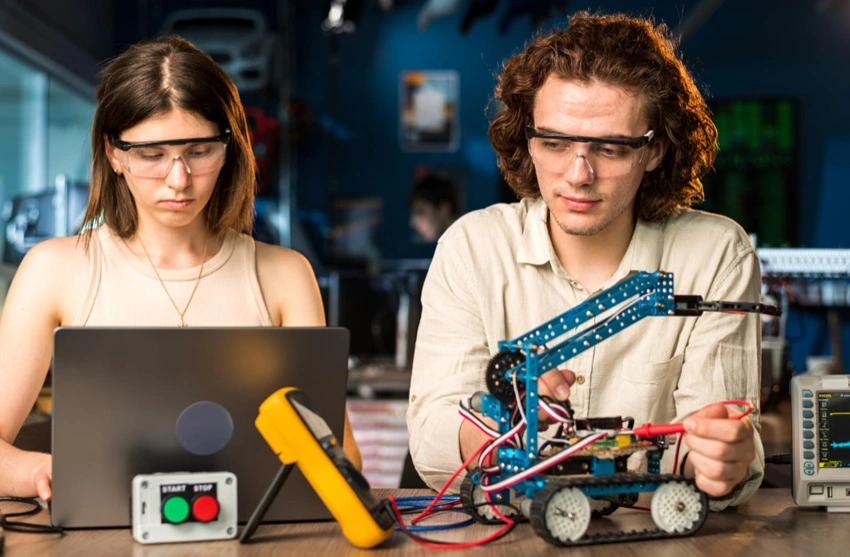
With India pushing EVs, smart mobility and automotive electronics, projects in this area are highly attractive.
Smart Helmet with Accident Detection & Alert
Purpose:
Improve rider safety by detecting accidents and ensuring helmet usage.
Features:
- IR / pressure sensor inside the helmet → detects whether it is worn
- Accelerometer/gyro to detect impact or fall
- BLE / GSM module sends SMS with GPS location to emergency contacts on crash detection
Smart helmet with accident detection and GSM alert is one of the top embedded project ideas listed for 2025–26.
Learning outcomes:
- Sensor fusion (accelerometer + threshold logic)
- Embedded communication stack (UART, SPI, I2C)
- Power management for wearable devices
Battery Monitoring & BMS Prototype for Two-Wheelers
Concept:
- Build a mini Battery Management System (BMS) prototype for a small Li-ion pack used in e-scooters or UPS
- Monitor cell voltage, pack current, temperature
- Provide over-charge, over-discharge and short-circuit protection
- Display SOC (state of charge) on a local display or send to app
Why it stands out:
- Power electronics + embedded control
- Strong link to EV and renewable energy sector projects suggested by many electronics project repositories.
Healthcare & Assistive Technology Projects
Assistive tech projects often perform well in competitions and hackathons because they show social impact plus technical depth.
Smart Wheelchair / Assistive Control System
Inspired by recent student innovations where smart wheelchairs enabled paralysed patients to control movement and appliances using facial recognition and IoT.
Your version could:
- Use head gestures, joystick, or voice to control wheelchair direction (for lab demo, use a small robotic platform instead of a real wheelchair)
- Integrate home automation control (lights, fan, TV) via relay board and wireless connection
- Include an SOS button that sends GPS location via GSM
Tech stack:
- MCU + motor drivers
- Wireless (Bluetooth/Wi-Fi) and/or GSM
- Basic HMI: LCD / mobile app
Wearable Health Monitoring Band
Functions:
- Monitor heart rate, SpO₂, step count and temperature
- Send data periodically to a smartphone app
- Set threshold alerts for abnormal readings
Skills:
- Interfacing biomedical sensors
- Low-power design (sleep modes, duty cycling)
- BLE communication & simple mobile integration
Healthcare and wearable devices are major growth areas for embedded engineers in India and globally.
Master Embedded Systems Programming!
Launch your tech career with our Embedded Systems Course, designed for hands-on learning and industry readiness.
Know MoreIndustrial Automation & Robotics Projects
Automation, robotics and Industry 4.0 are key embedded domains, and India is actively investing in labs, competitions and school-level robotics kits.
Line-Following or Obstacle-Avoiding Robot with Telemetry
Baseline version:
- Differential-drive robot with IR / ultrasonic sensors
- Follows path or avoids obstacles
Advanced twist:
- Add telemetry: send sensor data and position estimate to a base station
- Use a web dashboard or PC app to visualise path, speed, battery level
Why it’s good for your resume:
- Combines control algorithms (PID for line following)
- Real-time embedded programming
- Robotics + communication – a common combo in competitions like e-Yantra.
Industrial Parameter Monitoring & Fault Alert System
Idea:
- Design a low-cost embedded unit that monitors temperature, vibration and current in a small motor or pump
- Detect anomalies and send alerts (local buzzer + wireless notification)
Use cases:
- Predictive maintenance in small factories, water plants, and workshops
- Educational demo of Industry 4.0 concepts
This ties well into real industrial automation trends where embedded systems enable condition monitoring and predictive maintenance.
VLSI/Embedded-Heavy Ideas

If you’re leaning towards core embedded or semiconductor roles, try projects that emphasise bare-metal programming, RTOS or low-level driver development.
Bare-Metal Driver Suite for a Development Board
Instead of using Arduino libraries, pick an STM32 / LPC / PIC / SAM MCU and:
- Write your own drivers (GPIO, UART, SPI, I2C, timer, ADC) in C
- Build a small demo application (e.g., sensor node + display) using only your drivers
- Document the driver design and APIs like a mini SDK
This kind of project shows deep understanding, exactly what many embedded job listings in India look for.
RTOS-Based Multi-Task Application
Concept:
- Use FreeRTOS / Zephyr on an MCU
- Create multiple tasks:
- Sensor sampling task
- Communication task (UART/Wi-Fi)
- Logging task
- User interface task (buttons + display)
- Sensor sampling task
- Use queues, mutexes, timers properly
This shows you are comfortable with real-time concepts, something many advanced embedded roles expect.
Kickstart your systems career and turn your tech passion into high-demand skills!
How to Make Your Project Stand Out
Whatever idea you choose, you can make it far more impressive by focusing on:
- Documentation
- Clear problem statement
- Block diagram, schematics, flowcharts
- Design decisions and trade-offs (e.g., why ESP32 over Arduino)
- Clear problem statement
- Code quality
- Modular C files
- Comments, meaningful variable names
- Version control (GitHub repo with README)
- Modular C files
- Testing & validation
- Show test cases, failure scenarios and how you handled them
- Include logs, graphs or screenshots of performance metrics
- Show test cases, failure scenarios and how you handled them
- Realistic scope
- Better to do one focussed, reliable project than 5 half-baked ones
- Add one or two smart features (e.g., OTA update, simple dashboard, basic security) instead of endless features that barely work
- Better to do one focussed, reliable project than 5 half-baked ones
These extras often matter more in interviews than flashy hardware.
How Entri’s Embedded Systems Course Fits into Your Journey
If you’re serious about becoming an embedded engineer, you eventually need structured guidance – beyond YouTube tutorials and random blogs.
Entri offers an Embedded Systems Software Engineering Course designed to be completed in about 6 months, with:
- Comprehensive curriculum
- Microcontrollers & microprocessor basics
- Embedded C programming
- Real-time systems & RTOS concepts
- Interfaces: UART, SPI, I2C, CAN, etc.
- IoT fundamentals and peripheral integration
- Microcontrollers & microprocessor basics
- Hands-on, project-centric approach
- Real hardware practice
- Sensor, actuator, communication projects
- Portfolio-worthy embedded applications
- Real hardware practice
- Industry-oriented training
- Expert-led live/recorded classes
- Doubt clearing, assignments and mini-projects
- Placement assistance and interview preparation, especially targeting embedded roles in India’s growing electronics, automotive and IoT sectors
- Expert-led live/recorded classes
- Flexible access
- Online mode for learners across India
- City-specific pages (Kochi, Trivandrum, Calicut, Thrissur) highlight both local and remote options with the same core curriculum and support.
- Online mode for learners across India
If you pick any of the project ideas in this blog and pair them with structured learning from Entri’s embedded course, you’ll be far better positioned than the average electronics graduate who only has a basic mini-project.
Key Takeaways
- The market for embedded systems and electronics in India is expanding rapidly, driven by IoT, EVs, smart cities, healthcare and industrial automation – and there’s a notable shortage of skilled embedded engineers.
- Strong, well-documented projects are one of the best ways for electronics engineering students and aspiring embedded engineers to stand out.
- Focus your projects on high-relevance areas:
- Smart energy & smart cities
- Automotive & EV
- Healthcare & assistive tech
- IoT, robotics and industrial automation
- Low-level embedded & RTOS
- Smart energy & smart cities
- Treat each project as a learning journey:
- Understand the domain problem
- Design hardware + firmware cleanly
- Test thoroughly and document everything
- Understand the domain problem
- If you want guided learning and a clear roadmap from fundamentals to real projects, the Entri Embedded Systems Course is a strong option – combining microcontroller training, embedded C, IoT, RTOS basics and project-based learning with placement support.
Pick one project idea from this list, set yourself a 3-month or 6-month goal, and start building.
Every sensor you wire, every bug you debug, and every PCB you fix takes you one step closer to being the embedded engineer companies are actively searching for.
Master Embedded Systems Programming!
Launch your tech career with our Embedded Systems Course, designed for hands-on learning and industry readiness.
Know MoreFrequently Asked Questions
What are some good project ideas for electronics engineering students?
Electronics students can build projects like smart home automation, IoT weather stations, RFID door locks, solar trackers, line-following robots, and embedded monitoring systems.
Which projects are best for beginners in electronics engineering?
Beginner-friendly projects include LED blinking circuits, temperature sensors, Arduino-based automation, obstacle-detection modules, and basic IoT data loggers.
What are some innovative final-year electronics engineering projects?
AI-enabled surveillance, IoT-based health monitoring, gesture-controlled robots, smart agriculture systems, and embedded safety devices are top innovative ideas.
What are the best microcontroller-based projects?
Arduino, ESP32, PIC, and STM32 projects like motor controllers, environmental sensors, and wireless communication systems are widely preferred.
How do I choose the right electronics project topic?
Choose a topic based on your skill level, available components, real-world applications, and interest in fields like IoT, embedded systems, robotics, or renewable energy.
Which tools are essential for electronics projects?
A multimeter, soldering kit, breadboard, jumper wires, microcontrollers (Arduino/ESP32), sensors, and simulation software like Proteus or KiCad.
Are IoT projects important for electronics engineering students?
Yes. IoT projects help students build hands-on experience with sensors, cloud platforms, wireless modules, and embedded programming, key skills in today’s industry.
What course can help me become better in electronics and embedded projects?
The Entri Embedded Systems Course offers structured training in microcontrollers, IoT, PCB design, and real-world embedded projects—ideal for engineering students.