Table of Contents
C remains the most dominant language in embedded systems, but fast changes are underway. Rust is gaining traction in safety-critical areas like auto and medical devices at a fast pace.
Meanwhile, MicroPython is making embedded development more accessible to a wider range of developers.
According to the 2024 Embedded Systems Survey nearly 60% of developers still use C as their primary language, though nearly half of embedded projects in production now use Rust, a number which has shot up in the past year.
Master Embedded Systems and build the smart solutions of tomorrow!
Key Takeaways
- C is still the leading embedded language due to its unbeatable performance and incredibly small footprint.
- Rust is on the rise in safety-critical applications like auto and medical systems.
- C++ is doing the heavy lifting in robotics and automotive ECU’s thanks to C++20 standards.
- MicroPython & CircuitPython are the go to tools for rapid prototyping and when working on tight IoT hardware.
- Ada/SPARK sets the standard for mission critical systems like avionics and nuclear where reliability is paramount.
- In reality most production projects use a mix of languages – C for the core bits and then Rust or Python on top.
- By 2026 hiring managers will be looking for people with ARM/STM32 and Zephyr RTOS skills, as well as secure boot expertise and a good understanding of programming languages.
Why Language Choice Matters in Embedded Systems
Hardware constraints like low power, limited memory, and real-time execution are typical in embedded systems. Such constraints should decide your programming language choice. System crash, performance degradation, increased power consumption, and code expansion are all probable consequences of using an unsuitable choice of language.
Below are the reasons why language selection matters:
- Embedded systems need to run efficiently by having low overhead.
- For most uses, there must be consistent answers to enable real-time operation.
- In hardware control and portability, there are languages that offer more choices.
- Maintainable and comprehensible code results in longer system existence and fewer debugging hours.
Master Embedded Systems Programming!
Launch your tech career with our Embedded Systems Course, designed for hands-on learning and industry readiness.
Know MoreTop Programming Languages Used in Embedded Systems (2026)
1. C
C has been powering embedded systems for over five decades now and shows no signs of slowing down – its popularity endures. It gives developers a line to memory that is direct, a control flow that is dependable and predictable and a runtime footprint so small, it’s no problem to run on an 8 bit microcontroller.
You will also find that nearly every major Real Time OS – FreeRTOS, Zephyr, VxWorks – has been written in C, and almost every chip maker releases their software development kits and Hardware Abstraction Layer libraries written in C.
Why developers still choose it:
C has a portability across different architectures (ARM, RISC-V, AVR, MIPS) that is unmatched as well as a huge and healthy ecosystem of libraries to draw from and a mountain of battle-hardened code that has been in production systems for decades.
Where it is used:
Microcontrollers, car engine control system firmware, industrial control systems, and even some older aerospace systems.
Limitation to note:
The fact that C has no built-in memory safety is something developers should be aware of. You can end up with buffer overflows and undefined behaviour if you are not careful – it’s something that requires disciplined coding practices and tools like Valgrind or AddressSanitizer to mitigate.
2. The C++ program
C++ brings Object-Oriented Programming, templates and all the modern language bells and whistles (particularly with C++17 and C++20) to the tried-and-true performance of C.
In the past the embedded community had some reservations about C++ due to its somewhat weighty runtime footprint, but those issues can be quite easily addressed by stripping out the bits you don’t need through the -fno-exceptions and -fno-rtti compiler flags.
These days embedded C++ is anything but lean, it’s actually pretty lean, expressive and powerful and is being used heavily in robotics (ROS 2 for example is C++-first), automotive electronics control units and complex IoT gateways.
Best for: Robotics, automotive ECUs, Advanced Driver Assistance Systems (ADAS) and large-scale embedded software.
Trend: We’re seeing a trend towards the use of C++20 coroutines to tackle embedded tasks that require async functionality, which in some cases means you don’t have to resort to using a traditional RTOS.
3. Python
Python wasn’t exactly designed with embedded systems in mind but MicroPython changed that. It runs on the likes of ESP32, STM32 and Raspberry Pi Pico and gives developers a python 3 compatible environment that – crucially – uses a fraction of the memory you’d expect.
It’s the go-to choice for all things quick prototyping, IoT scripts and edge AI inference pipelines where development speed is way more important than raw performance. CircuitPython by Adafruit adds a bunch of beginner-friendly features and massively broadens hardware compatibility.
Best for: Quick prototyping on IoT devices, educational hardware projects, edge AI scripting and sensor dashboards.
Limitation: Limitation is that it’s not a good fit for hard real-time systems or on microcontrollers with less than 64KB of RAM.
4. Rust
Rust is the language that the embedded industry has been waiting for – it’s offering the same low-level control as C (i.e zero-cost abstractions, manual memory management) but with the added bonus of compile-time guarantees that eliminate all sorts of nasty bugs: null pointer dereferences, data races, and use-after-free errors.
The embedded-hal crate ecosystem and first-class no_std support make Rust genuinely usable on bare-metal hardware and it’s not just small players that are adopting Rust – we’re talking major players like Google, Microsoft and automotive suppliers all using Rust for firmware and OS components.
Why it matters in 2026: Strict new cybersecurity regulations like the EU Cyber Resilience Act are set to come in and with them comes a massive increase in demand for languages that can keep memory safe in safety-critical sectors, and Rust is pretty much in the box seat to benefit from this shift.
Best for: ADAS, medical devices, industrial safety systems and secure IoT firmware.
Trade-off: Trade-off is a steeper learning curve and smaller pool of talent compared to C/C++, though that gap is getting smaller by the day.
5. Assembly
Assembly language – this is about as close as you can get to writing code for the actual hardware short of picking up a soldering iron.
Some still use it for things like bootloaders, interrupt handling routines (ISRs) and the really low-level stuff like cycle-critical stuff in a DSP when your compiler just can’t make the code run fast enough.
Most projects don’t use Assembly for the entire codebase any more but still its a pretty common thing to see a bit of Assembly thrown into a C/C++ project – and that tends to be for things like signal processing, crypto acceleration and those real-time control loops that matter.
Best for: Bootloaders, ISRs, DSP code, getting new silicon up and running.
Also read: Cisco Hiring Embedded Software Engineer
6. Ada and SPARK
Ada isn’t exactly a household name but for avionics, railway control systems, nuclear facilities and military electronics it’s a must have, and often required by contract. Ada’s strong typing, tasking model and runtime checks virtually eliminate the chance of bugs making it through.
SPARK – a subset of Ada that you can actually prove mathematically is bug-free – goes a step further still. If you need the highest level of safety certification in DO-178C and IEC 61508 then Ada/SPARK are the way to go.
Best for: Flight control software, rail signalling, nuclear safety systems, all defence electronics.
Reality check: This language may not be the most popular but it is crucial in certain industries, to be honest it’s not the best choice for an IoT project you can sell.
7. Java (Embedded JVMs)
You can’t really say ’embedded systems with a Javascript twist’ but the Espruino project has brought a Javascript interpreter to some microcontrollers that will run with as little as 128KB of memory.
If you’re working on some smart home sensor or maybe a little Bluetooth hub then it might be worth looking at.
Best for: Smart home prototypes, BLE-connected sensors, networked hub devices.
8. Go
Go’s goroutines and channels make it an attractive option for edge gateways, telemetry servers, and networked embedded Linux systems where concurrency is the primary challenge.
It is not a bare-metal language – Go requires an OS. But for embedded Linux platforms like Raspberry Pi or industrial SBCs running gateway software, it is an excellent fit.
Best for: IoT gateways, telemetry aggregators, MQTT brokers on embedded Linux.
Embedded Language Comparison at a Glance
| Language | Main Strength | Common Applications | Main Limitation |
| C | Performance, hardware control | Microcontrollers, drivers, RTOS firmware | Limited built-in memory safety |
| C++ | Abstraction, reusable design | Robotics, automotive, complex firmware | Can add complexity if unmanaged |
| Rust | Memory-safe systems programming | Secure and safety-focused firmware | Steeper learning curve |
| MicroPython | Rapid development | Prototypes, education, IoT | Slower, less deterministic |
| Assembly | Precise processor control | Bootloaders, startup code | Difficult to maintain |
| Ada/SPARK | Safety, formal verification | Avionics, defence, railways | Smaller ecosystem |
| JavaScript | Application-level development | Smart devices, dashboards | Runtime overhead |
| Go | Networking, concurrency | Embedded Linux gateways | Not suited to bare-metal systems |
How to Choose the Right Language for Your Project
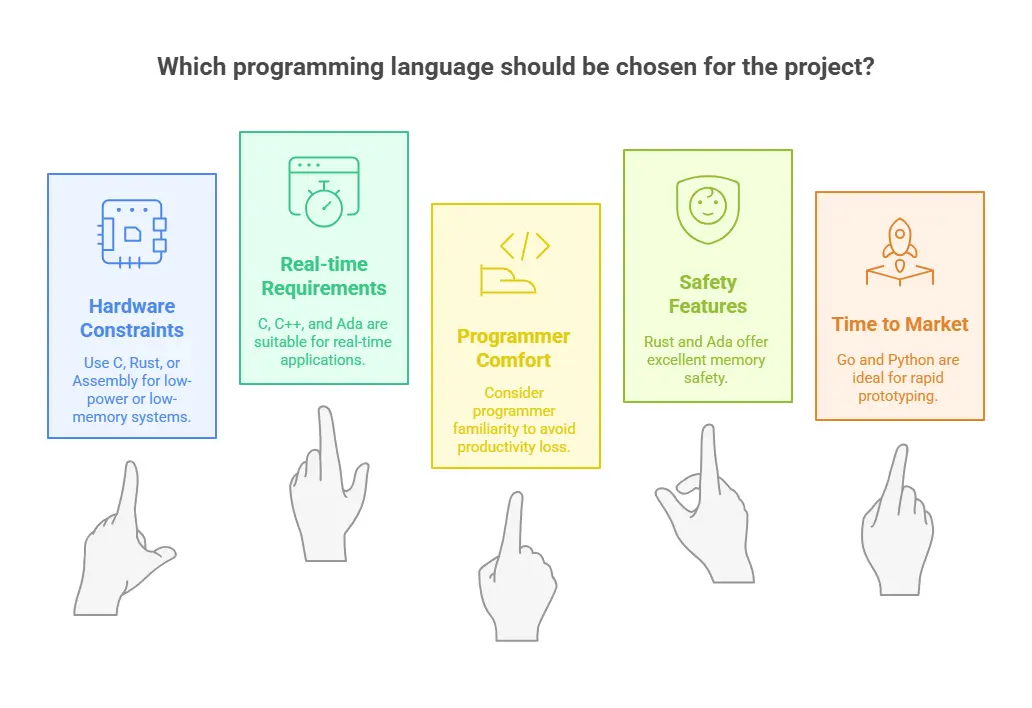
Choosing the most appropriate language depends on a set of considerations specific to the project:
- Hardware constraints: On low-power or low-memory systems, use C, Rust, or Assembly.
- Real-time requirement: C, C++, and Ada are wonderful for real-time applications.
- Programmer comfort: Think about how comfortable your programmers are—switching to another language may not be worth it.
- For safety, both Rust and Ada possess excellent memory safety features.
- Time to market: Go and Python are perfect for creating a rapid prototype and establishing that an idea is possible.
Tip: The majority of projects utilize more than one language. For instance, you can use C for low-level processing and Python for programming or UX.
Master Embedded Systems Programming!
Launch your tech career with our Embedded Systems Course, designed for hands-on learning and industry readiness.
Know More2026 Industry Trends Shaping Language Choices
Edge AI is changing the calculus.
TensorFlow Lite for Microcontrollers and ONNX Runtime now run on ARM Cortex-M chips, and developers need languages that can interface efficiently with ML inference engines. C and C++ are the primary interfaces, with Python used for model preparation and scripting.
Security regulations are forcing memory safety.
The EU Cyber Resilience Act and US National Cybersecurity Strategy explicitly call out memory-unsafe languages as a systemic risk. Expect procurement requirements in government and critical infrastructure to increasingly mandate Rust or formally verified code.
Hybrid stacks are the new norm.
Production embedded teams are settling on a practical pattern: C or C++ for the core firmware, Rust for new security-sensitive modules, and Python or JavaScript for configuration and tooling layers.
AI-assisted code generation is here.
Tools like GitHub Copilot and specialized firmware assistants are reducing the gap between experienced and junior embedded developers — but understanding the language deeply remains essential for reviewing, debugging, and optimizing AI-generated code.
Kickstart your embedded systems career and turn your tech passion into high-demand skills!
Final Thoughts
In 2026 there’s now more languages to choose from for embedded systems than ever, which is a pretty good thing. C remains a key part of every engineer’s toolset, C++ rules complex systems, Rust is now a must have for safety-critical code and MicroPython makes IoT prototyping a little bit easier.
The top dev’s all mix and match – they know the trade offs between languages and they know when to add some Rust to their C/C++ toolset. What’s the takeaway for students and pro’s looking to get into this field – start with C, get good at C++, then learn some Rust – that’s the stack the teams are using today.
Master Embedded Systems Programming!
Launch your tech career with our Embedded Systems Course, designed for hands-on learning and industry readiness.
Know MoreFrequently Asked Questions
What language should I learn first for embedded systems?
Start with C to build a strong foundation, then expand into C++ or Rust depending on your goals.
Are embedded systems a good career in 2026?
Absolutely. With IoT, automation, and smart devices booming, embedded systems continue to offer high-demand, future-proof careers.
Which language is best for embedded systems?
C remains the most widely used, but Rust and Python are growing fast in popularity for specific use cases.
What tools should I learn with these languages?
Familiarize yourself with tools like GCC, Keil, PlatformIO, JTAG debuggers, and build systems like CMake.
Is embedded programming difficult to learn?
It can be challenging at first due to hardware constraints and low-level concepts, but with practice and hands-on projects, it becomes manageable and rewarding.
Can I build a career in embedded systems without a degree?
Yes. While a degree helps, many successful embedded developers are self-taught with strong portfolios and certifications.