Table of Contents
Imagine you being half focused, half hopeful after a long day and having to scroll through resumes looking for jobs when a position suddenly comes up in your eyes. It’s not just some random software position, it’s an Embedded Software Engineer role at SanDisk, the company that develops the hardware that stores and protects the world’s data. That touch of recognition is tangible if you’ve worked close to hardware, optimised performance, and written robust, reliable code. You imagine yourself building firmware for SSDs, flash controllers, and storage products for all sectors. That spark of interest quickly becomes action as you apply.
Once the application is received, the real work begins: interview preparation. SanDisk interviews are aimed at capturing more information than can be gathered from the surface. They are about how well you understand embedded systems basics, memory management, C/C++ programming, debugging techniques and real-world problems. Interviewers tend to hire people who can explain how software interacts with hardware, how to handle performance limitations and write clean, reliable code in tight spaces. The same importance is your ability to think through problems, and to express the logic of your thoughts clearly, while also showing curiosity about how storage technologies work at a deeper level.
Kickstart your embedded systems career and turn your tech passion into high-demand skills!
The Role of an Embedded Software Engineer at SanDisk
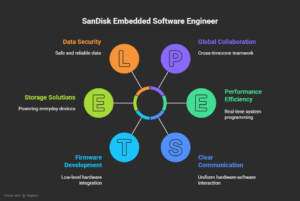
SanDisk builds storage solutions that quietly power many things in life—from smartphones and laptops to cars and enterprise systems. These products are based on embedded software which makes data moves quickly, safely and reliably. One Embedded Software Engineer at SanDisk is central in this ecosystem by developing low level firmware that is directly integrated with hardware. This study is heavily oriented toward real-time system programming in C, where performance, stability and efficiency are non-negotiable. Engineers create and maintain core firmware components, develop and improve storage protocols like UFS, PCIe and NVMe, and ensure a clear and uniform communication between hardware and software.
This is a technical position that needs both practical experience and high technical knowledge. Engineers will have to work with logic analyzers, debuggers, and special tools to identify and troubleshoot complex issues that may involve firmware, hardware behaviour, and/or system-level interactions. Collaboration is also an essential component of the job. Teams are global and therefore need clear communication and the ability to work across time zones. Candidate must possess at least 5 years of experience, have strong command of C++, excellent knowledge of NAND flash, and confidence in diagnosing problems in large, real-world systems. Python scripting is an added plus in automation, testing, and enhancing development workflows. Additional experience implementing multiple storage arrays—from firmware to system integration—is also desirable.
What to Expect in the SanDisk Interview Process
Interviews at SanDisk for Embedded Software Engineer spots often span multiple rounds. First comes a phone screen to check basic fit. Then technical sessions dive into coding and system design. Expect questions on firmware development cycles, from planning to testing. Behavioral parts assess teamwork and problem-solving under pressure. Some rounds involve coding on a whiteboard or computer, focusing on algorithms and data structures. Hardware knowledge gets tested too, especially with NAND flash and interfaces. The process aims to find engineers who can handle real-world tasks, like optimizing for low latency. Candidates who show clear thinking and hands-on experience move forward. Practice common scenarios to build confidence and respond smoothly.
Master Embedded Systems Programming!
Launch your tech career with our Embedded Systems Course, designed for hands-on learning and industry readiness.
Know MoreKey Skills Tested in Interviews
SanDisk seeks engineers with an understanding of embedded systems, and who would enjoy working in close proximity to hardware. This requires a clear understanding of C programming in RTOS, which is much of the work writing efficient, reliable, and maintainable low level code. SanDisk wants candidates who understand the full design and implementation process, testing and deployment along with coding. Validation by experience with FPGAs and real hardware platforms is especially valuable because it shows the ability to bridge theory with praxis and to identify issues before they even arrive at production.
Analytical thinking is an important component of this kind of engineering work. Engineers must identify possible issues early, work through complex problems at the system level, and make informed decisions in constraints. Collaboration is another key element, as embedded projects require close coordination between firmware, hardware, validation, and system teams. This is a careful observation of communication, technical understandings, and openness to criticism during interviews. SanDisk also seeks engineers that can learn quickly, adapt to new tools and technologies, and meet tight deadlines without sacrificing code quality.
Additional experience can be a competitive advantage. Knowledge of NAND flash products, storage architectures or other related domains is desirable as it reduces learning curve and allows quicker contributions. Python knowledge is also helpful, especially in the field of scripting, automation, or test development. SanDisk measures technical abilities, innovation and maintaining clean, robust code during the interviews. Understanding these aforementioned areas – and demonstrating them clearly – can help you stand out as a strong embedded systems engineer candidate.
20 Interview Questions and Answers for Embedded Software Engineer Roles
Based on the SanDisk job for Staff Engineer in Embedded Firmware, these questions draw from required skills like C coding, protocol handling, and debugging. Each includes a sample answer to guide preparation. Study them to see how they link to job duties.
Question 1: Describe your experience with embedded firmware development in C.
Experience in embedded firmware development shapes how engineers tackle storage tasks at SanDisk. Interviewers ask this to gauge your background in real-time systems. A strong answer highlights projects with RTOS and optimization. For example, in past roles, you developed firmware for NAND devices, focusing on efficient code that handles data flow without delays. You used C to create modules that manage memory and interfaces, ensuring reliability in high-volume products. Debugging involved tools like JTAG to fix timing issues. This work led to stable releases that met strict deadlines. Such details show readiness for SanDisk’s demands.
Question 2: Explain the firmware development lifecycle.
The lifecycle covers stages from design to deployment, key for predictable product outcomes. Start with requirements gathering, where specs define features. Then comes architecture planning, outlining modules and interactions. Coding follows, using C for implementation. Testing includes unit checks and integration on simulators. Validation on FPGA and hardware spots real issues. Deployment wraps up with reviews and updates. At SanDisk, this process uses Agile methods with CI/CD for quick iterations. Knowing it helps in early issue detection, as the job requires.
Question 3: How do you debug complex embedded systems?
Debugging keeps systems running smooth, a core skill for firmware engineers. Use a mix of software tools and hardware probes. Begin with logs to trace errors, then step through code in an IDE. For hardware, connect oscilloscopes to check signals. In one project, intermittent crashes traced back to race conditions via thread analysis. Fixed it by adding mutexes, improving stability. SanDisk values this for validating on varied platforms.
Question 4: What is your knowledge of NAND flash fundamentals?
NAND flash stores data in blocks, essential for SanDisk products. Cells hold bits, with wear from erase cycles managed by controllers. Garbage collection reclaims space, while error correction handles bit flips. In firmware, you code wear leveling to extend life. Understanding this aids in optimizing storage protocols like NVMe.
Question 5: Describe working with RTOS in embedded projects.
RTOS manages tasks in real-time, crucial for responsive devices. It schedules priorities to meet deadlines. In projects, you set up queues for inter-task communication, avoiding deadlocks. For a storage device, RTOS handled interrupt-driven I/O, ensuring low latency. This fits SanDisk’s need for high-throughput interfaces.
Question 6: How do you optimize data structures for storage protocols?
Optimization boosts performance in protocols like UFS. Use linked lists for dynamic queues, or arrays for fixed buffers. In NVMe, hash tables speed command lookups. Profile code to cut memory use, like aligning structures to cache lines. This reduces latency in firmware.
Question 7: Explain PCIe protocol in embedded storage.
PCIe connects devices with high-speed lanes. It uses packets for data transfer, with layers for transaction and data link. In firmware, you implement endpoints to handle requests. For SanDisk, this means coding drivers that manage bandwidth for NVMe commands.
Question 8: What experience do you have with UFS interface?
UFS offers fast mobile storage with low power. It builds on SCSI commands over MIPI lanes. In firmware, you develop host controllers to send init sequences and handle power modes. Projects involved tuning for better throughput in phones.
Question 9: How do you handle cross-functional team collaboration?
Teams span hardware, software, and testing. Regular meetings align on specs. In global setups, tools like Jira track progress. Shared docs clarify interfaces. This approach fixed a spec mismatch in one project, speeding delivery.
Question 10: Describe using simulation environments for firmware validation.
Simulators mimic hardware for early testing. Tools like QEMU run code without physical boards. You model peripherals to test interactions. This caught bugs before FPGA stage, saving time. SanDisk uses it for protocol stacks.
Question 11: What is your approach to Agile development in firmware?
Agile breaks work into sprints with daily standups. Backlogs prioritize features. CI/CD automates builds and tests. In teams, you commit code often, reviewing pulls. This keeps firmware adaptable to changes.
Question 12: How do you use Python for scripting in embedded work?
Python automates tests and data analysis. Scripts parse logs or generate configs. In projects, it drove regression suites, catching issues fast. Preferred at SanDisk for efficiency.
Question 13: Explain NVMe protocol for storage.
NVMe speeds SSD access over PCIe. It uses queues for commands, reducing overhead. Firmware maps requests to NAND operations. This enables parallel I/O, key for performance.
Question 14: What analytical skills help in problem-solving?
Breaking problems into parts identifies roots. Data from traces guides fixes. In a latency issue, metrics showed bottlenecks, leading to code tweaks. This drives innovation.
Question 15: Describe experience with FPGA platforms.
FPGAs prototype hardware for firmware tests. You load designs and run code. Debugged timing on Xilinx boards in projects. This bridges sim to final hardware.
Question 16: How do you ensure firmware maintainability?
Clean code with comments and modular design helps. Follow standards like MISRA. Version control tracks changes. Reviews catch issues early.
Question 17: What role do automated testing frameworks play?
They run checks consistently, covering edge cases. Tools like GoogleTest unit test modules. Integration tests verify stacks. This boosts quality.
Question 18: Explain contributing to IP generation.
Ideas from solving unique problems lead to patents. Documented a novel wear algorithm in past work. This adds value at SanDisk.
Question 19: How do you manage tight deadlines?
Prioritize tasks and break them down. Communicate blocks early. Overtime when needed, but plan to avoid it. Delivered a release on time this way.
Question 20: Describe delivering end-to-end storage solutions.
From spec to ship, you integrate firmware with hardware. Coordinated with teams for a NAND product launch. Tested full stack for reliability.
These questions reflect SanDisk’s focus on practical skills. Detailed answers show depth, helping interviewers see your value.
Tips for Preparing for SanDisk Interviews
Nerves can be turned into confidence if they are prepared, in technical endeavors where clarity of thought is as important as knowledge. Start with revisiting C basics, namely points, memory management, data structures, and edge cases, since good foundations do not hesitate in solving a problem. Combine this with regular use of programming platforms like LeetCode to sharpen logic, speed, and accuracy when coding under time constraints. Nevertheless, at the same time, practice networking and system protocols from an online source, so you can explain concepts to someone who knows better than you.
This is where mock interviews are crucial; they recreate real interview pressure and help you focus on your thinking while being flexible. For domain-specific depth, read and understand NAND flash memory via tutorials or technical blogs to see how it works beyond surface definitions. Building small praxis projects to reinforce learning such as a simple RTOS task manager can show understanding and you have real examples you can discuss confidently.
Strategic planning has an obvious impact beyond technical preparation. Networking with your existing colleagues or colleagues in similar positions can offer you an inside look at interview patterns, expectations, and team culture. Adjust your resume so that it is representative of the skills and technologies specified in the job description—this indicates alignment before you even speak. Ask questions about projects, workflows or challenges on your team to show genuine interest and maturity. Rest before interview, so you are focused and responsive, particularly during problem solving sessions. To check for success and failure after each practice or interview, customize your approach. Such a pattern of preparation, reflection, and improvement builds confidence over time, and good prepared preparation is often preceded by strong job offers.
Master Embedded Systems Programming!
Launch your tech career with our Embedded Systems Course, designed for hands-on learning and industry readiness.
Know MoreCommon Mistakes to Avoid
Many candidates lose their chance if they focus on coding and ignore fundamental hardware principles. Interviewers often seek engineers who understand how software interacts with memory, processors, networks and systems as a whole. As long as answers are not very clear, they are the result of a lack of understanding. Strong candidates use clear and actual examples—like what they achieved performance enhancements, addressed latency issues or fixed a system-level issue—to show depth. Because the truth is always more valuable than theoretical discourse, concrete stories always land better.
Another common miss is poor communication. Interviews equate collaboration with competence, and ambiguous explanations call to mind problems with teams. Another red flag is that agile teams, as most of modern teams are built around sprints and stands-ups and iterative delivery. It is more important to have candidates that are willing to explain their work in Agile ways. Lastly, most of them do not practice debugging stories. Having the opportunity to talk about how you identified, evaluated, and managed a real problem is a testament to maturity in problem solving. Avoid these pitfalls, and your chances are better.
Why SanDisk Stands Out for Embedded Software Engineers
SanDisk leads in memory tech, offering growth in a key field. Engineers work on products that impact billions. The global team fosters learning. Innovation thrives with resources for new ideas. This environment suits driven professionals.
Building a Strong Application
Craft a resume highlighting relevant projects. Cover letters tie experience to job needs. Include metrics, like reduced latency by 20%. This grabs attention.
After the Interview: Next Steps
Follow up with thanks and reflect on feedback. If offered, negotiate terms and prepare for onboarding.
Kickstart your embedded systems career and turn your tech passion into high-demand skills!
Conclusion
The first step in landing a Embedded Software Engineer job at SanDisk is to be a creative, intelligent, passionate about low-level systems, firmware development, and storage technologies. SanDisk is at the center of data storage, access, and protection across billions of devices, meaning that it directly affects performance and reliability in the real world. Training for this role requires not only clearing interviews, but confidence in that role to contribute meaningfully from the outset and grow with a globally respected engineering team.
These questions and helpful tips will help you stand out among competitors in the hiring process. They are designed to develop you a better understanding of the fundamentals of embedded systems, problem solving, and the hands-on programming skills that SanDisk values. If you work on these areas regularly and reflect on them, you improve your technical strength as well as your ability to understand complex ideas. This kind of combination is often what differentiates good candidates from excellent candidates during technical discussions and interviews.
Progress sometimes feels slow, but it pays to persevere. All the ideas and problems you have and every solution you try bring you one step closer to your desired outcome. Focus and discipline will help you not only secure the position, but also advance your career in a field where skilled embedded engineers are in demand.
Master Embedded Systems Programming!
Launch your tech career with our Embedded Systems Course, designed for hands-on learning and industry readiness.
Know MoreFrequently Asked Questions
What is the overall structure and timeline of the SanDisk Embedded Software Engineer interview process, and how should a candidate mentally prepare for each stage?
The interview process for an Embedded Software Engineer at SanDisk is a multi-stage, rigorous evaluation designed to assess both deep technical competency and cultural fit. The typical timeline can span 3 to 6 weeks from initial application to offer. It begins with an automated resume screening focused on keywords like C/C++, RTOS, NAND flash, firmware lifecycle, PCIe/NVMe, and debugging. Passing this leads to a recruiter phone screen, a 20-30 minute conversation verifying basic qualifications, project alignment, and salary expectations. The core of the process consists of 3-5 subsequent technical rounds, often conducted virtually. These include a focused coding round (data structures, algorithms in C), a system design and firmware architecture round (designing a flash translation layer or command queue), and a deep-dive hardware/software integration round (debugging a memory corruption scenario). There is frequently a behavioral and team-fit round with a hiring manager, focusing on past projects, conflict resolution, and agile methodologies. Finally, there may be a “bar-raiser” interview with a senior engineer from another team to calibrate candidate quality across the organization.
Mental preparation requires a tiered approach. For early stages, focus on clarity and conciseness in communicating your experience. For technical rounds, adopt a “show your work” mindset similar to an exam: think aloud, state assumptions, ask clarifying questions, and propose multiple solutions before coding. The process is as much about problem-solving methodology as the correct answer. Prepare for endurance; schedule interviews with breaks in between to avoid mental fatigue. Research your interviewers on LinkedIn beforehand to tailor your examples—if they work on UFS protocol, be ready to discuss relevant experience in detail. Embrace the process as a collaborative technical discussion rather than an interrogation; interviewers are seeking future colleagues who are both skilled and communicative.
Beyond standard C programming, what specific low-level concepts and memory management pitfalls are absolutely critical to master for this role, and how are they tested?
SanDisk firmware operates in resource-constrained, real-time environments where efficiency and reliability are paramount. Mastery of C is assumed; the differentiation comes from expertise in low-level concepts and nuanced memory management. Critical areas include: Pointer Arithmetic and Memory Alignment (understanding how misaligned accesses cause performance hits or bus errors on embedded processors), Volatile Keyword Usage (correct application for memory-mapped I/O registers to prevent compiler optimization from breaking hardware interaction), Bitwise Operations and Manipulation (for configuring hardware registers, setting/clearing flags in compact data structures), and Structure Padding and Packing (managing memory layout for efficient data transmission over storage protocols).
The most heavily tested pitfalls revolve around dynamic memory allocation (malloc/free) in embedded contexts. Interviewers will probe your understanding of why heap usage is often forbidden or severely restricted in safety-critical firmware due to non-deterministic timing and fragmentation. You must be able to discuss alternatives: static allocation, pool allocators, and ring buffers. A common interview question presents a scenario of intermittent corruption in a multi-threaded (RTOS) environment. The ideal candidate would methodically diagnose it as a race condition (solved with semaphores/mutexes), a stack overflow (analyzing task stack sizes), or a heap corruption (suggesting moving to static pools). Testing is done through written code analysis, whiteboard design, and hypothetical debugging scenarios. You might be asked to write a memory-safe circular buffer implementation from scratch or explain how you’d trace a wild pointer that only manifests after millions of operations. Demonstrating a paranoid, defensive approach to memory—where you always consider the hardware’s perspective—is key to success.
How in-depth should my understanding of NAND flash memory physics and associated firmware algorithms be, and can you provide a detailed example of how this knowledge is applied?
A candidate is not expected to be a semiconductor physicist, but a robust, working understanding of NAND flash characteristics and their direct firmware implications is a fundamental requirement. This is SanDisk’s core technology. You must understand the physical hierarchy (die, plane, block, page), basic operation timings (page program, block erase, page read), and the three fundamental constraints: 1) Erase-Before-Write (in-place update impossibility), 2) Limited Endurance (finite Program/Erase cycles per block), and 3) Read Disturb/Data Retention (charge leakage issues).
This knowledge translates directly into firmware algorithms you must be able to describe in detail:
-
Flash Translation Layer (FTL): The core abstraction. You should explain logical-to-physical address mapping, often using a hybrid approach (page-level mapping for performance, block-level for metadata efficiency).
-
Garbage Collection (GC): The process of reclaiming stale blocks. You need to discuss trigger mechanisms (background, on-demand), wear-leveling integration (selecting victim blocks not just by staleness but by wear count), and the critical challenge of write amplification. Interviewers may ask you to design a simple GC algorithm or analyze its impact on SSD latency during heavy, random writes.
-
Error Correction Codes (ECC): Understanding why strong ECC (like LDPC) is necessary as NAND scales, and how firmware must adapt read reference voltages based on wear and retention (a process called read retry or RAIN).
Example Application: Imagine an interview question: “Our SSD’s latency spikes intermittently under a specific workload. How would you investigate?” A strong answer would immediately suspect Garbage Collection. You’d elaborate: “I would first instrument the FTL to log GC triggers and durations. The spike likely occurs when a host write finds no free pages, forcing a foreground GC block reclamation. This involves reading valid pages from a victim block, rewriting them to a new block, and erasing the victim—a high-latency operation. To mitigate, we could tune the GC to be more proactive, increase the over-provisioned space, or implement a more intelligent, workload-aware victim selection algorithm to minimize valid page copying.” This answer links physical NAND traits (erase latency) to a firmware algorithm (GC) to a system-level performance symptom, demonstrating the integrated knowledge SanDisk seeks.
Can you elaborate on the practical expectations for experience with storage protocols like NVMe and PCIe, and describe a typical system-level design question involving them?
Experience with NVMe and PCIe is not merely theoretical; you must understand their role in the storage stack and have practical implementation or debugging experience. For PCIe, you should grasp the layered model (Transaction, Data Link, Physical), key concepts like TLPs (Transaction Layer Packets), BAR (Base Address Register) setup for memory-mapped I/O, and link training. For NVMe, focus on its queue-based architecture (Submission and Completion Queues in host memory), the command set (Admin and NVM commands like Read, Write, Flush), and its performance advantages over AHCI (deep queues, interrupt coalescing).
A typical system-level design question might be: “Design a simplified NVMe controller firmware for an SSD.” A strong response would be structured:
-
Hardware Abstraction: Outline core modules: a PCIe Core Driver (handles TLP routing, BAR configuration), a DMA Engine Controller (manages data transfers between host memory and internal SRAM/DRAM buffer), and an NVMe Protocol Processor.
-
Queue Management: Describe how the firmware services Submission Queues (SQs). “The host driver writes a 64-bit command doorbell. This triggers an interrupt. Our ISR reads the new command from host memory (via DMA), parses it, and places it in an internal command queue.”
-
Data Path: Detail the flow for a Write command. “The command contains data pointers (PRP or SGL). The DMA engine fetches the data from host memory into our internal buffer. We then segment it into NAND page-sized chunks, send it to the FTL for logical-to-physical translation, and ultimately issue commands to the NAND Controller.”
-
Concurrency & Performance: Discuss using multiple hardware queues (MSI-X) to parallelize command processing. Mention Completion Queue batching to reduce interrupt overhead.
-
Error Handling: Address PCIe link errors (LTSSM state recovery), NVMe command aborts, and end-to-end data protection (Data Integrity Field – DIF/DIX).
This question tests your ability to integrate a protocol standard into a realistic firmware architecture, considering hardware/software partitioning, data flow, and performance optimizations.
What does "real-time system programming" truly entail in the context of SanDisk's embedded environment, and how are RTOS concepts tested beyond textbook definitions?
At SanDisk, “real-time” means deterministic timing guarantees for critical operations, not necessarily “fast.” A NAND read operation might have a hard deadline of 100 microseconds to prevent a host timeout. The environment is typically a preemptive, priority-based RTOS (like ThreadX, FreeRTOS, or a proprietary one). Beyond knowing terms (task, semaphore, mutex, queue, interrupt), you must understand their pragmatic use and associated perils.
Testing goes deep into synchronization, communication, and timing analysis:
-
Priority Inversion: You’ll be given a scenario where a low-priority task holds a lock needed by a high-priority task, which is in turn blocked by a medium-priority task. You must identify it as priority inversion and propose solutions: priority inheritance protocol or priority ceiling protocol.
-
Interrupt Service Routine (ISR) Best Practices: Asked what to do/not do in an ISR. Correct answers: Keep it extremely short, defer processing to a Deferred Procedure Call (DPC) or task, use non-blocking code, avoid mutexes. You might design a system where a PCIe MSI interrupt kicks a high-priority task via a semaphore.
-
Resource Contention and Deadlock: Asked to design a lock hierarchy for multiple shared resources (e.g., a shared log buffer and a NAND controller interface) to prevent deadlock.
-
Performance Profiling: How would you measure worst-case execution time (WCET) of a critical task? Answers involve instrumenting code with hardware timers, analyzing disassembly for loop bounds, and considering cache effects.
A complex question might present a system suffering intermittent high latency. You’d be expected to ask for a scheduler trace log, then analyze it for evidence of preemption storms, semaphore queueing delays, or ISR overrun. This demonstrates you view the RTOS not as an abstract API but as a live system with measurable, sometimes pathological, behaviors that directly impact product performance.
How significant is the role of debugging and validation in the interview, and what kind of complex, multi-faceted debugging scenarios should I prepare to discuss?
Debugging and validation are arguably the central theme of the interview. SanDisk seeks engineers who are not just coders but forensic problem-solvers. You must be prepared to discuss war stories that showcase a methodical, layered approach.
Prepare for scenarios that blend multiple domains:
-
Heisenbug in Data Corruption: “Data read from the SSD occasionally has a single-bit flip in the same logical address, but not on every read.” Your discussion should cover the entire data path: Host DMA -> Internal SRAM Buffer -> NAND Controller -> NAND Array -> ECC Engine. You’d propose steps: First, rule out software by checking the buffer pre- and post-NAND transfer. Then, use the ECC correction counters—if they’re consistently high for that page, it points to NAND wear/retention (trigger a read-retry). If ECC logs are clean, the bug might be in the DMA Scatter/Gather List setup causing a misaligned transfer. You’d mention tools: logic analyzer on the NAND bus, memory content monitors, and invasive tracing.
-
System-Level Performance Regression: “After a new firmware update, sequential write throughput drops by 30% on a specific customer platform.” Approach: Isolate variables. Reproduce on internal test hardware. Use profiling to compare CPU utilization between versions. Check for new critical section locks that serialize parallel operations. Examine changes to the GC or wear-leveling algorithm that might be more aggressive. Consider PCIe link state power management interactions with the new host driver. This shows system-thinking.
-
Intermittent Device Hang: The device stops responding. You’d talk about watchdog timers, analyzing their timeout logs. You’d then attempt to connect a JTAG debugger post-mortem to inspect the call stack, task states, and semaphore ownership. You’d look for patterns (does it only happen after 72 hours of operation? pointing to a memory leak or counter overflow).
Interviewers will evaluate your tool proficiency (JTAG, oscilloscopes, logic analyzers, protocol analyzers for PCIe/UFS), your hypothesis-driven method, and your ability to communicate the investigation clearly. Saying “I would add more print logs” is a weak answer; proposing a targeted, minimally invasive instrumentation strategy is strong.
The job description emphasizes "Agile development" for firmware. What does Agile look like in a hardware-near firmware context, and how might this be assessed in a behavioral interview?
Agile in embedded firmware diverges from web development due to long hardware bring-up cycles, dependency on hardware validation, and the cost of reflashing. It often takes a hybrid form: sprint-based planning for firmware feature development, coupled with longer hardware milestone schedules. You’ll work in 2-3 week sprints but align with hardware checkpoints (FPGA tape-out, EVT, DVT).
Behavioral questions will probe your experience and adaptability:
-
“Describe how your team managed firmware development alongside a slipping hardware schedule.” A good answer discusses maintaining a feature branch for the new hardware while continuing development on the stable mainline, using simulation and FPGA emulation to progress despite physical delays, and constant re-prioritization of the backlog.
-
“Tell me about a time you had to integrate a last-minute change from a hardware team.” This assesses collaboration and technical flexibility. You should describe verifying the change (e.g., a register map update), updating drivers and header files, running a focused regression test, and communicating the risk/impact to the software team lead.
-
“How do you handle firmware testing when hardware units are scarce?” This evaluates resourcefulness. Discuss leveraging HIL (Hardware-in-the-Loop) rigs, instruction-set simulators, and FPGA prototypes to parallelize testing. Mention creating “golden unit” test suites that run automatically on any available hardware.
They will look for your understanding of CI/CD pipelines tailored for firmware: automated nightly builds that run on simulators, static code analysis (MISRA-C), unit tests for isolated modules, and automated smoke tests on a lab rack of devices. Demonstrating that you see Agile as a framework for managing complexity and risk in a physical product cycle, not just a ticket-moving process, will impress.
How should I prepare to discuss my past projects in a way that maximizes relevance to SanDisk, even if I haven't worked directly on storage products?
The key is to deconstruct your experience into fundamental embedded competencies and then re-map them to SanDisk’s domain. Use the STAR (Situation, Task, Action, Result) method but with a technical, SanDisk-aware filter.
-
Situation/Task: Don’t just say “I worked on a medical device.” Frame it: “I developed firmware for a battery-powered IoT sensor where reliability, low power, and efficient data handling were critical—constraints directly analogous to an SSD in a mobile device.”
-
Action: Highlight transferable skills:
-
Coding: “I implemented a wear-leveling algorithm for a limited-write-cycle FRAM memory.” (Direct parallel to NAND).
-
Protocols: “I developed a driver for a high-speed SPI interface, optimizing throughput by leveraging DMA and minimizing ISR overhead.” (Parallel to PCIe/NAND bus tuning).
-
Debugging: “I tracked down a data corruption bug using a logic analyzer on the memory bus, tracing it to a race condition between a DMA completion interrupt and a cache invalidation routine.” (Same methodology used for storage).
-
Performance: “I profiled and optimized the boot time by moving initialization routines from flash to RAM and deferring non-critical tasks.” (Similar to SSD latency optimization).
-
-
Result: Quantify in terms of metrics that matter to SanDisk: “Reduced latency by 15%, increased data throughput by 20%, eliminated a critical bug that caused 0.1% field failure rate.”
Even if your project was a microcontroller reading temperatures, you can discuss real-time scheduling of sensor reads, managing data in circular buffers, ensuring robust communication, and low-power sleep states—all concepts vital in storage firmware. The interviewer wants to see that you can abstract first principles from your experience and apply them to new domains.
What is the role of scripting, particularly Python, in this position, and what kind of practical scripting tasks might come up in the interview or on the job?
Python is the duct tape and automation engine of modern firmware development at a company like SanDisk. It is not a “nice-to-have” but a core productivity multiplier. Its primary roles are:
-
Test Automation and Validation: Writing scripts to control test equipment (power supplies, protocol analyzers, host machines), flash devices, execute test suites, parse massive log files, and generate pass/fail reports.
-
Data Analysis and Visualization: Analyzing performance benchmark results, plotting latency distributions, parsing NAND ECC statistics, and correlating events from different log sources to identify patterns.
-
Tooling and Infrastructure: Creating internal tools for binary image manipulation, register map code generation from spreadsheets, memory map visualizers, or automated code review checkers.
-
Simulation and Modeling: Building behavioral models of hardware blocks for pre-silicon firmware testing.
In an interview, you might get a practical question: “Given a large, messy debug log file with intermixed messages from different tasks and timestamps, how would you use Python to find all instances where a specific error code appears within 10ms of a DMA operation?” A strong answer would outline reading the file line-by-line, using regular expressions to parse timestamps and message types, building a simple in-memory timeline of events, and then iterating to find temporal correlations. They may also ask you to pseudo-code a script to automate a boring task, like checking 1000 firmware images for a specific version string.
Demonstrating that you think of Python as a force multiplier for tackling firmware grind-work—and that you have the practical skills to use it—shows you can hit the ground running and contribute to team efficiency beyond just writing C code.
What are the most common non-technical ("soft") mistakes that technically brilliant candidates make in SanDisk interviews, and how can I avoid them?
Technical prowess is necessary but insufficient. The most common soft-failures are:
-
Arrogance or Inability to Listen: Dismissing the interviewer’s hint or plowing forward with a wrong assumption. Remedy: Practice active listening. Pause after the question. Repeat it in your own words: “So, you’re asking me to design a system that prioritizes low latency over ultimate throughput, correct?” Engage the interviewer as a collaborator: “Is my approach aligning with the typical constraints here?”
-
Poor Communication of Thought Process: Jumping straight to silent coding or giving a terse, final answer. Remedy: Narrate your brain. “I see this as a producer-consumer problem. The first thing I need is a thread-safe queue. I’m considering a linked list versus a circular buffer… the buffer has better cache locality, so I’ll start there. My main concerns will be handling the empty/full states…”
-
Lack of Commercial or System Awareness: Solving a coding puzzle in isolation without considering product implications (power, cost, reliability, time-to-market). Remedy: Always ask clarifying questions about constraints. After proposing a solution, volunteer an analysis of its trade-offs: “My O(n log n) algorithm works, but if this is called in a hot path, the memory allocation could be problematic. For a product, we might need a more deterministic, pre-allocated O(n^2) approach.”
-
No Curiosity About the Company or Role: Failing to ask insightful questions at the end. Remedy: Prepare deep, technical questions that show research: “I read about your latest 3D NAND generation. How is the firmware architecture evolving to manage the increased plane parallelism?” or “Can you describe the balance between new feature development and legacy product support in the team?”
-
Being Unprepared for Behavioral Questions: Giving vague, non-technical answers to teamwork or conflict questions. Remedy: Have 3-5 detailed, technical project stories ready. Frame behavioral answers around technical collaboration: “A disagreement about interrupt architecture was resolved by prototyping both solutions and measuring the interrupt latency jitter on the scope, which showed my colleague’s approach was more deterministic.”
Avoiding these mistakes positions you as not just a competent coder, but a well-rounded engineer who can design, debug, communicate, and collaborate—the exact profile SanDisk hires to build industry-leading products.