Table of Contents
Many of our daily-use devices are powered by embedded systems. From smartphones to automobiles, embedded systems play a vital role in performing the specific functions in the devices.
In relatively larger devices, embedded systems easily combine both the hardware and software to make sure that the workflow and the functionalities are smooth and uninterrupted.
Read on to find out how the real-world projects are being affected by the challenges posed by embedded systems developments. And look into the hardest part of the embedded systems.
– An embedded system combines both hardware and software for efficient performance.
-Limited memory, strict real-time performance requirements and high processing power make the development of the embedded system challenging.
-Debugging and hardware-software integration are the hardest parts of embedded system development.
-Building reliable embedded systems requires strong knowledge and understanding of the software and hardware interfaces.
Introduction
Compared to other software, embedded systems have constrained environments and pose many challenges to developers. Embedded technology is around you and is shaping the future.
However, many developers find that the development of embedded systems is harder than traditional or regular software development. The most puzzling question now will be, ‘What makes embedded systems more challenging for experienced developers and programmers?’

Why Embedded Systems Feel More Challenging Than Regular Software
The embedded systems involve both the hardware and the software. And this makes the embedded system development harder than traditional software development. As it involves the simultaneous development of hardware and software, the embedded systems pose difficulties while developing with limited resources.
In traditional software development, where computers are designed with more processing power and memory, programmers ought to focus only on code writing.
Embedded developers are forced to write programs to run error-free. The microcontrollers are used in embedded systems, which run with limited resources. Let’s see why embedded systems are more challenging for developers.
- Limited memory power
- Less processing capacity
- Limited resources
- More environmental restrictions
- Power constraints
- Complicated debugging strategies
- High requirements for real-time performance
Due to the above-mentioned reasons, embedded system developers should first write neat, optimised, efficient and highly scalable and reliable code for its performance under constrained environments.
Kickstart your embedded systems career and turn your tech passion into high-demand skills!
Master Embedded Systems Programming!
Launch your tech career with our Embedded Systems Course, designed for hands-on learning and industry readiness.
Know MoreUnderstanding Embedded Systems Before Identifying the Hardest Part
It is important to understand the real nature of the embedded systems before diving deep into the hardest part of it.
In larger devices, a specialised computer system is installed to perform specific functions, and it is popularly known as the embedded system. The assigned tasks will be performed error-free with the aid of the embedded systems.
This is not a general-purpose computer, and this makes it different. Certain tasks are particularly assigned for the embedded system to perform. Here are a few common examples of embedded systems.
- Industrial automation devices
- Consumer electronics
- Smart home devices
- Medical monitoring devices
- Automatic control systems
An embedded system is commonly built with three core components, which include
- Hardware
- Software
- Communication Interfaces
Hardware – electronic circuits, microcontrollers, actuators and sensors
Software – C++ or C language programmes control the behaviour of the hardware.
Communication interface – data exchange with the help of UART, SPI and I2C
Without proper knowledge of the software, the hardware interface will result in challenges while dealing with the embedded system development. The embedded system development process should involve a complete understanding of the software and hardware components.
How Embedded Development Differs from Software Development
Unlike traditional software development, embedded system development differs in multiple ways, which range from debugging to tool development.
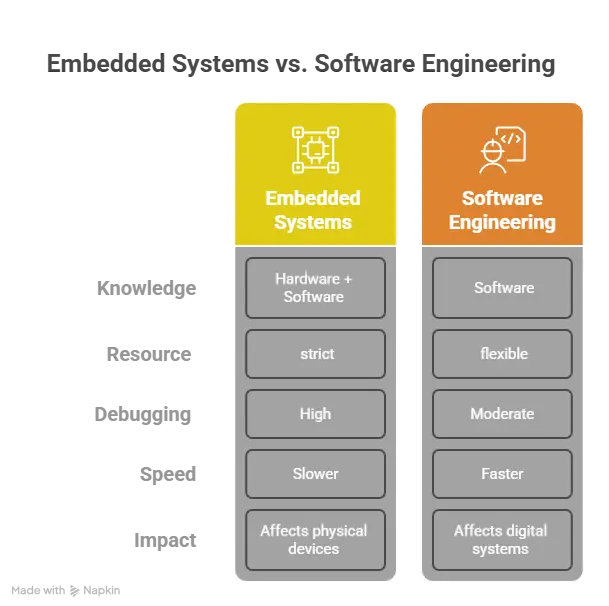
| Features | Embedded System Development | Software Development |
| Hardware interaction | Interacts directly and freely with hardware | hardware-independent |
| Performance requirements | Real-time | flexible |
| Debugging | difficult and dependent on hardware | easy with the aid of technologically advanced tools. |
| Tool development Hardware interaction | hardware boards | IDE frameworks |
| Memory usage | limited memory | unlimited memory. |
| Error impact | affects physical devices | software crashes |
Strong system knowledge and, mostly, hardware awareness are really important to avoid difficulties while developing embedded systems.
Kickstart your embedded systems career and turn your tech passion into high-demand skills!
The Hardest Parts of Embedded Systems
Strong command over the hardest part of the embedded systems is really essential for the embedded system developers.
Hardware and software integration
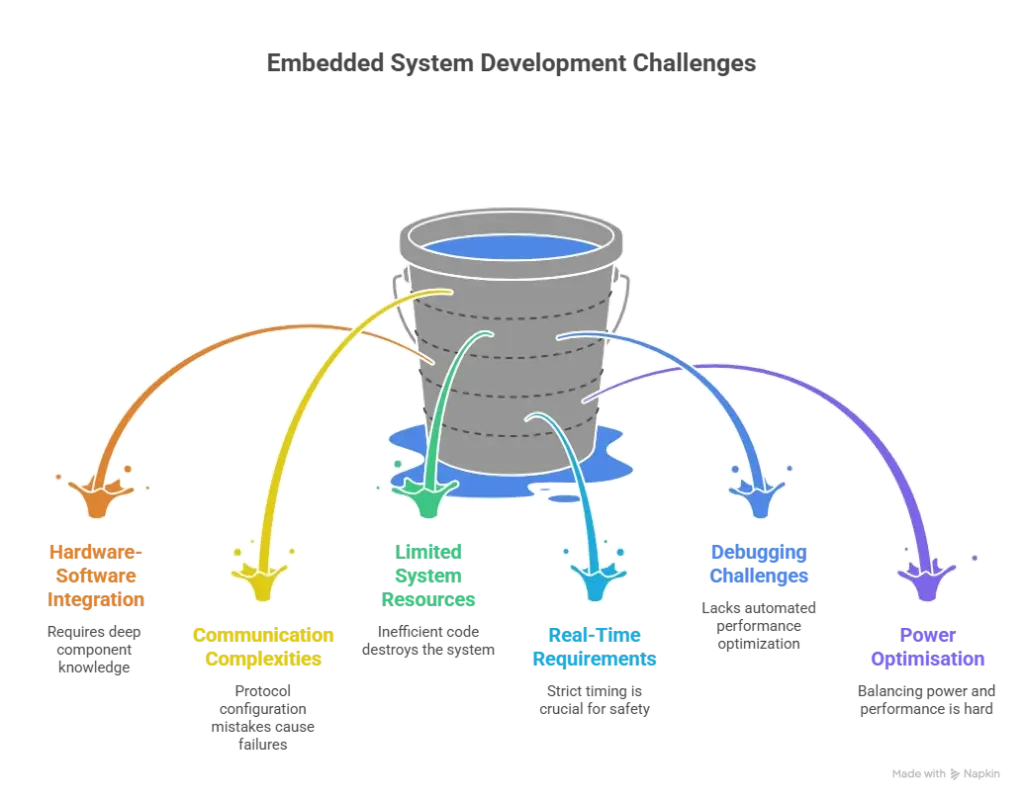
Integration of software with hardware interfaces is the most difficult part of the development of embedded systems. A strong knowledge of the software and hardware components is really essential to avoid any mistakes while developing the embedded systems.
The programme you develop should closely align with the displays, actuators, communication modules and sensors. The system will malfunction if an error occurs in the proper alignment of the software code and the hardware interface.
An embedded system developer should have a thorough understanding of the hardware registers, microcontrollers, and electrical signals. This knowledge and understanding are important, without which it is extremely difficult to build a strong and reliable application for embedded systems.
Communication complexities
The protocols are usually user-embedded device communication. It makes use of the protocols, including CAN, UART, SPI and I2C.
The rules and components of these protocols are structured and specific. The configuration mistakes can lead to complexities in communication. This is how the communication failures occur between the components in the embedded systems.
Limited system resources
The memory and processing power are limited for the embedded systems. The inefficient codes will destroy the entire system. Each memory byte matters, as the development of the system deeply relies on the resources. Embedded systems developers should optimise the use of memory.
They should willingly reduce the size of the code and should improve the speed of execution. The optimisation process will make the embedded programming more complex and complicated than traditional software development.
Real-time system requirements
The timing requirements in the real-time system are really strict and tight. The system should follow the appropriate timing requirements to function smoothly.
If the embedded system fails to give the real-time prompt, the system fails to perform and follows the safety hazards too. To resolve and find solutions to these problems, the embedded system developers use real-time operating systems (RTOS) to manage such issues.
Debugging challenges
The debugging of the embedded system is complex and requires more of the effort from the programmers.
In traditional software programming, developers can analyse, run and identify errors in the system to prevent the malfunctioning of the system.
An embedded system lacks the automated systems to optimise performance when unexpected disruptions happen in the environment.
Developers should make use of the advanced tools, including JTAG debuggers, oscilloscopes, and logic analysers, to constantly track the hardware signals to identify the issues within the system.
Optimisation of Power
A critical requirement of the embedded system is energy efficiency. Embedded systems run on low-power devices or, most often, on batteries. The embedded systems should be designed in such a way that they can optimise the communication tasks.
The system should move to sleep mode in low-power environments and should optimise the communication tasks. The challenge that the embedded devices always face is finding a balance between power and performance.
Kickstart your embedded systems career and turn your tech passion into high-demand skills!
Master Embedded Systems Programming!
Launch your tech career with our Embedded Systems Course, designed for hands-on learning and industry readiness.
Know MoreWhich Is Harder – Embedded Systems or Software Engineering?
Both software engineering and embedded systems have their own complexities and challenges. As the embedded systems combine software development with hardware engineering, the performance of the embedded system becomes more complex. Know which system, among embedded systems or software, is more here!
Why These Challenges Matter in Real-World Projects
Accuracy is extremely important in embedded systems. During critical situations, the embedded systems are used to ensure the reliability of the systems. The automotive systems, consumer electronics, healthcare medical devices and automation in industries rely deeply upon the embedded technology.
As these technologies are the critical part of each system, a sudden failure in the embedded systems cannot be afforded. These failures in the system can lead to financial risks, collapses and complete damage to the equipment.
These failures are due to rigorous testing and deep expertise in technology for the design of the same by the experts. The experts who design the embedded system should have a strong grip on the development of the embedded system, as it is the hardest part since it involves both the hardware and software alike.
If you are an embedded system developer, you should have a good knowledge and understanding of the hardware and software interfaces of the embedded system.
Conclusion
Embedded system development requires careful analysis and structured study. If you are an embedded system developer, you should have a strong grip on the software and hardware interfaces. Your knowledge should surpass all the anticipated system failures.
The creation of the programme code requires more clarity and accuracy. You have to train yourself to handle the development of the embedded systems. Proper training can lessen the confusion and help you to overcome the challenges. As embedded systems are an integral part of many of the industries, polishing and updating yourself can help you in the future!
Master Embedded Systems Programming!
Launch your tech career with our Embedded Systems Course, designed for hands-on learning and industry readiness.
Know MoreFrequently Asked Questions
Why is embedded system development harder?
The embedded systems involve both the hardware and the software. And this makes the embedded system development harder than traditional software development.
What is the challenging part of the embedded systems?
As the technologies are the critical part of each system, a sudden failure in the embedded systems cannot be afforded. These failures in the system can lead to financial risks, collapses and complete damage to the equipment.
What is debugging challenge?
The debugging of the embedded system is complex and requires more of the effort from the programmers.
What is the communication complexities in embedded system?
The configuration mistakes can lead to complexities in communication. This is how the communication failures occur between the components in the embedded systems.
What is hardware and software integration in embedded systems?
Integration of software with hardware interfaces is the most difficult part of the development of embedded systems. A strong knowledge of the software and hardware components is really essential to avoid any mistakes while developing the embedded systems.