Table of Contents
No, Artificial intelligence will not be able to completely replace mechanical engineers; it will significantly improve the work that they do.
It is still vital to have humans when it comes to creativity, design, and decision-making; nevertheless, it is possible to automate jobs that are repetitive.
The ability of engineers to adapt to artificial intelligence will boost their prospects of finding employment in the future.
Key Takeaways
- AI will affect mechanical engineers’ jobs.
- For repeated activities, AI can help.
- Design, decision-making, and creativity require human engineers.
- Intelligent systems and automation are transforming mechanical engineering.
- AI-integrated design, robots, and production are promising.
- Students and workers need digital and AI abilities to prosper in today’s labor economy.
- Human and AI efforts will need to be combined.
Join our MEP Course Online and Build a Successful Career!
Introduction
The field of engineering is one of the many areas that is being revolutionized by artificial intelligence (AI). Considering the increasing sophistication of automation and intelligent systems, a significant number of students and experts are pondering the possibility that mechanical engineers would become extinct.
In this blog, the reality that lies behind that concern is investigated, as well as what the future may bring.
Context
From the very beginning, mechanical engineering has been an essential area that drives businesses such as manufacturing, automotive, and energy systems to function. Historically, engineers were responsible for design, analysis, and problem-solving, and they did so through the use of manual methods and fundamental software tools.
Machine learning, automation, and intelligent simulations are some examples of the cutting-edge technologies that are currently being incorporated into engineering workflows as a result of the rise of artificial intelligence (AI). The performance of the system can be predicted, designs may be optimized, and massive amounts of data can be analyzed quickly with these technologies.
The job of mechanical engineers is changing as a result of the fact that industries are using AI in order to improve efficiency and cut costs. The focus of artificial intelligence is turning away from replacing engineers and toward activities that are more complicated, creative, and strategic. This transition is making human skills more crucial than ever before.
Master MEP Design with Industry-Leading Training!
Gain in-depth knowledge of Mechanical, Electrical, and Plumbing (MEP) Design with expert-led courses. Learn HVAC, fire safety, sustainable building strategies, and BIM applications to excel in the construction industry.
Know MoreWill AI Replace Mechanical Engineers?
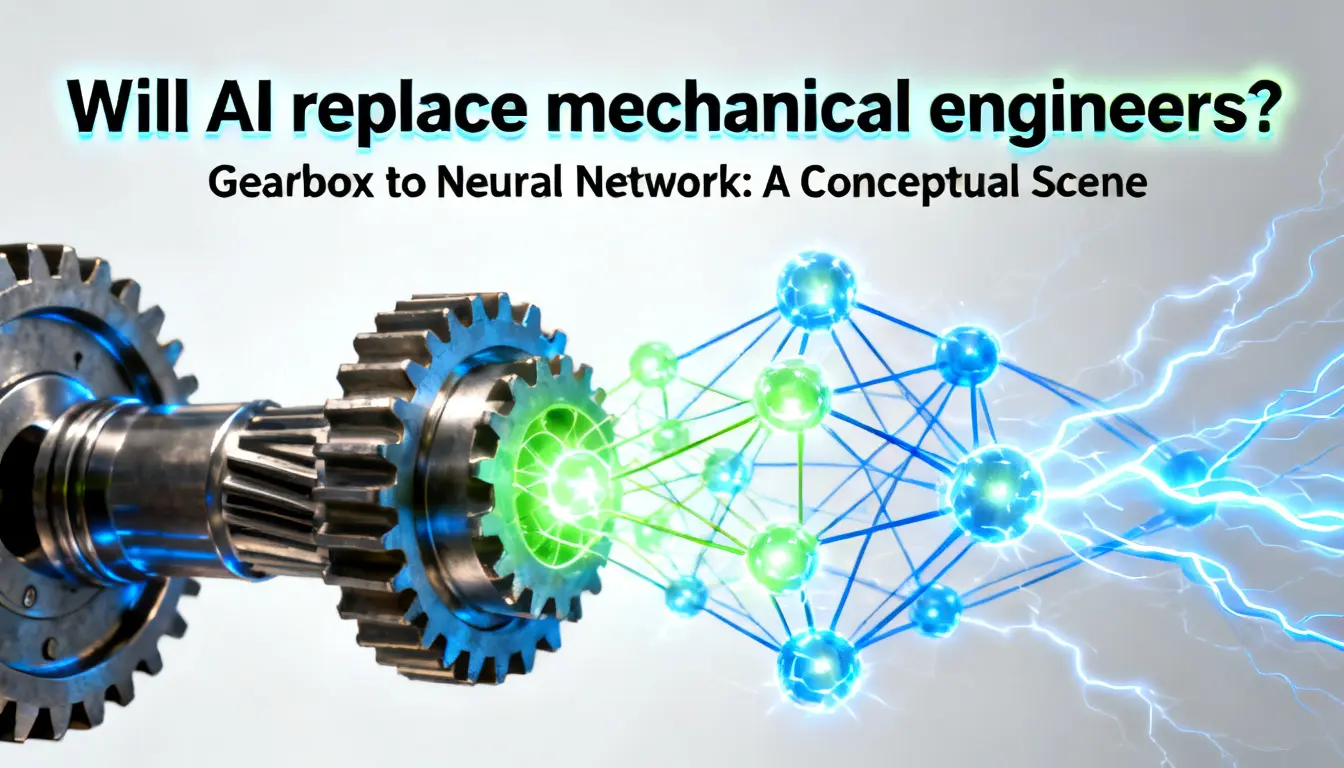
The field of mechanical engineering is undergoing a revolution thanks to machine learning, but artificial intelligence is not yet ready to completely replace human engineers. Job tasks that are repetitive and time-consuming can be automated. Some examples of these types of tasks are data analysis, simulations, and basic design optimization. As a consequence of this, engineers are able to spend more time to the creation of innovative solutions to problems that already exist and to the undertaking of challenges that are becoming increasingly difficult.
There are a number of human abilities that artificial intelligence does not possess, including the capacity to think critically, draw on personal experience, and make decisions in situations that are unclear. This is something that mechanical engineers are capable of doing. The importance of human contact cannot be overstated when it comes to engineering projects, which frequently require individuals to work together, exercise ethical discernment, and be flexible.
To provide a more specific example, the application of artificial intelligence as a tool is extremely beneficial to mechanical engineers nowadays. Their work is becoming more accurate, efficient, and of higher quality as a result of the fact that their jobs are undergoing change rather than being replaced.
AI vs Mechanical Engineers
Instead of competing with one another, artificial intelligence and mechanical engineers complement one another. Human engineers bring creativity, judgment, and an understanding of the actual world to the table, whereas artificial intelligence shines at speed and data processing.
| Aspect | AI | Mechanical Engineers |
|---|---|---|
| Quick & Effective | Instantly processes big data | A bit slower but insightful |
| Creativity | Only works with info that is already there | Very unique and new |
| Resolution of Issues | based on predetermined patterns | Provides solutions to difficult and unforeseen issues |
| Decision-Making Process | exclusively based on data | Combining experience, logic, and morality in one package |
| Ability to Adapt | Only applicable to programming | Exceptionally adaptable to novel circumstances |
| Innovation | Offers assistance in optimising, | Drives the development of innovative concepts and designs |
| Interaction with Humans | Incapable of working together emotionally | Powerful collaboration and communication skills |
Impact on Mechanical Engineering Careers
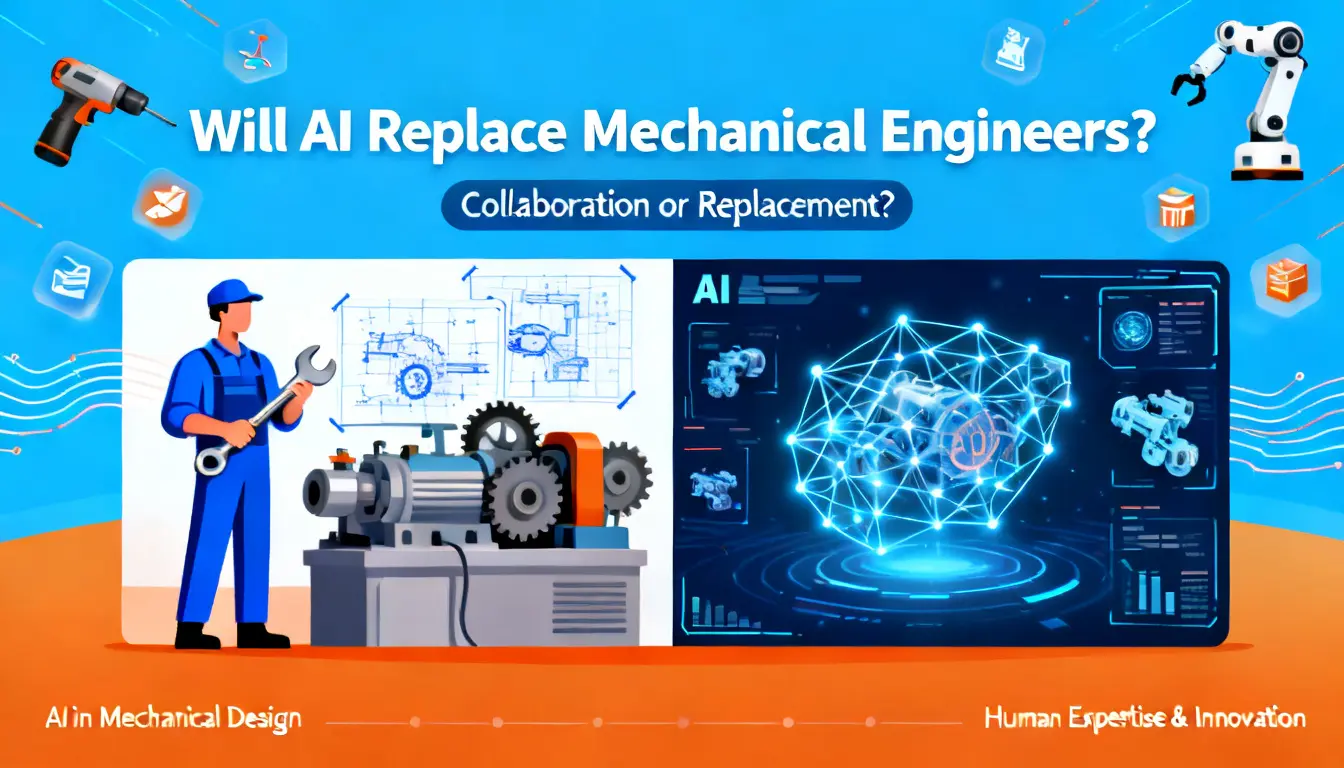
Artificial intelligence is transforming job opportunities in mechanical engineering, but it is not eliminating them. The adoption of artificial intelligence and automation by businesses is causing a shift in engineering employment.
One of the results is the disengagement from tedious, repetitive work. There is an increasing trend toward the automation of human work by artificial intelligence. Included in this package are fundamental drawing concepts, manual computations, and repeated analysis. Those who work in mechanical engineering have the ability to devote more time to strategic tasks such as the construction of systems, the generation of novel ideas, and the resolution of difficult challenges.
New prospects for professional development present themselves while this is taking place. With the growth of smart manufacturing, automation, robots, and renewable energy, there will be a demand for engineers who are knowledgeable about artificial intelligence. In order to be successful, businesses want employees who are proficient in both ancient engineering techniques and contemporary digital tools.
Engineers, on the other hand, are required to continue their education in order to keep up with progress. Learning on an ongoing basis is becoming increasingly important for maintaining relevance in the workplace.
Master MEP Design with Industry-Leading Training!
Gain in-depth knowledge of Mechanical, Electrical, and Plumbing (MEP) Design with expert-led courses. Learn HVAC, fire safety, sustainable building strategies, and BIM applications to excel in the construction industry.
Know MorePractical Implications for Students and Professionals
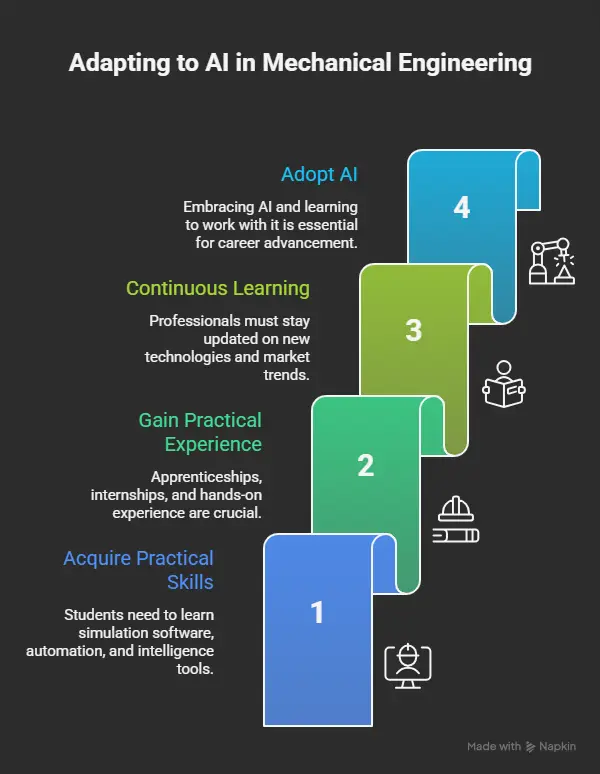
AI is causing a transformation in mechanical engineering; thus, students and professionals need to adapt to it. Today’s world requires the merging of engineering skills and technological understanding.
Instead of relying solely on textbooks, students are required to acquire practical skills such as simulation software, automation, and intelligence tools. There will be an increase in the value of apprenticeships, internships, and practical experience.
Training shouldn’t stop for professionals. New technologies, data-driven decision-making, and market trends are all things that engineers might need to be able to comprehend. To maintain their competitive edge in the labor market, pupils will benefit from learning and adaptability.
They will be able to advance their professions more quickly if they are willing to adopt artificial intelligence and learn how to work with it, while those who resist change may have difficulty doing so.
Skills to Learn
It is imperative that mechanical engineers cultivate a wide range of skills, including both traditional and contemporary ones, in order to ensure their continued relevance in a world of engineering that is increasingly driven by artificial intelligence.
Technical skills include the following:
- A comprehensive understanding of the subjects of material science, thermodynamics, and mechanics, among others
- CAD software programs like AutoCAD, SolidWorks, and CATIA are examples of computer-aided design software.
- MATLAB and ANSYS are two examples of software that may be used for simulation and analysis.
Artificial intelligence and digital skills:
- The fundamentals of programming, with Python being particularly helpful.
- An examination and interpretation of the data
- A brief introduction to the fundamentals of machine learning
- Knowledge and experience with various robotics and automation systems
Professional skills:
- Critical thinking and fixing problems
- Teamwork and talking to each other
- Managing projects and being flexible
- Mindset of always learning
Advantages and Concerns
AI is beneficial to mechanical engineering, but it also presents a number of significant challenges.
Advantages
To free engineers to concentrate on design and innovation, artificial intelligence automates mundane tasks. In comparison to more conventional approaches, it reduces the amount of human error, enhances the accuracy of simulations, and optimizes complex systems more quickly. Predictive maintenance and decision-making that are enabled by artificial intelligence are beneficial to manufacturing and automotive engineering.
Concerns
Artificial intelligence also presents some concerns, despite the fact that it offers a great deal of potential benefits. It is possible that engineers will need to consistently acquire new skills because the nature of employment positions is always evolving. We are dealing with a big issue here. An excessive dependence on AI tools is another potential cause for concern. If this reliance is not appropriately balanced, it could result in a loss in the amount of hands-on experience obtained in the process of problem-solving expertise. In addition, ethical considerations and the dependability of the system continue to be key factors, particularly in engineering applications that are intended to ensure safety.
Join our MEP Course Online and Build a Successful Career!
Wrapping Up
The field of mechanical engineering is actually being advanced by artificial intelligence, rather than being replaced by it. Automation may greatly enhance the speed, accuracy, and efficiency of data-intensive and repetitive engineering operations. Analyzing, deciding, and being creative are just a few of the many real-world jobs that call for the expertise of human engineers.
Changes in mechanical engineering will be brought about by collaborative efforts between humans and AI. For engineers to thrive in today’s tech-driven industry, they need to be nimble, meticulous, and quick to embrace new technology.
Master MEP Design with Industry-Leading Training!
Gain in-depth knowledge of Mechanical, Electrical, and Plumbing (MEP) Design with expert-led courses. Learn HVAC, fire safety, sustainable building strategies, and BIM applications to excel in the construction industry.
Know MoreFrequently Asked Questions
How is AI changing mechanical engineering?
AI is improving design accuracy, speeding up simulations, predictive maintenance, and helping engineers optimize machines and systems more efficiently.
Will mechanical engineers lose jobs because of AI?
Not overall. Some tasks may reduce, but new roles in automation, robotics, and smart manufacturing are also increasing job opportunities.
What skills should mechanical engineers learn to work with AI?
Skills like CAD tools, data analysis, programming basics (Python), robotics, and understanding of AI-driven design tools are useful.
Can AI design machines without engineers?
No, AI can assist in design but still needs engineers to define requirements, validate designs, and ensure safety and functionality.
Is mechanical engineering still a good career in the AI era?
Yes, it remains a strong career. Engineers who adapt and learn AI tools will have even better opportunities in the future.
Can AI design and manufacture products without humans?
No, AI can assist in design and manufacturing, but human engineers are needed to set goals, check safety, and make final decisions.
Will AI create new jobs for mechanical engineers?
Yes, AI is creating new roles in robotics, automation engineering, smart factories, and predictive maintenance systems.
Will AI make mechanical engineering easier or harder?
AI will make many tasks easier by automating calculations and simulations, allowing engineers to focus on creativity and innovation.
What is the future of mechanical engineering with AI?
The future is collaborative—AI will support engineers, not replace them, leading to more advanced and efficient engineering solutions.