

Designing a training programme without a method is like building a house without a plan. It might stand, but it probably won’t meet anyone’s needs. The ADDIE model is the most widely used framework for designing training, and it gives HR and L&D teams a clear, step-by-step process.
This lesson explains the five phases of ADDIE, shows how to apply them to a real training programme and compares ADDIE with the faster SAM model.
What is the ADDIE model?
ADDIE is an instructional design model with five phases:
- Analysis
- Design
- Development
- Implementation
- Evaluation
It was developed in the 1970s at Florida State University for training in the US armed forces, and it has since become the standard framework for designing training in companies, universities and e-learning.
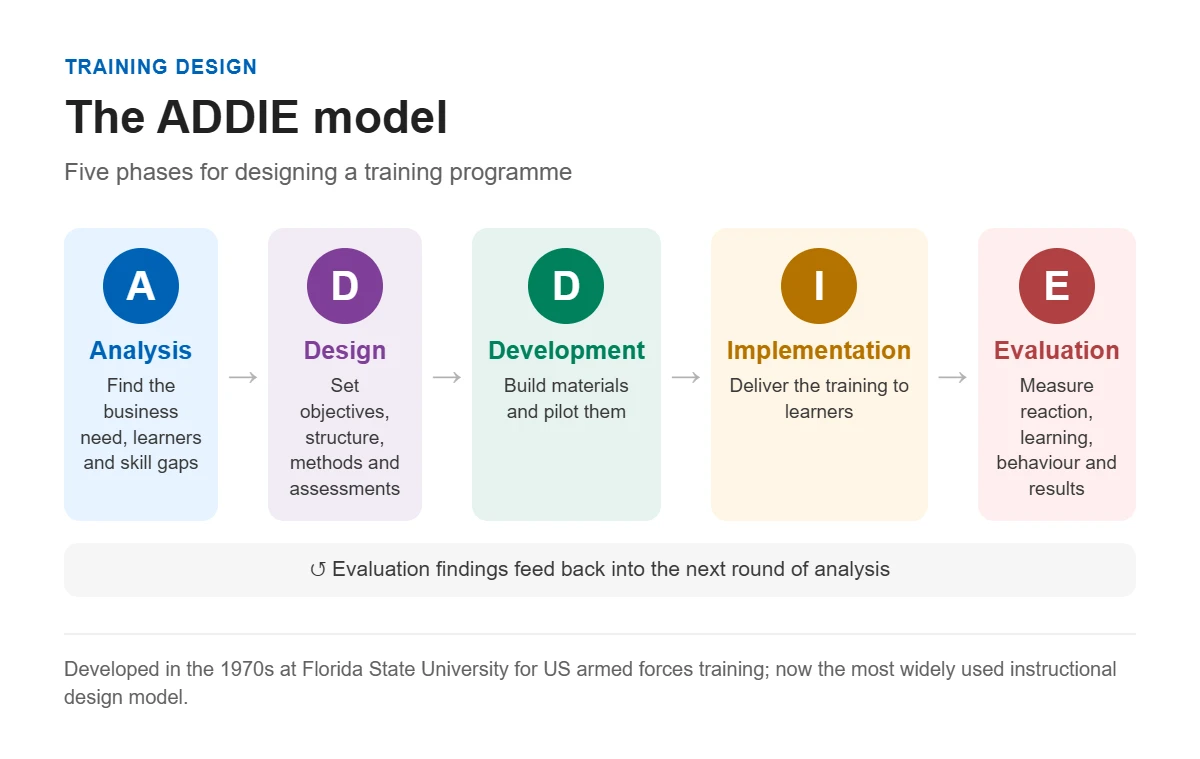
The ADDIE model for designing training.
The five phases of the ADDIE model
1. Analysis
Understand the problem before designing anything.
- What business problem should the training solve?
- Who are the learners, and what do they already know?
- What skills or knowledge gaps exist?
- What constraints apply: budget, time, location, technology?
The output is a clear statement of training needs and goals, usually from a training needs analysis.
2. Design
Plan the learning experience.
- Write learning objectives: what learners will be able to do after the training. Good objectives are specific and measurable, such as “Process a vendor invoice in the ERP system without errors”.
- Decide the structure: modules, sequence and duration.
- Choose methods: classroom, e-learning, simulations, role-plays or a blend.
- Plan assessments: how you’ll check whether learners met the objectives.
The output is a design document or storyboard.
3. Development
Build the training materials.
- slides, facilitator guides and participant workbooks
- e-learning modules and videos
- case studies, exercises and role-play scripts
- quizzes and assessments
Test the materials with a small pilot group and fix problems before the full rollout.
4. Implementation
Deliver the training.
- schedule sessions and invite participants
- brief trainers and prepare venues or online platforms
- upload e-learning to the learning management system
- communicate why the training matters
- run the sessions and support learners
5. Evaluation
Check whether the training worked, at two levels:
- Formative evaluation during each phase, such as reviewing the design or piloting materials
- Summative evaluation after delivery, measuring reactions, learning, behaviour change and results
The Kirkpatrick model is the most common framework for summative evaluation. Findings feed back into the next round of analysis, so ADDIE is often drawn as a cycle.
ADDIE example: designing a customer service training programme
| Phase | What the team does |
|---|---|
| Analysis | Customer complaints about rude or slow responses have risen 20%. TNA shows new agents struggle with handling angry customers and using the ticketing system. |
| Design | Objectives: de-escalate a complaint using a four-step method; resolve a ticket within the target time. Two-day blended programme: e-learning on the ticketing system plus a workshop with role-plays. |
| Development | Build a 45-minute e-learning module, workshop slides, five role-play scenarios and a final assessment. Pilot with one team. |
| Implementation | Roll out to all new agents over four weeks; managers schedule time off the floor. |
| Evaluation | Feedback forms, assessment scores, call quality audits after one month and complaint rates after three months. |
Benefits of the ADDIE model
- Structured: reduces the chance of skipping important steps
- Learner-focused: starts with needs, not with content
- Measurable: objectives and evaluation are built in
- Flexible: works for classroom, online and blended training
- Easy to explain to managers and stakeholders
Limitations of ADDIE
- can be slow and documentation-heavy for small or urgent projects
- in its traditional form, problems may only show up late in the process
- less suited to fast-changing content
Many teams now run ADDIE in a more iterative way, with reviews and pilots in every phase.
ADDIE vs SAM
SAM (Successive Approximation Model), developed by Michael Allen, is a faster, agile alternative. Instead of completing each phase before the next, SAM builds quick prototypes, tests them with learners and improves them in short cycles.
| ADDIE | SAM | |
|---|---|---|
| Approach | Sequential phases | Repeated short cycles |
| Speed | Slower, thorough | Faster |
| Best for | Large, stable programmes, compliance training | Fast-changing content, e-learning |
| Feedback | Mainly at evaluation, unless run iteratively | Throughout |
Tips for designing effective training
- start from the business problem, not the content you already have
- keep objectives few and specific
- use activities and practice, not just presentations
- relate examples to learners’ actual jobs
- plan how managers will support learners after the training
To measure the final phase properly, see our lesson on the four levels of training evaluation. If your programme includes online modules, our lesson on platforms that deliver online courses explains how they work. For guided practice designing a programme yourself, an HR programme that includes training design is one option.
