

The PoSH Act is India’s law against sexual harassment of women at work. Every HR professional needs to know it well, because the law places specific duties on employers, and getting the process wrong can hurt the complainant, the accused and the organisation.
This lesson explains what the PoSH Act covers, who it protects, what employers must do, and how a complaint moves from filing to final action.
What is the PoSH Act?
PoSH stands for Prevention of Sexual Harassment. The law’s full name is the Sexual Harassment of Women at Workplace (Prevention, Prohibition and Redressal) Act, 2013. It came into force on 9 December 2013, along with rules issued the same year.
Background: the Vishaka judgment
Before 2013, there was no specific law on workplace sexual harassment. In Vishaka v. State of Rajasthan (1997), the Supreme Court recognised sexual harassment at work as a violation of women’s fundamental rights to equality, to practise any profession and to life with dignity. It laid down the Vishaka Guidelines, which employers had to follow until Parliament passed a law. The PoSH Act built on those guidelines.
Objectives of the Act
- Prevention: stop harassment before it happens through policy, awareness and training
- Prohibition: make clear that sexual harassment is not allowed at any workplace
- Redressal: give women a fair, time-bound process to complain and get relief
What is sexual harassment under the PoSH Act?
The Act defines sexual harassment as any one or more of these unwelcome acts or behaviours, directly or by implication:
- physical contact and advances
- a demand or request for sexual favours
- making sexually coloured remarks
- showing pornography
- any other unwelcome physical, verbal or non-verbal conduct of a sexual nature
The Act also says that certain circumstances, when connected with such behaviour, can amount to sexual harassment, including:
- an implied or explicit promise of preferential treatment at work
- an implied or explicit threat of detrimental treatment
- a threat about her present or future employment
- interference with her work, or creating an intimidating, offensive or hostile work environment
- humiliating treatment likely to affect her health or safety
Quid pro quo vs hostile work environment
These two terms help explain the definition:
| Type | What it means | Example |
|---|---|---|
| Quid pro quo | “This for that”: a job benefit is linked to sexual favours, or a penalty to refusing them | A manager hints that a promotion depends on agreeing to a date |
| Hostile work environment | Repeated unwelcome sexual conduct makes the workplace intimidating or offensive | Sexual jokes and comments in a team chat, despite objections |
The test is whether the behaviour is unwelcome to the woman, not what the other person intended.
Who is protected?
The Act protects an aggrieved woman: a woman of any age, whether employed or not, who alleges she was sexually harassed at a workplace. This means it covers employees and also visitors, clients, students, trainees and customers who face harassment at a workplace.
An “employee” for this law includes regular, temporary, ad hoc and daily-wage staff, people engaged through contractors or agents, probationers, trainees, apprentices and interns, whether paid or not.
The Act’s complaint process is for women. Many companies voluntarily extend their anti-harassment policy to all genders, while following the statutory process for complaints by women.
What counts as a workplace?
The definition is wide. It includes:
- offices, factories, shops and branches
- hospitals, nursing homes, educational institutions and sports facilities
- any place the employee visits because of work, including during travel
- transport provided by the employer for the journey
- a dwelling place or house where someone is employed, such as domestic work
Remote and online interactions connected with work, such as video calls and work chats, are generally treated as part of the workplace by employers and courts.
In Dr. Sohail Malik v. Union of India, decided on 10 December 2025, the Supreme Court held that the Internal Committee at the woman’s workplace can inquire into her complaint even when the accused works for a different department or organisation.
Employer duties under the PoSH Act
Every employer must:
- Constitute an Internal Committee (IC) at each office or unit with 10 or more employees.
- Provide a safe working environment, including protection from people who come into contact with employees at the workplace.
- Display the penal consequences of sexual harassment and the order constituting the IC at a prominent place.
- Formulate and widely share an internal policy on prevention, prohibition and redressal.
- Organise workshops and awareness programmes at regular intervals, and orientation for IC members.
- Provide the IC with facilities to handle complaints and conduct inquiries.
- Help secure attendance of the respondent and witnesses before the IC.
- Assist the woman if she chooses to file a criminal complaint.
- Treat sexual harassment as misconduct under service rules and act on it.
- Monitor that IC reports are submitted on time.
Our lessons on how the ICC is formed and drafting a PoSH policy explain the first and fourth duties step by step.
Local Committee
Every district has a Local Committee, set up by the District Officer. It receives complaints from women in workplaces with fewer than 10 employees, from domestic workers, and where the complaint is against the employer.
The PoSH complaint process and timelines
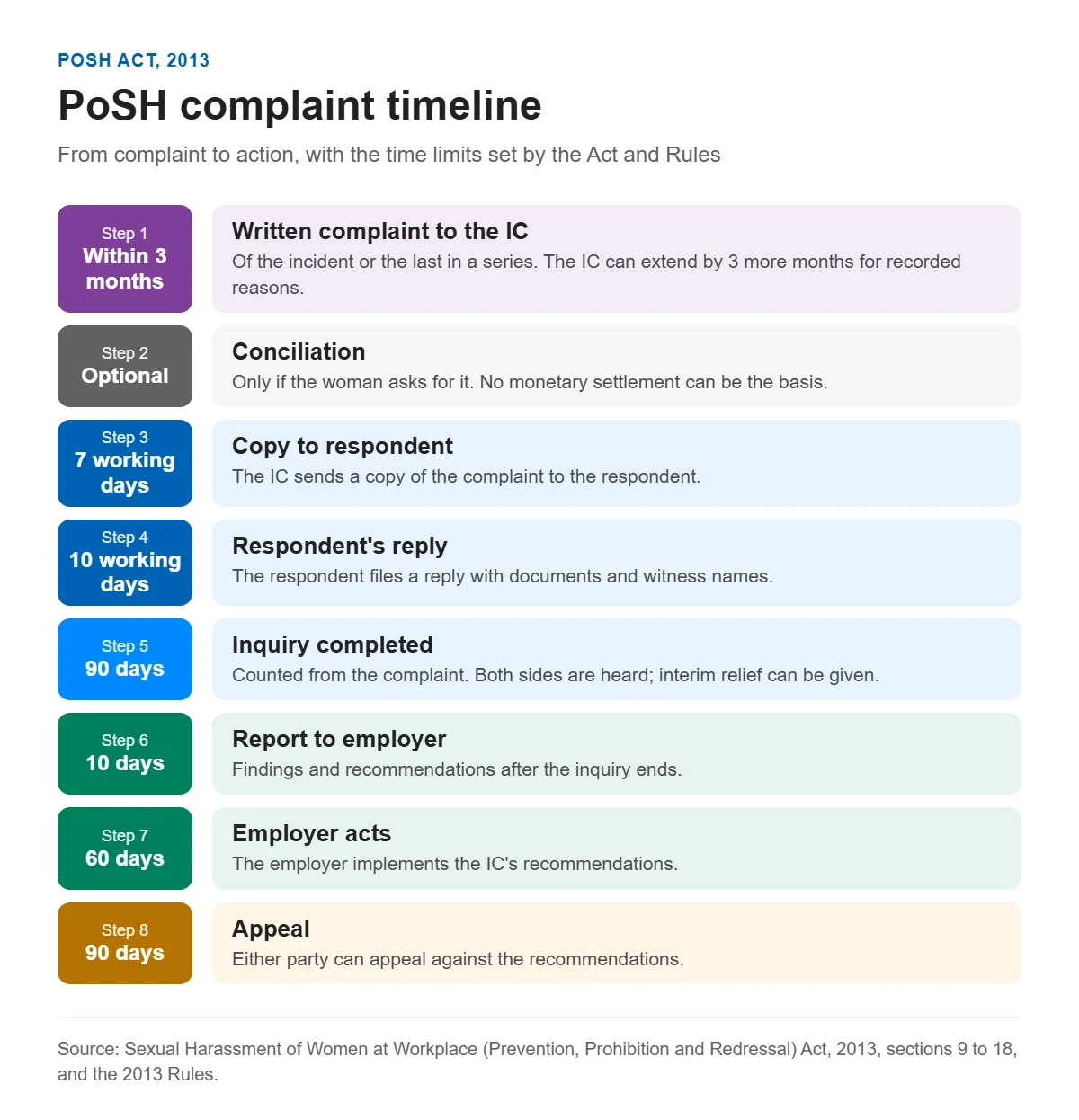
PoSH complaint timeline under the 2013 Act and Rules.
1. Filing a complaint
The aggrieved woman makes a written complaint to the IC (or Local Committee) within three months of the incident, or of the last incident in a series. The committee can extend this by another three months if circumstances prevented her from filing earlier. If she can’t write the complaint, committee members must help her put it in writing.
2. Conciliation (optional)
At the woman’s request, the IC can try to settle the matter through conciliation before starting an inquiry. No monetary settlement can be the basis of conciliation.
3. Inquiry
If there is no conciliation, the IC conducts an inquiry. The respondent gets a copy of the complaint within 7 working days and has 10 working days to reply. Both sides are heard. The IC has powers similar to a civil court to summon people and call for documents. The inquiry must be completed within 90 days.
4. Interim relief
During the inquiry, the woman can ask the IC to recommend interim measures, such as transferring her or the respondent, granting her leave of up to three months, or stopping the respondent from assessing her work.
5. Report and action
The IC gives its report to the employer within 10 days of finishing the inquiry. If the allegation is proved, it recommends action, such as disciplinary action under service rules or deduction from the respondent’s salary as compensation. The employer must act within 60 days.
6. Appeal
Either party can appeal against the recommendations within 90 days.
False or malicious complaints
If the IC finds that a complaint was knowingly false or malicious, it can recommend action against the complainant. Simply failing to prove a complaint, or lack of evidence, is not a reason for such action.
Confidentiality
The identity of the complainant, respondent and witnesses, and the details of the inquiry, must not be published or made public.
Penalties for employers
- failing to constitute an IC, or breaching other provisions: fine up to ₹50,000
- repeat offence: up to twice the punishment, and possible cancellation of the business licence or registration
Reporting requirements
- the IC prepares an annual report and submits it to the employer and the District Officer
- companies must disclose in their board’s report whether they have complied with the IC requirement and, since 14 July 2025, the number of complaints received, disposed of and pending for more than 90 days, along with a statement on compliance with maternity benefit law
PoSH and criminal law
The PoSH Act provides a civil, workplace remedy. Sexual harassment is also an offence under Section 75 of the Bharatiya Nyaya Sanhita, 2023. A woman can use either route or both, and the employer must help her if she chooses to file a police complaint.
For guided learning on PoSH compliance alongside other HR laws, an HR certification for working professionals can help you apply it to real workplace cases.
