

A two-person HR team and a 200-person HR function solve the same problems: hiring, paying, developing and retaining people. What changes is how the work is divided. The HR department structure decides who owns which part of the employee journey, who reports to whom, and how HR connects with the rest of the business.
What is an HR department structure?
An HR department structure is the way HR roles, teams and reporting lines are arranged. It defines:
- which HR roles exist and what each one is responsible for
- the hierarchy, from entry-level executives to the HR head
- how HR is split into teams, such as recruitment, payroll or learning
- how HR works with business units and leadership
A clear structure prevents gaps (nobody owns exit settlements) and overlaps (two people answering the same employee query differently).
The HR hierarchy
Job titles vary between companies, but most Indian organisations follow a hierarchy similar to this one.
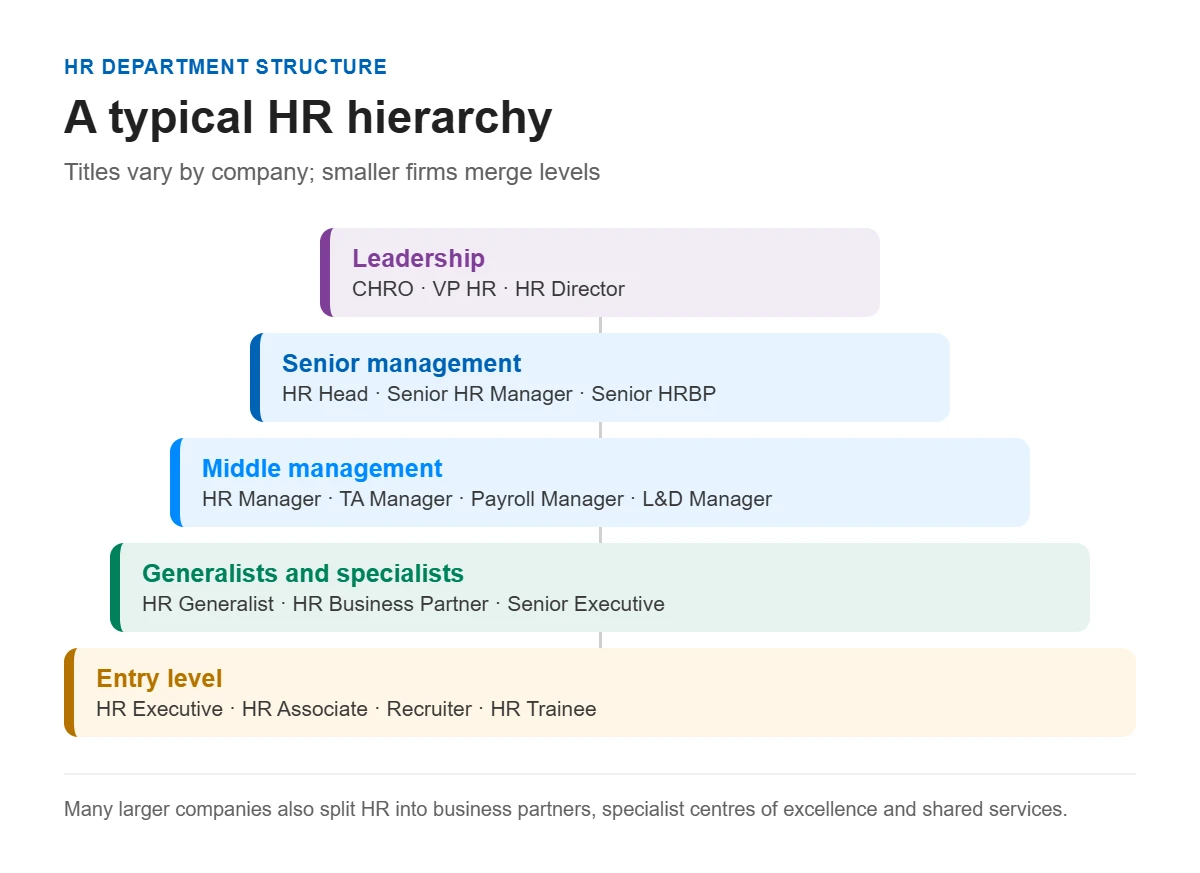
A typical HR hierarchy, from entry level to leadership.
| Level | Typical titles | Main focus |
|---|---|---|
| Leadership | CHRO, VP HR, HR Director | HR strategy, leadership team member, culture, policy |
| Senior management | HR Head, Senior HR Manager, HR Business Partner (senior) | Running HR for a business or region, advising leaders |
| Middle management | HR Manager, Talent Acquisition Manager, Payroll Manager, L&D Manager | Leading a team or function |
| Specialists and generalists | HR Generalist, HR Business Partner, Senior Executive | Delivering HR services, handling employee issues |
| Entry level | HR Executive, HR Associate, Recruiter, HR Assistant, HR Trainee | Recruitment support, records, onboarding, payroll inputs, queries |
In smaller companies, several levels merge: an HR manager may report directly to the founder and manage two executives.
Common HR organisational structures
The way HR is organised usually mirrors the company’s overall structure. Entri’s mentor sessions on organisational structure describe four common types, and each one shapes HR differently.
Functional structure
HR is one central department with teams for each function: recruitment, payroll, L&D and so on. Clear reporting lines and deep specialisation make it common in large single-business companies.
Divisional structure
Each business division, product line or region has its own HR team, often with a central HR team for policy. Suitable for diversified companies, where a manufacturing plant and a software division need very different HR support.
Matrix structure
HR professionals report to both a functional HR head and a business leader. An HR business partner for the sales division, for example, may report to the HR head and work day-to-day with the sales director. This encourages collaboration but can confuse priorities if roles are unclear.
Flat vs hierarchical
A flat structure has few management layers and fast decisions, which is typical in startups. A hierarchical structure has a clear chain of command and structured growth, which is typical in large or regulated organisations.
The three-pillar HR model
Many medium and large companies organise HR using the three-pillar model associated with Dave Ulrich:
- HR business partners (HRBPs): work closely with business leaders, advising on people decisions, performance, restructuring and talent.
- Centres of excellence (CoEs): specialist teams such as talent acquisition, compensation and benefits, learning and development, and HR analytics, which design programmes and policies.
- Shared services: a central HR operations team that handles transactional work such as records, payroll inputs, onboarding paperwork and employee queries, often through an HRMS and a helpdesk.
This model lets specialists focus on design, business partners on advice, and shared services on efficient delivery. Our lesson on how shared HR operations work in practice explains the shared services side.
How HR structure changes as a company grows
| Stage | Typical HR structure |
|---|---|
| Startup (1–50 employees) | Founder or office manager handles HR; payroll often outsourced |
| Early growth (50–200) | First HR manager or generalist, one or two executives, basic policies |
| Scaling (200–1,000) | Separate recruitment and HR operations teams, first HRMS, HR business partners for key departments |
| Large company (1,000+) | Full three-pillar model, HR leadership in the senior team, specialist CoEs, shared services |
A common rule of thumb for HR team size is a ratio of HR staff to employees, but it varies widely by industry, how much is outsourced and how automated HR is, so treat any fixed ratio with caution.
HR’s role in the company’s overall structure
HR also helps the wider organisation manage its own structure. When the business restructures, HR:
- makes sure job roles and reporting lines are clear
- supports workforce alignment, transfers and redeployment
- helps employees adapt to the change and understand their new roles
Structure affects career growth, collaboration and employee satisfaction, so HR’s involvement in organisational design is one of the places it adds real strategic value.
For a sense of where these roles sit in pay and career terms, this overview of an HR manager’s role and responsibilities is a useful next read.
