

A job offer says “₹6 LPA CTC”, but the first salary credit is much lower than ₹50,000. This surprises many first-time employees. The reason is that CTC includes several items that never reach your bank account each month.
This lesson explains the CTC full form, what CTC includes, a sample CTC breakup, how to calculate in-hand salary and the difference between CTC, gross salary and net salary.
CTC full form and meaning
CTC stands for Cost to Company. It is the total amount an employer spends on an employee in a year, including salary, allowances, employer contributions to statutory schemes and other benefits.
LPA means “lakhs per annum”, so “₹6 LPA” means a CTC of ₹6,00,000 a year.
What CTC includes
| Part | Examples | Paid monthly? |
|---|---|---|
| Fixed salary | Basic pay, HRA, special allowance, other allowances | Yes |
| Variable pay | Performance bonus, incentives | Usually yearly or quarterly, if earned |
| Employer contributions | Employer PF, employer ESI where applicable | No, deposited in the scheme |
| Gratuity provision | Amount set aside for future gratuity | No, paid on exit if eligible |
| Insurance | Group health and term insurance premiums | No |
| Other benefits | Meal cards, reimbursements, joining or retention bonus | Varies |
CTC vs gross salary vs net (in-hand) salary
| Term | Meaning |
|---|---|
| CTC | Everything the employer spends on you in a year |
| Gross salary | Salary before deductions: fixed pay plus any allowances paid to you |
| Net salary (in-hand / take-home) | What reaches your bank account after deductions such as employee PF, professional tax and income tax |
In short: CTC − employer-side costs = gross salary; gross salary − deductions = net salary.
Sample CTC breakup
CTC: ₹6,00,000 a year, for an employee in a metro city.
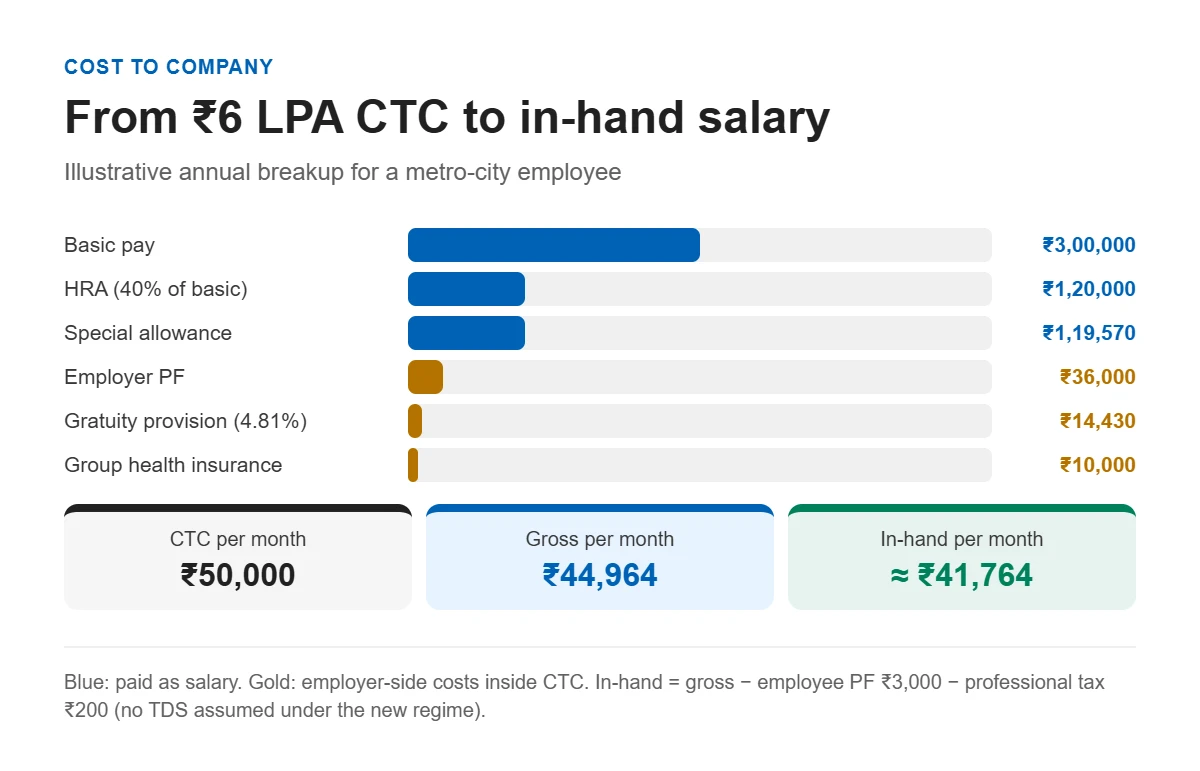
How a ₹6 LPA CTC turns into monthly in-hand salary (illustrative).
| Component | Annual (₹) | Monthly (₹) |
|---|---|---|
| Basic pay (50% of CTC) | 3,00,000 | 25,000 |
| HRA (40% of basic) | 1,20,000 | 10,000 |
| Special allowance | 1,19,570 | 9,964 |
| Gross salary | 5,39,570 | 44,964 |
| Employer PF (12% of ₹25,000) | 36,000 | 3,000 |
| Gratuity provision (4.81% of basic) | 14,430 | 1,203 |
| Group health insurance | 10,000 | 833 |
| CTC | 6,00,000 | 50,000 |
Monthly in-hand salary
| Item | Monthly (₹) |
|---|---|
| Gross salary | 44,964 |
| Less: employee PF (12% of ₹25,000) | 3,000 |
| Less: professional tax (varies by state) | 200 |
| Less: income tax (TDS) | 0 |
| In-hand salary | ≈ 41,764 |
Why no tax? Under the new tax regime, which is the default for tax year 2026-27, an employee with gross salary up to about ₹12.75 lakh a year generally pays no income tax after the standard deduction and rebate. Tax depends on the regime chosen and other income, so actual TDS can differ.
Why 4.81%? The gratuity formula pays 15 days’ wages per year of service, calculated on a 26-day month. 15 ÷ 26 ÷ 12 ≈ 4.81% of monthly wages per month of service.
How to calculate in-hand salary from CTC
- Start with the annual CTC.
- Subtract employer-side items: employer PF, employer ESI (if applicable), gratuity provision, insurance premiums and any variable pay not guaranteed.
- The result is annual gross salary; divide by 12 for monthly gross.
- Subtract employee deductions: employee PF, employee ESI if applicable, professional tax and estimated TDS.
- The result is the approximate monthly in-hand salary.
Things to check in an offer letter
- Fixed vs variable: how much of CTC depends on performance
- Basic pay share: a higher basic increases PF and gratuity, which can reduce monthly in-hand pay but increase long-term savings
- Employer PF: whether it is calculated on full basic or capped at the statutory ceiling
- One-time items: joining bonuses or relocation support included in “first-year CTC”
- Insurance: who is covered and whether premiums are included in CTC
- Notice period and clawbacks: conditions attached to bonuses
Why CTC and in-hand pay differ so much
- employer contributions are part of CTC but not paid to you monthly
- gratuity is paid only on exit after the eligibility period
- variable pay depends on performance and timing
- deductions such as PF and tax reduce take-home pay
Tips for HR when explaining CTC
- show both CTC and estimated monthly in-hand pay in offer letters
- separate fixed, variable and one-time items clearly
- explain PF and gratuity as long-term savings, not “lost” money
- share a total rewards statement once a year
How the fixed part is designed is covered in our lesson on salary components and bands, and how it appears each month is covered in our lesson on understanding a monthly payslip.
