

When offices reopened after remote work became common, many companies discovered that “come in three days a week” was not a policy. It left open who decides which days, what happens when a team is spread across cities, who pays for the internet, and how a manager judges performance. A hybrid work policy answers these questions in writing so that employees and managers are treated consistently.
This lesson explains the common work models, what a policy should cover, a simple outline you can adapt, and how HR can manage performance, engagement and compliance in a hybrid setup.
What is a hybrid work policy?
A hybrid work policy sets out when, where and how employees may split work between an office and another location, usually home. It defines eligibility, expectations, tools, costs, security, performance measurement and the rights of both employee and employer.
Common work models
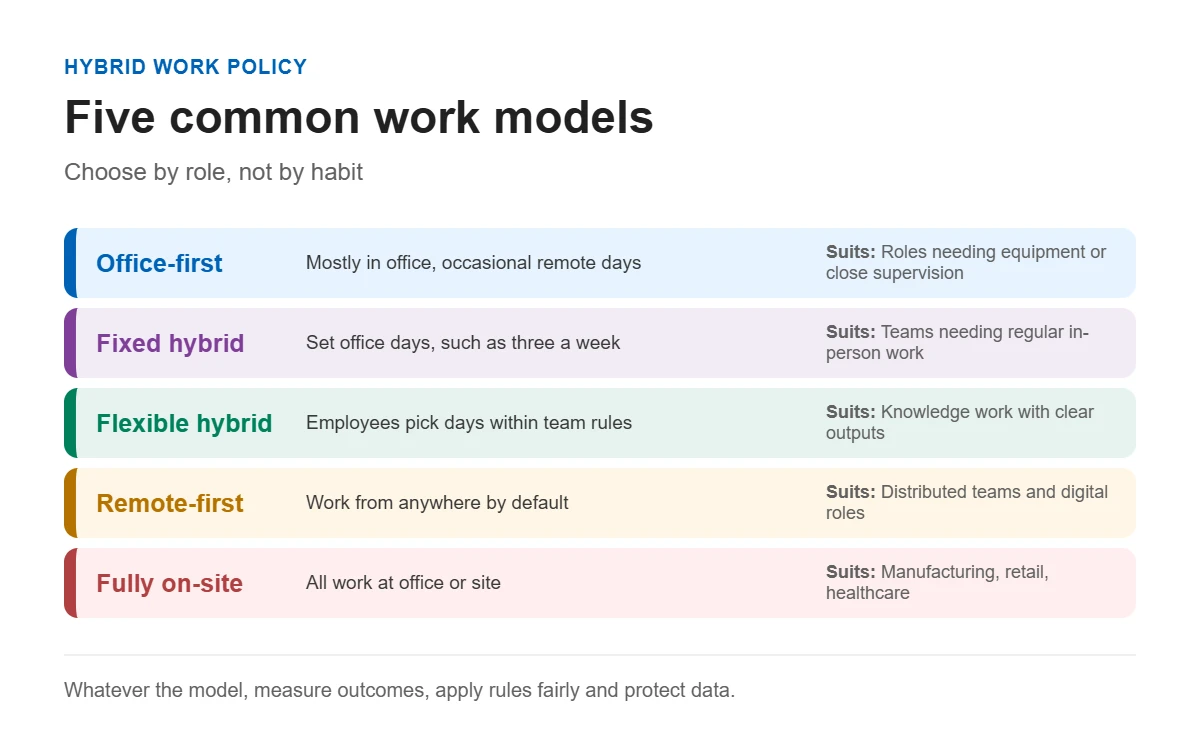
Five common work models for a hybrid work policy.
| Model | How it works | Suits |
|---|---|---|
| Office-first | Most work in the office, occasional remote days | Roles needing equipment, customer presence or close supervision |
| Fixed hybrid | Set office days, such as three days a week | Teams that need regular in-person collaboration |
| Flexible hybrid | Employees choose days within team rules | Knowledge work with clear outputs |
| Remote-first | Work from anywhere by default, office for occasional meetings | Distributed teams and digital roles |
| Fully on-site | All work in the office or at site | Manufacturing, retail, healthcare and similar roles |
Policies often differ by role. A hybrid policy for desk-based staff does not need to pretend that a machine operator can work from home, but it should be open about why.
What a hybrid work policy should cover
Eligibility and approval
- which roles and teams are eligible, and the criteria used
- whether new joiners and employees on probation qualify
- who approves requests and how exceptions are handled
Schedule and availability
- anchor days or core hours when teams are expected to be online or in office
- how to share schedules so colleagues know who is where
- response-time expectations for messages and meetings
Workplace and equipment
- who supplies laptops, monitors and chairs
- any internet or home-office allowance, and how to claim it
- safe working conditions at home
Data security and confidentiality
- use of company devices and approved tools only
- secure connections and password rules
- handling of confidential documents at home and in public places
- reporting a lost device or suspected breach immediately
Performance and communication
- goals and outputs measured the same way for all employees
- regular one-to-ones and team check-ins
- how and when to use chat, email and video calls
Pay, leave and attendance
- how attendance is recorded for remote days
- how leave, overtime and working hours rules apply
- whether pay or allowances vary by work location
Review and exit from hybrid
- how often the policy is reviewed
- when the company may change or withdraw hybrid arrangements, with notice
A simple policy outline
- Purpose and scope
- Definitions of work models
- Eligibility and approval process
- Work schedule and core hours
- Equipment, expenses and allowances
- Data security and confidentiality
- Performance and communication standards
- Health, safety and well-being
- Attendance, leave and working hours
- Compliance with company policies, including the code of conduct
- Review process and policy owner
Managing performance when you cannot see everyone
- Set clear outcomes. Agree goals and deadlines instead of tracking hours in a chair. Our guide to managing performance across the year covers goal setting and reviews.
- Hold regular one-to-ones. Weekly or fortnightly conversations catch problems early.
- Treat everyone equally. Avoid favouring people who are physically visible, which can create proximity bias in promotions.
- Use data carefully. Output measures are fair. Constant screen monitoring harms trust and raises privacy concerns.
Keeping remote and hybrid employees engaged
- plan in-office days around team meetings, workshops and social time, not solo tasks
- document decisions in writing so remote colleagues are not left out
- recognise contributions publicly, whatever the location
- watch for isolation, overwork and blurred boundaries, and encourage breaks and logging off on time
- extend onboarding support to new joiners who start remotely
For more on this, see our lesson on how to build employee engagement.
Legal and compliance points in India
India has no single national law dedicated to hybrid work, so HR should check how existing rules apply.
- State Shops and Establishments laws, and labour codes. Working hours, overtime, leave and records still apply to employees working remotely. Our compliance checklist for HR teams is a good place to start.
- Special Economic Zones. SEZ rules allow IT and IT-enabled units to permit hybrid working under Rule 43A, as amended in November 2023. Check the latest rule text before relying on it.
- Workplace harassment. Conduct rules, including the PoSH Act, can extend to online interactions and remote settings, so train managers and employees accordingly.
- Data protection. The Digital Personal Data Protection Act, 2023 applies to personal data handled while working remotely, so secure access and clear data-handling rules matter.
- Tax and allowances. Treatment of home-office allowances depends on how they are structured, so involve finance and payroll.
Common mistakes
- writing a policy but never training managers on how to apply it
- applying rules unevenly across teams
- measuring presence instead of results
- ignoring the cost and security of home setups
- forgetting new joiners and junior staff, who often benefit most from in-person guidance
