

A few years ago, an HR team spent most of its week on paperwork: joining forms, leave records, payroll queries and attendance. Today, much of that work runs on software, and leaders now ask HR different questions. Which skills will we need in three years? How do we keep people when work can happen anywhere? Can we trust the data behind our people decisions?
The future of HR is the shift from running people administration to shaping how work, skills and culture evolve. This lesson covers the trends driving that shift, what they mean for HR roles, and how to prepare.
Why the HR function is changing
Three forces are pushing HR to change at the same time:
- Technology. The World Economic Forum’s Future of Jobs Report 2025 found that most employers expect AI and information-processing technologies to transform their business by 2030.
- Skills. The same report says employers expect about 39% of the key skills in the job market to change by 2030. It projects about 170 million new jobs and 92 million displaced jobs globally by then, a net gain of 78 million.
- Work models. Hybrid work, freelancers and distributed teams are now normal in many industries, so policies built for a nine-to-five office no longer fit.
Seven trends shaping HR
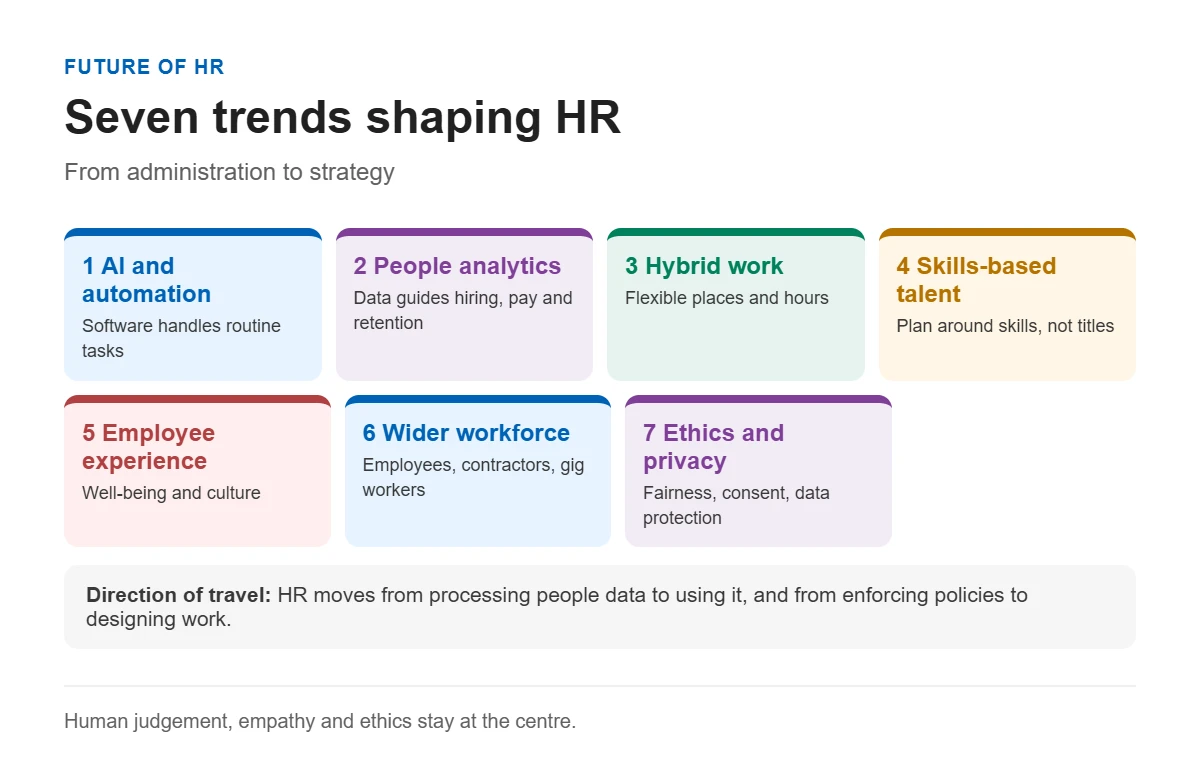
Seven trends shaping the future of HR.
1. AI and automation
Routine work such as resume screening, interview scheduling, payroll checks and employee queries is increasingly handled by software. HR spends less time processing and more time deciding and advising. See how AI is already used across the HR lifecycle for examples and risks.
2. People analytics
HR teams use data to predict attrition, plan headcount, spot pay gaps and measure whether training works. Decisions that once relied on instinct now need evidence.
3. Hybrid and flexible work
Policies must cover where, when and how people work, and how performance is measured when managers cannot see everyone in the office.
4. Skills-based talent management
Instead of hiring and promoting only by job title and degree, more organisations map the skills people have and the skills the business needs, then hire, train and move people to close the gap.
5. Employee experience and well-being
Employee experience covers every interaction from recruitment to exit. Well-being programmes, mental health support, fair workloads and a respectful culture are now part of the retention conversation, not extras.
6. A wider workforce mix
Companies increasingly combine employees, contract staff, freelancers and platform-based workers. HR must manage engagement, compliance and performance across all of them.
7. Ethics, privacy and trust
More data and more automation raise questions about bias, consent and security. In India, the Digital Personal Data Protection Act, 2023 sets rules for handling personal data, including employee data, and HR teams need to prepare for it.
Early-stage idea: some organisations are testing blockchain-based records for tamper-proof verification of employee credentials and payroll entries. Adoption is still limited, so treat it as a trend to watch, not a standard practice.
How HR roles will change
| Today | Increasingly |
|---|---|
| Processing joining, leave and payroll data | Designing the process and checking exceptions |
| Reporting last month’s headcount | Forecasting next year’s workforce needs |
| Enforcing policies | Designing policies around employee and business needs |
| Running training calendars | Building skill pathways linked to business goals |
| Reacting to resignations | Predicting and preventing avoidable attrition |
New roles are appearing alongside traditional ones, such as people analyst, HR technology specialist, employee experience designer and workforce planner. Core roles such as recruiter, HR business partner and compensation specialist remain, but with more data and technology in the job.
What does not change
Technology can handle tasks, not trust. Handling a grievance, negotiating an offer, coaching a manager through a hard conversation and standing up for fair treatment still need human judgement. Communication, empathy and ethics become more valuable as routine work is automated.
How to prepare: a practical plan
- Audit your week. List recurring tasks and mark which are repetitive and rule-based. Those are candidates for automation.
- Learn the basics of data. Start with simple metrics such as attrition and time to hire, then move to analysis. The lesson on how companies use people data to decide is a good next step.
- Understand the business. Learn how your company earns and spends money so that your proposals speak the language of leaders.
- Build a skills plan. Use our guide to the capabilities HR professionals will need to choose three skills to build this year.
- Pilot small. Test one new tool or policy with one team, measure results and then scale.
- Keep ethics in the room. Ask who could be harmed or excluded before adopting any new system.
If you want structured practice in these areas, an HR management course covering modern HR practice can help you build the foundation.
Key takeaways
- HR is moving from administration to strategy, supported by technology and data.
- Skills, not just job titles, are becoming the unit of workforce planning.
- Flexible work and a mixed workforce need new policies.
- Human judgement, empathy and ethics remain central.
