

An employee feels they were passed over for promotion because of favouritism. Another says their manager humiliates them in team meetings. A third has been short-paid overtime for three months. Each of them has a grievance, and how HR responds decides whether the issue ends quietly or turns into attrition, a legal dispute, or a reputation problem.
This lesson explains what an employee grievance is, the common types, a practical handling procedure, and what Indian law now expects from employers.
What is an employee grievance?
An employee grievance is a formal complaint an employee raises about something at work that they believe is unfair, wrong or against policy or law. It can be about pay, working conditions, a manager’s behaviour, discrimination, harassment, or how a company rule was applied.
A grievance is different from a routine query. “What is my leave balance?” is a query: HR answers it and moves on. “My leave was rejected while others in my team got the same dates approved” is a grievance: the employee feels treated unfairly and expects an investigation and a decision.
Not every grievance is a legal violation. Many come from poor communication or inconsistent decisions. That’s exactly why a fair process matters: it separates real problems from misunderstandings, and handles both with respect.
Types of employee grievances
Most grievances fall into a few categories:
| Category | Examples |
|---|---|
| Pay and benefits | Salary errors, unpaid overtime, delayed reimbursements, wrong deductions |
| Working conditions | Unsafe workplace, lack of basic facilities, excessive working hours |
| Managerial behaviour | Bias, favouritism, micromanagement, public criticism |
| Policy and career decisions | Promotion delays, unfair appraisal ratings, transfers |
| Discrimination and harassment | Unequal treatment based on gender, caste, religion, disability; bullying; sexual harassment |
Complaints of sexual harassment follow a separate legal route under the PoSH Act, handled by the Internal Committee. A general grievance procedure should point employees to that channel rather than handle such complaints itself.
The grievance handling procedure
Grievance handling is the end-to-end process of receiving, investigating, resolving and closing an employee’s complaint. A simple procedure that works in most organisations has five steps.
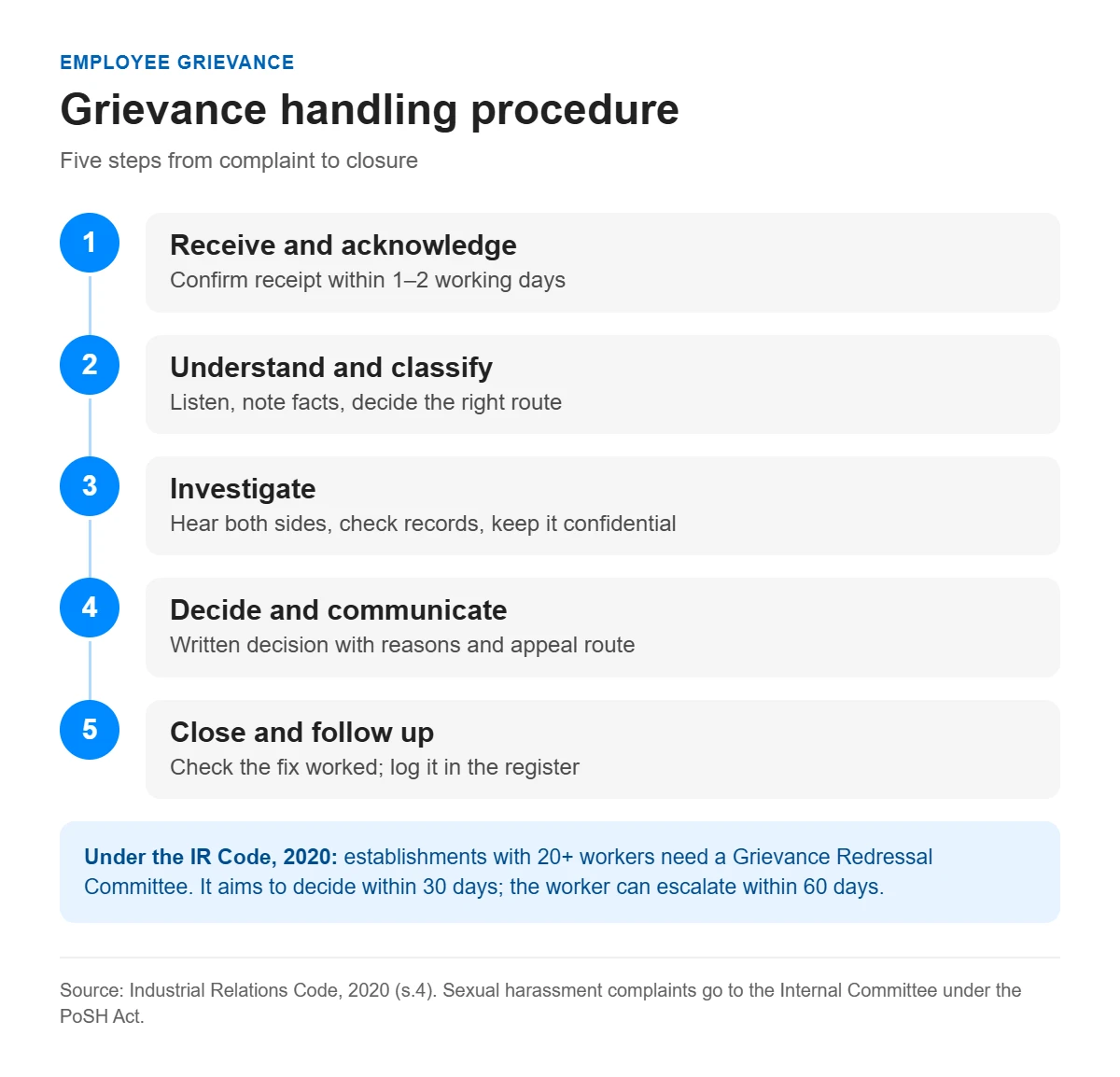
The five steps of a fair grievance handling procedure.
1. Receive and acknowledge
Make it easy to raise a grievance: an email ID, an HRMS form, a written letter, or an anonymous channel for sensitive issues. Acknowledge every grievance quickly, ideally within one or two working days, and tell the employee what happens next and roughly how long it will take.
A short acknowledgement does a lot. It tells the employee they were heard, which lowers tension before any investigation starts.
2. Understand and classify
Meet the employee, listen fully, and note the facts: what happened, when, who was involved, and what outcome they want. Then decide what kind of grievance it is. A payroll error might be fixed in a day. A complaint about a manager needs a careful, neutral inquiry. A harassment complaint goes to the Internal Committee.
3. Investigate
Collect evidence from both sides. That can mean speaking to the manager, checking attendance and payroll records, reviewing emails, and talking to witnesses. Keep notes of every conversation.
Two rules matter most here. First, confidentiality: share details only with people who need them. Second, neutrality: HR’s role is to establish facts, not to defend the manager or automatically side with the employee.
4. Decide and communicate
Propose a resolution that is consistent with company policy and the law. That could be correcting the pay, revisiting an appraisal, mediation between the employee and manager, a warning, a transfer, or explaining clearly why the complaint was not upheld.
Communicate the decision in writing, with reasons. If the employee disagrees, tell them how to appeal, whether to a senior manager, an appeals panel or the statutory route described below.
5. Close and follow up
A grievance isn’t closed when the letter goes out. Check a few weeks later whether the fix actually happened and whether the employee faced any retaliation. Record the outcome in a grievance register so HR can spot patterns, such as repeated complaints about one team or one policy.
The grievance redressal procedure under Indian law
Under the Industrial Relations Code, 2020, which replaced the Industrial Disputes Act from 21 November 2025, every industrial establishment with 20 or more workers must set up one or more Grievance Redressal Committees (GRCs) to resolve disputes arising from individual grievances.
The key points of the statutory grievance redressal procedure:
- Composition: the GRC has an equal number of employer and worker representatives, with a maximum of ten members, and women workers must be adequately represented.
- Chairperson: chosen alternately from the employer side and the worker side, rotating every year.
- Filing: a worker can raise a grievance with the GRC within one year of the issue arising.
- Timeline: the committee is expected to complete its proceedings within 30 days of receiving the application.
- Escalation: if the worker disagrees with the decision, or the grievance is not resolved within 30 days, they can approach the conciliation officer through their trade union within 60 days.
The Industrial Relations (Central) Rules, 2026 also allow grievances and related applications to be filed electronically. Since states issue their own rules for establishments under their control, check the state rules that apply to your workplace as well.
Even if your organisation is below the 20-worker threshold, or most staff fall outside the legal definition of “worker”, a written grievance procedure modelled on these steps is good practice.
What makes grievance handling work in practice
Policies on paper don’t resolve complaints. People do. A few habits separate HR teams that employees trust from those they avoid:
- Train managers first. Most grievances start with a manager’s decision, and many can be solved at that level if managers know how to listen without getting defensive.
- Protect against retaliation. State clearly in the policy that raising a grievance in good faith will never be held against the employee, and act fast if it is.
- Track resolution time. Measure how long grievances stay open. A complaint that sits for two months becomes a resignation.
- Look for patterns. Ten complaints about overtime in one department point to a staffing or scheduling problem, not ten individual issues.
- Use technology carefully. HRMS tools can log and track grievances, but sensitive cases still need a human conversation.
Grievance handling also connects to how people leave. Unresolved complaints often surface in exit interviews, which is one reason the way you run exit conversations and handovers deserves as much care as joining.
A quick example
An employee in a manufacturing unit complains that his overtime for two months was paid at the normal rate. HR acknowledges the grievance the same day, pulls attendance and overtime records, and confirms with the supervisor that the extra hours were approved. Payroll finds that a configuration change had reset the overtime rate for one shift. HR corrects the pay in the next cycle, explains the cause to the employee in writing, and asks payroll to check every employee on that shift. One complaint fixed a problem affecting forty people.
That is the real value of a grievance process: it is an early warning system for the organisation, not just a complaint box.
If you’d like to practise handling real HR scenarios like this one, including grievances, labour law and payroll, you can explore a practical HR certification programme that covers them through case work.
