

Who reports to whom, who decides what, and how work flows between teams all depend on an organisation’s structure. Get it wrong and decisions slow down, people duplicate work and good employees leave because they cannot see a path to grow.
This lesson explains what organizational structure means, the main types with pros and cons, how to choose the right one and HR’s role when the structure changes. For how the HR department itself is organised, see our lesson on roles inside an HR team.
What is organizational structure?
Organizational structure is the formal system that defines:
- roles and jobs in the organisation
- reporting relationships (who reports to whom)
- authority and decision-making (who can approve what)
- how work and information flow between people and teams
It is usually shown as an organization chart (org chart).
Key elements of structure
| Element | Meaning |
|---|---|
| Span of control | Number of people reporting to one manager |
| Chain of command | The line of authority from top to bottom |
| Centralisation | How much decision-making sits at the top |
| Formalisation | How far rules and procedures guide work |
| Departmentalisation | How jobs are grouped: by function, product, region or customer |
Types of organizational structure
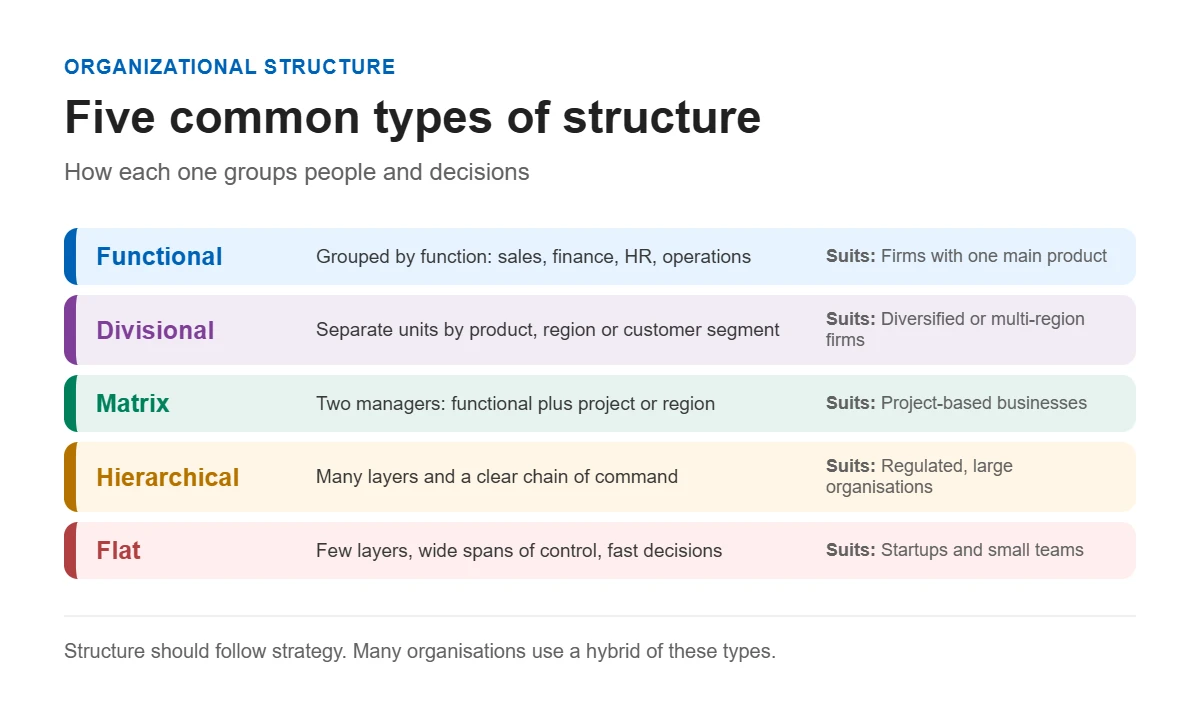
Five common types of organizational structure.
1. Functional structure
Teams are grouped by specialist function: sales, finance, HR, operations, technology.
| Pros | Cons |
|---|---|
| Deep expertise and clear career paths within functions | Silos between departments |
| Efficient use of specialist resources | Slow decisions that need many functions |
| Clear reporting lines | Weak focus on customers or products as a whole |
Suits: small and mid-size companies with one main product or service.
2. Divisional structure
The organisation is split into semi-independent divisions by product, region or customer segment. Each division has its own functions.
| Pros | Cons |
|---|---|
| Strong focus on each market or product | Duplication of functions across divisions |
| Clear accountability for division results | Higher cost |
| Faster local decisions | Divisions may compete instead of cooperate |
Suits: diversified companies with several product lines or regions.
3. Matrix organizational structure
Employees report to two managers: a functional manager (for example, the head of engineering) and a project, product or regional manager.
| Pros | Cons |
|---|---|
| Combines expertise with project or market focus | Confusion over priorities and authority |
| Flexible use of people across projects | Conflict between the two managers |
| Encourages cross-functional collaboration | Needs strong communication and clear rules |
Suits: project-based businesses such as consulting, IT services and engineering.
4. Hierarchical (tall) structure
Many management layers with a clear chain of command.
- Pros: clear authority, defined promotion steps, close supervision
- Cons: slow decisions, distance between leaders and front line, higher management cost
5. Flat structure
Few management layers and wide spans of control.
- Pros: fast decisions, open communication, lower overhead, more autonomy
- Cons: managers stretched thin, unclear career progression, roles can blur as the company grows
6. Other structures
| Structure | Description |
|---|---|
| Team-based | Built around self-managing teams |
| Network | Core team plus outsourced partners and contractors |
| Hybrid | Mix of types, for example functional at the head office and divisional by region |
How to choose the right structure
| Question | Points towards |
|---|---|
| One product or many? | One: functional. Many: divisional |
| Need speed and innovation? | Flat or team-based |
| Work is mainly projects? | Matrix |
| Operating across many regions? | Divisional by region, or hybrid |
| Strict regulation or safety rules? | More hierarchy and formalisation |
| Early-stage startup? | Flat, then add structure as headcount grows |
Rule of thumb: structure should follow strategy. When the business strategy changes, review whether the structure still fits.
HR’s role in organizational structure
- Advising leaders on design options, spans of control and layers
- Job design: clear roles, responsibilities and reporting lines
- Grading and pay: linking new roles to salary bands
- Workforce planning: right number of people in each unit
- Restructuring: selection, redeployment, notice and statutory requirements
- Change management: communication, training and support for affected employees
- Updating systems: org charts, HRIS and approval workflows
Restructuring: steps for HR
- Agree the business reason and the design with leaders.
- Map current roles to new roles; identify gaps and surplus roles.
- Check legal requirements and company policy before any role changes.
- Plan communication: leaders first, then affected employees, then everyone.
- Hold one-to-one conversations with impacted people.
- Update reporting lines, systems and job descriptions.
- Support employees with training and regular check-ins.
- Review after three to six months: is the new structure working?
Our lesson on leading people through change covers the people side in detail.
Signs your structure needs a review
- decisions need too many approvals
- managers have too many or too few direct reports
- teams duplicate work or blame each other
- customers deal with several teams for one request
- talented people leave because they cannot see a growth path
