

Gratuity is a lump sum an employer pays to an employee as a reward for long service, usually when the employee leaves, retires or dies. It is one of the largest single payments many employees receive at the end of a job, and one of the most common questions HR handles.
This lesson explains what gratuity is, the law that governs it now, eligibility, the gratuity calculation formula with examples, the maximum limit, tax treatment, payment timelines and HR’s responsibilities.
What is gratuity?
Gratuity is a statutory benefit that recognises an employee’s continuous service. It is paid by the employer, not deducted from the employee’s salary, although many companies show the provision for it as part of CTC.
Payment of Gratuity Act and the new law
For decades, gratuity was governed by the Payment of Gratuity Act, 1972. Since 21 November 2025, gratuity is governed by Chapter V of the Code on Social Security, 2020, which replaced the 1972 Act. The basic formula and the five-year rule for regular employees stayed the same, but there are two important changes:
- Fixed-term employees become eligible after one year of service, on a pro rata basis
- gratuity is calculated on wages as defined in the labour codes, including the 50% rule
Many people still search for “gratuity act” or “payment of gratuity act”, and older documents refer to it, so HR teams should know both names.
Who is eligible for gratuity?
The law applies to establishments with 10 or more employees. Once covered, an establishment stays covered even if headcount later falls.
An employee is eligible when employment ends after at least five years of continuous service, through:
- superannuation (retirement)
- retirement or resignation
- death or disablement due to accident or disease
- termination of employment
Exceptions to the five-year rule
| Situation | Service needed |
|---|---|
| Death or disablement | No minimum |
| Fixed-term employee | One year, pro rata |
| Working journalist | Three years |
In case of death, gratuity is paid to the nominee or legal heir.
Gratuity calculation formula
Gratuity = Last drawn wages × 15 × Years of service ÷ 26
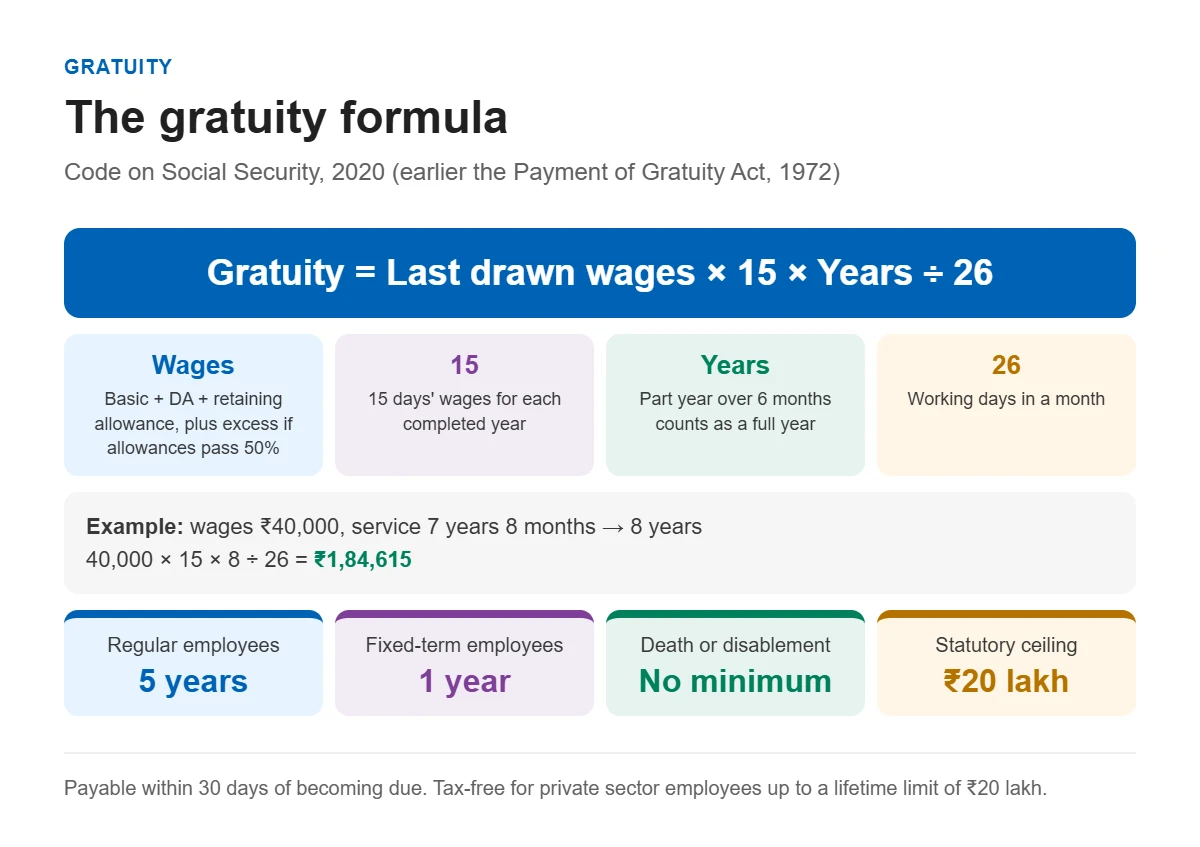
The gratuity formula with a worked example.
- Last drawn wages: monthly wages as defined in the labour codes, mainly basic pay + dearness allowance + retaining allowance, plus any excess if excluded allowances exceed 50% of remuneration
- 15: 15 days’ wages for each completed year
- 26: working days in a month (excluding four Sundays)
- Years of service: completed years; any part of a year over six months counts as a full year
Example 1: standard case
Priya resigns after 7 years and 8 months. Her last drawn basic + DA is ₹40,000 a month, and allowances are below 50% of pay.
- Years counted: 8 (8 months is more than 6)
- Gratuity = 40,000 × 15 × 8 ÷ 26 = ₹1,84,615
Example 2: part year under six months
Arjun retires after 12 years and 4 months with last drawn wages of ₹60,000.
- Years counted: 12 (4 months is less than 6)
- Gratuity = 60,000 × 15 × 12 ÷ 26 = ₹4,15,385
Example 3: the 50% rule
Meera’s total monthly remuneration is ₹1,00,000: basic + DA ₹35,000 and allowances ₹65,000. Allowances exceed 50% (₹50,000) by ₹15,000, so wages = ₹35,000 + ₹15,000 = ₹50,000. After 10 years:
- Gratuity = 50,000 × 15 × 10 ÷ 26 = ₹2,88,462
Example 4: fixed-term employee
Rahul has a two-year fixed-term contract with wages of ₹30,000. At the end of the contract:
- Gratuity = 30,000 × 15 × 2 ÷ 26 = ₹34,615
Maximum gratuity limit
The statutory maximum gratuity is ₹20 lakh. The ceiling was raised to ₹20 lakh in 2018 and has continued under the Code on Social Security. Employers may pay more under their own policy or contract, but the excess is taxable.
Is gratuity taxable?
From tax year 2026-27, gratuity is treated under the Income-tax Act, 2025.
| Employee type | Tax-free amount |
|---|---|
| Central and state government employees | Fully exempt |
| Private sector employees covered by the law | Least of: actual gratuity received, the formula amount and ₹20 lakh |
| Employees not covered | Least of: actual gratuity, half a month’s average salary per completed year, and ₹20 lakh |
The ₹20 lakh limit is a lifetime limit across all employers. Gratuity received while still in service is fully taxable.
Payment timeline and forfeiture
- the employer must pay gratuity within 30 days of it becoming payable
- delayed payment attracts simple interest at the rate notified by the government
- gratuity can be forfeited wholly or partly if the employee is terminated for causing wilful damage to the employer’s property, or for riotous or disorderly conduct, violence or an offence involving moral turpitude in the course of employment
- employees should file a nomination, which the employer must record
Gratuity in CTC
Many employers include a gratuity provision of about 4.81% of basic pay in CTC. This is a cost set aside, not money paid monthly. Our lesson on what CTC includes explains the effect on in-hand pay.
HR’s responsibilities
- maintain accurate service records and joining dates
- collect and update nominations
- calculate gratuity correctly using the latest wage definition
- arrange funding, such as a group gratuity scheme with an insurer, where required
- pay within the deadline and keep proof of payment
- explain gratuity clearly at exit, as part of a well-run employee exit
