

HR teams spend hours on repetitive work: screening CVs, answering the same policy questions, scheduling interviews and building reports. Artificial intelligence (AI) can take over much of this, freeing HR to focus on people. But AI also brings real risks around bias, privacy and trust.
This lesson explains what AI in HR means, use cases across the employee lifecycle, types of AI tools for HR, HR chatbots, benefits, risks and ethics, data protection in India and how to adopt AI responsibly.
What is AI in HR?
AI in HR means using technologies that can learn from data, recognise patterns, understand language and generate content to support HR tasks and decisions.
Main types of AI used in HR:
| Type | What it does | HR example |
|---|---|---|
| Machine learning | Finds patterns in data and makes predictions | Predicting attrition risk |
| Natural language processing (NLP) | Understands and processes text and speech | Parsing CVs, analysing survey comments |
| Generative AI | Creates new text, images or summaries | Drafting job descriptions or policy summaries |
| Conversational AI | Holds text or voice conversations | HR chatbots answering employee questions |
| Robotic process automation (RPA) | Automates rule-based tasks | Generating offer letters, updating records |
AI use cases across the employee lifecycle
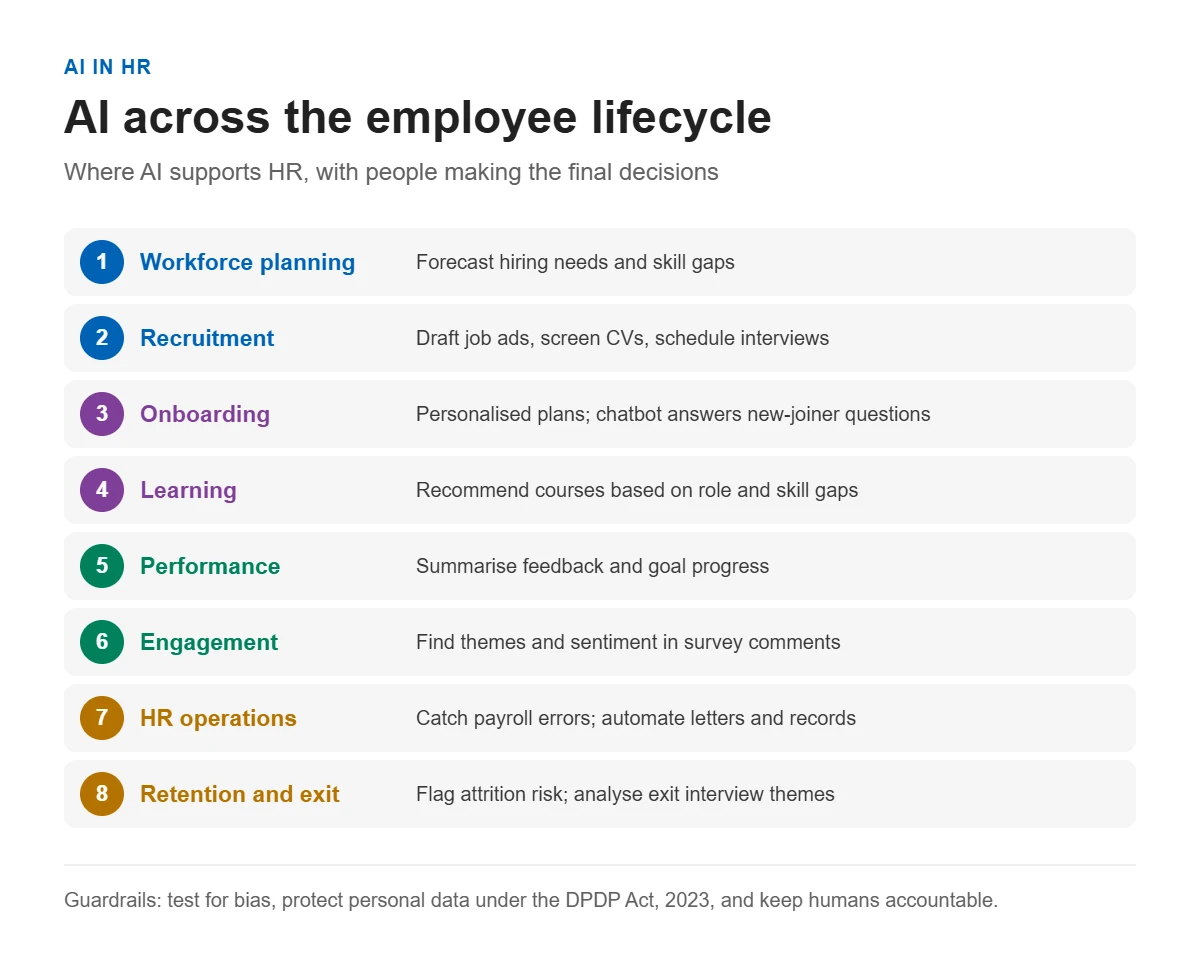
Where AI supports HR across the employee lifecycle.
| Stage | How AI helps |
|---|---|
| Workforce planning | Forecasting hiring needs and skill gaps |
| Recruitment | Writing job ads, sourcing, CV screening, interview scheduling |
| Onboarding | Personalised onboarding plans, answering new-joiner questions |
| Learning and development | Recommending courses based on role and skill gaps |
| Performance | Summarising feedback, spotting goal progress trends |
| Engagement | Analysing survey comments for sentiment and themes |
| Payroll and HR operations | Detecting payroll errors, automating documents |
| Retention | Flagging employees at risk of leaving |
| Offboarding | Analysing exit interview themes |
AI tools for HR
Most AI in HR comes built into software HR teams already use, or as specialist add-ons:
- HRMS and HRIS platforms with AI features for analytics, document generation and self-service
- Applicant tracking systems with CV parsing, ranking and automated scheduling
- Learning platforms with personalised course recommendations
- Survey and engagement tools with sentiment analysis
- General-purpose AI assistants for drafting policies, emails and job descriptions
- People analytics tools for prediction and dashboards
The HR system itself is explained in our lesson on human resource information systems.
HR chatbots
An HR chatbot is a conversational AI tool that answers employee questions through chat on a portal, messaging app or HRMS.
Common uses:
- leave balance and holiday list queries
- payslip and tax declaration questions
- policy questions, such as notice period or reimbursement rules
- onboarding support for new joiners
- raising simple requests and tickets
Good practice: train the chatbot on current, approved policies; make it easy to reach a human; never let it handle sensitive matters such as harassment complaints or grievances on its own.
Benefits of AI in HR
- Speed: faster screening, scheduling and query resolution
- Efficiency: less time on repetitive admin
- Better insights: patterns in data that people may miss
- Employee experience: instant answers at any time
- Consistency: the same criteria and information applied each time
Risks and ethical concerns
| Risk | Example | How to reduce it |
|---|---|---|
| Bias | A model trained on past hires favours one gender or college | Test outcomes for bias; use diverse training data; human review |
| Lack of transparency | Candidates rejected without knowing why | Explainable criteria; tell people when AI is used |
| Privacy | Excessive monitoring or misuse of personal data | Collect only needed data; consent and notice; access controls |
| Inaccuracy | Generative AI gives a wrong policy answer | Approved knowledge sources; human checks |
| Over-reliance | Managers accept AI scores without judgement | Keep humans responsible for final decisions |
| Job anxiety | Employees fear replacement | Communicate openly; reskill staff |
Our lesson on recognising hidden bias at work explains how bias enters decisions in the first place.
Data protection in India
AI in HR uses large amounts of personal data, so HR must follow the Digital Personal Data Protection (DPDP) Act, 2023. The DPDP Rules were notified in November 2025, and most core obligations apply from 14 May 2027. Key duties for employers include:
- process personal data only for a lawful purpose, with notice and consent or another legitimate use, which includes certain employment purposes
- collect only data that is necessary
- keep data accurate and secure, and report breaches
- erase data when the purpose is over, unless the law requires keeping it
- respond to employees’ rights to access, correct and erase their data
How to adopt AI in HR responsibly
- Start with a problem: pick a clear pain point, such as slow query resolution.
- Check data quality: AI is only as good as the data it learns from.
- Pilot small: test with one team or process.
- Keep humans in the loop: especially for hiring, promotion and termination decisions.
- Audit for bias and accuracy regularly.
- Be transparent with employees and candidates about where AI is used.
- Train HR teams in AI skills and data literacy.
- Write an AI use policy covering approved tools, data handling and accountability.
Skills HR professionals need
- data literacy and basic analytics
- prompt writing for generative AI tools
- understanding of bias, fairness and privacy law
- change management to support adoption
