

An HR professional who was hired ten years ago for strong recruitment and employee-relations skills may now be asked to read an attrition model, test a chatbot, advise on a hybrid policy and explain employee cost to the finance head. The job title has not changed, but the skills it needs have.
This lesson covers the future HR skills that matter most, why each matters, how to build them, and a simple 90-day plan. If you are still building the basics, start with the foundation skills every HR professional needs.
Why HR skills need to evolve
The World Economic Forum’s Future of Jobs Report 2025 found that employers expect about 39% of key job skills to change by 2030, and that analytical thinking is the most sought-after core skill. HR is not exempt. HR teams are adopting new tools, handling more data and supporting leaders through constant change.
Ten skills for the future HR professional
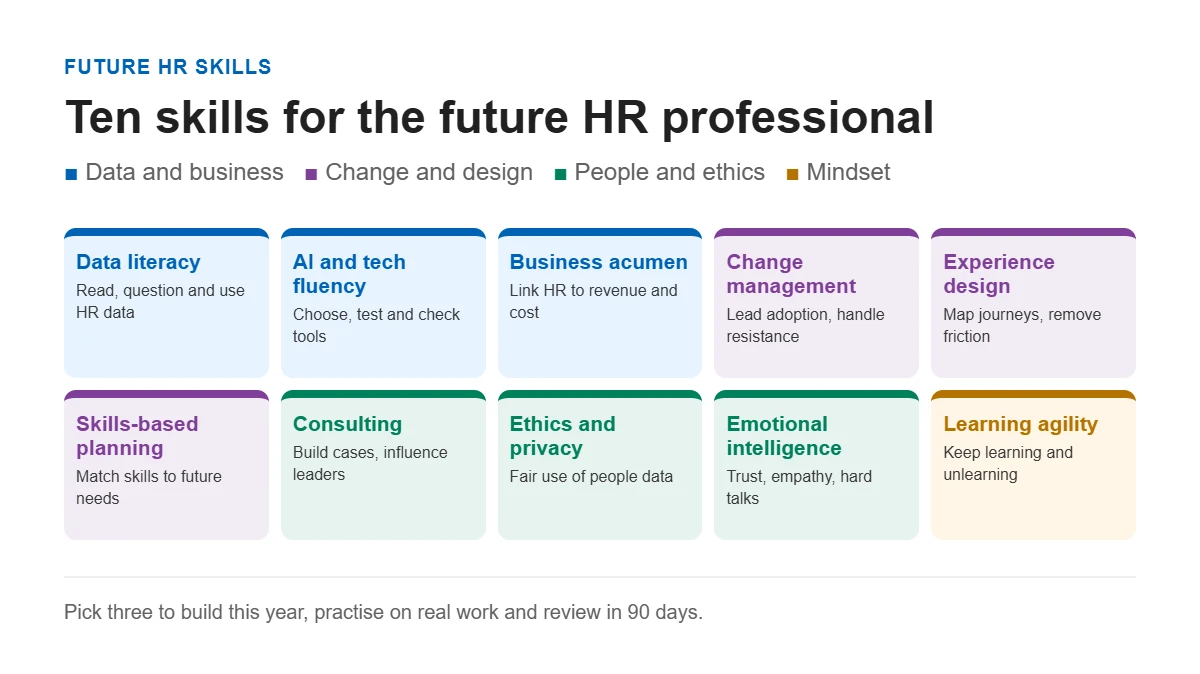
Ten skills for the future HR professional.
1. Data literacy and analytical thinking
Why: decisions about hiring, pay and retention now need evidence.
What it looks like: reading charts, spotting patterns, asking “what does the data say?”, and understanding sampling and averages.
How to build: practise with your own HR metrics in a spreadsheet, then learn a visualisation tool.
2. AI and technology fluency
Why: AI-assisted tools are entering recruitment, learning and employee support.
What it looks like: knowing what a tool can and cannot do, writing clear prompts, checking outputs and spotting errors and bias.
How to build: try approved tools on low-risk tasks such as drafting a job description, then compare with your own work.
3. Business acumen
Why: HR proposals are judged in business terms.
What it looks like: understanding revenue, cost, margins and strategy.
How to build: read your company’s annual report and learn the profit and loss statement. Our lesson on thinking like a business leader shows how.
4. Change management
Why: new technology, mergers, restructures and policy changes all need people to adapt.
What it looks like: communicating clearly, handling resistance, supporting managers and tracking adoption.
How to build: study a change model and apply it to one small change at work.
5. Employee experience design
Why: experience affects engagement and retention.
What it looks like: mapping the employee journey, finding friction points and fixing them with simple changes.
How to build: map the first 90 days of a new joiner and list five improvements.
6. Skills-based workforce planning
Why: the skills needed will change faster than job titles.
What it looks like: keeping a skills inventory, spotting gaps and planning hiring, training and mobility.
How to build: list the top skills for one team now and in two years.
7. Consulting and influencing
Why: HR advises leaders; it does not simply instruct.
What it looks like: asking good questions, building a business case, and handling disagreement calmly.
How to build: practise writing a one-page proposal with problem, options, cost and recommendation.
8. Ethical judgement and data privacy
Why: HR holds sensitive information and uses tools that can be biased.
What it looks like: knowing when data use is fair, questioning unclear algorithms and following data protection law such as India’s Digital Personal Data Protection Act, 2023.
How to build: write down what employee data you collect and why, then challenge any item without a clear purpose.
9. Emotional intelligence and communication
Why: as routine tasks are automated, the human side of HR grows in value.
What it looks like: listening, empathy, handling tough conversations and building trust.
How to build: ask a trusted colleague for feedback on how you handle difficult conversations.
10. Learning agility
Why: tools and rules will keep changing.
What it looks like: curiosity, trying new methods, learning from mistakes and unlearning old habits.
How to build: set aside a small, fixed weekly slot for learning, even one hour.
Skills snapshot
| Skill area | Today | Future |
|---|---|---|
| Data | Read monthly reports | Analyse patterns and predict outcomes |
| Technology | Use the HR system | Choose, test and govern HR tools |
| Business | Know HR policies | Link HR decisions to cost and revenue |
| Change | Communicate announcements | Lead adoption and manage resistance |
| People | Handle cases | Coach, influence and design experiences |
A 90-day learning plan
Days 1–30: Assess and set a baseline
- rate yourself on the ten skills and pick three
- learn five core HR metrics and calculate them for your team
Days 31–60: Practise
- build one simple chart or dashboard on a real HR question
- try an approved AI tool on a low-risk task and record what worked and what did not
- read your company’s financial summary
Days 61–90: Apply and share
- run one small improvement project, such as a faster onboarding step
- present results in a one-page summary to your manager
- plan the next three skills
Where these skills take your career
Strong data, business and technology skills open paths such as HR business partner, people analyst, HR technology lead, workforce planner and head of HR. To see how they fit into a career path, read our overview of the career paths open to HR professionals. If you prefer a structured route, an HR certification course that builds modern HR skills can give you a guided plan.
