

Leading change without a framework is like navigating without a map. Change management models give leaders and HR a structured way to plan change, anticipate problems and help people through it.
This lesson explains the most widely used change management models, Lewin’s three-stage model, Kotter’s 8-step model and Prosci’s ADKAR model, along with the change curve, and shows how to choose between them.
What are change management models?
Change management models are frameworks that describe the stages of change and the actions needed at each stage. Some focus on the organisation as a whole, such as Lewin and Kotter, while others focus on how individuals change, such as ADKAR and the change curve.
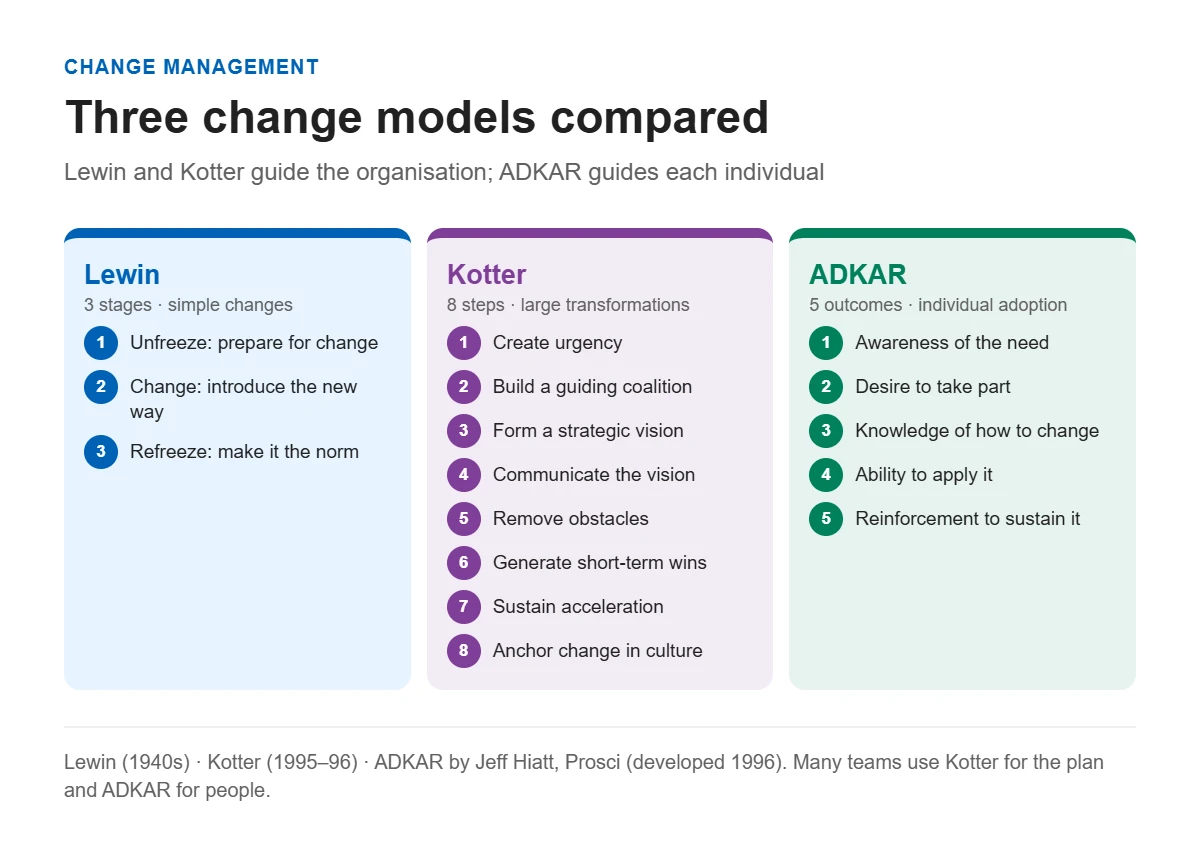
Lewin, Kotter and ADKAR change models compared.
1. Lewin’s change model
Psychologist Kurt Lewin described change as three stages. It is one of the earliest and simplest change models, generally dated to his work in the late 1940s.
Unfreeze
Prepare people to let go of the current way of working. Explain why change is needed, create a sense of need and address concerns.
Change
Introduce the new processes, systems or behaviours. Provide communication, training and support while people adjust.
Refreeze
Make the new way the normal way. Update policies, systems and rewards, and celebrate success so people don’t slip back.
Example: a company moves from paper leave forms to an HRMS. Unfreeze: show how much time paper forms waste and the errors they cause. Change: train employees and managers, and run both systems for two weeks. Refreeze: stop accepting paper forms and make the HRMS the only route.
Strengths: simple and easy to explain. Limitations: too simple for complex, continuous change; “refreeze” can feel outdated when organisations change constantly.
2. Kotter’s 8-step change model
John Kotter, a professor at Harvard Business School, set out eight steps in a 1995 Harvard Business Review article and his 1996 book Leading Change, based on why transformation efforts fail.
| Step | What it means |
|---|---|
| 1. Create a sense of urgency | Help people see why change is needed now |
| 2. Build a guiding coalition | Form a strong group of leaders and influencers to drive the change |
| 3. Form a strategic vision | Create a clear picture of the future and how to get there |
| 4. Communicate the vision | Share it often, through every channel, and model it |
| 5. Remove obstacles | Change structures, systems or behaviours that block progress |
| 6. Generate short-term wins | Plan and celebrate visible early successes |
| 7. Sustain acceleration | Use credibility from wins to tackle bigger changes |
| 8. Anchor the change in culture | Connect new behaviours to success and build them into culture |
Kotter later updated the model, but the original eight steps remain the version most taught.
Example: a retail chain shifts to omnichannel selling. Leaders share data on falling store sales (urgency), form a cross-functional team (coalition), set out a vision of “one customer, every channel,” communicate it in town halls, change store incentives that discouraged online orders (remove obstacles), celebrate the first pilot stores’ results (quick wins), expand to all stores (sustain) and make omnichannel goals part of every manager’s KRAs (anchor).
Strengths: detailed and leadership-focused. Limitations: top-down; less guidance on supporting individual employees.
3. ADKAR model
The ADKAR model focuses on how individuals change. It was developed by Jeff Hiatt, founder of Prosci, in 1996, first published in 1999 and set out in his 2006 book. Change succeeds when each person reaches five outcomes in order:
| Element | Meaning | HR actions |
|---|---|---|
| Awareness | Of the need for change | Explain the business reasons |
| Desire | To support and take part in the change | Address “what’s in it for me,” involve people |
| Knowledge | Of how to change | Training, guides, demos |
| Ability | To implement new skills and behaviours | Practice, coaching, time to learn |
| Reinforcement | To sustain the change | Recognition, feedback, updated goals |
ADKAR is also a diagnostic tool. If adoption stalls, check which element is missing. For example, people may know how to use a new system (knowledge) but still lack time to practise (ability).
Strengths: people-focused, practical for diagnosing resistance. Limitations: less guidance on organisation-wide strategy.
4. The change curve
The change curve is adapted from Elisabeth Kübler-Ross’s work on grief. It describes the emotions people often go through during change: shock, denial, frustration, depression, experimentation, decision and integration. It reminds managers that a drop in morale and productivity is normal early on, and that support helps people move through it faster.
Comparison of change management models
| Lewin | Kotter | ADKAR | |
|---|---|---|---|
| Focus | Organisation | Organisation and leadership | Individual |
| Number of stages | 3 | 8 | 5 |
| Best for | Simple, clear changes | Large transformations | Diagnosing and supporting adoption |
| Strength | Easy to explain | Detailed leadership roadmap | Pinpoints where people are stuck |
| Limitation | Too simple for complex change | Top-down | Light on overall strategy |
How to choose a change management model
- Size of change: small process changes may need only Lewin; transformations benefit from Kotter
- Focus: if adoption by individuals is the main risk, use ADKAR
- Culture: a collaborative culture may prefer models that involve people early
- Combine models: many organisations use Kotter to plan the overall change and ADKAR to support individuals
The model is only a guide. Success still depends on leadership, communication and support, covered in our lesson on leading people through organisational change. To build these skills with mentor guidance, an HR certification covering change management is one route.
