

A workforce with people of different genders, ages, regions, languages and abilities does not automatically become fair or welcoming. That takes deliberate effort. Diversity, equity and inclusion (DEI) is the HR approach that turns a varied workforce into one where everyone has a real chance to contribute and grow.
This lesson explains what DEI means, the difference between equity and equality, why DEI matters, the Indian laws that support it, common DEI initiatives and how HR measures progress.
DEI full form and meaning
DEI stands for Diversity, Equity and Inclusion. Some organisations add B for Belonging (DEIB).
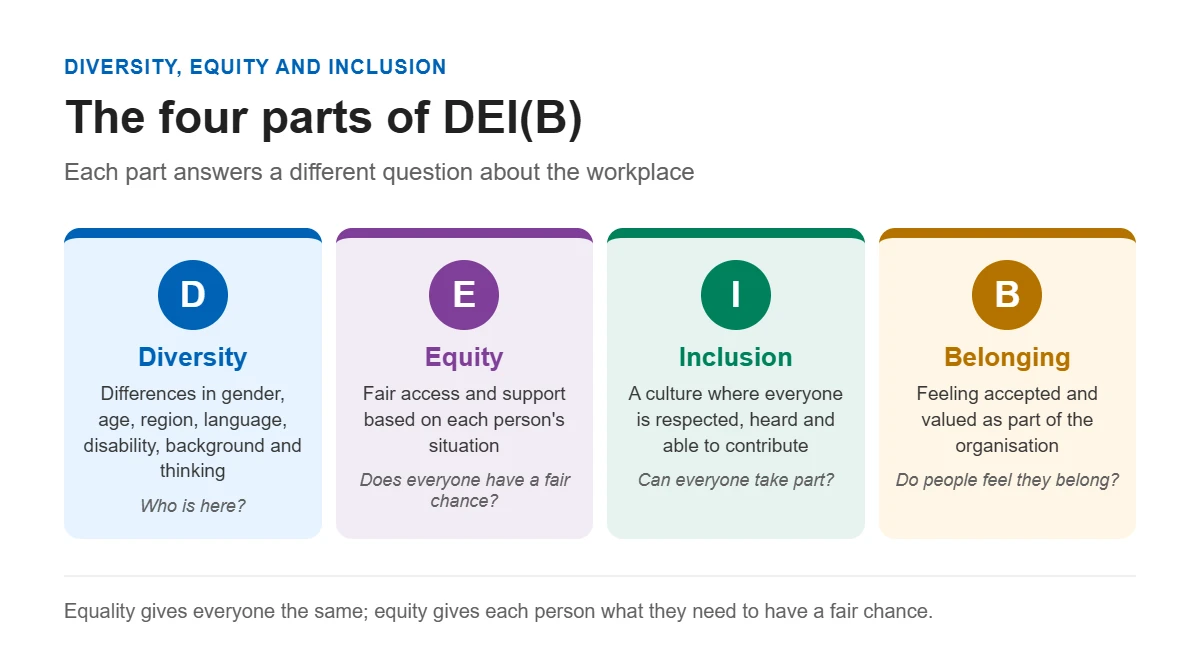
The four parts of DEI and DEIB.
| Term | Meaning | Question it asks |
|---|---|---|
| Diversity | The presence of differences in a group: gender, age, caste, religion, region, language, disability, sexual orientation, education, experience and more | Who is here? |
| Equity | Fair treatment, access and opportunity, giving people the support they need based on their situation | Does everyone have a fair chance? |
| Inclusion | A culture where everyone feels welcome, respected and able to take part fully | Can everyone contribute and be heard? |
| Belonging | Feeling accepted and valued as a member of the organisation | Do people feel they belong here? |
A simple way to remember it: diversity is being invited to the party, inclusion is being asked to dance, and belonging is feeling free to dance the way you like.
Equity vs equality
| Equality | Equity | |
|---|---|---|
| Principle | Everyone gets the same | Everyone gets what they need to have a fair chance |
| Example | Every employee gets the same standard laptop | An employee with low vision also gets screen-reader software |
| Risk | Ignores different starting points | Needs clear criteria so it is seen as fair |
A well-known illustration shows three people of different heights watching a game over a fence. With equality, each gets one box and the shortest still can’t see. With equity, each gets the number of boxes they need, and everyone can see.
Dimensions of diversity in the Indian workplace
- Gender, including women and transgender persons
- Age and generation
- Disability, visible and invisible
- Religion, caste and community
- Region and language
- Socio-economic background and first-generation graduates
- Sexual orientation
- Education and work experience
- Thinking styles and personality
Why DEI matters
- Better decisions: teams with different perspectives are less likely to fall into groupthink.
- Talent: a fair, inclusive reputation widens the talent pool.
- Innovation: different experiences produce different ideas.
- Engagement and retention: people stay where they feel respected and fairly treated.
- Customers: a workforce that reflects customers understands them better.
- Compliance and reputation: fair practices reduce legal and reputational risk.
Studies by consulting firms have linked diverse leadership with better financial results. These studies show correlation, not proof that diversity alone causes higher profits, so HR should present them carefully.
Indian laws that support DEI
- Code on Wages, 2019: under section 3, employers must not discriminate on the ground of gender in wages, recruitment or conditions of employment for the same or similar work. The Ministry of Labour’s FAQs confirm this covers transgender persons.
- Rights of Persons with Disabilities Act, 2016: prohibits discrimination against persons with disabilities in employment and requires establishments to publish an equal opportunity policy.
- Transgender Persons (Protection of Rights) Act, 2019: prohibits discrimination against transgender persons in employment, recruitment and promotion.
- PoSH Act, 2013: requires a safe workplace free from sexual harassment.
- Maternity benefit provisions under the Code on Social Security, 2020.
- Companies Act, 2013: listed companies and certain large public companies must have at least one woman director.
- SEBI’s Business Responsibility and Sustainability Report (BRSR): large listed companies disclose workforce data such as gender and differently abled employees.
DEI initiatives HR can run
Diversity initiatives
- inclusive job descriptions free of biased language
- sourcing from a wider range of colleges, regions and job boards
- returnship programmes for women restarting careers
- partnerships to hire persons with disabilities
- diverse interview panels
Equity initiatives
- regular pay equity audits to find unexplained gaps
- clear, published promotion criteria
- reasonable accommodations, such as accessible workspaces and assistive technology
- structured interviews to reduce bias
Inclusion initiatives
- unconscious bias and inclusive leadership training
- employee resource groups (ERGs), such as a women’s network or a disability network
- mentorship and sponsorship programmes for under-represented groups
- inclusive policies: parental leave, flexible work, gender-neutral facilities
- safe feedback and grievance channels
- celebrating festivals and cultures across communities
How to build a DEI strategy: step by step
- Assess the current state using workforce data, pay data and an inclusion survey.
- Set priorities: focus on the biggest gaps rather than launching many programmes at once.
- Set measurable goals, for example raising women in middle management from 18% to 25% in three years.
- Get leadership commitment and assign owners.
- Launch targeted initiatives linked to each goal.
- Train managers, since they shape day-to-day inclusion.
- Measure and report progress regularly.
- Adjust based on data and feedback.
Measuring DEI
| Metric | What it shows |
|---|---|
| Representation by level | Diversity at entry, middle and senior levels |
| Hiring funnel by group | Where candidates from different groups drop out |
| Promotion rates by group | Whether growth opportunities are fair |
| Pay equity ratio | Pay gaps for similar roles after accounting for experience |
| Attrition by group | Whether some groups leave faster |
| Inclusion survey scores | Whether people feel respected and heard |
Common DEI mistakes
- treating DEI as a one-time training or a festival calendar
- focusing on hiring numbers but ignoring inclusion and retention
- setting targets without changing processes
- collecting sensitive data without clear consent and confidentiality
Bias is often the hidden barrier behind DEI gaps. Our lesson on spotting hidden bias at work explains how to identify and reduce it, and our lesson on employee-led affinity networks shows how ERGs support inclusion.
