

Many HR teams have a long list of initiatives: a new performance system, a wellness week, a leadership programme. Leaders still ask what any of it has to do with the company’s goals. An HR strategy answers that question by starting from the business plan and working backwards.
This lesson shows how to build an HR strategy that is aligned with business goals, with a step-by-step method, an example and the metrics to track. For the theory and models behind it, see our lesson on strategic human resource management.
What is an HR strategy?
An HR strategy is a plan that sets out how the organisation will attract, develop, reward and retain the people it needs to achieve its business goals.
A good HR strategy is:
- derived from the business strategy, not written separately
- focused on a few priorities that matter most
- measurable, with clear targets
- time-bound, usually for one to three years
Why HR strategy must align with business goals
- HR budgets go to the initiatives that support company priorities
- leaders see HR as a partner rather than a cost centre
- employees understand how their work connects to company goals
- HR can show its impact with business-linked metrics
Common business goals and what they need from HR
| Business goal | What HR must deliver |
|---|---|
| Revenue growth | Hire and ramp up sales and delivery teams on time; incentive plans linked to targets |
| Expansion to new cities or markets | Workforce plans, local hiring, compliance with state rules, relocation support |
| Cost control | Productivity improvement, smarter staffing mix, lower attrition |
| Innovation or new products | Hiring scarce skills, learning programmes, a culture that rewards experiments |
| Better customer experience | Service training, engagement, recognition for customer-facing staff |
| Digital transformation | Reskilling, change management, HR technology |
How to build an aligned HR strategy: step by step
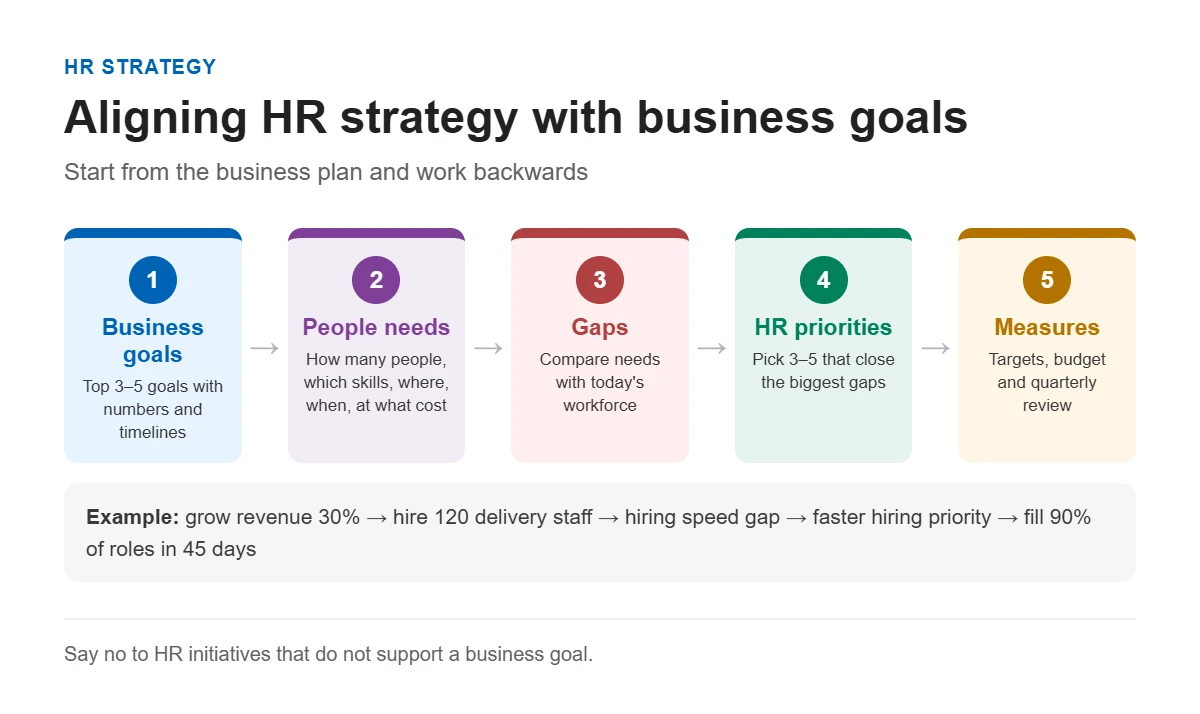
How business goals cascade into an aligned HR strategy.
- Understand the business strategy. Read the annual plan and meet leaders. Note the top three to five goals, with numbers and timelines.
- Translate goals into people implications. For each goal ask: how many people, with what skills, where, by when, at what cost?
- Assess the current workforce. Headcount, skills, attrition, engagement, leadership bench and employee cost.
- Find the gaps. Compare what the business needs with what exists today.
- Choose HR priorities. Pick three to five priorities that close the biggest gaps. Say no to initiatives that do not support them.
- Set HR goals and measures. Turn each priority into a goal with a target, for example in an OKR format.
- Plan resources. Budget, HR team capacity, technology and partners.
- Communicate. Share the plan with leaders, managers and the HR team.
- Review regularly. Check progress quarterly and adjust when business plans change.
Steps 2 to 4 overlap with forecasting future workforce needs.
Example: aligning HR with a growth goal
Business goal: a software services company plans to grow revenue by 30% next year by winning clients in a new industry.
| Business need | HR priority | HR goal | Measure |
|---|---|---|---|
| 120 more delivery staff | Faster, better hiring | Fill 90% of roles within 45 days | Time to fill, offer acceptance |
| Industry knowledge | Reskilling | Train 200 existing staff in the new domain by Q2 | Certification completion, project staffing |
| Retain key engineers | Retention | Keep regretted attrition below current level | Regretted attrition rate |
| New team leads | Leadership pipeline | Promote 25 internal leads with a development programme | Internal fill rate |
| Margins must hold | Cost discipline | Keep employee cost within the agreed share of revenue | Employee cost ratio |
Figures are illustrative.
Tools that help with alignment
- Goal cascade: company goals → department goals → team and individual goals
- OKRs or KRAs/KPIs: connect individual targets to company priorities
- HR scorecard or dashboard: tracks a small set of HR measures linked to business results
- Workforce plan: numbers, skills and timing of hiring
- Budget review with finance: confirms the plan is affordable
Metrics that show alignment
| Metric | What it shows |
|---|---|
| Revenue per employee | Workforce productivity |
| Employee cost as a share of revenue | Cost efficiency |
| Time to fill critical roles | Ability to support growth |
| Regretted attrition | Loss of valuable talent |
| Internal fill rate for leadership roles | Strength of talent pipeline |
| Engagement score in key teams | Risk to delivery and service |
Challenges in aligning HR with business goals
- Business plans change quickly: keep the HR plan short and review it often
- HR is not in planning meetings: ask to join, and bring data
- Too many initiatives: prioritise ruthlessly
- Hard to measure impact: agree measures with leaders before starting
- Resistance from managers: involve them early and show what is in it for their teams
