

When an employee is accused of misconduct, HR has two duties that can feel like they pull in opposite directions: protect the workplace and treat the accused person fairly. Disciplinary action done well manages both. Done badly, it ends with a labour court overturning the decision and ordering reinstatement with back wages.
This lesson walks through the disciplinary process used in Indian workplaces, from the first show cause notice to the final order.
What is disciplinary action?
Disciplinary action is the formal process an employer follows when an employee is believed to have broken workplace rules, and the penalty that follows if the charge is proved. Its purpose is to correct behaviour and protect the organisation, not to humiliate the employee.
Types of misconduct
Misconduct is usually defined in the standing orders, service rules or code of conduct. It is commonly grouped as minor or major.
| Minor misconduct | Major (gross) misconduct |
|---|---|
| Habitual late coming | Theft, fraud or dishonesty |
| Short unauthorised absence | Violence, assault or threats |
| Careless work | Wilful insubordination |
| Minor breach of rules | Sexual harassment |
| Disorderly behaviour without serious harm | Being drunk or using drugs at work |
| Damaging company property on purpose | |
| Leaking confidential information or unauthorised system access |
Complaints of sexual harassment against women are first inquired into by the Internal Committee under the PoSH Act. The employer then acts on the committee’s recommendations under its service rules.
The legal framework in India
- Standing orders: under the Industrial Relations Code, 2020, industrial establishments with 300 or more workers must have standing orders that define misconduct and the disciplinary procedure. The Model Standing Orders, 2026, notified on 8 May 2026, apply where an employer has not certified its own.
- Time limit and subsistence allowance: in establishments covered by these standing orders, if a worker is suspended pending inquiry, the IR Code expects the inquiry to be completed ordinarily within 90 days. During suspension the worker gets a subsistence allowance of 50% of wages for the first 90 days and 75% after that, if the delay isn’t the worker’s fault.
- Natural justice: courts insist on two rules even where no statute spells them out: the decision-maker must be unbiased, and the accused must be heard before being punished.
For employees not covered by standing orders, such as managers, the appointment letter and company policies govern the process, but courts still expect basic fairness.
The disciplinary process: step by step
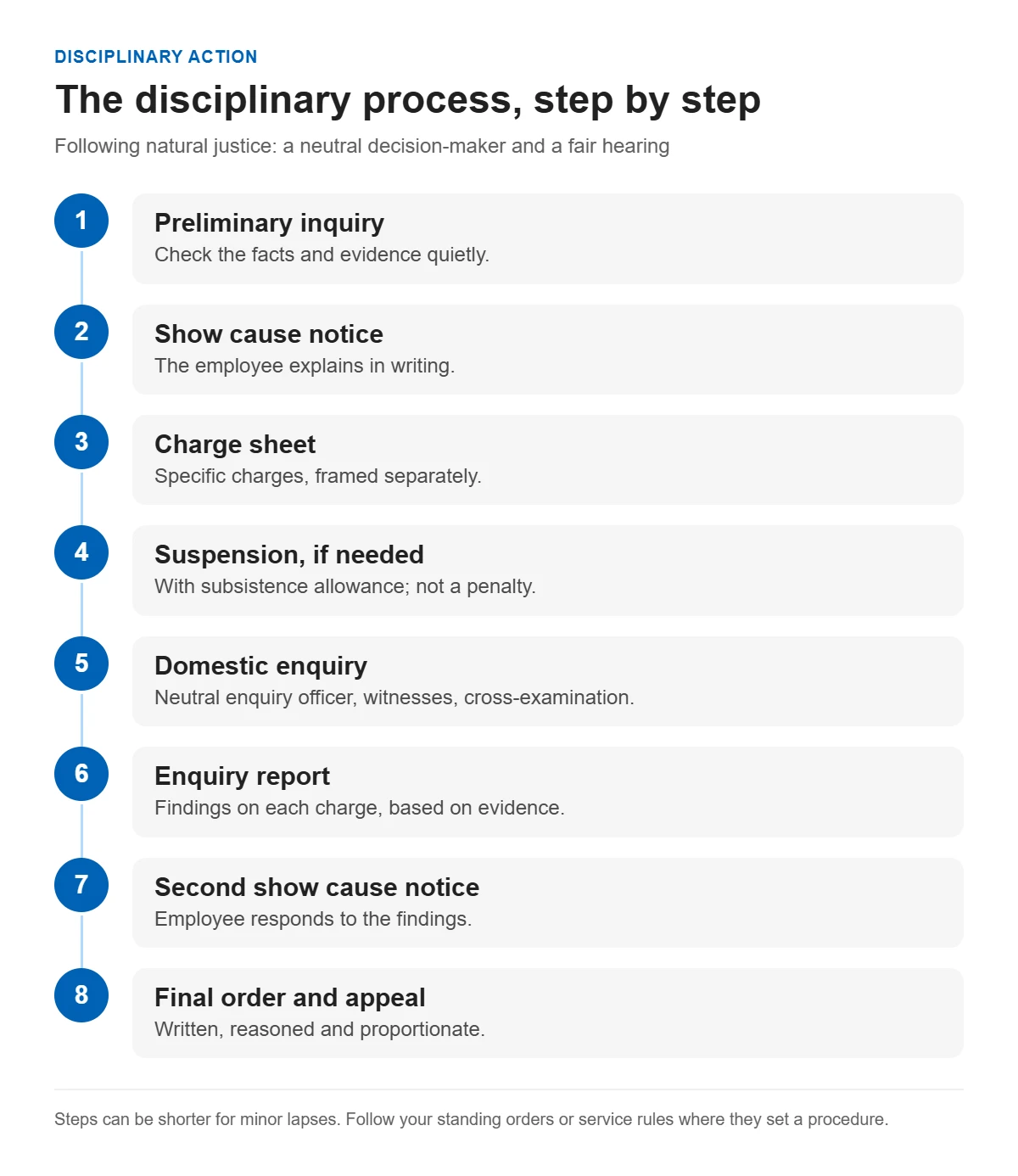
The disciplinary process in Indian workplaces, step by step.
Step 1: Preliminary inquiry
Before accusing anyone, check the facts quietly: collect CCTV footage, attendance records, emails or witness accounts. This decides whether there is a case to answer.
Step 2: Show cause notice
A show cause notice asks the employee to explain their conduct and say why action should not be taken. It is the employee’s first formal chance to respond.
A good show cause notice includes:
- the employee’s name, designation and employee ID
- a clear description of the alleged misconduct: what happened, when and where
- the rule, standing order or policy clause that may have been breached
- the time allowed to reply (often a few days; your standing orders or policy may fix this)
- a statement that the company may proceed without a reply if none is received
If the explanation is satisfactory, the matter can be closed with or without a caution. If not, the process moves to a formal enquiry for serious charges.
Step 3: Charge sheet
The charge sheet frames the specific charges for the enquiry. Each charge should be stated separately and precisely, with the evidence the company relies on. Vague charges such as “your behaviour has been unsatisfactory” are a common reason enquiries fail in court.
Step 4: Suspension pending enquiry (if needed)
Suspension is not a punishment. It is used when the employee’s presence could influence witnesses, tamper with records or put others at risk. The suspension order should state the reason and the subsistence allowance payable.
Step 5: Appointing the enquiry officer and presenting officer
The enquiry officer runs the hearing and gives findings. They must be neutral: not a witness, not the complainant and not someone who has already formed a view. The presenting officer presents the company’s case. The employee should be told who they are.
Step 6: Domestic enquiry hearings
A domestic enquiry is the internal hearing where the charges are tested. During the hearings:
- the charges are read out and the procedure explained
- the company’s witnesses give evidence, and the employee can cross-examine them
- the employee can present their own witnesses and documents
- the employee may be assisted by a co-worker or union representative, as the rules allow
- proceedings are recorded in writing and signed by those present
- the hearing is held in a language the employee understands
Step 7: Enquiry report
The enquiry officer writes a report setting out each charge, the evidence on both sides and a finding on whether each charge is proved. Findings must rest on the evidence, not on suspicion.
Step 8: Second show cause notice
Courts have held that the employee must receive a copy of the enquiry report and get a chance to respond before a penalty is decided. The second notice shares the findings and, often, the proposed penalty.
Step 9: Final order and appeal
The disciplinary authority considers the report and the employee’s reply, then issues a written, reasoned order. If the company’s rules provide an appeal, the order should say how and by when to appeal.
Penalties: matching the action to the misconduct
| Minor penalties | Major penalties |
|---|---|
| Verbal or written warning | Suspension as a penalty |
| Censure | Demotion |
| Withholding an increment | Discharge |
| Small fine where the law permits | Dismissal |
The penalty must be proportionate. Labour courts can reduce a penalty they find excessive, for example replacing dismissal with a lesser punishment for a first minor lapse. Consistency matters too: two employees who did the same thing should face similar consequences.
Common mistakes that sink disciplinary action
- relying on a vague charge sheet
- appointing an enquiry officer who was involved in the incident
- refusing to let the employee cross-examine witnesses
- not giving the employee a copy of the documents relied on
- skipping the second show cause notice
- long, unexplained delays while the employee stays suspended
- deciding the penalty before the enquiry ends
Documentation checklist for HR
- ☐ Preliminary investigation notes and evidence
- ☐ Show cause notice and proof of delivery
- ☐ Employee’s reply
- ☐ Charge sheet and suspension order (if any)
- ☐ Appointment letters for enquiry and presenting officers
- ☐ Signed minutes of every hearing
- ☐ Enquiry report
- ☐ Second show cause notice and reply
- ☐ Final order and proof of delivery
If the outcome is termination, HR also needs to manage the exit correctly. Our lesson on final settlement and exit steps covers that stage. For hands-on practice drafting notices and running mock enquiries, a mentor-guided HR programme covering employee relations is one way to build the skill.
