

Getting salaries right is only half of payroll. The other half is making sure every deduction, deposit and filing follows the law. Miss a provident fund deposit or deduct the wrong tax, and the company faces interest, penalties and unhappy employees, while HR spends weeks fixing it.
Payroll compliance in India also changed a great deal recently. The four labour codes came into force on 21 November 2025 and replaced 29 older central labour laws, and a new Income-tax Act applies to salary paid from 1 April 2026. If your notes still mention the Payment of Wages Act or Form 16, this lesson will bring you up to date.
What is payroll compliance?
Payroll compliance means following every law that governs how employees are paid: how much at minimum, when, what can be deducted, what must be contributed to social security, how tax is withheld, and what records must be kept and filed.
It protects the company from legal penalties, but it also protects employees. A missed PF deposit, for example, is money missing from someone’s retirement savings.
Payroll compliance in India: the laws that matter now
| Law | What it governs in payroll |
|---|---|
| Code on Wages, 2019 | Definition of wages, minimum and floor wages, payment timelines, deductions, bonus, equal pay, wage slips |
| Code on Social Security, 2020 | Provident fund, ESI, gratuity, maternity benefit and other social security |
| Income-tax Act, 2025 | Tax deducted at source (TDS) on salary |
| State professional tax laws | Professional tax slabs and deposits |
| State labour welfare fund laws | Small periodic contributions in states that have them |
| Industrial Relations Code and OSH Code | Standing orders, working hours, overtime and related records |
The Code on Wages replaced the Payment of Wages Act, the Minimum Wages Act, the Payment of Bonus Act and the Equal Remuneration Act. The Central Government notified its final rules under all four labour codes on 8 May 2026. States issue their own rules for establishments under their control, and they are at different stages, so always check the rules for the state where your employees work.
Key payroll compliance requirements
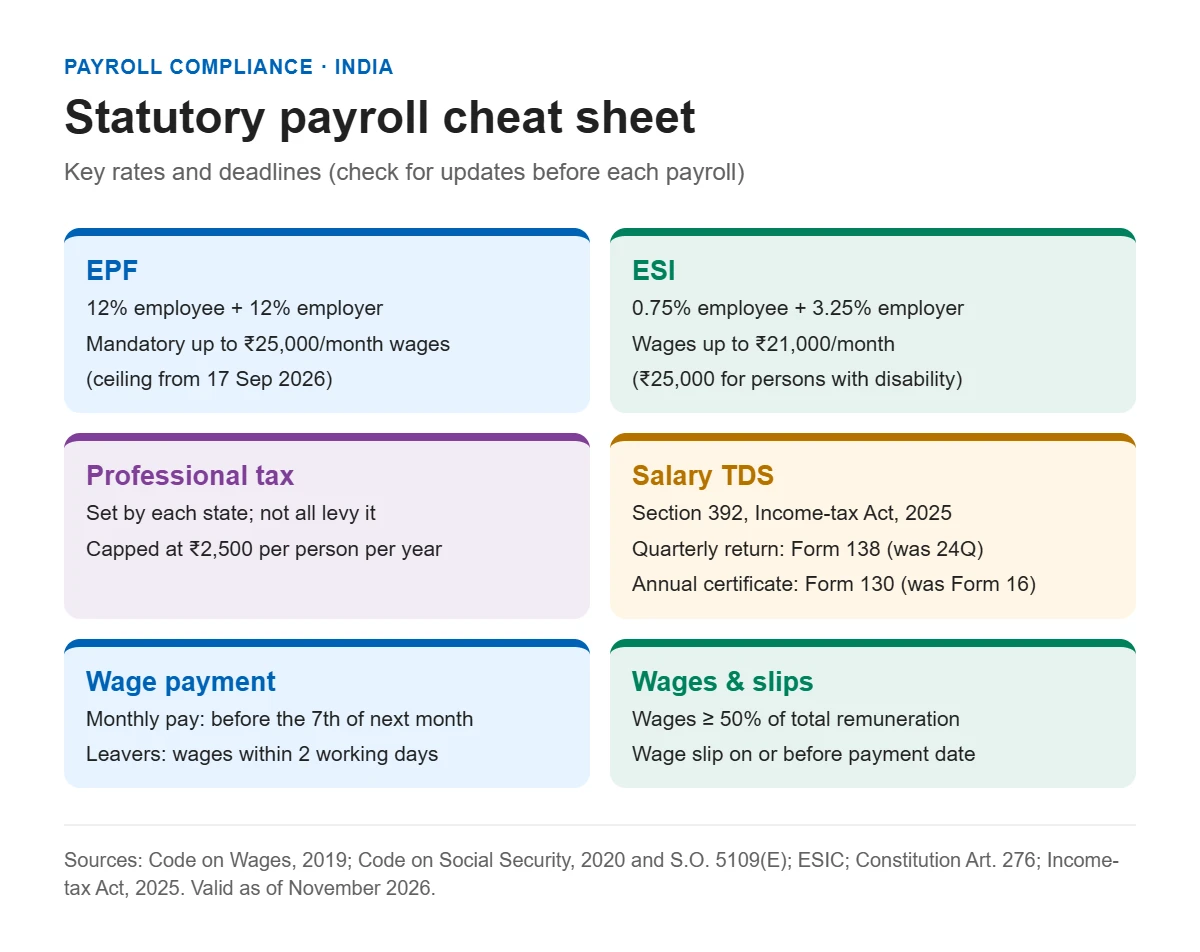
Key statutory payroll rates and deadlines, valid as of November 2026.
1. Pay at least the minimum wage
Every employee must be paid at least the minimum wage fixed by the appropriate government for their category and region. Under the Code on Wages, the Central Government sets a national floor wage, and states cannot fix minimum wages below it.
2. Follow the wage definition and the 50% rule
The Code defines wages as basic pay, dearness allowance and retaining allowance. Allowances such as HRA, conveyance, overtime and bonus are excluded, but if the excluded items exceed 50% of total remuneration, the excess counts as wages. Since contributions and benefits such as gratuity are calculated on wages, salary structures need to respect this rule.
3. Pay on time
- Monthly-paid employees: wages must be paid before the end of the seventh day of the following month.
- Employees who leave: when an employee resigns, is dismissed, removed or retrenched, wages due must be paid within two working days.
- Mode: wages may be paid by bank transfer or other electronic modes.
The two-day rule applies to wages. Gratuity, provident fund and some other dues follow their own timelines. Meeting the two-day deadline is much easier when exit clearances start during the notice period rather than on the last day.
4. Issue wage slips
Give every employee a wage slip, physically or electronically, on or before the day wages are paid.
5. Provident fund (EPF)
- Employer and employee each contribute 12% of wages (10% for certain specified establishments).
- Contribution is mandatory up to the statutory wage ceiling. That ceiling was raised from ₹15,000 to ₹25,000 a month with effect from 17 September 2026, through notification S.O. 5109(E).
- Of the employer’s 12%, part goes to the pension scheme (EPS) and the rest to the provident fund.
- Contributions above the ceiling are voluntary, as per company policy.
- Deposits and the monthly electronic return are made through the EPFO portal.
6. Employee state insurance (ESI)
- Employer contributes 3.25% and employee contributes 0.75% of wages.
- Covers employees in covered establishments earning up to ₹21,000 a month (₹25,000 for employees with disabilities).
- Employees earning up to ₹176 a day are exempt from paying their share, while the employer still pays its part.
7. Professional tax
Professional tax is levied by state governments, so slabs and rules differ by state, and some states don’t levy it at all. The Constitution caps it at ₹2,500 per person per year. The employer deducts it from salary and deposits it with the state, and must register in each state where it has employees liable to pay it.
8. Income tax deducted at source (TDS)
- From 1 April 2026, salary TDS is governed by section 392 of the Income-tax Act, 2025 (it replaced section 192 of the 1961 Act).
- The employer estimates each employee’s annual taxable salary under the regime the employee chooses (the new regime is the default), and deducts tax each month.
- Deposit TDS with the government by the due date, file the quarterly salary TDS statement (now Form 138, earlier Form 24Q), and give employees the annual TDS certificate (now Form 130, earlier Form 16).
- Collect investment declarations at the start of the year and proofs before year-end, for employees on the old regime.
9. Gratuity
Under the Code on Social Security, gratuity is generally payable after five years of continuous service. Fixed-term employees become eligible after one year. Many employers cover this liability through a group gratuity scheme with an insurer.
10. Bonus and equal pay
The Code on Wages carries forward statutory bonus for eligible employees and prohibits gender-based discrimination in pay and recruitment for the same or similar work.
11. Keep records and registers
Maintain registers of wages, attendance, deductions and overtime in the prescribed format, along with challans, returns and declarations. The new rules lean heavily towards electronic records and online filing.
A monthly payroll compliance checklist
- ☐ Attendance, joiners and exits finalised before the payroll cut-off
- ☐ Salary structures checked against the 50% wage rule after any revision
- ☐ Salaries credited before the seventh day of the following month
- ☐ Wage slips issued on or before the payment date
- ☐ Full and final wages paid within two working days for every leaver
- ☐ EPF deposited and electronic return filed
- ☐ ESI contributions deposited
- ☐ Professional tax deposited in each applicable state
- ☐ TDS deposited; quarterly statement filed when due
- ☐ Registers and challans saved for audit
What happens when payroll compliance slips
Non-compliance has three kinds of cost:
- Financial: late PF, ESI and TDS deposits attract interest and penalties, and repeated or wilful defaults attract heavier penalties.
- Legal: inspections, claims before labour authorities, and prosecution for serious violations.
- Human: employees lose trust quickly when a deduction shows on their slip but never reaches their PF account.
The labour codes also shift inspection towards a risk-based, electronic approach, which makes clean digital records more important than ever.
How HR teams stay compliant
- Keep a compliance calendar with every due date by state, and review it when rules change.
- Track notifications. Rates, ceilings and forms change, as the 2026 EPF wage ceiling revision showed. Follow EPFO, ESIC, the Income Tax Department and the labour ministry, or rely on a trusted payroll partner.
- Use payroll software or compliance partners. Tools like greytHR, Keka and Zoho Payroll update statutory calculations, but HR must still check configuration after every change.
- Audit regularly. A quarterly internal audit of payroll and challans catches problems before an inspector does.
If you want to go deeper into the labour codes and statutory compliance, the HR certification with labour law and payroll modules covers them with mentor-led sessions.
