

A salary slip is the one HR document every employee reads, usually on the day salary is credited, usually looking for one number. But for HR, the payslip is much more than a monthly statement. It is legal proof of payment, a record that banks and embassies rely on, and the first place employees look when they think their pay is wrong.
This lesson covers what a salary slip is, its standard format, each salary component, and the 2025 labour code change that is reshaping how salary structures look.
What is a salary slip?
A salary slip (also called a payslip or wage slip) is a document an employer issues to an employee for each pay period. It shows what the employee earned, what was deducted and why, and the net amount paid.
Under the Code on Wages, 2019, which came into force on 21 November 2025, employers must give employees a wage slip on or before the day wages are paid. It can be issued on paper or electronically, so the PDF payslip most employees download from an HR portal meets the requirement.
Why a salary slip matters
For employees, a payslip is:
- proof of employment and income for loans, credit cards and rental agreements
- a document visa offices and universities often ask for
- the basis for salary negotiation when changing jobs
- a running record of tax deducted, useful while filing income tax returns
For employers, a payslip is:
- proof that wages were paid correctly and on time
- a transparency tool that heads off many pay disputes
- part of the records labour inspectors and auditors may check
Standard salary slip format
Payslip designs vary between companies, but almost every salary slip in India follows the same four-block layout.
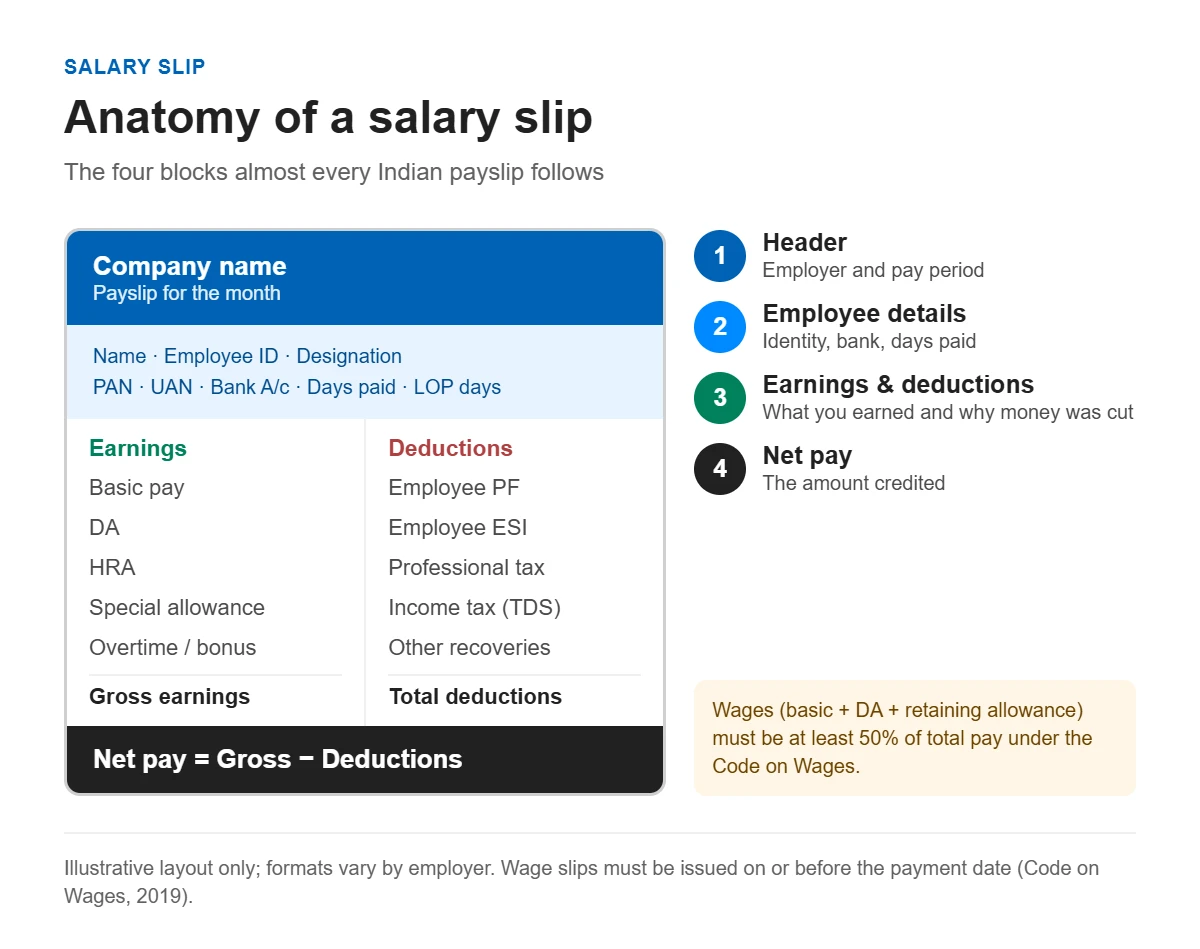
The four blocks found on almost every salary slip.
- Header: company name, address and the month or pay period.
- Employee details: name, employee ID, designation, department, date of joining, PAN, UAN, bank account (usually partly masked), days paid and loss-of-pay days.
- Earnings and deductions: usually two columns side by side, each with a total.
- Net pay: the amount credited, often written in figures and words.
Salary components on a payslip: earnings
Basic pay
Basic pay is the fixed core of the salary. Many other components are calculated from it, including provident fund contributions, gratuity and, in many companies, HRA. It is fully taxable.
Dearness allowance (DA)
DA is an allowance meant to offset inflation. It is standard in government and public sector pay and less common in private companies.
House rent allowance (HRA)
HRA helps employees pay for rented accommodation. Employees who live in rented housing can claim part of it as tax-exempt under the old tax regime, subject to conditions. Under the new regime, which is the default, that exemption isn’t available.
Special allowance and other allowances
Special allowance is usually the balancing figure that brings the monthly salary up to the agreed amount. Other allowances you may see include conveyance, shift, night duty, telephone or internet allowance.
Overtime, bonus and incentives
Overtime pay, performance bonuses, sales incentives and arrears appear only in the months they are paid. Because they vary, they explain most month-to-month changes in a salary slip.
Reimbursements
Some companies show reimbursements, such as fuel or internet bills, on the payslip. Their tax treatment depends on the rules and on documentation, so they are often listed separately from regular earnings.
Salary components on a payslip: deductions
| Deduction | What it is | Who it applies to |
|---|---|---|
| Employee provident fund (EPF) | Employee’s 12% contribution to the provident fund | Mandatory up to the statutory wage ceiling, which became ₹25,000 a month from 17 September 2026; voluntary above it |
| Employee state insurance (ESI) | Employee’s 0.75% contribution for medical and cash benefits | Employees earning up to ₹21,000 a month in covered establishments |
| Professional tax | A state tax on employment | Only in states that levy it; capped at ₹2,500 a year |
| Income tax (TDS) | Tax deducted on estimated annual salary | Based on the employee’s tax regime and declarations |
| Other recoveries | Loan EMIs, salary advance, canteen, notice-period recovery | As agreed with the employee |
The employer’s own contributions to EPF and ESI are not deducted from the employee’s pay, but some companies show them on the payslip for transparency.
Payroll components: CTC, gross pay and net pay
These three terms cause more confusion than any single line on a payslip.
- CTC (cost to company): everything the employer spends on the employee in a year, including salary, employer PF and ESI contributions, gratuity provision, insurance and annual bonus.
- Gross pay: the monthly earnings before deductions, which is the “Total earnings” line on the slip.
- Net pay (take-home): gross pay minus deductions, the amount credited to the bank account.
So a ₹12 lakh CTC does not mean ₹1 lakh credited each month. Employer contributions sit inside CTC but never reach the salary account, and employee deductions come off the gross. Explaining this clearly at the offer stage of the hiring cycle prevents a lot of disappointment on the first salary day.
The 50% wage rule and your salary structure
For years, many companies kept basic pay low, often well under half of CTC, and put the rest into allowances. Since PF, gratuity and some other benefits are calculated on basic pay or wages, this reduced those costs.
The Code on Wages changes that. It defines “wages” as basic pay, dearness allowance and retaining allowance, and excludes items such as HRA, conveyance, bonus and overtime. If the excluded items add up to more than 50% of total remuneration, the excess is added back to wages. In practice, wages must make up at least half of the pay.
What this means on a payslip:
- basic pay (plus DA) tends to rise, and allowances shrink
- benefits linked to wages, such as gratuity, can increase
- take-home pay may change slightly, depending on how the employer restructures and how PF is applied
HR teams restructuring salaries should check each component against the wage definition rather than simply renaming allowances.
How to read your salary slip each month
A quick routine helps you catch errors early, whether you’re checking your own slip or answering an employee’s question:
- Check days paid and loss-of-pay days against your attendance.
- Compare each earning with your offer letter or latest revision letter.
- Check that PF and ESI are calculated on the right base.
- Look at TDS: a sudden jump usually means missing declarations or a one-time payment such as a bonus.
- Match net pay with the amount actually credited.
If something doesn’t add up, raise it with HR or payroll with the slip and your calculation. The way HR should investigate and fix such issues is covered in our lesson on the payroll process.
At the end of the year, the employer also issues an annual TDS certificate. For salary paid from 1 April 2026, this is Form 130 under the Income-tax Act, 2025 (it replaced Form 16), and it should match the tax shown across your monthly payslips.
Learning to build salary structures and generate payslips in HR software is a core skill in payroll and HR operations jobs. A structured HR course that teaches payroll tools is one way to practise it before your first role.
