

Most employees want to know three things about their work: what is expected of them, how they are doing and what happens next. Performance management is the HR process that answers those questions throughout the year, not just at appraisal time.
This lesson explains what performance management means, the five stages of the performance management cycle, the parts of a performance management system and how it differs from a performance appraisal.
What is performance management?
Performance management is a continuous process of setting clear expectations, tracking progress, giving feedback and developing employees so that their work supports the organisation’s goals.
It connects three levels:
- Organisation: business goals for the year
- Team: what each department must deliver
- Individual: each employee’s goals, behaviours and development
When these levels line up, every employee can see how their work contributes to the bigger picture.
Objectives of performance management
- Alignment: link individual work to business goals
- Clarity: make expectations and priorities clear
- Improvement: spot gaps early and fix them
- Development: identify training and growth needs
- Fair decisions: give a sound basis for pay, promotion and recognition
- Engagement: regular feedback and recognition keep people motivated
The performance management cycle
A widely used model, from the US Office of Personnel Management, describes performance management as a continuous cycle of five stages.
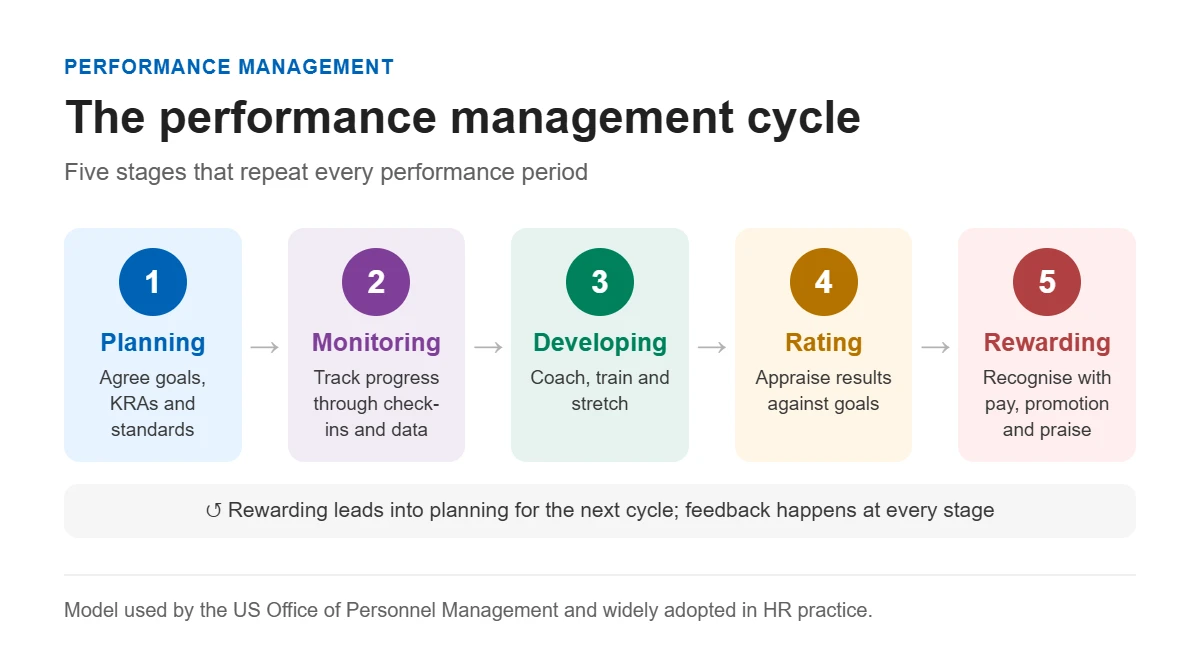
The performance management cycle.
1. Planning
Manager and employee agree on goals and standards at the start of the cycle. Goals should be specific and measurable, and should link to team and company objectives. Many companies use SMART goals, KRAs and KPIs, or OKRs at this stage.
2. Monitoring
Progress is tracked during the year through check-ins, dashboards and project reviews. Monitoring is not micromanagement: the aim is to spot problems early and remove obstacles.
3. Developing
Gaps found during monitoring are addressed through coaching, training, new assignments or mentoring. Strong performers are also stretched so they keep growing.
4. Rating
At set points, usually half-yearly or yearly, performance is summarised and rated against the goals agreed at the start. This is the performance appraisal step.
5. Rewarding
Good performance is recognised through pay increases, bonuses, promotions and everyday recognition. The cycle then starts again with planning for the next period.
What is a performance management system?
A performance management system is the combination of policies, processes, tools and roles an organisation uses to run the cycle. A typical system includes:
| Part | What it covers |
|---|---|
| Goal framework | How goals are set: SMART goals, KRAs and KPIs, OKRs or MBO |
| Review calendar | When check-ins, mid-year and annual reviews happen |
| Rating scale | How performance is scored, for example a 5-point scale |
| Feedback methods | Manager feedback, self-assessment, 360-degree feedback |
| Calibration | Meetings where managers compare ratings to make them consistent |
| Links to rewards | How ratings affect increments, bonuses and promotions |
| Development plans | How gaps turn into training and growth actions |
| Technology | Software that records goals, feedback and ratings |
Good performance management software should be easy to customise, transparent for employees, based on objective data and able to support real-time feedback as well as periodic ratings.
Performance management vs performance appraisal
| Performance management | Performance appraisal | |
|---|---|---|
| Scope | The whole cycle: planning to rewarding | One step: rating performance |
| Timing | Continuous through the year | Periodic, often yearly or half-yearly |
| Focus | Future improvement and development | Past performance |
| Approach | Ongoing two-way conversations | Formal evaluation |
An appraisal is part of performance management, not a replacement for it. Our lesson on how employees are formally rated covers the appraisal step in detail.
Continuous performance management
Many companies are moving away from relying only on a year-end review. Continuous performance management adds frequent, lighter touchpoints:
- monthly or fortnightly one-on-ones
- quarterly goal reviews
- real-time feedback and recognition
- goals that can change when business priorities change
The annual review still exists in most companies because pay decisions need a summary, but it should contain no surprises.
Common performance management techniques
- SMART goals for clear, measurable targets
- KRAs and KPIs to define responsibilities and how they are measured
- OKRs for ambitious objectives with measurable key results
- Management by objectives (MBO) for jointly agreed goals
- Balanced scorecard for performance across financial and non-financial areas
- 360-degree feedback for input from several directions
The right mix depends on the culture, the roles and whether teams work in an office or remotely.
Role of HR and managers
| HR | Managers |
|---|---|
| Designs the system and calendar | Set goals with each team member |
| Trains managers | Hold regular check-ins |
| Runs calibration | Give honest, specific feedback |
| Links ratings to rewards policy | Support development |
| Tracks completion and fairness | Rate performance fairly |
Common mistakes
- treating performance management as a once-a-year form
- goals that are vague or not linked to business priorities
- feedback only at year-end
- ratings that surprise the employee
- no follow-up on development needs
- inconsistent standards between managers
