

Salary alone rarely keeps people. Employees also weigh benefits, flexibility, recognition and the chance to grow. Total rewards brings all of these together into one view of what an employer offers.
This lesson explains what total rewards means, its main components, variable pay in detail, total rewards statements, how to build a total rewards strategy and how to measure whether it works.
What is total rewards?
Total rewards is everything an employee receives from the employer in return for their work, both financial and non-financial. It includes pay and benefits, but also wellbeing, development and recognition.
A total rewards strategy decides how the organisation mixes and communicates these elements to attract, motivate and retain the right people within budget.
Components of total rewards
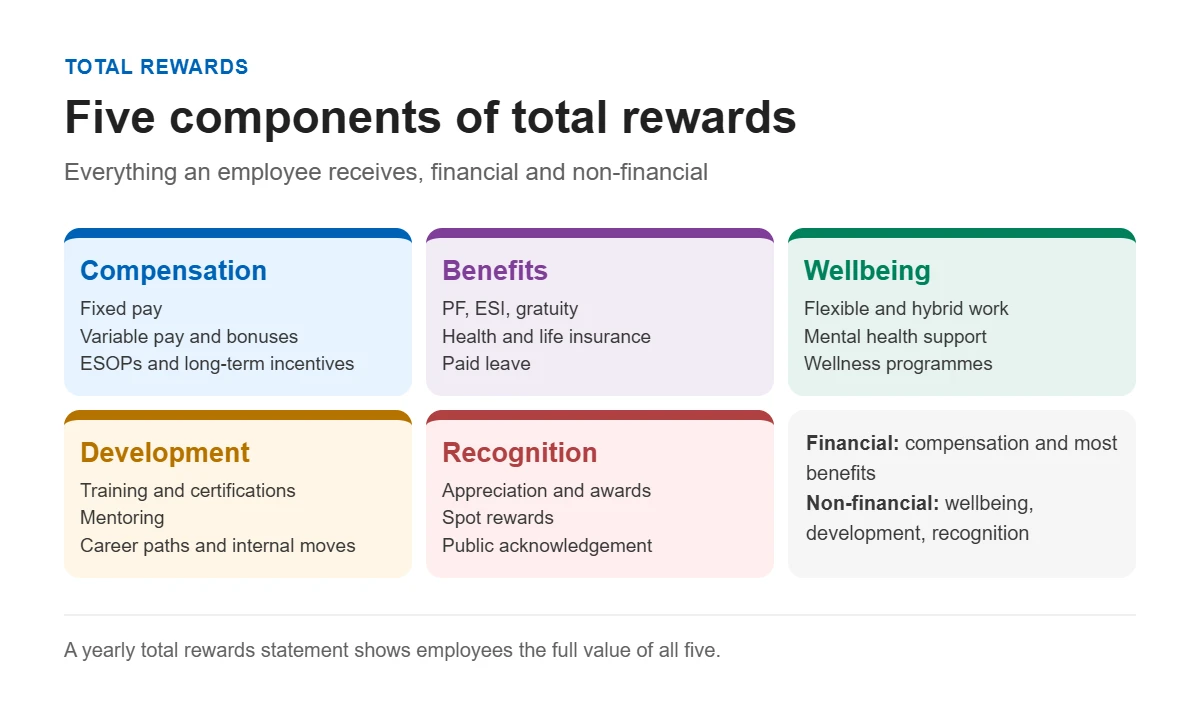
The five components of total rewards.
| Component | What it includes |
|---|---|
| Compensation | Fixed pay, variable pay, long-term incentives such as ESOPs |
| Benefits | Statutory benefits, insurance, retirement benefits, paid leave |
| Wellbeing | Flexible work, mental health support, wellness programmes, work-life balance |
| Development | Training, certifications, mentoring, career paths, internal mobility |
| Recognition | Appreciation, awards, spot rewards, public acknowledgement |
Financial vs non-financial rewards
- Financial: salary, bonuses, incentives, ESOPs, insurance, retirement benefits
- Non-financial: recognition, learning, flexibility, meaningful work, a good manager
Variable pay
Variable pay is the part of compensation that changes with performance or results. It is not guaranteed.
Types of variable pay
| Type | How it works | Common in |
|---|---|---|
| Performance bonus | Yearly or half-yearly, based on individual rating | Most roles |
| Sales incentive or commission | Linked to sales targets or revenue | Sales teams |
| Team or project bonus | Shared when a team meets its goals | Projects, operations |
| Profit sharing | A share of company profit distributed to employees | Mature companies |
| Gain sharing | Rewards from measurable productivity or cost savings | Manufacturing |
| Spot award | Small immediate reward for exceptional work | All levels |
| Retention bonus | Paid if the employee stays for an agreed period | Critical roles |
Statutory bonus is different. Under the Code on Wages, 2019, eligible employees must receive an annual bonus of at least 8.33% of wages, subject to the rules. It is a legal requirement, not discretionary variable pay.
Designing a variable pay plan
- Define the purpose: what behaviour or result should it drive?
- Choose measures: clear, measurable and within the employee’s control, such as targets linked to KRAs.
- Set the size: variable pay as a share of CTC, often higher for senior and sales roles.
- Decide the payout curve: what is paid at threshold, target and stretch performance.
- Write clear rules: timing, eligibility, effect of leaving mid-year.
- Communicate and track: show employees their progress during the year.
Pitfalls
- targets that are unclear or impossible
- variable pay so small it does not change behaviour
- rewarding only individual results where teamwork matters
- paying late or changing rules mid-year
Total rewards statement
A total rewards statement is a personalised document that shows each employee the full value of what they receive.
What it typically shows:
- fixed salary and variable pay earned
- employer contributions to PF, ESI and gratuity provision
- insurance cover and premiums paid by the employer
- learning spend, ESOP value and other benefits
- leave and wellbeing benefits
Employees often underestimate the value of benefits; a yearly statement makes it visible.
How to build a total rewards strategy
- Link to business strategy: a fast-growing startup and a stable manufacturer need different mixes.
- Understand employees: surveys and exit data show what people value.
- Benchmark: compare each component with the market.
- Decide the mix: for example, market-level fixed pay, strong variable pay and above-market learning.
- Ensure fairness: check pay equity and consistent rules.
- Communicate: offer letters, statements and manager conversations.
- Review yearly: adjust based on results and feedback.
Measuring total rewards effectiveness
- offer acceptance rate
- voluntary attrition, especially of high performers
- engagement survey scores on pay and recognition
- benefits usage
- reward cost as a share of revenue or operating cost
- pay equity results
Recognition is a large part of total rewards; see our lesson on recognising employee contributions. The benefits pillar is covered in our lesson on statutory and voluntary benefits.
