

What happens if your sales head resigns next month, or your only payroll specialist goes on long leave? Without a plan, the business scrambles, work stalls and an expensive external hire becomes urgent. Succession planning prepares for these moments in advance.
This lesson explains what succession planning is, why it matters, the steps to do it well and how to use the nine-box grid to identify successors.
What is succession planning?
Succession planning is the process of identifying critical roles and developing employees who can step into them when they become vacant, so the organisation keeps running smoothly.
It is sometimes called replacement planning, but modern succession planning goes further: it builds a pipeline of leaders and specialists for the future, not just a list of backups.
Key terms
- Critical role: a position whose vacancy would seriously affect operations, revenue or strategy
- Successor: an employee being prepared to take on a critical role
- Readiness: how soon a successor could take the role, such as “ready now”, “ready in 1–2 years” or “ready in 3–5 years”
- High potential (HiPo): an employee with the ability and motivation to grow into bigger roles
Why succession planning matters
- Business continuity: reduces disruption when key people leave, retire or fall ill
- Risk management: removes dependence on a single person
- Knowledge transfer: captures critical knowledge before it walks out of the door
- Leadership development: builds future leaders from within
- Retention: high performers stay when they see a path forward
- Lower cost: internal successors usually cost less and settle faster than external hires
Succession planning process: step by step
Step 1: Identify critical roles
List the roles that would cause the most damage if left vacant. These are not only senior leaders; they can include specialists with rare skills, such as a statutory compliance expert or a key client relationship manager.
Step 2: Define what success looks like in each role
Document the skills, experience, knowledge and behaviours each critical role needs, now and in the future.
Step 3: Assess current talent
Review employees’ performance and potential using appraisals, manager input, assessments and career conversations.
Step 4: Identify potential successors
Shortlist one or more candidates for each critical role and rate their readiness.
Step 5: Close the development gaps
Create individual development plans with training, mentoring, job rotation, stretch projects and exposure to senior leaders.
Step 6: Transfer knowledge
Document processes, introduce successors to key stakeholders and let them shadow the role holder.
Step 7: Review and update
Review the plan at least once a year and whenever the business or people change.
Using the nine-box grid
The nine-box grid is a simple tool for comparing employees on two dimensions: performance (results in the current role) and potential (ability to grow into bigger roles). Each dimension is rated low, medium or high, creating nine boxes.
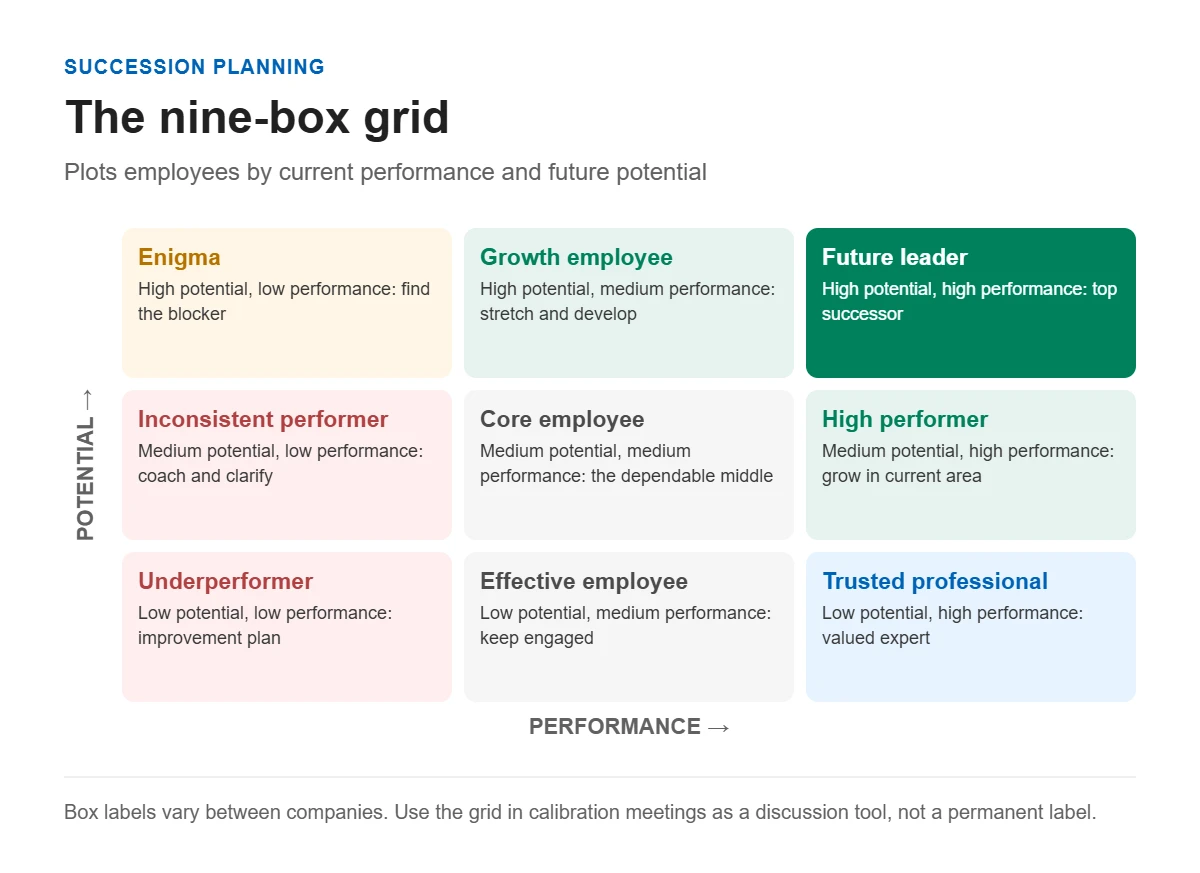
The nine-box grid for performance and potential.
| Low performance | Medium performance | High performance | |
|---|---|---|---|
| High potential | Enigma: high ability but not delivering yet | Growth employee: develop and stretch | Future leader: top successor candidate |
| Medium potential | Inconsistent performer: coach and clarify | Core employee: the dependable middle | High performer: grow in current area |
| Low potential | Underperformer: performance plan or exit | Effective employee: keep engaged | Trusted professional: valued expert |
Labels vary between companies. The grid works best in a calibration meeting, where managers discuss ratings together so that standards are consistent and personal bias is reduced.
Use it carefully: the grid is a conversation tool, not a permanent label. Potential is harder to judge than performance, and people’s positions change over time.
Succession planning example
| Critical role | Successor | Readiness | Development actions |
|---|---|---|---|
| Payroll Manager | Senior Payroll Executive | Ready in 1 year | Labour codes training, lead year-end process, mentoring by current manager |
| Regional Sales Head | Area Sales Manager (North) | Ready in 2 years | Leadership programme, manage a second territory, attend leadership reviews |
| HR Business Partner | HR Generalist | Ready now | Shadow business reviews, handle two departments independently |
Common succession planning mistakes
- focusing only on the CEO and top leadership
- choosing successors based on loyalty or similarity rather than capability
- naming successors but not developing them
- keeping the plan secret so successors don’t know they are valued
- never updating the plan
- relying on a single successor for each role
Who is involved
- Leadership: sponsors the process and reviews critical roles
- HR: designs the process, runs calibration and tracks plans
- Managers: assess people and support development
- Employees: share career goals and take ownership of growth
Succession planning is one part of a wider talent strategy. Our lesson on the wider talent strategy shows how it connects, and our lesson on development plans for future leaders explains how to build the plans successors need.
