

The new labour codes are the biggest change to Indian employment law in decades. Four codes came into force on 21 November 2025, replacing 29 central labour laws, some of them nearly a century old. The Central Government then notified the detailed Central Rules on 8 May 2026.
For HR, this changes how salaries are structured, how gratuity is calculated, who gets social security and how compliance is filed. This lesson explains the four codes, the key changes and what HR teams need to do.
What are the 4 labour codes?
| Code | Year passed | Number of laws replaced | Focus |
|---|---|---|---|
| Code on Wages | 2019 | 4 | Minimum wages, wage payment, bonus, equal pay |
| Industrial Relations Code | 2020 | 3 | Unions, standing orders, disputes, retrenchment |
| Code on Social Security | 2020 | 9 | EPF, ESI, gratuity, maternity, gig workers |
| Occupational Safety, Health and Working Conditions (OSH) Code | 2020 | 13 | Safety, health, working hours, leave, contract labour |
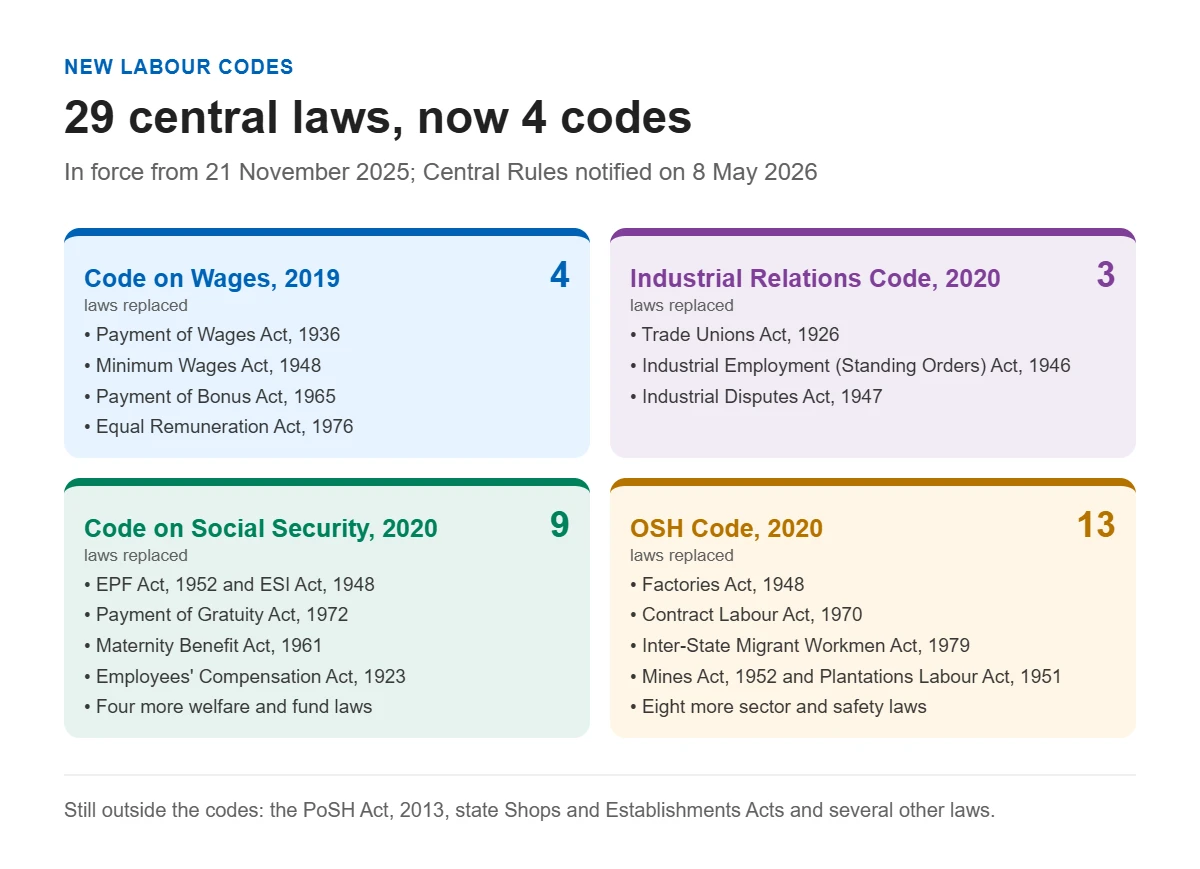
How 29 central labour laws map to the four labour codes.
Timeline at a glance
- 2019–2020: Parliament passes the four codes.
- 21 November 2025: All four codes come into force.
- 30 December 2025: Draft Central Rules published for consultation.
- 8 May 2026: Final Central Rules and Model Standing Orders, 2026 notified.
- 2026: States notify their own rules in stages. Until a state notifies final rules, existing rules continue there.
Key changes under the new labour codes
1. Appointment letters for all workers
Every worker must now get an appointment letter stating designation, wages and social security entitlements. Earlier, this wasn’t a universal requirement.
2. Minimum wage for every employee
Minimum wages earlier applied only to listed “scheduled employments”. The Code on Wages extends a statutory minimum wage to all employees. The Centre also fixes a floor wage, and no state can set a minimum wage below it.
3. A uniform definition of wages and the 50% rule
“Wages” now has one definition used for PF, gratuity, bonus and other benefits. Wages include basic pay, dearness allowance and retaining allowance. Certain items, such as HRA, conveyance and overtime, are excluded, but if the excluded items add up to more than 50% of total pay, the excess is added back to wages.
What this means for salaries: companies that kept basic pay very low may need to restructure. A higher wage base can increase provident fund and gratuity amounts, which may reduce take-home pay slightly while increasing long-term savings. Our lesson on reading the components on a payslip shows how these parts appear on a salary slip.
4. Timely payment of wages
For a monthly wage period, wages must be paid by the 7th of the following month. When an employee resigns, is dismissed or is retrenched, wages due must be paid within two working days.
5. Gratuity for fixed-term employees after one year
Permanent employees still need five years of continuous service for gratuity (except on death or disablement). Fixed-term employees now qualify after one year, and must get wages, leave and benefits on a par with permanent staff doing similar work.
6. Social security for gig and platform workers
For the first time, “gig work”, “platform work” and “aggregator” are defined in law. Aggregators contribute 1–2% of annual turnover to a social security fund, capped at 5% of the amount paid to gig and platform workers. An Aadhaar-linked Universal Account Number makes benefits portable across states.
7. Working hours, overtime and leave
- standard working hours are 8 hours a day and 48 hours a week
- overtime is paid at twice the normal wage rate and needs the worker’s consent
- paid annual leave becomes available after 180 days of work in a year, down from 240
8. Women at work
Women may work night shifts and in all types of work across establishments, with their consent and the required safety measures. Gender discrimination in pay and hiring is prohibited, and women must be represented on grievance committees.
9. Health and safety
Employers must provide a free annual health check-up to workers above 40. Safety committees are required in establishments with 500 or more workers.
10. Wider ESIC coverage
ESIC coverage becomes pan-India instead of only notified areas. It is voluntary for establishments with fewer than 10 employees and mandatory where even one employee works in a hazardous process.
11. Industrial relations changes
- standing orders apply to industrial establishments with 300 or more workers (up from 100)
- prior government permission for layoff, retrenchment and closure applies at 300 or more workers in factories, mines and plantations
- 14 days’ notice is required before a strike or lockout in every industrial establishment, not just public utilities
- employers must contribute 15 days’ wages of each retrenched worker to a Worker Re-skilling Fund; the Central Rules require the deposit within 10 days of retrenchment
- a Grievance Redressal Committee is required where there are 20 or more workers
12. Higher thresholds for factories and contract labour
| Item | Earlier | Under the OSH Code |
|---|---|---|
| Factory definition (with power) | 10 workers | 20 workers |
| Factory definition (without power) | 20 workers | 40 workers |
| Contract labour law applies at | 20 contract workers | 50 contract workers |
13. Simpler compliance and softer enforcement
- a single registration, a single licence and a single annual return instead of separate filings under each law
- electronic registers and returns, largely through the Shram Suvidha portal
- inspectors become Inspector-cum-Facilitators, with web-based, randomised inspections
- for many first-time lapses, the employer gets a written direction to comply before prosecution, and several offences can be settled by paying a compounding amount
Old laws vs new labour codes: quick comparison
| Area | Old regime | New labour codes |
|---|---|---|
| Minimum wage coverage | Scheduled employments only | All employees |
| Appointment letter | Not universal | Mandatory for every worker |
| Gratuity for fixed-term staff | 5 years | 1 year |
| Annual leave eligibility | 240 days of work | 180 days of work |
| Strike notice | Mainly public utilities | All industrial establishments |
| Gig workers | Not covered | Social security framework |
| Registrations and returns | Separate under each law | Single registration and return |
What HR teams should do now
- Map your locations. Note which states you operate in and whether each has notified final rules.
- Review salary structures against the 50% wage rule and model the impact on PF, gratuity and take-home pay.
- Issue appointment letters to every worker, including contract and fixed-term staff, in the new format.
- Update policies on working hours, overtime, leave, night shifts and fixed-term employment.
- Check thresholds: standing orders, Grievance Redressal Committee, crèche, safety committee and contract labour.
- Set up single registration and returns on the relevant portals once your state’s rules allow.
- Train managers and payroll staff on the changes.
- Brief employees about why their salary slip or PF deduction may change.
For the full set of registrations, registers and returns employers must keep, see the statutory compliance lesson. If you want guided practice applying the codes to real payroll and HR cases, consider HR training that includes the new labour codes.
