

A new performance management system can be well designed and still fail because managers were never consulted, the leadership team was not convinced, or employees heard about it through rumours. Most HR projects succeed or fail on stakeholder management: understanding who is affected and bringing them along.
This lesson explains what stakeholder management means for HR, who HR’s stakeholders are, how to carry out stakeholder analysis and mapping, and how to write an engagement plan.
What is stakeholder management?
A stakeholder is any person or group who affects, or is affected by, a decision, project or organisation.
Stakeholder management is the process of identifying stakeholders, understanding their interests and influence, and planning how to inform, involve and win support from them.
Who are HR’s stakeholders?
| Stakeholder | What they care about |
|---|---|
| Board and CEO | Strategy, growth, risk, culture, leadership succession |
| Business heads and line managers | Getting the right people on time, performance, low attrition |
| Employees | Fair pay, growth, wellbeing, clear communication |
| Finance | Budgets, employee cost, accurate payroll |
| IT | System security, integration, data protection |
| Legal and compliance | Labour law compliance, policies, investigations |
| Unions or employee representatives | Wages, working conditions, job security |
| Candidates | Fair, timely hiring and a good experience |
| External partners | Recruiters, insurers, payroll and training vendors |
| Government bodies | Statutory filings, inspections, contributions |
Stakeholder analysis
Stakeholder analysis looks at each stakeholder in a structured way. For a given project, ask:
- Who is affected or can influence the outcome?
- What is their interest in the project?
- How much power do they have over decisions or resources?
- What is their current attitude: supportive, neutral or resistant?
- What do they need from HR: information, involvement or reassurance?
- What could go wrong if they are ignored?
Stakeholder mapping: the power-interest grid
The most common mapping tool is the power-interest grid. Place each stakeholder on two scales: how much power they have, and how much interest they have in the project.
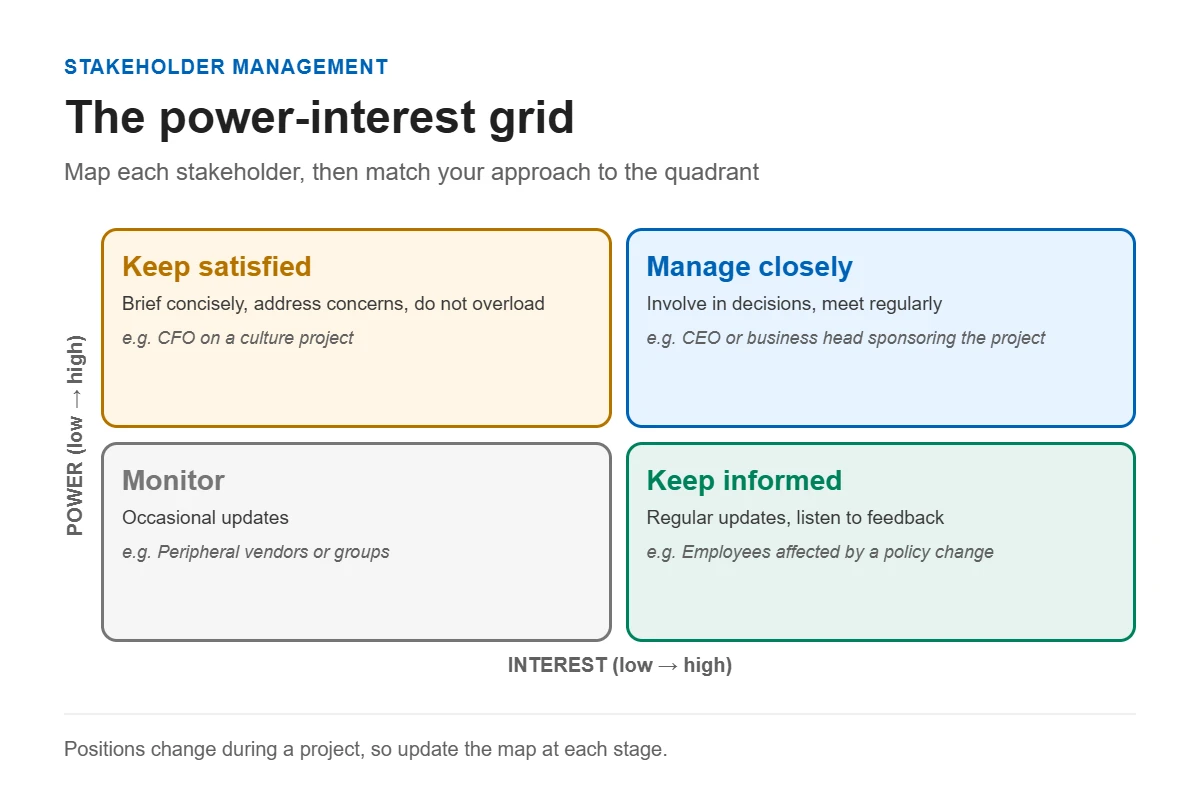
The power-interest grid for stakeholder mapping.
| Quadrant | Who | Approach |
|---|---|---|
| High power, high interest | Key players, such as the CEO or business head sponsoring the project | Manage closely: involve in decisions, meet regularly |
| High power, low interest | For example, the CFO on a culture project | Keep satisfied: brief concisely, address their concerns, avoid overloading |
| Low power, high interest | For example, employees affected by a policy change | Keep informed: regular updates, listen to feedback |
| Low power, low interest | Peripheral groups | Monitor: occasional updates |
Positions change during a project. A neutral manager can become a key player once the change reaches their team, so update the map regularly.
Stakeholder management process
- Identify all stakeholders for the project or decision.
- Analyse their interests, influence and attitudes.
- Map them on the power-interest grid.
- Plan engagement: what to communicate, how, how often and by whom.
- Engage: meetings, workshops, updates, pilots, feedback sessions.
- Monitor and adjust: track support and concerns; change your approach when needed.
Stakeholder engagement plan template
| Stakeholder | Interest | Power | Attitude | Goal | Approach | Channel and frequency | Owner |
|---|---|---|---|---|---|---|---|
| Sales head | Faster hiring for 40 roles | High | Supportive | Champion | Co-design hiring plan | Weekly review | HRBP |
| CFO | Cost control | High | Neutral | Approve budget | Business case with ROI | Monthly | HR head |
| Line managers | Workload, team impact | Medium | Mixed | Use new process | Training and FAQs | Workshops, then fortnightly | HR team |
| Employees | Fairness, clarity | Low | Unsure | Understand change | Town hall, FAQs | Monthly updates | HR communications |
Example values for a hiring process redesign.
Example: launching a new performance system
- Manage closely: CEO (sponsor) and business heads; agree goals, rating approach and timeline with them
- Keep satisfied: CFO; show the link between ratings and the bonus budget
- Keep informed: managers and employees; training, guides, sample conversations, a feedback channel
- Monitor: vendors and auditors; share updates when relevant
Skills HR needs for stakeholder management
- clear communication and active listening
- influencing without formal authority
- negotiation and handling conflict
- business acumen to speak each stakeholder’s language
- emotional intelligence to read concerns and resistance
Our lesson on managing emotions in leadership covers the last point in depth.
Common mistakes
- engaging stakeholders only after decisions are made
- treating all stakeholders the same way
- ignoring quiet but influential people
- giving senior leaders too much detail and employees too little
- not closing the loop on feedback
Stakeholder management is central to HR’s role as an internal adviser to the business.
