

When an organisation changes one thing, such as its structure or technology, other parts often stop fitting together. The McKinsey 7S model is a simple tool for checking whether all the key parts of an organisation are aligned, and what else must change when one part moves.
This lesson explains the McKinsey 7S model, the hard and soft elements, what each S means, how to use the model and a worked example.
What is the McKinsey 7S model?
The McKinsey 7S model is a framework for analysing an organisation through seven interconnected elements: strategy, structure, systems, shared values, style, staff and skills. Its central idea is that an organisation performs well only when these seven elements support each other.
The model was introduced by Robert Waterman, Tom Peters and Julien Phillips, then consultants at McKinsey & Company, in a 1980 article titled “Structure is not organization” in Business Horizons. Peters and Waterman later used it in their 1982 book In Search of Excellence.
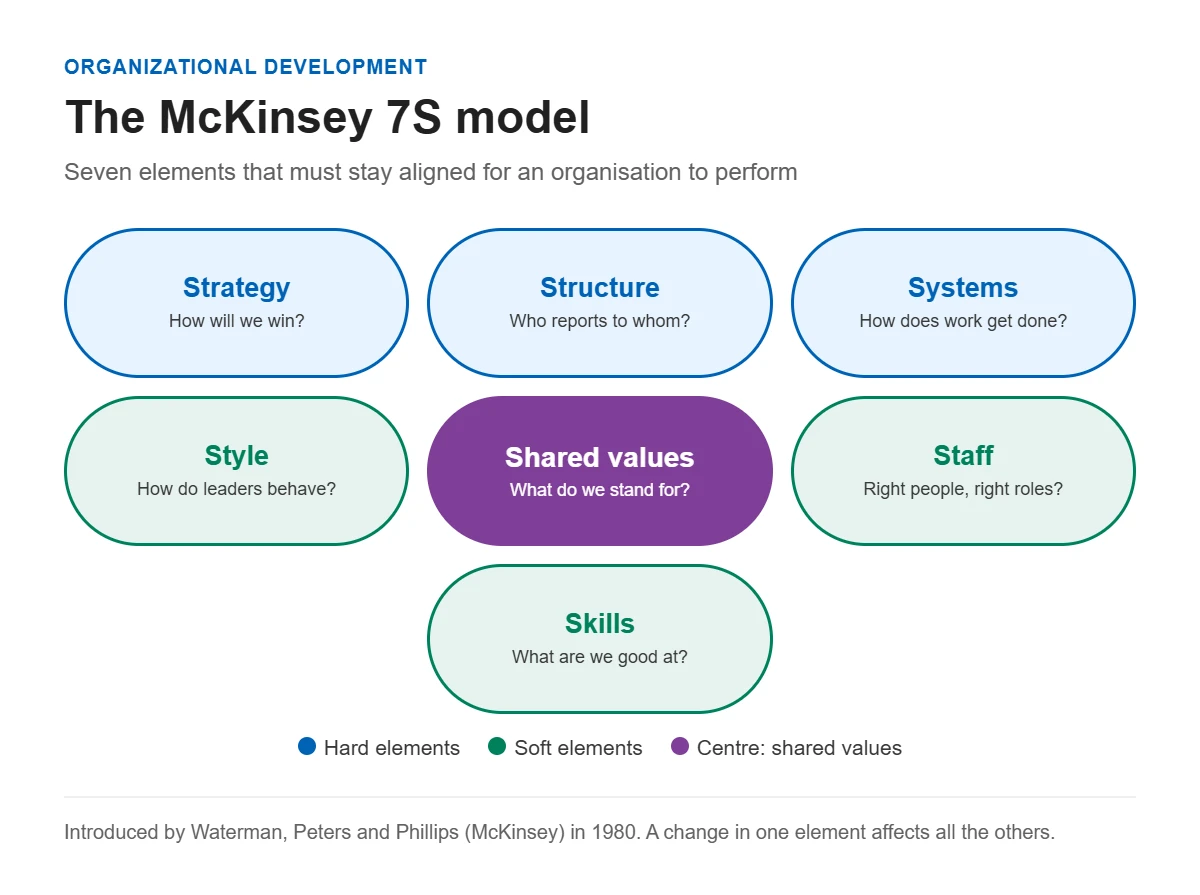
The McKinsey 7S model: hard and soft elements.
Hard and soft elements
| Hard elements | Soft elements |
|---|---|
| Strategy | Shared values |
| Structure | Style |
| Systems | Staff |
| Skills |
Hard elements are easier to define and change directly through decisions and documents. Soft elements are less tangible, shaped by culture and people, and usually take longer to change. Shared values sit at the centre because they influence all the others.
The seven elements explained
1. Strategy
The organisation’s plan to build and keep a competitive advantage. Question: What are we trying to achieve, and how will we win?
2. Structure
How the organisation is arranged: departments, reporting lines, spans of control and decision rights. Question: Who reports to whom, and how are teams organised?
3. Systems
The processes and procedures that run day-to-day work, such as budgeting, hiring, performance management, IT systems and quality control. Question: How does work actually get done?
4. Shared values
The core beliefs and values that guide behaviour, originally called “superordinate goals.” Question: What do we stand for?
5. Style
The leadership style of top management and the informal culture of how people behave. Question: How do leaders make decisions and treat people?
6. Staff
The people in the organisation: their numbers, types, and how they are recruited, developed and motivated. Question: Do we have the right people in the right roles?
7. Skills
The capabilities of the organisation and its employees. Question: What are we good at, and what capabilities do we need?
How to use the 7S model
The model is used when:
- planning a major change, such as a merger, restructuring or new technology
- diagnosing why a strategy is not working
- checking alignment after growth or leadership changes
Step 1: Describe the current state
For each S, describe how things are today.
Step 2: Describe the desired state
For each S, describe what it needs to look like to support the new strategy.
Step 3: Find the gaps and misalignments
Compare current and desired states, and check how the elements affect one another.
Step 4: Plan the changes
Decide what must change in each element and in what order. Changes to hard elements are often quicker; soft elements need longer-term effort.
Step 5: Review alignment regularly
Re-check the seven elements as the change progresses.
McKinsey 7S example: moving to hybrid work
A mid-sized IT services company decides to move to a hybrid working model.
| Element | Current state | Desired state | Change needed |
|---|---|---|---|
| Strategy | Office-based delivery | Hybrid delivery to widen the talent pool | Communicate the reason for change |
| Structure | Teams organised by office location | Teams organised by client, across locations | Redesign team structure |
| Systems | Attendance-based tracking | Output-based goals and digital collaboration tools | New performance and IT systems |
| Shared values | “Being seen is working hard” | “Results and trust matter” | Leadership messaging and recognition |
| Style | Managers supervise in person | Managers coach and set clear goals | Manager training in remote leadership |
| Staff | Hired from two cities | Hired from across India | Update hiring and onboarding |
| Skills | Limited remote collaboration skills | Strong virtual communication | Training for all employees |
The example shows why changing only the policy (systems) is not enough: values, style and skills must change too.
Why the 7S model is useful for HR
Four of the seven elements, staff, skills, style and shared values, are directly linked to HR work: hiring, training, leadership development and culture. HR uses the model to:
- show leaders the people side of a strategy
- plan workforce and skill changes
- align performance and reward systems with new strategy
- support culture change
Advantages
- simple and easy to remember
- covers both hard and soft factors
- highlights how elements are connected
- useful for many kinds of change
Limitations
- doesn’t tell you how to make the changes
- can be time-consuming to apply thoroughly
- doesn’t directly consider the external environment, such as competitors or regulation, so it is often used with tools such as SWOT or PESTLE analysis
Shared values and style together make up much of an organisation’s workplace culture. To plan the change itself, see our lesson on Lewin, Kotter and ADKAR compared.
