

Companies spend a lot on training, but many can’t say whether it made any difference. Did people learn anything? Do they work differently now? Did the business benefit? The Kirkpatrick model is the most widely used way to answer those questions.
This lesson explains the four levels of the Kirkpatrick model, how to measure each one, a worked example and how the Phillips ROI model adds a fifth level.
What is the Kirkpatrick model?
The Kirkpatrick model is a framework for evaluating training at four levels: Reaction, Learning, Behaviour and Results. It was introduced by Donald Kirkpatrick in 1959 and remains the standard model for training evaluation worldwide.
Each level builds on the one before it. Positive reactions make learning more likely, learning makes behaviour change possible, and behaviour change leads to business results.
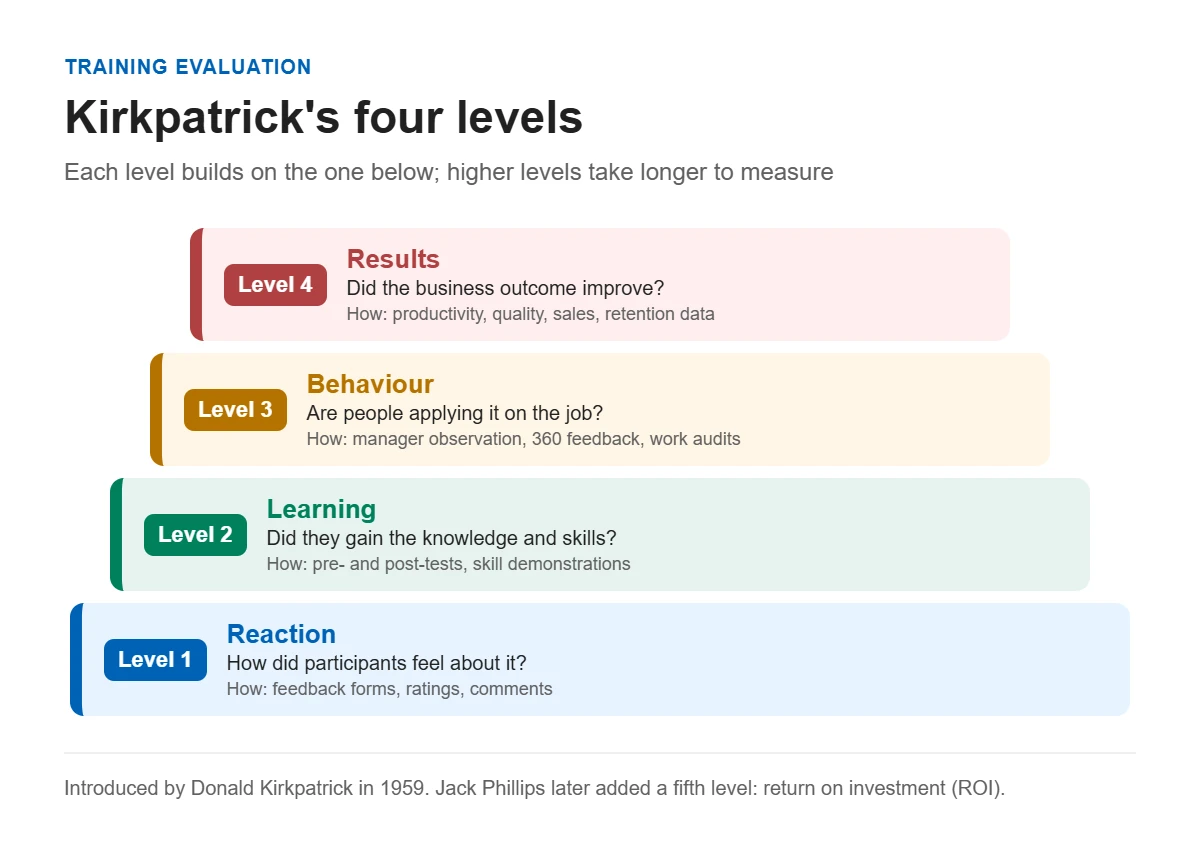
Kirkpatrick’s four levels of training evaluation.
The four levels of the Kirkpatrick model
Level 1: Reaction
Question: How did participants feel about the training?
Measures whether learners found the training engaging, relevant and useful.
How to measure:
- feedback forms at the end of the session
- quick polls or ratings
- open comments about what was most and least useful
Example questions: “How relevant was this training to your job?” “Would you recommend it to a colleague?”
Level 2: Learning
Question: Did participants gain the intended knowledge, skills or attitudes?
How to measure:
- pre- and post-training tests
- quizzes and assessments
- skill demonstrations or role-plays
- confidence ratings before and after
Comparing scores before and after training shows how much was learned.
Level 3: Behaviour
Question: Are participants applying what they learned on the job?
This is where many programmes fall short. People may learn in the classroom but go back to old habits at work.
How to measure:
- manager observation and feedback a few weeks or months later
- 360-degree feedback
- work samples, audits and quality checks
- self-reports and follow-up surveys
Behaviour change depends heavily on the work environment: managers who support and reinforce the new skills make a big difference.
Level 4: Results
Question: Did the training improve business outcomes?
How to measure:
- productivity and output
- quality and error rates
- sales or conversion figures
- customer satisfaction scores
- safety incidents
- employee retention
Results take longer to show and can be affected by other factors, so it helps to compare trained and untrained groups where possible.
Kirkpatrick model example: sales training
| Level | What was measured | Result |
|---|---|---|
| 1. Reaction | Feedback survey after the two-day workshop | 4.4 out of 5 average rating; role-plays rated most useful |
| 2. Learning | Product knowledge test before and after | Average score rose from 58% to 85% |
| 3. Behaviour | Managers observed sales calls after six weeks | 70% of reps used the new needs-discovery questions |
| 4. Results | Conversion rate over the next quarter | Conversion improved from 12% to 15% in the trained group |
The Phillips ROI model: a fifth level
Jack Phillips added a fifth level to measure the return on investment (ROI) of training:
Training ROI (%) = (Monetary benefits − Training costs) ÷ Training costs × 100
Example: a programme costs ₹5 lakh and produces measurable benefits worth ₹8 lakh. ROI = (8 − 5) ÷ 5 × 100 = 60%.
Calculating ROI requires converting results into money and isolating the effect of training from other factors, so it is usually reserved for large or expensive programmes.
Other training evaluation models
- Kaufman’s five levels: expands Kirkpatrick by separating inputs and process from reaction, and adding societal impact
- Brinkerhoff’s Success Case Method: studies the most and least successful participants to understand what made the difference
- Anderson’s model of learning evaluation: focuses on whether learning aligns with the organisation’s strategic priorities
Kirkpatrick remains the most widely used because it is simple and easy to explain.
How to use the Kirkpatrick model well
- Start with Level 4 when planning. Decide what business result you want, then work backwards to the behaviours and learning needed. This links naturally to the needs analysis that sets goals.
- Measure more than Level 1. Happy participants don’t prove the training worked.
- Plan Level 3 support. Brief managers on how to coach and reinforce new skills.
- Set a baseline before the training so you can compare.
- Allow time for behaviour and results to show.
- Report clearly to leadership in business terms.
Limitations of the Kirkpatrick model
- higher levels are harder and costlier to measure
- results can be influenced by factors other than training
- the levels don’t always follow neatly from one another
Despite these limits, it gives a practical, shared language for discussing training effectiveness. It fits into the final phase of an instructional design model such as ADDIE.
