

If you ask ten HR professionals what HR does, you’ll hear ten different lists: hiring, payroll, training, engagement, compliance, policies, exits. They’re all correct. The functions of HRM are a way to organise that long list into a clear structure, so you can see how each activity fits.
The most widely used classification splits HR functions into two groups: managerial functions, which are about how HR manages its work, and operative functions, which are about what HR actually does for employees.
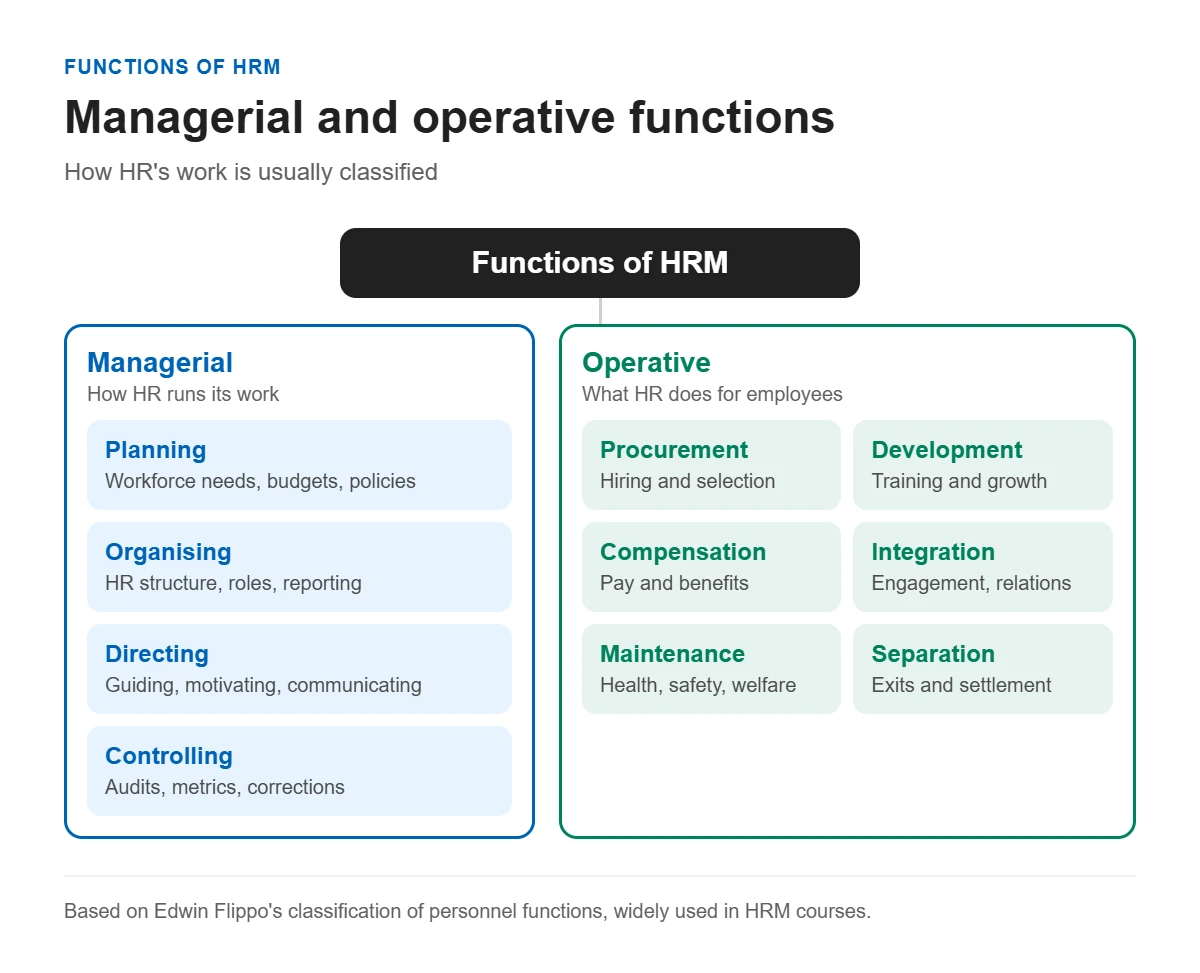
Managerial and operative functions of HRM.
Managerial functions of HRM
These are the general management functions every department performs. In HR, they apply to the people side of the business.
Planning
Deciding in advance what the organisation will need in terms of people, and how HR will meet it. That includes workforce planning (how many people, with what skills, by when), HR budgets and HR policies.
Example: forecasting that the company will need 25 more customer support staff before the festive season and planning hiring for it.
Organising
Setting up the HR structure: who in HR does what, reporting lines, and how HR connects with other departments. It also includes designing roles and responsibilities across the organisation.
Directing
Guiding and motivating people to carry out plans. In HR, directing shows up as leadership, communication, motivation and making sure managers apply HR policies consistently.
Controlling
Checking whether HR activities are achieving what they should, and correcting course if not. HR audits, attrition tracking, time-to-hire reports and payroll error checks are all forms of control.
Operative functions of HRM
These are the specific HR functions carried out for employees. They follow the employee’s journey from joining to leaving.
1. Procurement (acquisition)
Getting the right people into the organisation:
- job analysis and job descriptions
- recruitment and candidate sourcing
- selection, interviews and offers
- placement and induction
Our lesson on what talent acquisition involves explains this function in detail.
2. Development
Helping people build skills and grow:
- training programmes and on-the-job learning
- management and leadership development
- career planning and succession planning
- performance appraisal and feedback
3. Compensation
Paying people fairly and competitively:
- job evaluation and salary structures
- wages, allowances, incentives and bonuses
- payroll processing and statutory deductions
- benefits such as insurance, provident fund and gratuity
4. Integration
Aligning employee interests with organisational goals, so people feel part of the organisation:
- employee engagement and communication
- motivation, recognition and job satisfaction
- grievance handling and discipline
- relations with unions and workers’ representatives
5. Maintenance
Keeping the workforce healthy, safe and committed:
- health, safety and working conditions
- welfare facilities and wellbeing programmes
- social security benefits
6. Separation
Managing exits properly, whether through resignation, retirement, retrenchment or termination:
- exit formalities and interviews
- full and final settlement
- knowledge transfer and access removal
Advisory and compliance functions
Modern HR also advises leadership and managers on people decisions and ensures the organisation follows labour laws, keeps proper records and handles audits. Many textbooks list these as additional functions alongside the operative ones.
Functions of the HR department in a company
In practice, these functions are divided among HR teams. A mid-sized company’s HR department might look like this:
| HR team | Main functions |
|---|---|
| Talent acquisition | Recruitment, selection, employer branding |
| HR operations | Records, onboarding, exits, payroll inputs, compliance |
| Payroll and benefits | Salary processing, statutory deductions, benefits |
| Learning and development | Training, leadership programmes |
| HR business partners | Advising managers, performance, employee relations |
| Employee engagement | Surveys, recognition, events, communication |
Our lesson on the day-to-day work of HR operations shows how several of these functions come together in one team.
Managerial vs operative functions at a glance
| Managerial functions | Operative functions | |
|---|---|---|
| Focus | How HR plans and runs its work | What HR does for employees |
| Examples | Planning, organising, directing, controlling | Hiring, training, pay, relations, welfare, exits |
| Shared with other departments? | Yes, every manager performs them | Mostly specific to HR |
Understanding both helps you see HR as a system rather than a list of tasks: managerial functions decide the direction, and operative functions deliver it.
